Texas Car Accidents Involving Out-of-State Drivers


Every article on this site is researched by our internal team, reviewed for legal accuracy against current Texas law, and held to State Bar of Texas advertising standards before publication. We do not publish content that overstates outcomes or makes promises about results.
Learn more about our
editorial standards .
Key Takeaways
- When a crash happens in Texas, Texas fault-based rules typically govern the claim process even if the at-fault driver lives in another state.
- The two-year Texas statute of limitations applies regardless of where the other driver resides, so delays in pursuing your claim can be costly.
- Texas courts can often exercise jurisdiction over nonresident defendants under the state's long-arm statute when the accident occurred in Texas.
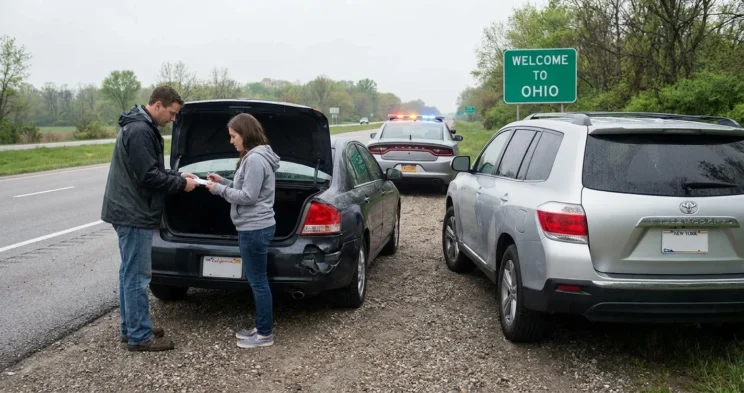
You were driving home on I-10 when another vehicle ran a red light and hit your passenger side. The other driver handed you an insurance card from a company you’ve never heard of and a license from Minnesota. Now you’re wondering if this changes everything about your claim.
The good news: a car accident in Texas generally means Texas rules apply. The challenge: out-of-state drivers can add layers of complexity to an already stressful situation.
Texas Law Usually Controls When the Crash Happens Here
When a collision occurs on Texas roads, Texas fault-based rules typically govern how negligence is determined and how damages are calculated. This applies even if the at-fault driver lives in another state.
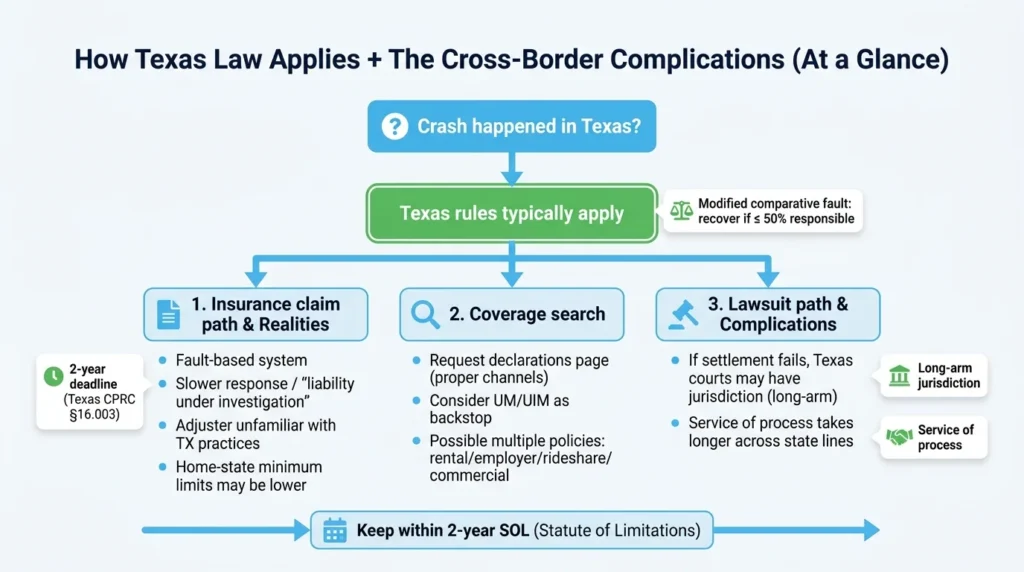
Texas uses a “modified comparative fault” system. You can recover compensation as long as you’re not more than 50% responsible for the crash. The location of the accident, not where the drivers live, usually determines which state’s framework applies.
That said, nonresident drivers do create extra complications. You may deal with insurance adjusters unfamiliar with Texas claim practices. Verifying coverage can take longer. If a lawsuit becomes necessary, serving a defendant who lives elsewhere requires additional steps.
What to Do Immediately After a Texas Crash With an Out-of-State Driver
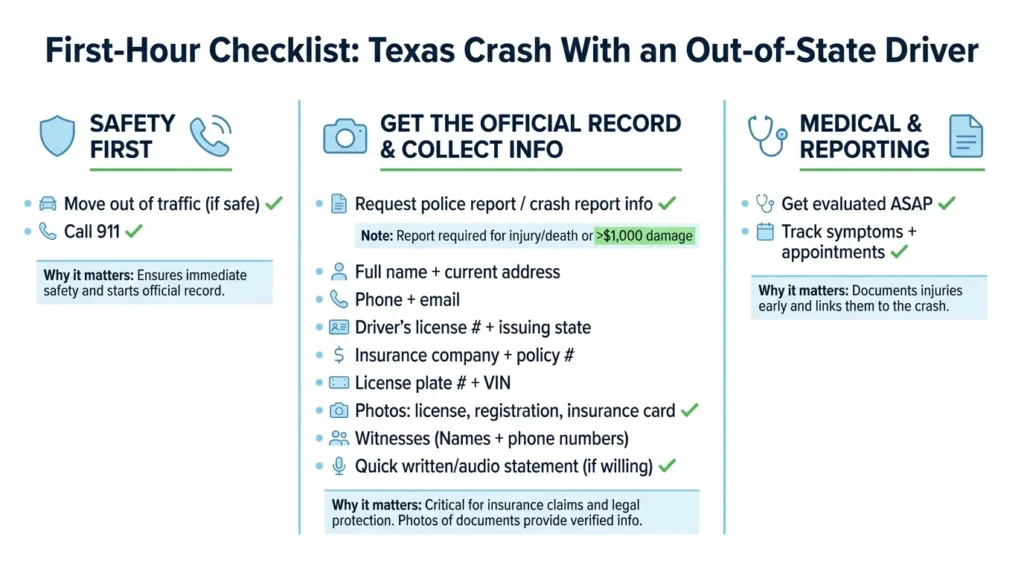
When the other driver may leave Texas quickly, thorough documentation becomes even more critical.
Start with safety. Move vehicles out of traffic if possible and call 911. Texas law requires reporting crashes that result in injury, death. Law enforcement is required to take a written report on all accidents involving property damage over $1,000. That police report creates an official record that can support your claim later.
Collect detailed information from the other driver:
- Full legal name and current address
- Phone number and email
- Driver’s license number and issuing state
- Insurance company name and policy number
- License plate number and vehicle identification number (VIN)
- Photos of their license, registration, and insurance card
Get contact information from any witnesses. Their accounts may carry significant weight if the other driver disputes fault after returning home.
Seek medical attention promptly, even if injuries seem minor. Delays in treatment can be used against you during negotiations. Keep records of every appointment, prescription, and symptom.
Evidence That Becomes Especially Important When the At-Fault Driver Leaves Texas
Once the other driver crosses state lines, your documentation may matter more than their later statements.
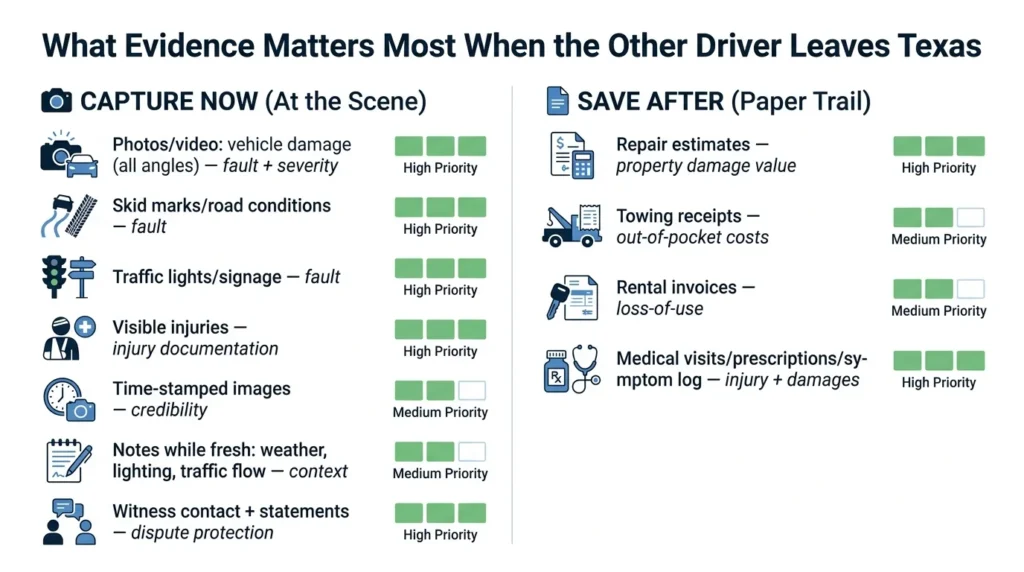
Take photos and video of everything: vehicle damage from multiple angles, skid marks, road conditions, traffic signals, and any visible injuries. Time-stamped images are particularly valuable.
Write down what happened while details are fresh. Note the weather, lighting, traffic flow, and exactly what you observed before impact. Ask witnesses to do the same.
Save all repair estimates, towing receipts, and rental car invoices. These records support your property damage claim and help establish the collision’s severity.
Which State’s Laws Apply If the Other Driver Is From Another State?
Many people worry that the other driver’s home-state rules will somehow take over their claim. In most Texas crashes, that’s not how it works.
The general framework looks at where the accident happened. A crash on Westheimer Road in Houston means Texas law typically governs fault determination, damage calculations, and the basic claim process. The other driver’s home state doesn’t override this.
There are edge cases. Disputes involving commercial vehicles, rental cars, or complex multi-party scenarios may require case-by-case analysis. Insurance policy terms can also introduce variables.
The practical takeaway: even if the insurance company is headquartered in another state, you can still pursue your claim through Texas channels. The adjuster’s location doesn’t change where the crash occurred.
Insurance Complications with Nonresident Drivers
Out-of-state drivers often mean out-of-state adjusters. This can translate to longer response times, unfamiliar claim practices, and more “liability still under investigation” delays.
When speaking with any insurance representative, stick to basic facts. Don’t guess at speeds or distances. Don’t minimize your injuries or say you’re “fine” before you’ve been fully evaluated. Recorded statements can be used to reduce your claim value later.
Texas requires drivers to carry minimum liability coverage of $30,000 per person, $60,000 per accident for bodily injury, and $25,000 for property damage. These limits apply to Texas-registered vehicles. Out-of-state drivers must meet their home state’s requirements, which may be lower.
The Texas Department of Insurance provides consumer guidance on claim-handling expectations. Understanding your rights can help you push back against unreasonable delays.
Finding All Available Coverage
When injuries are serious, the question isn’t just “who’s at fault?” It’s “what coverage exists to pay the claim?”
Request the at-fault driver’s policy declarations page through proper channels. This document shows coverage limits and can reveal whether the policy is actually active.
Your own uninsured/underinsured motorist (UM/UIM) coverage serves as a backstop. If the other driver has no insurance, insufficient limits, or coverage that’s difficult to verify, your UM/UIM policy may apply.
Special situations add layers of potential coverage. Rental cars, employer-owned vehicles, rideshare drivers, and permissive-use scenarios can all involve multiple policies. A commercial vehicle accident may involve the trucking company’s insurance in addition to the driver’s personal policy.
Can You Sue an Out-of-State Driver in Texas?
If the insurance company won’t offer fair compensation, a lawsuit may become necessary. Texas courts can often hear cases involving nonresident defendants when the crash happened here.
“Jurisdiction” refers to a court’s authority to decide a case. When someone causes an accident in Texas, that connection to the state typically gives Texas courts the power to hear claims arising from that crash.
Texas Civil Practice and Remedies Code Chapter 17 establishes the state’s “long-arm” provisions. Section 17.042 specifically addresses nonresident defendants and the circumstances under which Texas courts can exercise jurisdiction over them.
Venue determines where in Texas the case is filed. This is often the county where the crash occurred. Strategic venue selection can affect how a case proceeds.
Service of Process When the Driver Lives in Another State
Even with jurisdiction established, you must properly “serve” the lawsuit on the defendant. This means officially delivering legal documents in a way that satisfies procedural requirements.
Serving someone in another state takes more time and coordination than local service. Outdated addresses, frequent moves, or uncooperative defendants can create obstacles.
This is another reason why collecting accurate information at the scene matters. A correct name, current address, and verified contact details make later service significantly easier.
The Texas Statute of Limitations Still Applies
Waiting is one of the biggest ways people lose leverage. Cross-border complications can burn through time quickly.
Texas Civil Practice and Remedies Code § 16.003 establishes a two-year statute of limitations for most personal injury claims. This deadline generally runs from the date of the accident.
Nonresident cases often require more runway. Verifying coverage, gathering medical records, and coordinating service across state lines all take time. “Waiting to see how things develop” can leave you scrambling as the deadline approaches.
If you’re unsure about applicable deadlines, get a legal review of your specific situation sooner rather than later.
How Angel Reyes & Associates Can Help
Out-of-state driver cases require attention to details that can easily slip through the cracks. Coverage verification, proper service, and deadline management all become more complex when the at-fault party lives elsewhere.
Our firm has spent over 30 years helping Texas accident victims recover compensation. We’ve recovered more than $1 billion for our clients and understand how to handle the added complications that nonresident defendants create.
We offer free initial consultations and work on contingency; you pay no fee unless we win. We’re available 24/7 and serve clients across all of Texas from more than 20 office locations statewide. Contact us today to discuss your case and understand your options.
Out-of-State Driver Accident FAQs
What happens if the out-of-state driver’s insurer denies coverage after the crash?
You may still have options through your own policy, including collision coverage, personal injury protection, MedPay, or UM/UIM coverage depending on what you purchased. A coverage denial also does not automatically eliminate the driver’s personal liability for the wreck.
Can a passenger injured in a Texas crash involving an out-of-state driver file a claim too?
Yes. An injured passenger may have a separate claim against the at-fault driver and, in some cases, against another liable party depending on how the crash happened.
Does it matter if the out-of-state driver was working when the collision happened?
Yes. If the driver was acting within the scope of employment, an employer may be another source of liability and insurance coverage, which can materially change the value and handling of the claim.
How long do I have to file a lawsuit after a Texas crash involving a nonresident driver?
Under Texas Civil Practice and Remedies Code Section 16.003, most personal injury claims must be filed within two years of the accident date. Cross-state service and coverage issues can eat up time quickly, so waiting can create avoidable problems.
Can Texas courts hear a lawsuit against a driver who lives in another state?
Often yes. Texas law allows courts to exercise jurisdiction over a nonresident defendant when the claim arises from a tort committed in whole or in part in Texas, which commonly includes a Texas car wreck.
About the Authors

Angel Reyes
Writer
Angel L. Reyes, III is the Founder and Managing Partner of Angel Reyes & Associates. A nationally recognized trial attorney and business leader, Angel has helped over 70,000 injury victims recover more than $1 billion since founding the firm in 1993. Named to the Texas Super Lawyers list annually since 2008, Angel brings Wall Street experience, Ivy League education, and a deep commitment to client advocacy. He is a frequent legal commentator and published author with extensive contributions to legal scholarship, trial strategy, and consumer protection.

Kyle Nicolas
Editor
Kyle Nicolas is the Web Content & SEO Manager at Angel Reyes & Associates. He has more than 10 years of experience as a marketing co...

Angel Reyes
Reviewer
Angel L. Reyes, III is the Founder and Managing Partner of Angel Reyes & Associates. A nationally recognized trial attorney and business...