Employer Liability When an Employee Causes a Crash


Every article on this site is researched by our internal team, reviewed for legal accuracy against current Texas law, and held to State Bar of Texas advertising standards before publication. We do not publish content that overstates outcomes or makes promises about results.
Learn more about our
editorial standards .
Key Takeaways
- Employers can be liable under respondeat superior when an employee causes a crash while acting within the scope of their job.
- The frolic-versus-detour rule determines whether a deviation from a work task breaks the employment connection.
- Negligent entrustment is a separate theory that applies when an employer knowingly gave a vehicle to an unfit driver.
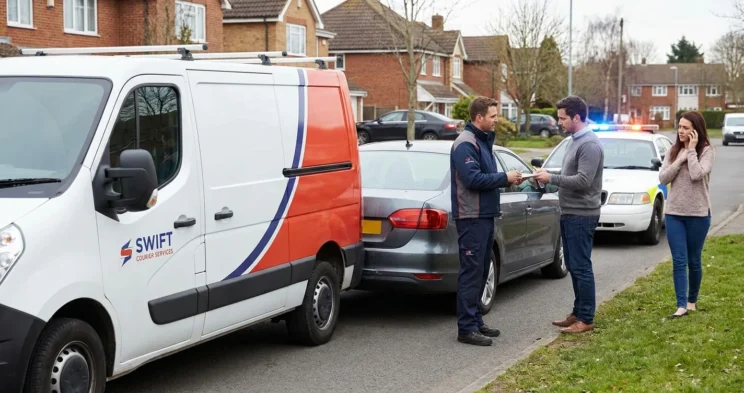
You were stopped at a red light when a van with a company logo rear-ended you. The driver apologized and handed over their insurance card, but now you are wondering whether the company itself bears any responsibility. That question matters because commercial policies carry significantly higher limits than personal auto coverage.
When Employers Are Legally Responsible
An employer can be held liable for an employee’s crash when the incident happens within the scope of employment. Respondeat superior requires that the act fall within the employee’s general authority, further the employer’s business, and serve a purpose for which they were hired to perform. When those three conditions are satisfied, the employer’s commercial insurance enters the picture.
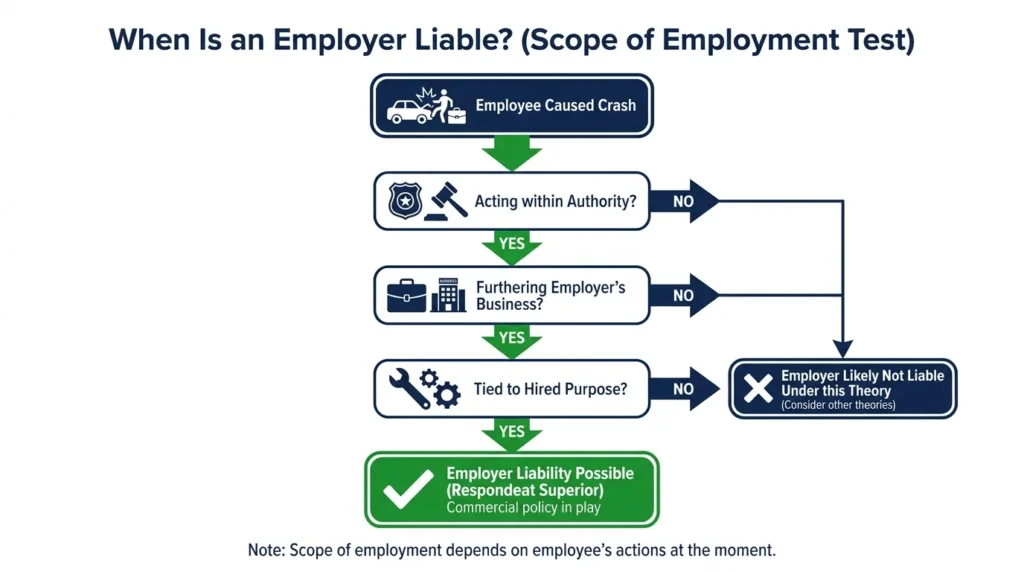
Commercial policies often carry limits far above what personal auto coverage provides. If you were hit by a company vehicle, understanding that difference matters for your claim.
What “Scope of Employment” Means in Practice
“Scope of Employment” is not a bright line. Texas courts ask what the employee was doing at the exact moment of the crash and whether that activity was connected to their job. A delivery driver making a scheduled drop is clearly within scope, while an employee who detoured across town to handle a personal matter typically is not.
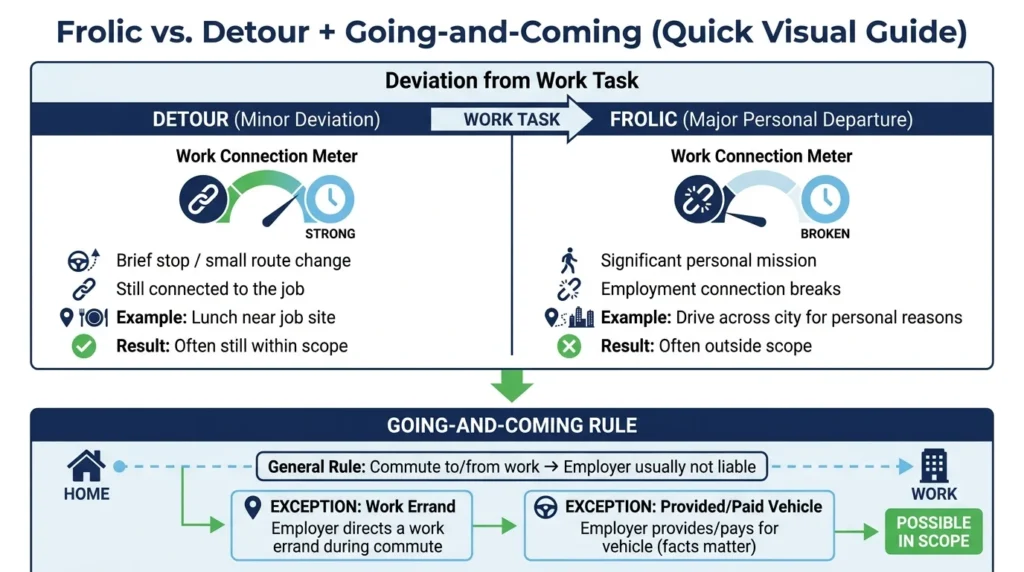
Courts use the frolic-versus-detour distinction to sort ambiguous situations. A detour is a minor deviation from the work task; it is a brief stop that does not substantially break the employment connection. A frolic is a major personal departure that removes the employee entirely from the scope of their job; meaning a service technician who grabs lunch near a job site is likely still within scope, while a technician who drives across the city for personal reasons during the workday is likely not.
The going-and-coming rule applies a similar principle to commutes: employers are generally not liable for accidents during an employee’s drive to or from work, though that rule has exceptions. If the employer directs the employee to run a work errand on the way in or provides and pays for the vehicle, the commute may fall within scope. The Texas Civil Practice and Remedies Code (CPRC) Chapter 33 governs how fault is allocated once liability is established.
Do not assume the employer is off the hook because the crash happened outside normal work hours. What the employee was doing and who ordered the task matters.
Negligent Entrustment as a Separate Theory
Negligent entrustment is a direct claim against the employer for knowingly handing a vehicle to a driver they had reason to believe was unfit. Unlike respondeat superior, which is a vicarious liability theory, negligent entrustment holds the employer directly responsible for their own decision to put that driver behind the wheel.
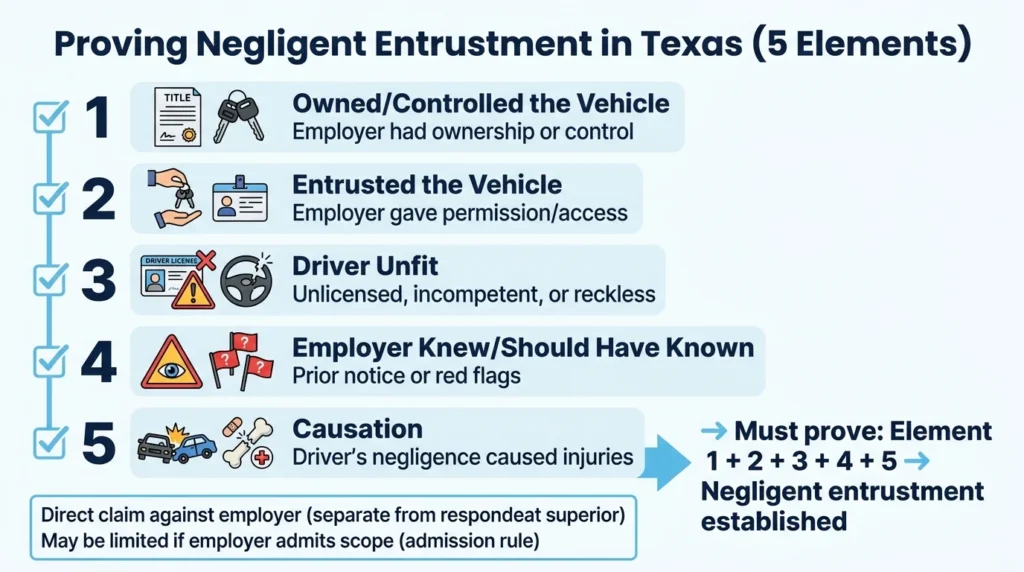
To prove negligent entrustment in Texas, you must establish five elements:
- The employer owned or controlled the vehicle
- The employer entrusted it to the driver
- The driver was unlicensed, incompetent, or reckless
- The employer knew or should have known the driver was unfit
- The driver’s negligence caused your injuries
This theory applies when the employee was off-duty but using a company vehicle, or when the employer had prior notice of the driver’s dangerous history. A company that kept a driver on active routes despite documented violations may face direct liability even when respondeat superior does not apply.
One limit to know: when an employer admits the employee was acting in scope, Texas courts may bar the negligent entrustment claim as redundant under the admission rule. Cases involving commercial vehicle crashes often turn on which theories survive pre-trial rulings.
Independent Contractors vs. Employees
Respondeat superior applies to employees only. When a company labels its driver an independent contractor, it argues that no vicarious liability attaches to the company. That argument does not always succeed, because Texas courts look at the actual degree of control exercised over the work, not just the label in the contract.
If the company controlled the driver’s route, schedule, tools, and manner of work, courts may treat the relationship as employment regardless of what the paperwork says. Misclassification is common in trucking, delivery, and gig economy work.
An attorney experienced in these cases can investigate whether the independent contractor designation was genuine or a liability shield. Reviewing the Texas commercial insurance requirements provides context on how coverage structures interact with these classifications.
What to Do After a Crash Involving a Company Vehicle
The evidence you collect in the first hours after a crash can determine whether you can reach the employer’s commercial insurance. Acting quickly matters because commercial fleets have short windows to preserve vehicle data, GPS logs, and dispatch records. Starting at the scene gives you the best chance of building an evidence trail.
Photograph the vehicle from multiple angles. Company logos, fleet numbers, and commercial markings establish the employment connection. Take photos of the damage, the road, and any skid marks before anything is moved.
Ask the driver for their employer’s name and the company’s insurance carrier. Many drivers will not have all of this at the scene. Get the driver’s name, license number, and the vehicle’s license plate.
Request the employee’s delivery manifests, work orders, GPS trip logs, and phone records. These documents can confirm the employee was on a work task at the time of the crash, which is the foundation of the scope of employment argument.
Do not accept a quick settlement from the commercial insurer, as their job is to close the claim at the lowest possible cost, and our case results reflect what proper preparation produces for Texas accident victims.
Talk to a Texas Injury Attorney
With over 30 years of experience and over $1 billion recovered, Angel Reyes & Associates leverages a network of 20+ statewide offices and 600+ dedicated professionals to guide injured Texans through complex commercial claims.
Employer liability cases involve multiple legal theories, competing insurance policies, and commercial carriers with experienced defense teams. We work on contingency, meaning there are no fees unless we win, and free consultations are available 24/7. Reach out to us at our contact page to talk through your claim in English or Spanish.
Past results do not guarantee future outcomes.
Employer Liability for Crashes FAQs
How long do I have to file a claim against an employer for a car accident in Texas?
Texas gives you two years from the date of the crash to file a personal injury lawsuit, including claims against an employer under respondeat superior or negligent entrustment. Missing that deadline typically bars your claim entirely.
Can an employer be liable if the employee was driving their own personal vehicle?
Yes, if the employee was performing a work task at the time of the crash. Texas respondeat superior applies based on what the employee was doing, not which vehicle they were driving.
Do these rules apply to rideshare and delivery app drivers?
It depends on the platform and the driver’s status at the time of the crash. Most rideshare and delivery companies classify drivers as independent contractors, which normally limits vicarious liability. However, several platforms carry commercial insurance that activates while a driver is actively on a delivery or ride request.
What if I was partly at fault for the crash?
Texas uses a proportionate responsibility system. You can still recover damages as long as your share of fault is not 51% or more. Your recovery is reduced by your percentage of fault, so being 20 percent at fault on a $100,000 claim results in an $80,000 recovery.
Can I recover from both the employee and the employer in the same lawsuit?
Yes. Texas law allows you to name both the employee and the employer as defendants in the same case. A jury assigns fault percentages to each party, and you may collect from either depending on who can pay and the extent of their coverage.
About the Authors

Angel Reyes
Writer
Angel L. Reyes, III is the Founder and Managing Partner of Angel Reyes & Associates. A nationally recognized trial attorney and business leader, Angel has helped over 70,000 injury victims recover more than $1 billion since founding the firm in 1993. Named to the Texas Super Lawyers list annually since 2008, Angel brings Wall Street experience, Ivy League education, and a deep commitment to client advocacy. He is a frequent legal commentator and published author with extensive contributions to legal scholarship, trial strategy, and consumer protection.

Kyle Nicolas
Editor
Kyle Nicolas is the Web Content & SEO Manager at Angel Reyes & Associates. He has more than 10 years of experience as a marketing co...

Angel Reyes
Reviewer
Angel L. Reyes, III is the Founder and Managing Partner of Angel Reyes & Associates. A nationally recognized trial attorney and business...