The 100 Deadliest Days for Teen Drivers & How to Make Them Safer


Every article on this site is researched by our internal team, reviewed for legal accuracy against current Texas law, and held to State Bar of Texas advertising standards before publication. We do not publish content that overstates outcomes or makes promises about results.
Learn more about our
editorial standards .
Key Takeaways
- Over 30 percent of teen driver deaths happen during the 100 days from Memorial Day to Labor Day.
- Distracted driving, speeding, and unbuckled seat belts drive most teen crashes in summer.
- Texas parents who set rules and actively monitor their teen can cut that teen's crash risk by half.
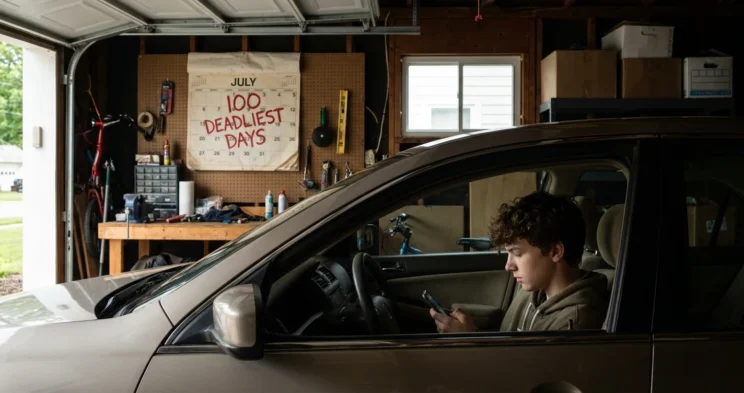
The 100 deadliest days for teen drivers runs from Memorial Day through Labor Day. It is the period when teen driver fatality rates spike most sharply compared to the rest of the year.
According to AAA’s 2025 teen driver crash analysis, more than 30 percent of annual teen driver deaths happen during this window. Summer sees an average of eight people killed daily in teen-involved crashes, compared to seven per day the rest of the year.
When school lets out, teens drive more miles, at later hours, with fewer adults nearby. Teen drivers ages 16 and 17 already face elevated crash risk from inexperience, and over the next three months, they’ll likely drive more miles every day than they did during the school year.
Why Teen Crash Rates Jump in Summer
The summer spike is the result of an annual increase in several compounding risks that CDC teen driver data and national crash research identify year after year.
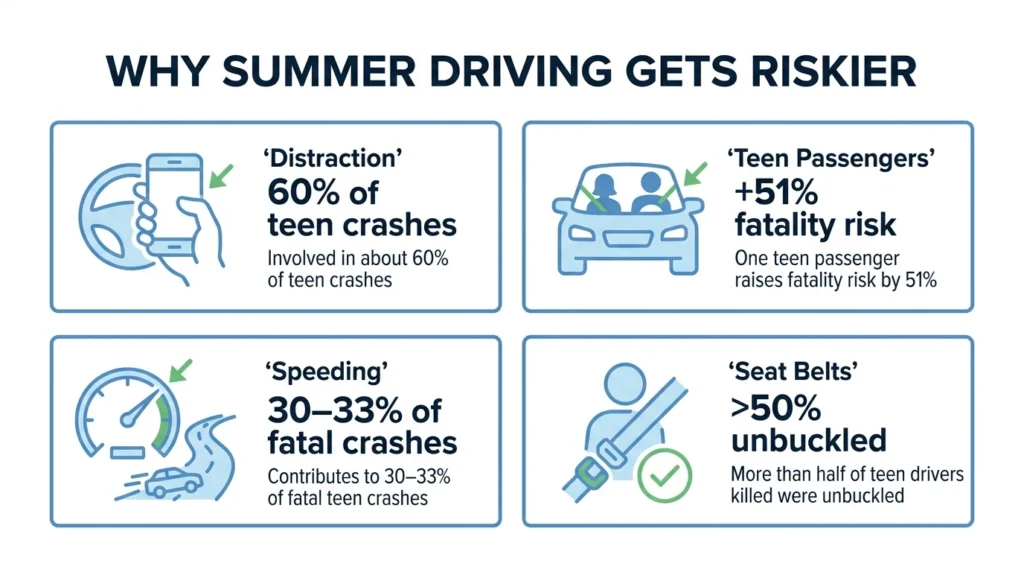
Distracted driving factors into approximately 60 percent of teen crashes. Phone use, teen passengers, and in-vehicle entertainment systems are the three primary sources. A teen driver carrying only teen passengers sees a 51 percent increase in fatality risk. Each additional peer in the car compounds the danger further.
Speeding contributes to 30 to 33 percent of fatal teen crashes. Young drivers are more likely than adults to misjudge speed and stopping distance.
Seat belt use remains a serious gap: more than half of teen drivers killed in crashes were not buckled.
Finally, impaired driving rounds out the picture. AAA’s data shows around 30 percent of teenage drivers involved in summer holiday crashes had been drinking.
Teen Driving Restrictions in Texas
Texas addresses these risks directly through the Graduated Driver Licensing program. The restrictions apply to drivers under 18 holding a provisional license and are rooted in Texas Transportation Code Chapter 521.
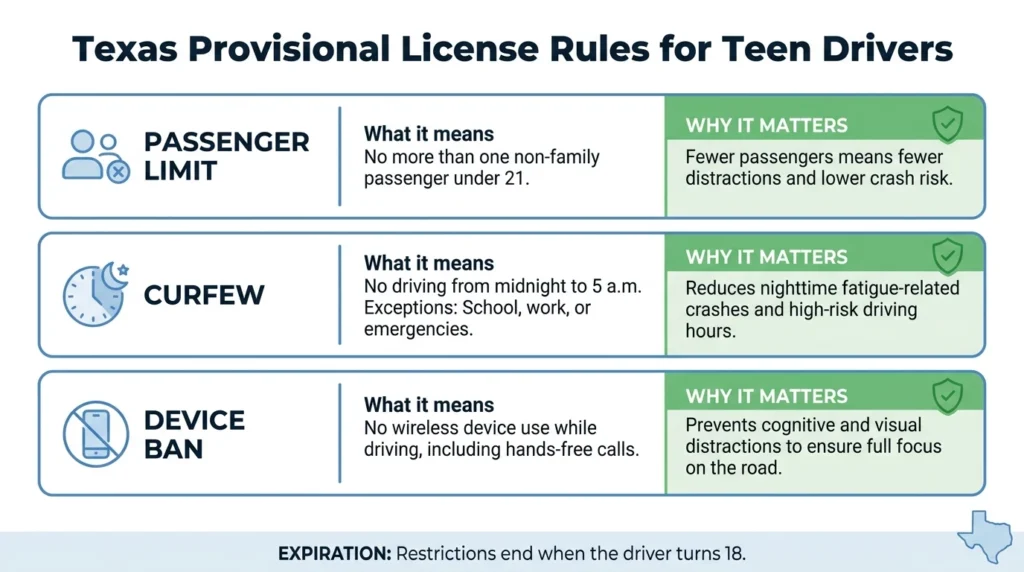
The three most important summer restrictions are the passenger cap, the curfew, and the device ban. Provisional license holders may carry no more than one non-family passenger under 21. Nighttime driving between midnight and 5 a.m. is prohibited except for school, work, or an emergency.
Provisional license holders also may not use any wireless communication device while driving, including hands-free calls. These restrictions expire when you turn 18.
Until then, a violation can affect a teen’s license status and expose the family to liability after a crash. Knowing what your teen is covered for under Texas insurance requirements is part of managing that exposure. Any collision during this window can become the basis of an auto accident claim in Texas.
How to Protect Your Teen This Summer
Research shows that parents who actively monitor their teen’s driving and set clear household rules can cut crash risk by up to 50 percent. These six steps give you a place to start:
- Create a driving agreement before summer begins. Define passenger limits, phone rules, curfew, and consequences in writing.
- Model the behavior you want. Teens absorb parental habits behind the wheel. If you reach for your phone, speed, or skip your seat belt, they take note.
- Enforce the passenger restriction or go stricter. Texas law limits provisional license holders to one non-family passenger under 21. Fewer passengers means proportionally lower risk.
- Reduce nighttime driving time. Even if your teen’s license allows driving until midnight, fewer late hours means less exposure to dangerous conditions.
- Pre-set navigation and music before the car moves. Make it a clear rule that the phone stays untouched once the car is in gear.
- Give your teen a safe exit. A no-questions-asked pickup policy lets your teen call you instead of riding with a driver who has been drinking or is driving recklessly.
What to Do After a Teen Driver Crash
Prevention is the goal, but crashes still happen. If your teen is involved in a collision this summer, the steps taken in the hours that follow shape everything that comes after.
Document the scene: photograph the vehicles, road conditions, and any visible injuries, and collect contact information from witnesses. Do not make statements to the other driver’s insurance company before speaking with an attorney.
If your teen is injured this summer by a negligent driver, knowing your legal options is part of preparation. Angel Reyes & Associates has spent more than 30 years helping Texas accident victims navigate the process after a crash. We have recovered more than $1 billion for clients, with no fee unless we win.
Meet our legal team and contact us for a free consultation. A negligent driver who injured your teenager this summer is a legal problem your family does not have to face alone.
Past results do not guarantee future outcomes.
Witness Statement FAQs
Does Texas have summer-specific driving rules for teen drivers?
Texas does not create summer-specific restrictions for teen drivers, but the state’s Graduated Driver Licensing program imposes year-round passenger caps, a midnight-to-5 a.m. curfew, and a wireless device ban on provisional license holders under 18. Those restrictions cover the entire 100 deadliest days window and expire automatically when the teen turns 18 and qualifies for an unrestricted license.
Can Texas parents be held liable if their teen causes a crash during the 100 deadliest days?
Texas Family Code Section 41.001 makes parents who sign their minor’s driver’s license application financially responsible for damages the teen causes on the road. The negligent entrustment doctrine can also apply independently when a parent knowingly allows a reckless or inexperienced teen to drive, giving injured parties a separate legal path to hold the family accountable.
What should a family do if their teen is injured by another driver this summer?
Seek medical care immediately, document the crash scene with photographs, and collect contact information from any witnesses before leaving. Texas imposes a two-year statute of limitations for personal injury claims, though an injured minor generally has until two years after their 18th birthday to file suit, so consulting a personal injury attorney early protects the family’s options.
What happens to a family's liability exposure if a teen violates Texas GDL restrictions and causes a crash?
A violation such as carrying too many passengers or driving after curfew can affect the teen’s provisional license standing and function as evidence of negligence if a crash occurs. When a parent was aware of and permitted the restricted behavior, that knowledge can strengthen claims against the family under the negligent entrustment doctrine.
About the Authors

Angel Reyes
Writer
Angel L. Reyes, III is the Founder and Managing Partner of Angel Reyes & Associates. A nationally recognized trial attorney and business leader, Angel has helped over 70,000 injury victims recover more than $1 billion since founding the firm in 1993. Named to the Texas Super Lawyers list annually since 2008, Angel brings Wall Street experience, Ivy League education, and a deep commitment to client advocacy. He is a frequent legal commentator and published author with extensive contributions to legal scholarship, trial strategy, and consumer protection.

Kyle Nicolas
Editor
Kyle Nicolas is the Web Content & SEO Manager at Angel Reyes & Associates. He has more than 10 years of experience as a marketing co...

Angel Reyes
Reviewer
Angel L. Reyes, III is the Founder and Managing Partner of Angel Reyes & Associates. A nationally recognized trial attorney and business...