Motorcycle Accidents with a Rideshare Vehicle in Texas


Every article on this site is researched by our internal team, reviewed for legal accuracy against current Texas law, and held to State Bar of Texas advertising standards before publication. We do not publish content that overstates outcomes or makes promises about results.
Learn more about our
editorial standards .
Key Takeaways
- Rideshare coverage in Texas ranges from $0 to $1 million, depending on the driver's app status at the time of impact.
- Texas bars recovery if you are 51% or more at fault and reduces damages by your fault share.
- Texas gives motorcycle crash victims 2 years from the date of the crash to file an injury lawsuit.
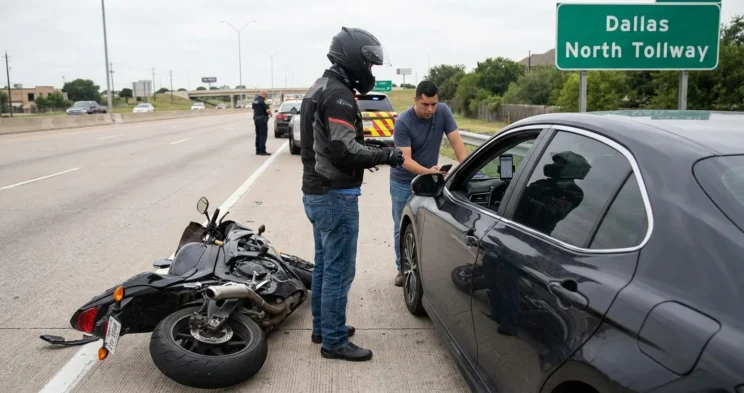
You were riding down I-35 when a rideshare driver unexpectedly swerved across lanes and clipped your front wheel. You went down hard. Now the driver is telling you he wasn’t really “working,” and the insurance calls have already started. Motorcycle crashes involving Uber or Lyft drivers can create insurance problems that regular car accidents usually do not.
How Rideshare Insurance Coverage Works in Texas
Texas requires Uber and Lyft to carry layered insurance that turns on and off based on the driver’s app status at the moment of the crash. There are three coverage periods. The wrong period can mean the difference between a $50,000 policy and a $1 million policy applying to your motorcycle injury claim.
The drivers themselves are independent contractors, not employees. That classification limits direct claims against the company, but it does not block access to the company’s commercial insurance.
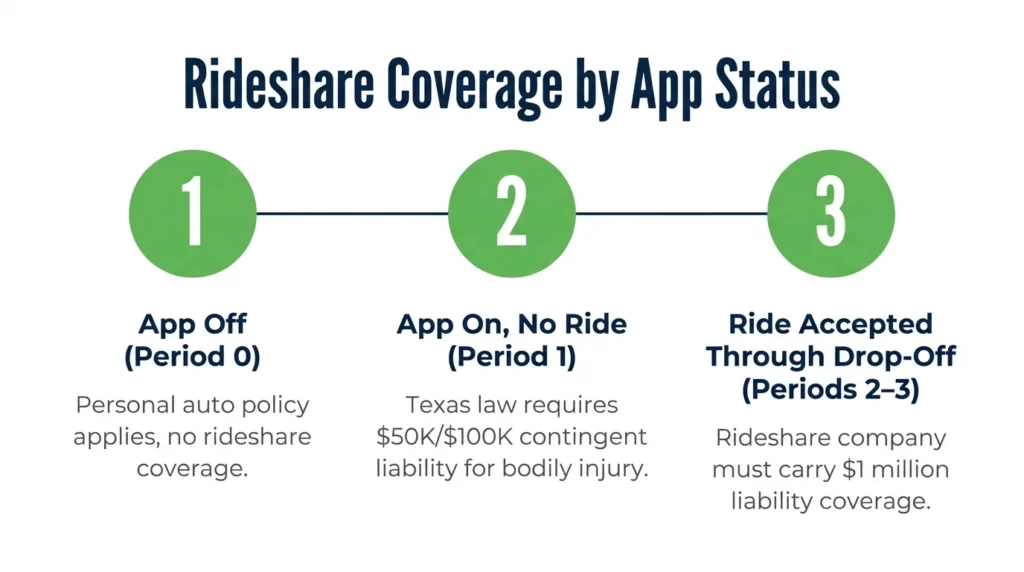
The Texas Insurance Code Chapter 1954 governs automobile insurance requirements for rideshare drivers. Coverage breaks down by period:
- Period 0 (app off): Only the driver’s personal auto policy applies. The rideshare company’s coverage is not available.
- Period 1 (app on, waiting for a request): Texas Insurance Code § 1954.052 requires contingent liability of at least $50,000 per person and $100,000 per incident for bodily injury, plus $25,000 for property damage.
- Periods 2 and 3 (ride accepted through drop-off): Texas Insurance Code § 1954.053 requires at least $1 million in liability coverage held by the company or the driver.
The same crash can fall into different financial worlds depending on whether the driver tapped “accept” two seconds before impact. The driver’s app status can completely change how much insurance coverage is available. For a broader walkthrough of how these claims work, see our Texas rideshare accident practice page.
Which Coverage Period Applies to Your Crash?
The driver’s app status decides the period at the exact moment of the collision. Not before. Not after. The driver’s own description of what they were doing is not the final word, and insurers have a financial reason to claim Period 0 whenever they can. The most important evidence usually comes from the rideshare app itself.
Uber and Lyft keep records that may show:
- GPS activity
- ride requests
- trip timestamps
- driver status changes
Those records sometimes conflict with what the driver says after the crash. An attorney can request those records during the legal process before they disappear.
Document everything from your end, too. Save your own GPS data from your phone if you had a ride-tracking app running. Note any visible rideshare placard or sticker on the vehicle. Get the driver’s name and license plate before they leave.
The period question also affects your own policy. If the driver’s available rideshare coverage cannot pay your full damages, your uninsured/underinsured motorist (UM/UIM) coverage may step in to fill the gap. For more on protecting your rights early, our guide to legal strategies after a Texas motorcycle accident walks through the first moves that matter most.
Injuries & Fault in Motorcycle-Rideshare Crashes
Two things decide what you actually recover: how badly you were hurt and how much of the accident was your fault. They are separate questions with separate effects, and both shape the final dollar amount.
Injury Severity for Motorcyclists
A rider has no airbag, no crumple zone, and no seatbelt. The result is a different injury profile than that of the people inside the rideshare car. Head trauma, spinal damage, broken legs, and severe road rash are common after even moderate-speed impacts.
Economic damages cover medical bills, rehabilitation, and lost wages. Non-economic damages cover pain, suffering, and loss of enjoyment of life. Serious injuries push claims into higher coverage tiers, which is why the period question in the prior section carries real money.
Our overview of common injuries in motorcycle accidents explains what symptoms to watch for after a collision.
Proportionate Responsibility & Motorcyclist Bias
Texas uses a modified comparative fault system. Under the Texas Civil Practice and Remedies Code § 33.001, if you are found 51 percent or more at fault, you recover nothing. If you are 50 percent or less at fault, your damages are reduced by your percentage.
Motorcyclists often face unfair assumptions after a crash. Insurance adjusters may assume the rider was speeding or riding aggressively, even when the evidence does not support it. That bias can push your assigned fault higher than the facts support.
Fault percentages can make a major difference in how much compensation you recover. A $300,000 claim drops to $210,000 if you are 30 percent at fault. Evidence can become important if the insurance company tries to shift blame onto you. Try to preserve:
- witness statements
- traffic camera footage
- helmet camera footage
- skid marks
- road conditions
An attorney familiar with Texas motorcycle-rideshare claims can pull app records, retain accident reconstructionists, and push back against fault inflation before the insurer’s story takes hold. If your crash happened in North Texas, our Dallas motorcycle accident team handles these fault disputes directly.
Steps to Take After a Motorcycle-Rideshare Crash
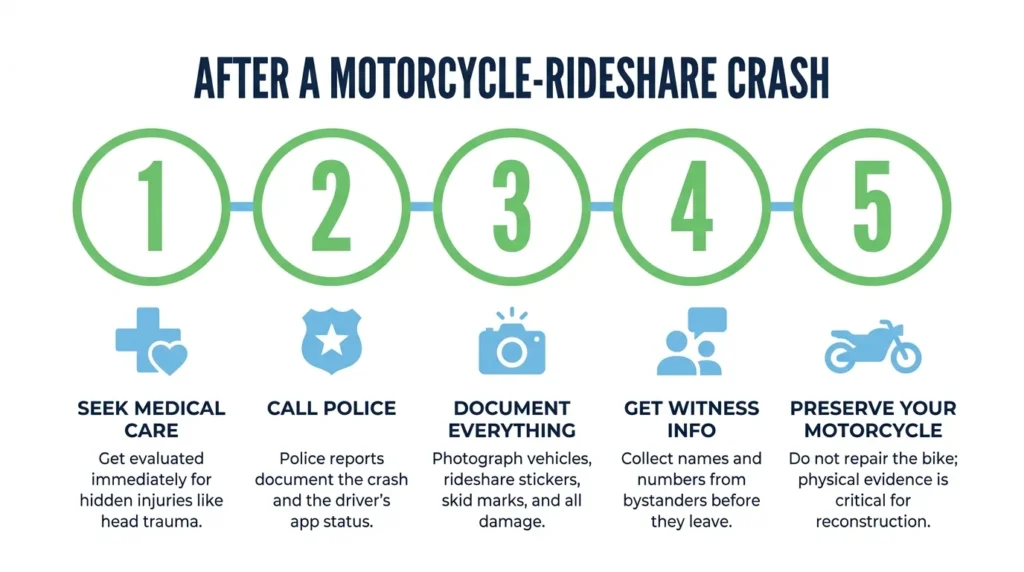
The first few hours after a crash can affect both your health and your injury claim. Try to take these steps as soon as possible.
- Get medical care immediately. Concussions and internal injuries often do not appear right away after a motorcycle crash. It’s also important that you have documentation of your medical care.
- Call the police and get the crash report. The report captures the driver’s information and may note their app status.
- Photograph the scene. Photograph vehicle damage, skid marks, traffic signals, and any Uber or Lyft sticker on the vehicle.
- Get witness contact information before anyone leaves.
- Do not give a recorded statement to any insurer, including the rideshare company’s insurer, before talking to an attorney. Insurance companies may use early statements to challenge your version of the crash later.
- Preserve your motorcycle. Do not repair it until you have documented it and, if needed, had it inspected by a forensic expert.
You also have a hard filing deadline. Texas Civil Practice and Remedies Code § 16.003 gives you two years from the date of the crash to file a personal injury lawsuit. Miss it, and the claim is almost always dead.
Riders dealing with serious injuries, disputed fault, or insurance issues after a crash may also find our Texas motorcycle accident practice page helpful.
Talk to an Attorney About Your Case
Motorcycle rideshare claims often involve multiple insurance policies, app records, and disputes over fault. Important evidence can disappear quickly after a crash, especially digital rideshare records and witness footage.
Angel Reyes & Associates has helped injured Texans for more than 30 years and recovered more than $1 billion for clients. We offer free consultations, and there are no fees unless we win your case. Our case results show examples of prior recoveries for injured Texans. If an Uber or Lyft driver hit you while you were riding in Texas, you can also contact us today to discuss your options.
Past results do not guarantee future outcomes.
Motorcycle Rideshare Crash FAQs
Can a rideshare driver's personal auto policy deny coverage if the driver was logged into Uber or Lyft?
Yes. Many personal auto insurance policies in Texas exclude coverage when the driver was using the vehicle for rideshare activity at the time of the crash. That is one reason rideshare coverage under Texas Insurance Code § 1954.052 exists during Period 1.
What happens to my claim if the rideshare driver who hit me was uninsured or underinsured at the time of the crash?
If the driver’s personal policy is inadequate and the available rideshare coverage does not fully apply, your own uninsured/underinsured motorist coverage may help pay the remaining damages up to your policy limits. Texas insurers must offer UM/UIM coverage, although drivers can reject it in writing.
Can property damage to my motorcycle be claimed separately from my bodily injury claim in Texas?
Yes. Property damage and bodily injury claims are often handled separately and may involve different adjusters or coverage limits. However, you should review any settlement paperwork carefully before signing because some releases may affect other parts of your claim.
Is there a way to find out which Uber or Lyft coverage period was active without filing a lawsuit?
Possibly. Uber and Lyft both allow injured parties to report crashes and request trip information through their claims systems. However, important app records and trip data may be limited outside of formal legal proceedings.
Can helmet camera footage help in a motorcycle rideshare accident claim?
Yes. Helmet cameras, dashcams, and witness videos may help show traffic conditions, vehicle positions, lane movement, and driver behavior before the crash. That evidence may become important if you dispute fault later.
About the Authors

Angel Reyes
Writer
Angel L. Reyes, III is the Founder and Managing Partner of Angel Reyes & Associates. A nationally recognized trial attorney and business leader, Angel has helped over 55,000 injury victims recover more than $1 billion since founding the firm in 1993. Named to the Texas Super Lawyers list annually since 2008, Angel brings Wall Street experience, Ivy League education, and a deep commitment to client advocacy. He is a frequent legal commentator and published author with extensive contributions to legal scholarship, trial strategy, and consumer protection.

Kyle Nicolas
Editor
Kyle Nicolas is the Web Content & SEO Manager at Angel Reyes & Associates. He has more than 10 years of experience as a marketing co...

Angel Reyes
Reviewer
Angel L. Reyes, III is the Founder and Managing Partner of Angel Reyes & Associates. A nationally recognized trial attorney and business...