How Much Can You Sue for After a Motorcycle Accident in Texas?


Every article on this site is researched by our internal team, reviewed for legal accuracy against current Texas law, and held to State Bar of Texas advertising standards before publication. We do not publish content that overstates outcomes or makes promises about results.
Learn more about our
editorial standards .
Key Takeaways
- Texas riders can recover economic, non-economic, and in some cases punitive damages after a crash.
- A rider found 51% or more at fault under Texas comparative negligence law recovers nothing.
- CPRC § 16.003 gives Texas motorcycle crash victims two years from the crash date to sue.
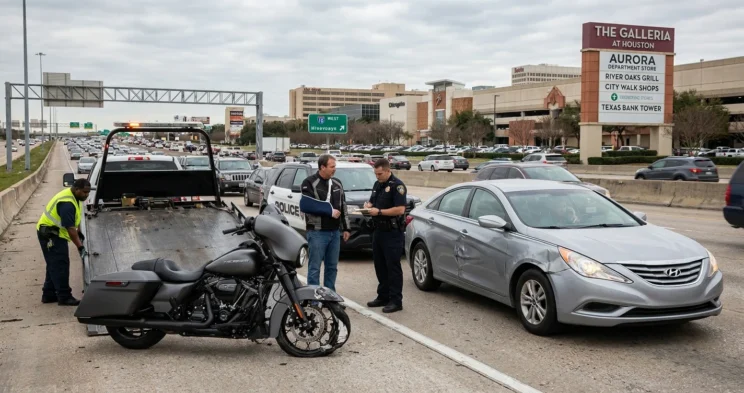
You were heading west on I-10 near the Galleria when a driver drifted into your lane and clipped your bike. Now you’re staring at a hospital bill, a shop estimate on a totaled motorcycle, and weeks of missed work. One of the first questions many riders ask is how much their case may actually be worth.
Types of Damages in a Texas Motorcycle Lawsuit
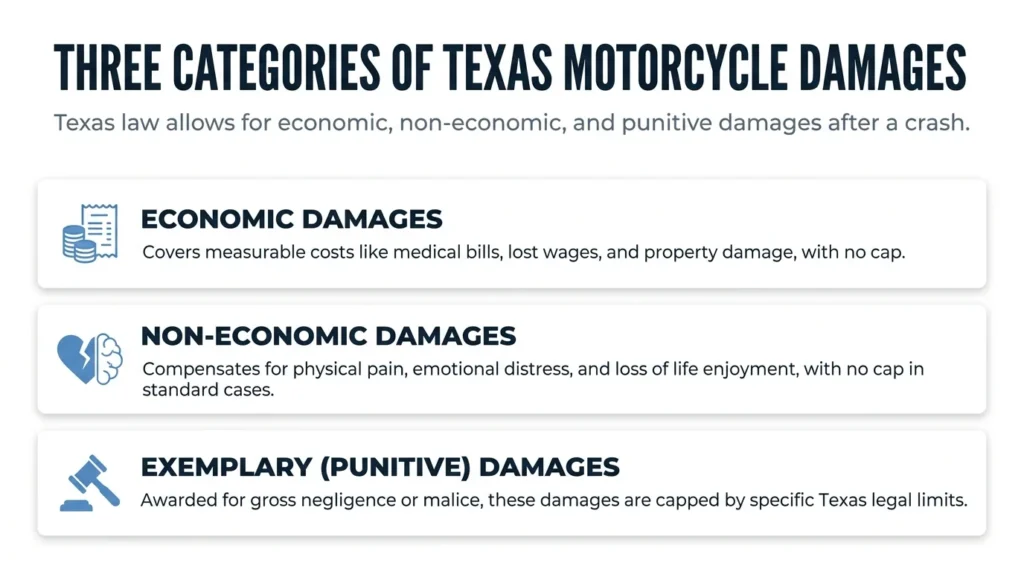
Texas usually recognizes economic and non-economic damages in motorcycle accident lawsuits. A third category, exemplary (punitive) damages, applies only in limited cases. Compensatory damages aim to restore you to the financial and personal position you held before the crash. They do not exist to punish the other driver.
Two crashes with similar facts can produce different settlement values because the injuries themselves often drive the outcome. Riders who suffer traumatic brain injuries, spinal cord injuries, or other serious injuries may face higher medical costs, longer recovery periods, and more long-term damage than riders with less severe injuries. Common injuries riders sustain in motorcycle crashes affect the value of your claim.
Economic Damages You Can Recover
Economic damages are your financial losses. They often include medical expenses, lost wages, loss of future earning capacity, and property damage.
Medical expenses may include emergency treatment, hospital stays, surgery, rehabilitation, and future medical care related to the accident. Lost wages cover the income you missed while recovering from your injuries. Loss of earning capacity is different from lost wages. It applies when an injury permanently affects your ability to earn income at the same level you did before the crash.
Property damage covers the repair or replacement of your motorcycle and any gear damaged in the accident. Helmets, jackets, boots, gloves, and saddlebags may all be included in a property damage claim. Many of the same factors that affect Texas motorcycle accident claims also affect the value of economic damages, including the severity of your injuries, the amount of available insurance coverage, and the evidence supporting your losses.
Non-Economic Damages & Punitive Damages
You can’t always measure losses with bills, receipts, or pay stubs. Non-economic damages compensate for the personal impact an injury has on your life, while punitive damages may apply only in limited situations involving especially reckless conduct.
Pain & Suffering
Non-economic damages may include physical pain, emotional distress, disfigurement, loss of enjoyment of life, and permanent impairment. Texas does not cap these damages in most personal injury cases.
Insurance companies often use different methods to estimate pain and suffering, including formulas based on the severity of the injuries and the amount of economic damages. However, no fixed calculation applies to every case.
Mental anguish and loss of consortium may also be available in certain situations. Medical records, mental health treatment records, and testimony about how the injuries affect your daily life can help support these claims. In fatal motorcycle crashes, surviving family members may be able to pursue Texas wrongful death claims for losses related to the death of a loved one.
Exemplary (Punitive) Damages
Punitive damages in Texas are available only in limited situations involving especially reckless or intentional conduct. For example, punitive damages may be available when a drunk driver or street racer acts with extreme disregard for the safety of others.
Texas law places limits on punitive damages in most cases. Under Texas Civil Practice and Remedies Code (CPRC) § 41.008, punitive damages are generally capped at the greater of $200,000 or two times economic damages plus up to $750,000 in non-economic damages.
Factors That Affect Your Motorcycle Accident Settlement
What damages are available is one question. What your case is actually worth is another question. The value of a case depends on several factors, and no two settlements are exactly alike.
The severity of your injuries is often the biggest factor. Catastrophic injuries typically result in higher medical expenses, longer recovery periods, and greater non-economic damages.
When the evidence clearly shows the other driver caused the crash, settlement negotiations are often more straightforward. When liability is disputed, the value of a claim may be affected. Police reports, photographs, witness statements, medical records, and accident reconstruction evidence can all help support your claim.
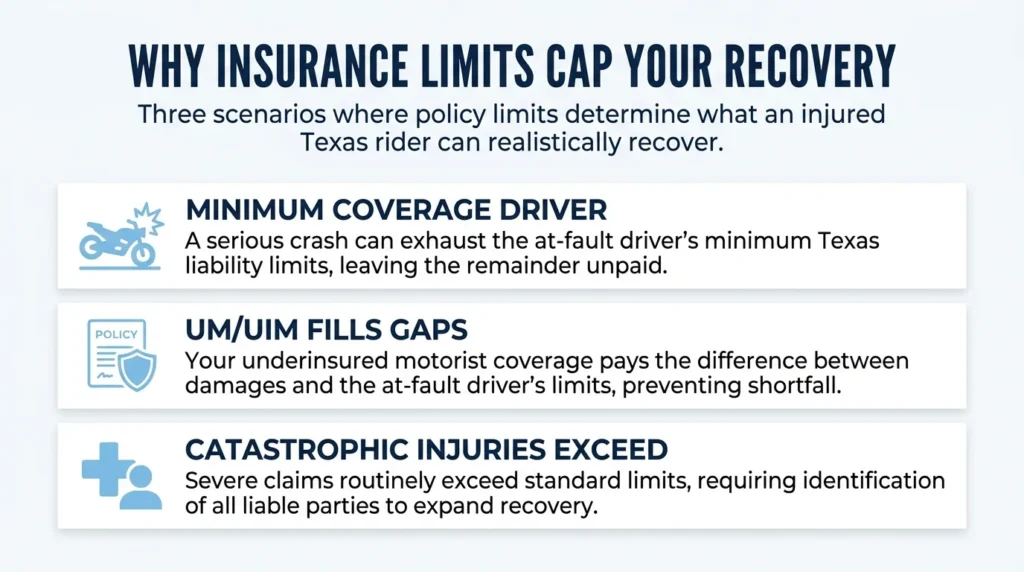
Insurance coverage can also limit recovery. Even when injuries are severe, the available insurance coverage may affect how much compensation you can realistically collect. Texas motor vehicle crash statistics show that serious motorcycle injuries can quickly exceed minimum insurance limits.
Texas Transportation Code § 661.003 allows some riders age 21 and older to ride without a helmet if they meet certain legal requirements. Even when helmet use is not required, the insurance company or defense attorney may argue that riding without a helmet contributed to certain injuries, particularly head trauma.
How Comparative Fault Reduces Texas Motorcycle Claims
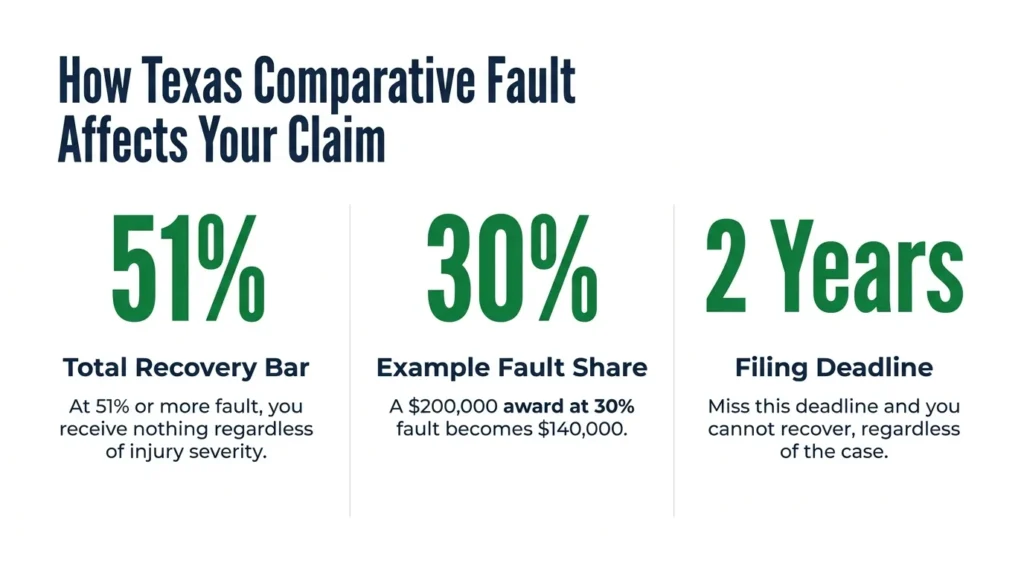
Texas uses a modified comparative fault system under CPRC Chapter 33. Your damages award gets reduced by your percentage of fault. If you are 51 percent or more at fault, you recover nothing. At 50 percent or less, you collect your damages minus your share of fault. For example, if a jury awards $200,000 in damages and finds you 30 percent at fault, your recovery is reduced to $140,000.
Disputes over fault are common in motorcycle accident cases. Insurance companies and defense attorneys may argue that a rider’s speed, lane position, helmet use, or other actions contributed to the crash. The percentage of fault assigned to each party can significantly affect the value of a claim.
Under Code § 16.003, you generally have two years from the date of the accident to file a personal injury lawsuit. Missing that deadline can prevent you from recovering compensation regardless of who caused the crash.
Questions about fault often arise when both parties share some responsibility for the accident. Texas law allows injured riders to pursue compensation even when they are partially at fault, provided they do not exceed the 50 percent threshold established under Texas comparative negligence and the 51 percent rule.
Talk to a Texas Motorcycle Accident Attorney
If you were injured in a motorcycle accident, you may have questions about what your case is worth and what compensation may be available. An attorney can review the facts of your case, identify the damages that may be available, and explain how Texas law applies to your situation.
Angel Reyes & Associates has represented injury victims across Texas for more than 30 years. We have recovered more than $1 billion for our clients. We work on a contingency basis, so there is no fee unless we win. Our case results include examples of claims we have handled across Texas. To discuss your situation, contact us for a free consultation in English or Spanish.
Past results do not guarantee future outcomes.
Motorcycle Accident Settlement FAQs
Can I still recover compensation if the at-fault driver had no insurance?
Texas requires drivers to carry minimum liability insurance, but many do not. If the at-fault driver is uninsured, your own uninsured motorist (UM) coverage can pay for your injuries and losses if you added it to your policy.
Does Texas allow family members to sue for damages if a rider was killed in a motorcycle crash?
Yes. Under the Texas Wrongful Death Act, surviving spouses, children, and parents can file a wrongful death claim against the at-fault party. They may recover for lost financial support, lost companionship, and mental anguish.
What happens to my claim if the at-fault driver was ticketed but not convicted?
A traffic citation can support your civil claim as evidence of negligence, but a criminal conviction is not required to win a personal injury lawsuit. Civil cases use a lower standard of proof than criminal cases, so a ticket alone can still strengthen your position.
Can I recover damages for a motorcycle accident caused by a road defect in Texas?
You may be able to sue a government entity responsible for road maintenance, but Texas law requires you to file a formal notice of claim within six months of the incident under the Texas Tort Claims Act. Strict deadlines and liability caps apply to claims against government entities, which differ from standard personal injury rules.
Does Texas require motorcyclists to carry any specific type of insurance that could affect a claim?
Texas requires all motorists, including motorcyclists, to carry at least $30,000 in bodily injury liability per person and $60,000 per accident. Carrying uninsured and underinsured motorist coverage is optional but can make a significant difference in recovery when the at-fault driver’s policy limits fall short.
About the Authors

Alex Ivanov
Writer
Alex Ivanov is a personal injury attorney at Angel Reyes & Associates, focused on car, truck, and motorcycle accident cases. Licensed in Texas and multiple federal districts, Alex brings international legal experience and a global education to his practice. He earned his LL.M. from Texas A&M University School of Law after graduating from Belarussian State University in 2016. Alex is fluent in Russian, English, Ukrainian, and Belarussian, and is recognized by multiple national trial lawyer associations for his results and leadership under 40.

Kyle Nicolas
Editor
Kyle Nicolas is the Web Content & SEO Manager at Angel Reyes & Associates. He has more than 10 years of experience as a marketing co...

Angel Reyes
Reviewer
Angel L. Reyes, III is the Founder and Managing Partner of Angel Reyes & Associates. A nationally recognized trial attorney and business...