How Social Media Posts Can Hurt Your Bus Accident Claim


Every article on this site is researched by our internal team, reviewed for legal accuracy against current Texas law, and held to State Bar of Texas advertising standards before publication. We do not publish content that overstates outcomes or makes promises about results.
Learn more about our
editorial standards .
Key Takeaways
- Insurers can subpoena private social media records even when your account is set to private.
- Deleting posts after a bus accident claim begins is spoliation and can trigger court sanctions.
- Government-bus claims carry notice deadlines as short as 45 to 90 days, so post with caution.
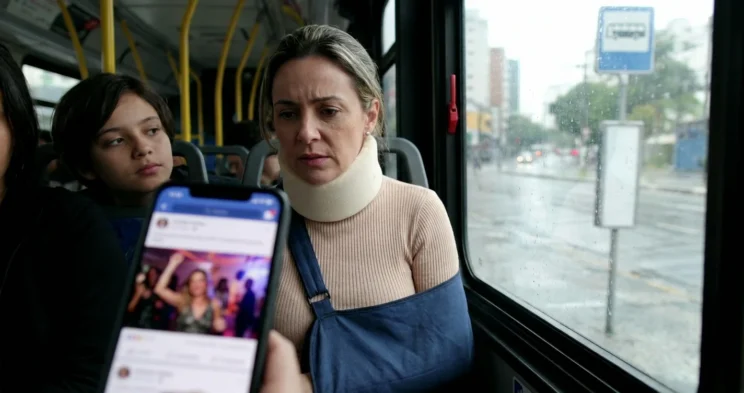
You were taking the bus home from a concert in Midtown, your phone full of photos from the night, when the driver slammed into a car near I-45. Now, your back hasn’t stopped hurting, and you just realized those photos are still sitting on your profile. Could the people investigating your claim be looking at them right now?
The Unique Social Media Risks of Bus Accident Claims
Bus accident claims carry social media risks for a simple reason: bus trips are social events, and social events today leave a digital trail that a solo drive on the freeway doesn’t.
Many bus accidents happen during group outings, organized trips, or daily commutes. You and the people with you often have a documented record of that day—photos, check-ins, and event tags that can appear online before the crash ever happens. You can’t control or delete what others share, so every account is another place an insurer can look.
This record is exactly what insurers want. A photo of you dancing or moving freely hours before the wreck gives them a visual baseline. They can use it to argue your injuries can’t be as serious as you say.
What Not to Post on Social Media After a Bus Accident
The safest move after a bus accident is to not post on social media until your claim is resolved. But if you stay active online, certain posts create far more risk than others.
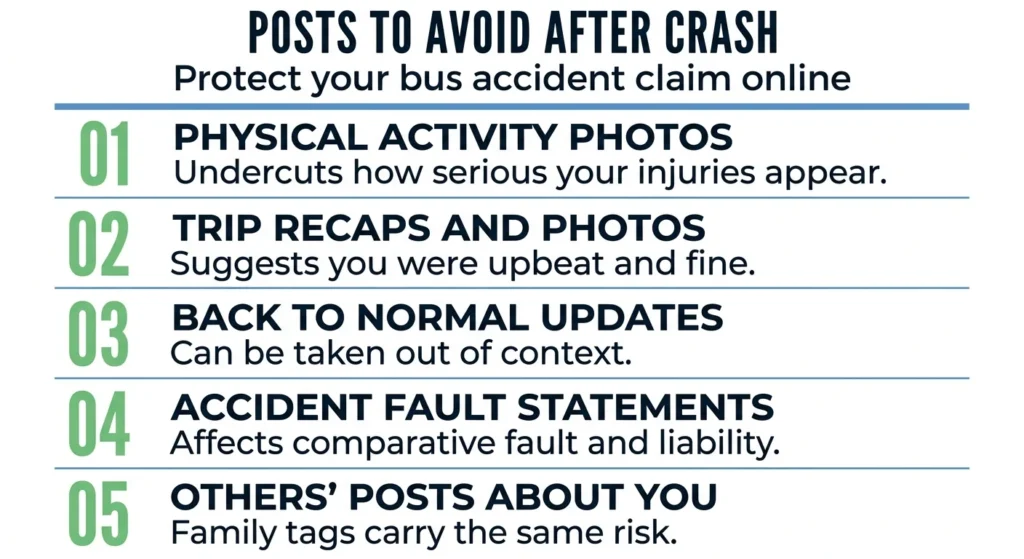
- Avoid photos showing physical activity. A post that shows you walking, dancing, lifting, or playing sports after the crash directly undercuts how serious your injuries appear.
- Avoid trip recaps, group photos, and check-ins. If you post images from the outing tied to the bus trip, insurers might argue you were upbeat and physically OK around the time of the crash.
- Avoid updates about getting back to normal. Posts about returning to work, resuming exercise, or attending events can be taken out of context, even if posted during a slow, partial recovery.
- Avoid statements about the accident itself. Comments on fault, the crash, or the bus driver and company can affect issues of comparative fault and liability.
- Watch what others post about you. Family members’ photos and tags carry the same risk, because insurers will use content posted by anyone that mentions you. These same tactics show up when insurers verify pre-existing injuries.
- Don’t delete posts after you file a claim. Destroying evidence once a claim exists is called spoliation, and it can trigger court sanctions, an adverse inference against you, or dismissal of your case.
How Insurers Use Social Media Against Your Claim
Insurance companies and defense attorneys treat your social media as a standard part of claim investigation. They review what you posted before, during, and after the accident, and they do so early.
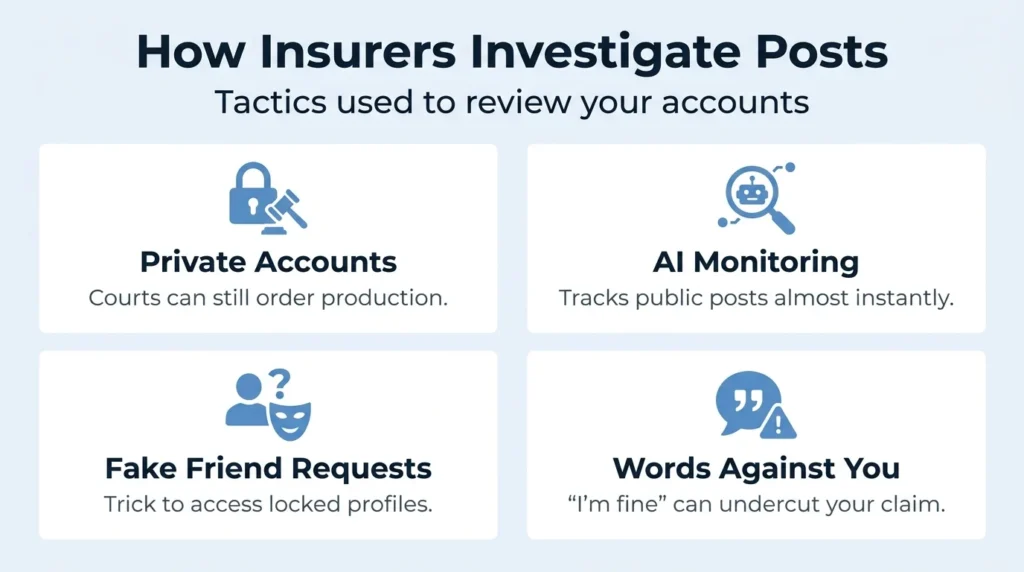
Setting your account to private doesn’t lock them out. Courts have consistently held that private accounts aren’t shielded from civil discovery, and defense attorneys can compel production of your social media records by either directly requesting them from you or, in some cases, by serving the social platform with a court order. Your privacy settings won’t block a valid discovery request.
Some insurers go further, using AI monitoring software to track public posts almost as they happen. Fake friend requests are a known trick used to slip inside a locked profile, so be skeptical of a stranger’s follow or friend request after a crash.
Even a kind word can harm you. When a worried friend asks how you are and you reply “I’m fine,” that can become a statement against your own interest. Insurers may introduce it to chip away at your claims of pain and suffering.
Social content related to the crash is legally relevant for two years under Texas Civil Practice and Remedies Code (CPRC) § 16.003. That’s also how long you have to file a bus accident claim.
Government Buses & Claim Timelines
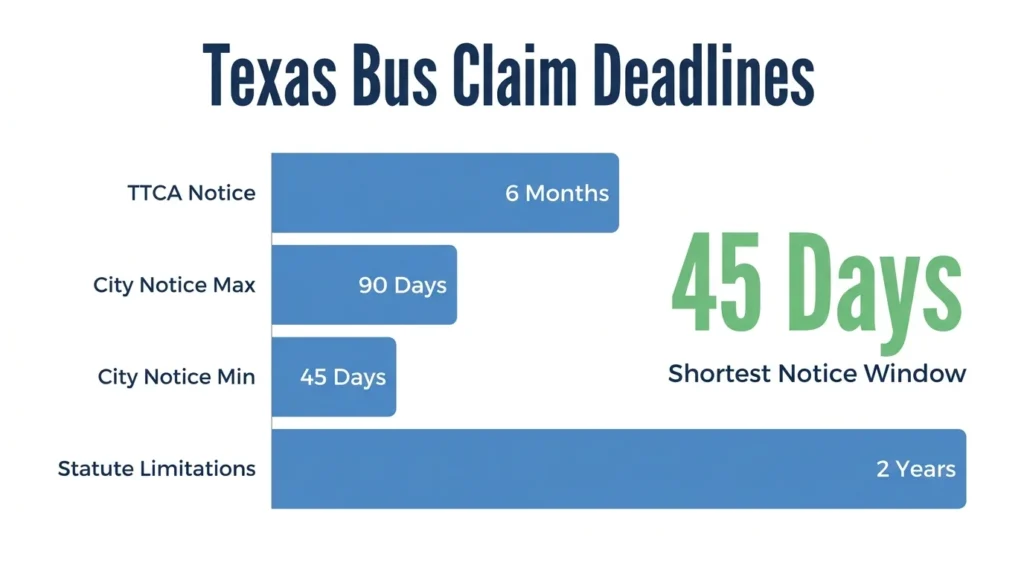
If you were riding on a bus operated by a city transit authority, school district, or other public agency, the Texas Tort Claims Act § 101.101 tightens the deadlines that shape your claim. It requires written notice of your claim to the government entity within six months of the incident. Some cities cut that further, imposing notice windows of just 45 or 90 days.
A shorter deadline means your social media caution cannot wait. Government defense teams open their investigation soon after you file notice, so posts you make in the first few weeks will face close scrutiny.
If the bus crossed state lines, federal rules add another layer. The FMCSA passenger carrier safety standards shape how a carrier’s liability and evidence get handled in interstate cases. The interaction between these rules and the Texas Tort Claims Act limits on bus accidents decides much of what your claim looks like.
When a public agency operates the bus, talking with an attorney quickly helps you avoid a missed deadline you never saw coming. Knowing how to file a bus accident claim early keeps your options open.
Talk to a Bus Accident Attorney Before You Post Anything
The hours after a bus accident are confusing, and one well-meaning post can cost you more than you realize. Angel Reyes & Associates has spent over 30 years helping injured Texans protect their claims from the moment the investigation begins. With more than $1 billion recovered for clients, we work on a no-fee-unless-we-win basis, so reviewing your situation costs you nothing upfront.
Our attorneys serve all of Texas and answer the phone 24/7, because a deadline does not wait for business hours. Reach out for a free consultation before you post anything about your accident.
Past results do not guarantee future outcomes.
Frequently Asked Questions
Can a screenshot of a post still be used as evidence if I deleted the original?
Yes. Once someone else captures or caches a post, deleting the original does not erase it from the record. Opposing counsel can also argue that deletion itself shows you knew the content was harmful to your claim.
Can private direct messages be subpoenaed in a bus accident case?
Courts can order you to produce your own direct message data even when platforms resist a direct subpoena. A single public post that appears to contradict your injury claim is often enough for a judge to authorize access to your private messages as well.
Does social media affect a bus accident claim if the crash happened during a work trip?
Yes. If you were injured on a work-related bus trip, your employer’s workers’ compensation carrier will investigate just like a liability insurer would. Posts showing physical activity or contradicting your reported limitations apply equally in a workers’ comp claim.
About the Authors

Angel Reyes
Writer
Angel L. Reyes, III is the Founder and Managing Partner of Angel Reyes & Associates. A nationally recognized trial attorney and business leader, Angel has helped over 70,000 injury victims recover more than $1 billion since founding the firm in 1993. Named to the Texas Super Lawyers list annually since 2008, Angel brings Wall Street experience, Ivy League education, and a deep commitment to client advocacy. He is a frequent legal commentator and published author with extensive contributions to legal scholarship, trial strategy, and consumer protection.

Graham Griffin
Editor
Graham Griffin is the Web & Content Manager at Angel Reyes & Associates, where he oversees content strategy, AI-powered workflows, a...

Angel Reyes
Reviewer
Angel L. Reyes, III is the Founder and Managing Partner of Angel Reyes & Associates. A nationally recognized trial attorney and business...