What Is the Common Carrier Standard in Bus Accidents?


Every article on this site is researched by our internal team, reviewed for legal accuracy against current Texas law, and held to State Bar of Texas advertising standards before publication. We do not publish content that overstates outcomes or makes promises about results.
Learn more about our
editorial standards .
Key Takeaways
- Texas bus companies owe passengers a higher standard of care than ordinary drivers.
- Government bus claims require written notice within six months of the crash, or you lose the right to file a lawsuit.
- Private bus injury claims follow the standard two-year Texas filing deadline under § 16.003.
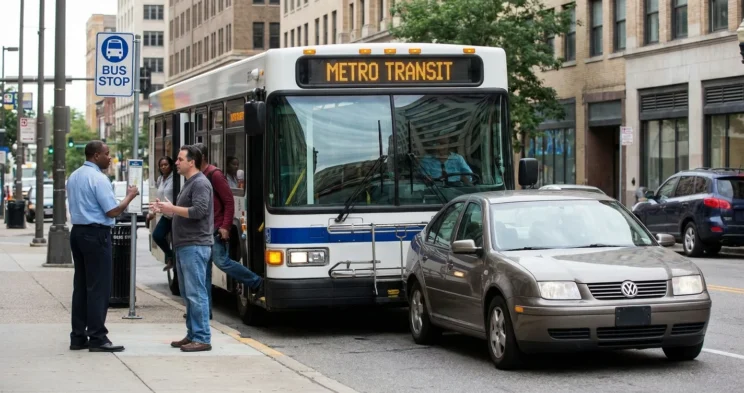
You boarded a city bus in downtown Austin, heading to work along Congress Avenue, when the driver braked hard and threw you into the seat ahead of you. Now, you are dealing with a hospital bill and a bus company that’s acting like the crash was routine.
What they don’t want you to know is that the company operating the bus is held to a much higher legal standard than any other driver on the road.
What Is a Common Carrier in Texas?
A common carrier is any business that transports passengers or goods for hire and serves the general public. City buses, charter buses, intercity coaches, and paratransit vans all fall under this definition.
The common carrier label is important. Once a business qualifies as a common carrier, Texas law demands higher standards than an ordinary driver.
The Texas Transportation Code Chapter 5 provides the legal framework for these duties and responsibilities. Understanding common carrier liability in Texas begins by knowing which operators are covered by these rules.
For example, school buses operated by public school districts are in a separate legal category than bus operators that carry paying members of the general public. However, rideshare companies and taxis also qualify as common carriers under Texas law.
The Duty of Care That Bus Companies Owe Passengers
Under Texas law, common carriers owe passengers the highest level of care. In comparison, a regular driver owes a duty of reasonable care.
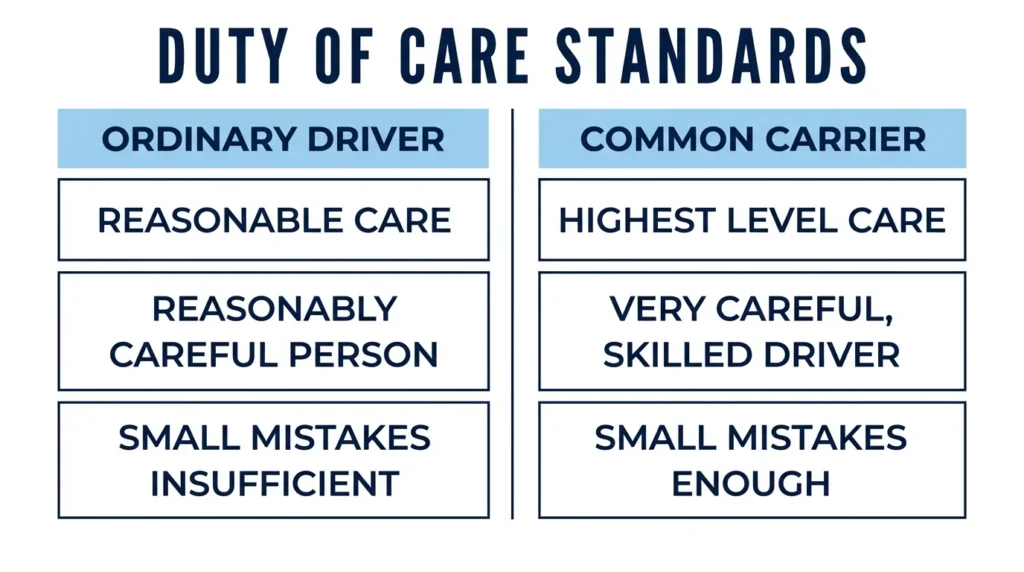
Here’s the difference:
- A duty of reasonable care means acting as a reasonably careful person would in the same situation.
- The highest level of care requires acting as a very careful, responsible, and skilled driver who takes every reasonable precaution to protect others from harm.
In 2020, the Texas Supreme Court reaffirmed this higher standard in VIA Metropolitan Transit v. Meck. This ruling confirmed that the standard applies to both private and government-operated bus systems.
This higher standard makes a big difference. Even a small mistake that might not prove fault in a typical car accident claim can prove fault in a bus accident case.
Additionally, a bus company cannot avoid this liability by hiring another contractor to operate the vehicle. It is still responsible if a passenger gets hurt.
The highest level of care applies from the moment you board the bus until you safely step off the bus.
Government vs. Private Bus Operators
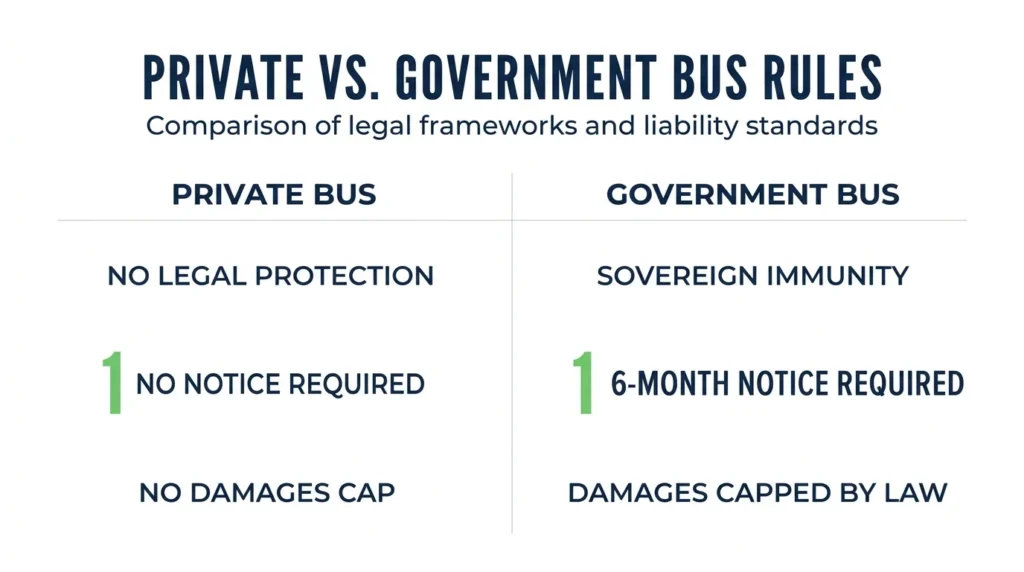
Not every bus operator follows the same rules. Private bus companies and government transit authorities have different liability rules, notice deadlines, and damages caps. These differences can determine the outcome of your entire claim.
Private Bus Companies
Private operators (such as charter companies and intercity carriers) do not have legal protections. You can file a lawsuit against them directly without giving written notice first.
Your filing deadline is the same as any other personal injury lawsuit, which means you have two years after the date of the crash to file a claim, under Texas Civil Practice and Remedies Code (CPRC) § 16.003.
Federal law also requires interstate buses carrying 16 or more passengers to carry at least $5 million in liability coverage under 49 CFR Part 387.
Government-Operated Bus Companies
Public transit authorities (like city or regional bus systems) operate under a special legal protection called sovereign immunity, which limits your recovery and forces you to follow specific steps before filing a lawsuit.
The Texas Tort Claims Act, found in Chapter 101 of the CPRC, allows lawsuits to be filed against government entities, but only in specific situations, and it limits the amount of damages that can be recovered against government entities.
The most important deadline to remember is that you must give written notice to the government entity within six months of the crash. If you miss that deadline, then you can lose your right to file a lawsuit. Read more about the Texas Tort Claims Act limits on bus accidents.
Sovereign immunity does not lower the standard of care. VIA Metropolitan Transit v. Meck confirmed that government transit systems still owe passengers the same high standard of care as private carriers. This standard allows some injured riders to sue a public transportation agency.
How the Standard Affects a Bus Accident Claim
A bus company owes the highest standard of care to its passengers, which can affect settlement negotiations. The defense counsel knows that the carrier’s fault will be determined based on a higher legal standard of care, which can give you more leverage when negotiating a settlement.
The higher standard of care also makes it so you do not have to prove that the driver acted recklessly. Ordinary lapses in attention, poor driver training, or failing to properly maintain the bus may be enough to show that the company was legally responsible for the crash.
Federal rules create specific standards that bus companies must follow. Under 49 CFR Part 391, commercial bus operators must meet minimum driver qualification requirements, and a violation of these requirements can serve as proof of negligence.
Evidence in a Bus Accident Claim
Certain records determine proof of liability in bus accident claims. The following documents can help determine whether the carrier met its duty of care:
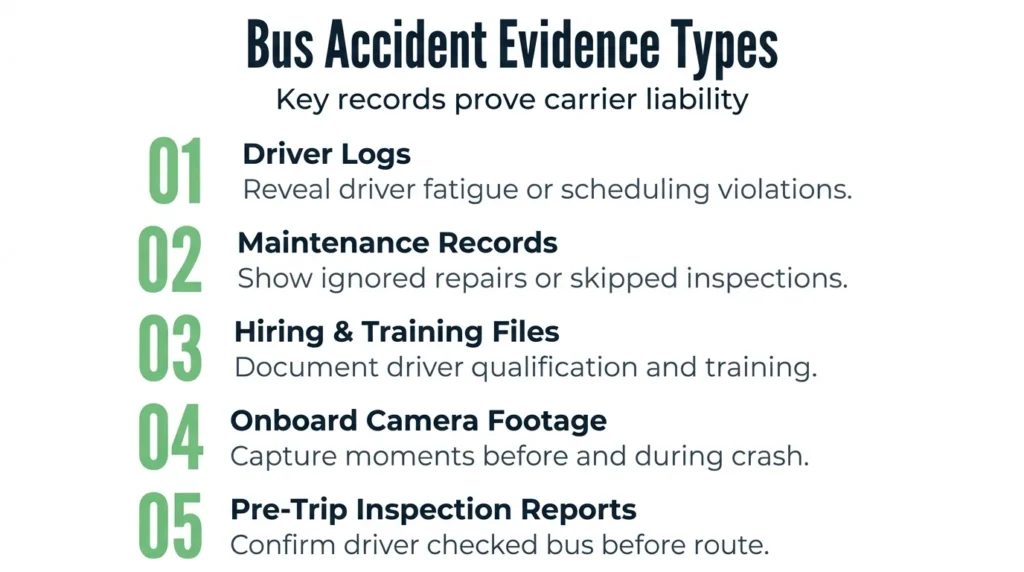
- Driver logs: Hours-of-service records reveal driver fatigue or scheduling violations.
- Maintenance records: These show whether the carrier ignored needed repairs or skipped inspections.
- Hiring and training files: These document whether the driver was qualified and properly trained.
- Onboard camera footage: Video footage can capture the moments before and during the crash.
- Pre-trip inspection reports: These confirm whether the driver checked the bus before starting the route.
The 51% Bar Rule
Fault can still be shared across multiple parties in an accident. Texas uses proportionate responsibility rules under Chapter 33 of the CPRC, which means a passenger who was partially at fault can still recover compensation, as long as their share of fault is not greater than 50%.
The facts of your specific accident will determine how the common carrier standard applies to your specific situation. An attorney who handles bus accident liability questions in Texas can evaluate your case.
Work with an Attorney on Your Bus Accident in Texas
A bus accident claim requires you to prove that the company failed to meet its higher standard of care, which means you’ll need fast access to records controlled by the carrier. Angel Reyes & Associates has spent over 30 years helping injured Texans hold negligent bus companies accountable, with more than $1 billion recovered for clients.
We offer free initial consultations, and you pay no fee unless we win. Our team serves the entire state of Texas from more than 20 office locations, we are available 24/7, and we can handle the majority of your case remotely.
You can review what our clients say about working with us or learn more about the attorneys who handle your case. When you are ready, reach out to us for a free consultation.
Past results do not guarantee future outcomes.
Common Carrier Standard FAQs
Does the common carrier standard apply if I was injured at a bus stop, but I was never on the bus?
Texas courts have found that a carrier’s duty of care extends beyond the vehicle itself to also include passengers who are boarding or getting off the bus. However, passengers at the bus stop who have not yet boarded are generally not protected by the same standard. Whether the duty of care applies at a bus stop depends on the specific facts of your case, and how much control the carrier had over that area at the time of the accident.
Does the common carrier standard apply to the bus driver personally, or only the company?
The higher common carrier standard applies to the operating company, not the driver as an individual. Typically, the bus company is the defendant named in a lawsuit because the driver works for the company, but the company is responsible for hiring, training, and supervising the driver.
What types of compensation can a passenger recover after a Texas bus accident?
An injured passenger can seek damages for medical bills, lost wages, future medical care, pain and suffering, and in some cases, loss of earning capacity. Texas law does not limit most of these damages for private bus company claims, but separate caps apply to government transit authority cases under the Texas Tort Claims Act.
Can an out-of-state bus company be held to the common carrier standard in a Texas accident?
Yes. If the accident occurs in Texas, then Texas courts will apply Texas law to the claim, including the higher common carrier standard. An out-of-state or interstate bus company is still subject to Texas common carrier rules when it operates within Texas borders.
What happens to a bus accident claim if the bus company no longer exists or has filed for bankruptcy?
A bankruptcy filing does not automatically dismiss a personal injury claim. You may still file a claim against the company’s estate through the bankruptcy process. Federal law requires interstate bus carriers to maintain liability insurance, which can serve as a source of recovery even if the company shuts down.
About the Authors

Angel Reyes
Writer
Angel L. Reyes, III is the Founder and Managing Partner of Angel Reyes & Associates. A nationally recognized trial attorney and business leader, Angel has helped over 70,000 injury victims recover more than $1 billion since founding the firm in 1993. Named to the Texas Super Lawyers list annually since 2008, Angel brings Wall Street experience, Ivy League education, and a deep commitment to client advocacy. He is a frequent legal commentator and published author with extensive contributions to legal scholarship, trial strategy, and consumer protection.

Graham Griffin
Editor
Graham Griffin is the Web & Content Manager at Angel Reyes & Associates, where he oversees content strategy, AI-powered workflows, a...

Angel Reyes
Reviewer
Angel L. Reyes, III is the Founder and Managing Partner of Angel Reyes & Associates. A nationally recognized trial attorney and business...