What Is Vehicular Manslaughter in Texas?


Every article on this site is researched by our internal team, reviewed for legal accuracy against current Texas law, and held to State Bar of Texas advertising standards before publication. We do not publish content that overstates outcomes or makes promises about results.
Learn more about our
editorial standards .
Key Takeaways
- Texas has no vehicular manslaughter law. Instead, prosecutors use one of three charges.
- A wrongful death claim can proceed even without a criminal conviction.
- Your family generally has two years to file a wrongful death claim in Texas.
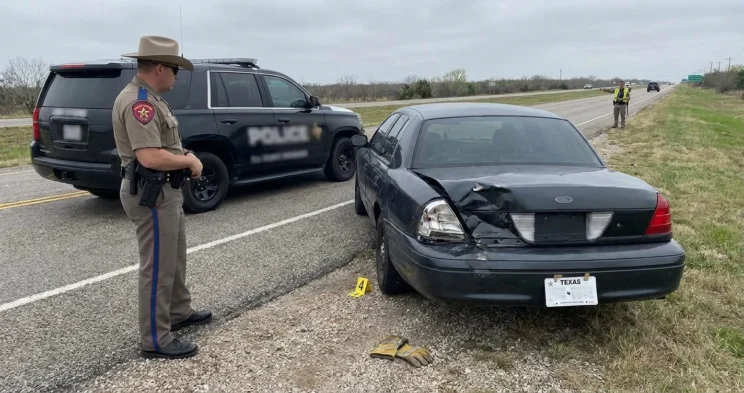
Your brother was driving home on the I-35E access road near Waxahachie when another driver ran a red light and hit him. Unfortunately, he did not survive. Now, you keep hearing the phrase “vehicular manslaughter,” and you need to know what it has to do with your family.
The Three Possible Charges After a Fatal Crash
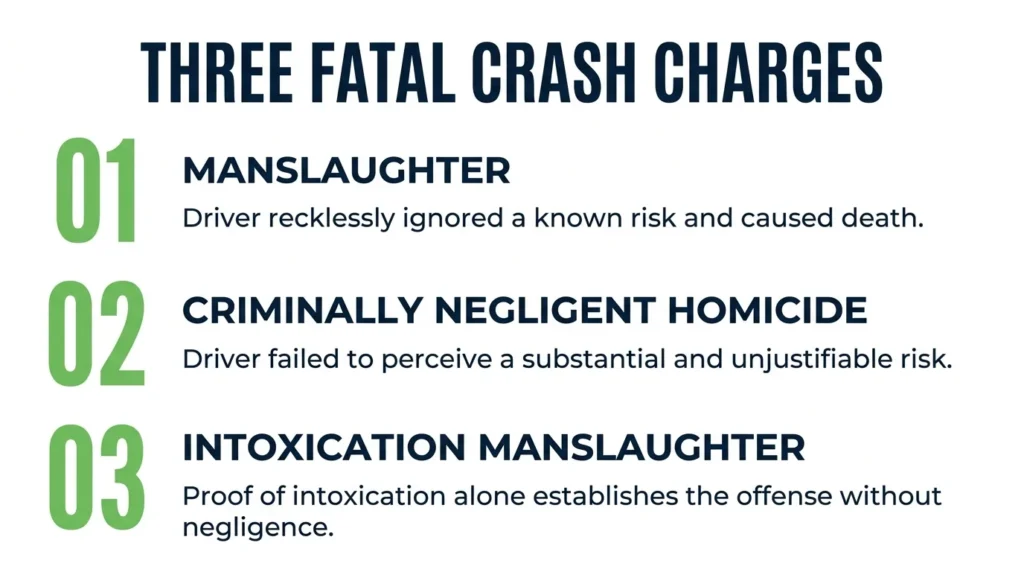
Texas has no official crime called “vehicular manslaughter.” Instead, the phrase is shorthand for one of three separate charges, all of which are the result of a fatal car accident. The prosecutor will decide which charge to file based on the at-fault driver’s state of mind behind the wheel.
Each charge is associated with a different mental state:
- Reckless
- Criminally negligent
- Intoxicated
The same crash can lead to different charges depending on the facts, so it is worth looking into all of your family’s options after a car accident, no matter which charge is filed.
Manslaughter
Manslaughter is a reckless conduct charge. Under Texas Penal Code § 19.04, an at-fault driver can be charged with manslaughter when they acted recklessly behind the wheel and caused a death.
This applies when the driver knew about a serious risk and ignored it. For example, a driver who knowingly raced through a red light could face a manslaughter charge.
Criminally Negligent Homicide
Criminally negligent homicide sits one step below manslaughter. It applies when a driver should have known about a serious risk but was not aware of one. For example, a driver is unfamiliar with the area and is looking for a street name. They are so absorbed by looking at their surroundings that they fail to notice traffic ahead has come to a complete stop. They rear-end another vehicle at full speed, causing a fatal crash.
This is a lower standard than manslaughter, and Penal Code § 19.05 treats this as a less serious felony because the driver failed to recognize the risk that their actions posed.
Intoxication Manslaughter
Intoxication manslaughter applies when a driver causes a death while intoxicated. Once the state proves intoxication, it does not have to separately prove recklessness or negligence.
Penal Code § 49.08 makes intoxication the focal point of the charge. In the case of an intoxication manslaughter charge, the driver’s intoxicated state equates to the reckless or careless conduct required for the other two charges.
Texas Manslaughter Penalty Ranges
Two of these charges carry the same serious penalties. The third has a lighter penalty because the driver’s actions are considered less blameworthy.
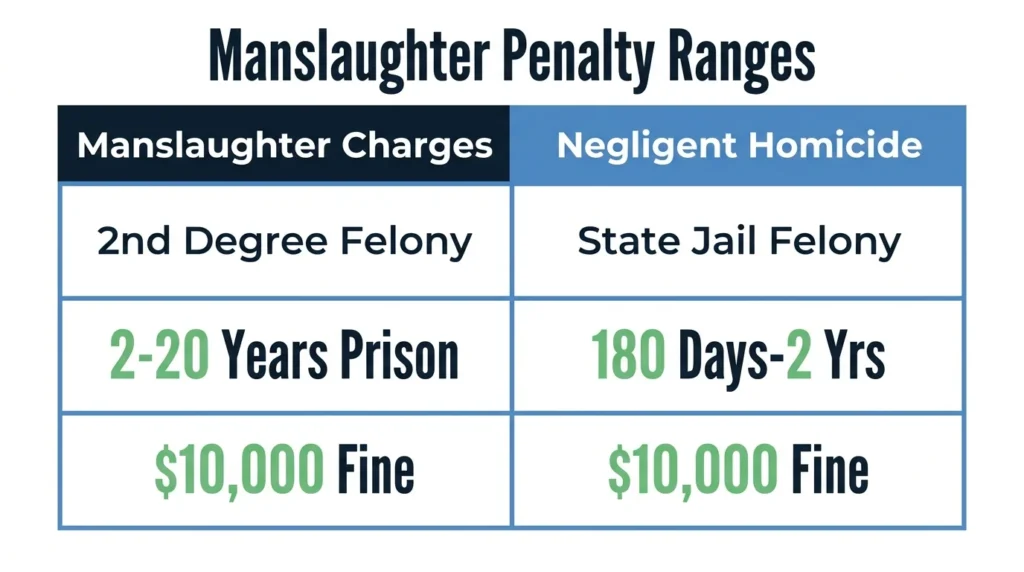
Here is how the three charges compare according to felony class and prison time:
- Manslaughter and intoxication manslaughter: Both are second degree felonies. Texas Penal Code § 12.33 sets the sentence at 2 to 20 years in prison, plus a fine of up to $10,000.
- Criminally negligent homicide: This offense is a state jail felony. Penal Code § 12.35 sets the sentence at 180 days to 2 years in a state jail, plus a fine of up to $10,000.
These penalties punish the driver, but they don’t put money in your family’s hands or cover the costs you will face after a wrongful death.
Wrongful Death Claims Are a Separate Case
Your family can file a wrongful death claim no matter what happens in the criminal case. You do not need a conviction to file a claim, and an acquittal does not prevent you from filing a claim, either. Your family can file under the Texas Wrongful Death Act whether the driver is convicted, acquitted, or never charged at all.
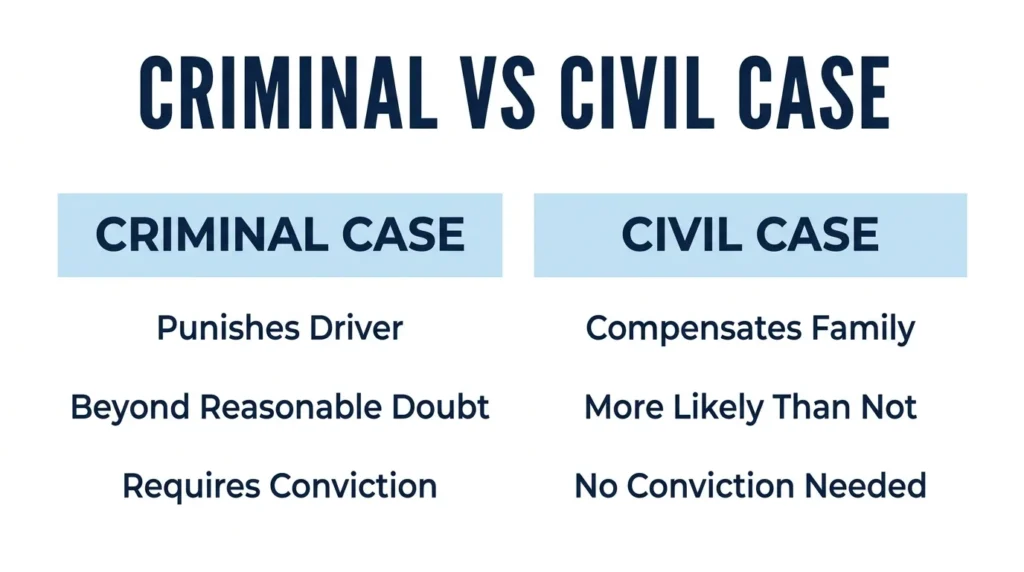
The criminal case punishes the driver, but a civil wrongful death claim seeks compensation for legally recognized family members of the deceased.
The civil case also requires a lower standard of proof. You only have to show that the driver was likely responsible, not guilty beyond a reasonable doubt. Even if the criminal case looks weak, this lower bar can still leave your family a path to financial recovery.
However, not everyone can file a claim. Texas Civil Practice and Remedies Code (CPRC) § 71.004 limits the claim to the surviving spouse, children, and parents of the deceased.
This holds true even when the charge is intoxication manslaughter. A civil claim against a drunk driver does not depend on a conviction, and the rights of drunk driving victims are upheld regardless of whether the driver is convicted in criminal court.
Reading how families pursue wrongful death and survival claims after a fatal crash can clarify the civil claims process.
How the Criminal Case Affects Your Deadline
Your family can pursue a wrongful death claim before the driver’s trial ends, and it is recommended that you do so, as waiting for the criminal case to be resolved will cost you time that you do not have.
Your wrongful death claim generally has a two-year deadline starting from the date of the death, under Texas Civil Practice and Remedies Code § 16.003. This deadline is separate from the criminal case, so it’s important to understand how the wrongful death filing deadline works before the criminal case is resolved.
It’s equally as important to hire an experienced legal team who will keep track of the criminal proceedings and your filing deadline simultaneously.
Work with an Attorney on Your Wrongful Death Claim in Texas
If you are grieving and being asked to make legal decisions at the same time, contact Angel Reyes & Associates. We have guided Texas families through fatal crash cases for over 30 years, and we can pursue your civil wrongful death claim even while the criminal case against the driver is still in process.
We work on contingency, so there is no upfront cost, and you owe us no fees or expenses unless we win. We serve families across the entire state in English and Spanish, and we are available 24/7. Reach out for a free consultation to discuss your options and deadlines today.
Vehicular Manslaughter FAQs
What is the difference between a survival claim and a wrongful death claim in Texas?
A wrongful death claim compensates the family for their own losses (like lost financial support and grief). A survival claim compensates the deceased’s estate for the pain, medical bills, and other losses that the person suffered before they died.
What compensation can a family recover in a Texas wrongful death claim?
Families can seek damages for lost financial support, lost household services, funeral and burial costs, and mental anguish from the loss. The exact amount depends on the family’s relationship with the deceased.
What happens if the driver fled the scene of a fatal crash in Texas?
Fleeing a deadly crash is a separate charge called “failure to stop and render aid,” which is a second-degree felony that can result in 2 to 20 years of prison time. This charge does not prevent a family from filing a civil wrongful death claim.
Can a family still recover damages if the at-fault driver has no insurance?
Yes. Many Texas auto policies include uninsured or underinsured motorist coverage, which can pay a claim if the at-fault driver has little or no insurance.
About the Authors

Angel Reyes
Writer
Angel L. Reyes, III is the Founder and Managing Partner of Angel Reyes & Associates. A nationally recognized trial attorney and business leader, Angel has helped over 70,000 injury victims recover more than $1 billion since founding the firm in 1993. Named to the Texas Super Lawyers list annually since 2008, Angel brings Wall Street experience, Ivy League education, and a deep commitment to client advocacy. He is a frequent legal commentator and published author with extensive contributions to legal scholarship, trial strategy, and consumer protection.

Kyle Nicolas
Editor
Kyle Nicolas is the Web Content & SEO Manager at Angel Reyes & Associates. He has more than 10 years of experience as a marketing co...

Angel Reyes
Reviewer
Angel L. Reyes, III is the Founder and Managing Partner of Angel Reyes & Associates. A nationally recognized trial attorney and business...