What Is Criminally Negligent Homicide in Texas?


Every article on this site is researched by our internal team, reviewed for legal accuracy against current Texas law, and held to State Bar of Texas advertising standards before publication. We do not publish content that overstates outcomes or makes promises about results.
Learn more about our
editorial standards .
Key Takeaways
- Criminally negligent homicide is a state jail felony and Texas's lowest homicide charge.
- The sentence for criminally negligent homicide ranges from 180 days to 2 years in state jail, plus up to a $10,000 fine.
- A criminal charge does not stop your family from filing a separate wrongful death claim.
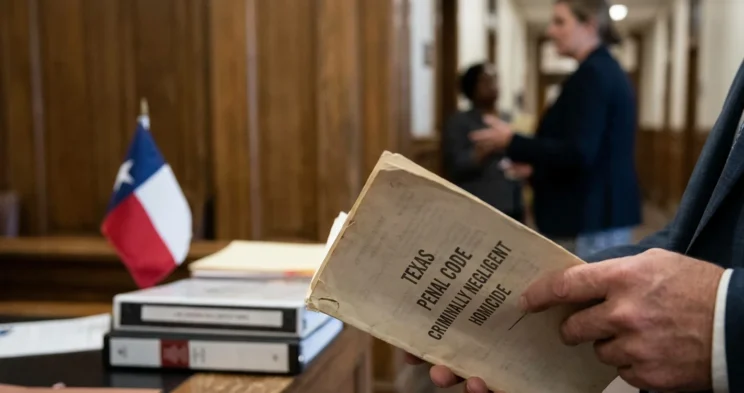
In the middle of the night, you get a call from the police saying that someone you love was killed in a crash on I-45 near The Woodlands. Weeks later, you learn that the driver was charged with criminally negligent homicide. The name of the charge doesn’t sound serious enough, and you’re wondering what it means.
Texas Law on Criminally Negligent Homicide
Criminally negligent homicide means causing a person’s death by failing to use the level of care that a reasonable person would have used in the same situation. According to Texas Penal Code § 19.05, it is classified as a state jail felony—the least serious homicide charge in Texas—because it involves the lowest level of criminal responsibility.
Most families first hear about this charge after a fatal traffic crash, and they are often stunned that causing a death on the road is not met with a harsher charge.
Four Culpable Mental States in Texas Homicide Cases
Texas classifies its homicide charges according to what was happening in the driver’s mind at the time of the crash. Penal Code § 6.03 details four culpable mental states:
- Intentional
- Knowing
- Reckless
- Criminally negligent
The charge an at-fault driver faces is based on the mental state that a prosecutor can actually prove. If the evidence points to the lowest mental state (criminally negligent), then the charge is criminally negligent homicide.
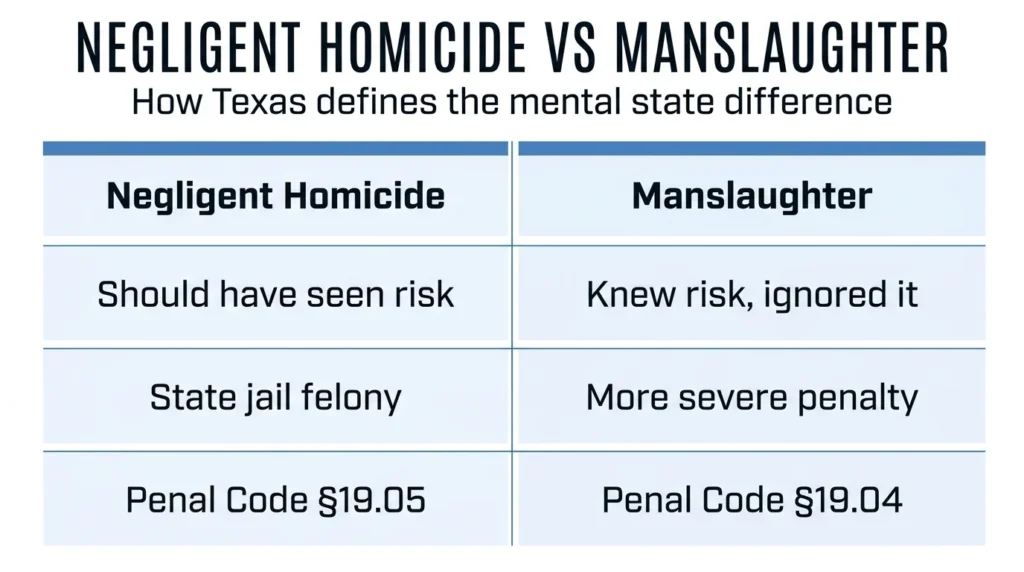
Criminally Negligent Homicide vs. Manslaughter in Texas
To receive a manslaughter charge, the driver must have known about a real risk and chosen to ignore it. To receive a criminally negligent homicide charge, the driver should have seen the risk but didn’t. That distinction is why manslaughter carries a more severe penalty under Penal Code § 19.04.
Intoxication Manslaughter vs. Criminally Negligent Homicide in Texas
If drugs or alcohol played a role in the crash, prosecutors frequently charge the at-fault driver with intoxication manslaughter under Penal Code § 49.08, which is a more serious offense.
If a drunk driver caused your loss, it’s important to understand your rights as a drunk driving victim.
What Is the Sentence for Criminally Negligent Homicide in Texas?
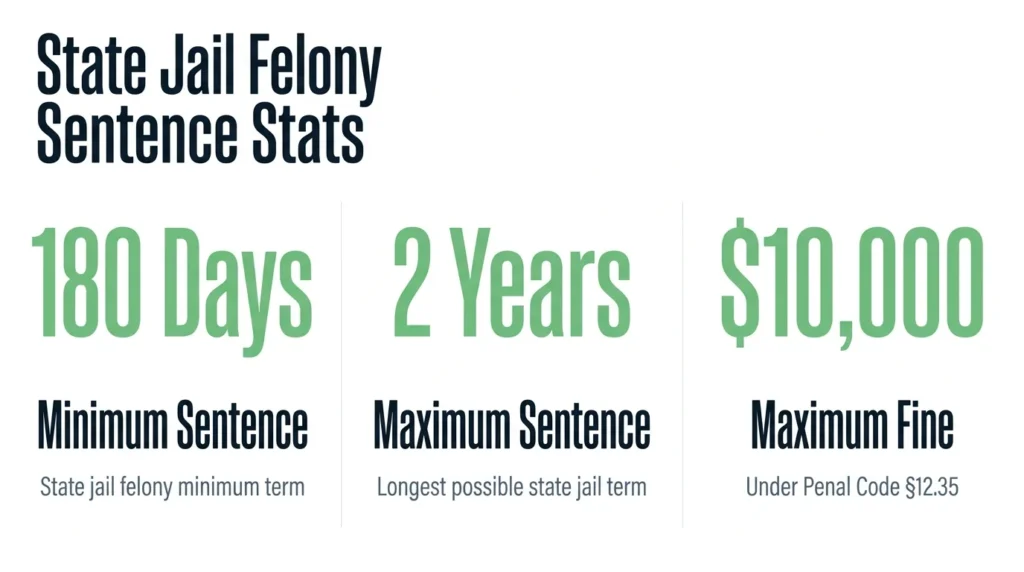
As a state jail felony, a criminally negligent homicide sentence is typically 180 days to 2 years in a state jail facility, plus a fine of up to $10,000, according to Penal Code § 12.35.
A shorter sentence reflects the charge that the prosecutor could prove, not the severity of your loss. Additionally, it does not stop your family from pursuing a separate civil claim, which is why it is worth exploring the damages that a wrongful death claim can cover.
How Criminal Charges Affect Wrongful Death Claims
A criminal case and a civil wrongful death claim are two separate legal actions with different goals and different evidence requirements. If the at-fault driver receives a plea deal, a lesser charge, or even an acquittal, your family is still entitled to file a wrongful death claim under Texas’s Wrongful Death Act.
Texas Civil Practice and Remedies Code Chapter 71 allows certain family members to recover damages for the loss of a spouse, parent, or child.
How Long Do You Have to File a Wrongful Death Claim?
Your civil claim has its own deadline. CPRC § 16.003 gives your family two years from the date of the death to file your claim.
This is separate from the criminal timeline, and the criminal process does not control the deadline of your civil claim. Our guide to the wrongful death statute of limitations in Texas provides details on the timeline.
Work with an Attorney on Your Wrongful Death Claim in Texas
Losing someone you love to another driver’s carelessness leaves your family struggling with grief, hard questions, and an unfeeling legal system. But the criminal charge is only one part of the story, and it does not determine what your family can recover.
Angel Reyes & Associates has guided Texas families through wrongful death claims for over 30 years, with more than $1 billion recovered for clients. You pay no fees or expenses unless we win. Schedule a free consultation to discuss your options today.
Past results do not guarantee future outcomes.
Criminally Negligent Homicide FAQs
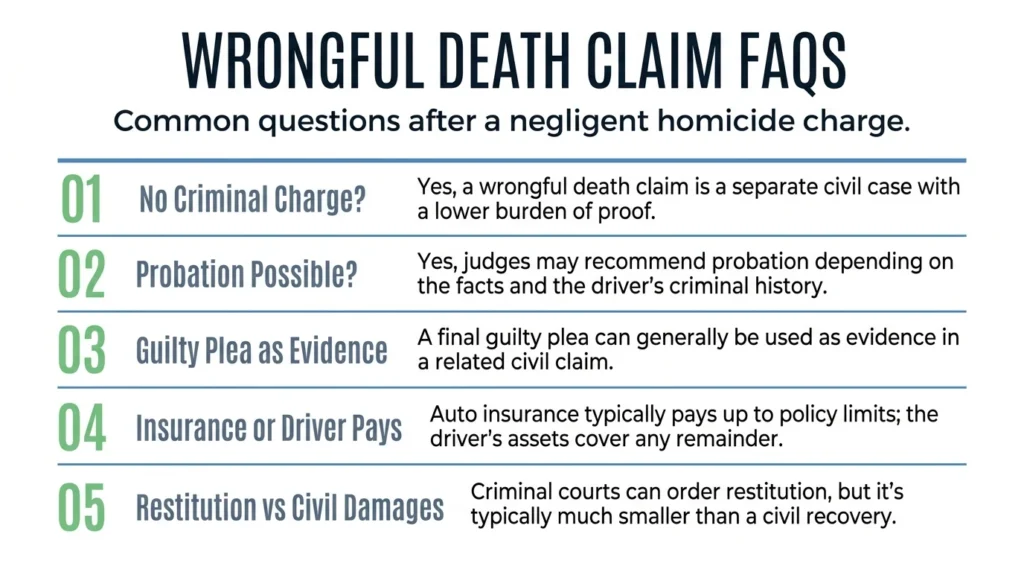
Can my family still file a wrongful death claim if the driver was never criminally charged?
Yes. A wrongful death claim is a separate civil case with a lower burden of proof, so it is not dependent on whether prosecutors filed criminal charges.
Is probation possible instead of jail time for criminally negligent homicide in Texas?
Yes. Texas judges and juries can recommend probation for a state jail felony, depending on the facts of the case and the driver’s criminal history.
Can a guilty plea in the criminal case be used as evidence in the wrongful death lawsuit?
In most cases, yes. A guilty plea that becomes final in a felony case can generally be used as evidence in a related civil claim.
Who actually pays if my family wins a wrongful death claim: the driver or their insurance?
In most cases, the driver’s auto insurance pays the claim up to the policy’s limits. Your family may also pursue the driver’s personal assets for any amount the insurance does not cover.
Can a criminal court order the driver to pay restitution to my family separate from a civil case?
Yes. A Texas criminal court can order restitution for costs like funeral expenses, but that amount is typically much smaller than a civil wrongful death recovery.
About the Authors

Spencer Browne
Writer
Spencer Browne is a partner at Angel Reyes & Associates and a Board Certified personal injury trial lawyer with nearly 100 jury trials across Texas. He focuses on car, truck, and wrongful death cases, with notable verdicts including a landmark win in the Choctaw Casino bus crash case. A recognized speaker and legal educator, Spencer is a member of the American Board of Trial Advocates and has been honored as a Texas Super Lawyer and one of D Magazine’s Best Lawyers in Dallas. He brings deep trial experience and relentless advocacy to every client he represents.

Kyle Nicolas
Editor
Kyle Nicolas is the Web Content & SEO Manager at Angel Reyes & Associates. He has more than 10 years of experience as a marketing co...

Angel Reyes
Reviewer
Angel L. Reyes, III is the Founder and Managing Partner of Angel Reyes & Associates. A nationally recognized trial attorney and business...