Which Doctor Should You See After a Crash?


Every article on this site is researched by our internal team, reviewed for legal accuracy against current Texas law, and held to State Bar of Texas advertising standards before publication. We do not publish content that overstates outcomes or makes promises about results.
Learn more about our
editorial standards .
Key Takeaways
- Get emergency care for serious warning signs; otherwise, start with a primary care provider.
- Under Guevara v. Ferrer, some medical links need expert evidence, not just timing.
- A Section 18.001 affidavit can show charges were reasonable but does not prove causation.
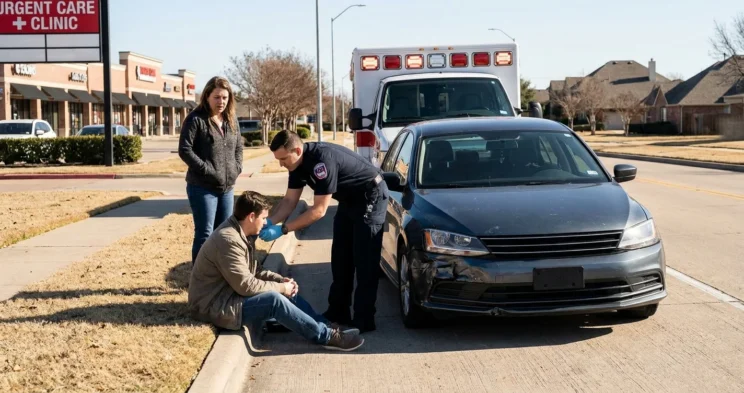
After a crash on I-35 or another Texas road, which doctor you should see depends on your symptoms. Serious warning signs call for emergency care right away. Without those signs, a regular healthcare professional can evaluate you and decide whether you need a specialist. Accurate care records can also help explain your injuries in a Texas claim.
Where Should You Get Medical Care After a Crash?
MedlinePlus lists signs that need emergency help, including serious head or neck injury, unconsciousness, confusion, severe bleeding, and trouble breathing.
After a head injury, other concerning signs include a severe headache that gets worse, repeated vomiting, a seizure, abnormal speech, or being unable to move an arm or leg. If you notice any of these, get emergency care. Don’t wait for a routine appointment.
If you don’t have emergency signs, Mayo Clinic’s neck pain guidance says to start with your regular healthcare professional. That clinician can examine you, sort out your symptoms, and refer you if needed.
Mayo Clinic notes that whiplash symptoms may develop later and recommends prompt evaluation of neck pain and other symptoms after an injury. Seeking care when delayed symptoms appear after a car accident also helps document when those symptoms began.
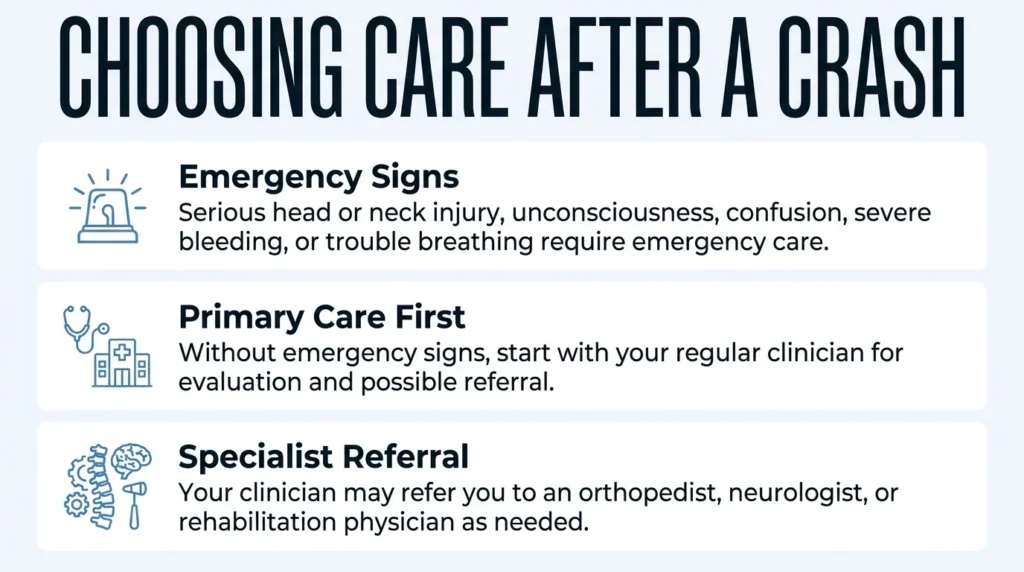
These steps can help you choose a doctor after a car accident and prepare for your appointment.
- Call 911 or go to an emergency room for any emergency warning sign.
- See your regular clinician promptly for pain or symptoms that aren’t an emergency.
- Describe the crash and your symptoms accurately, including when each symptom started.
- Mention prior injuries or conditions, even if they seem unrelated.
- Follow the care plan and referrals your clinician recommends.
During the visit, your doctor can record the crash history you report, when your symptoms began, what the exam found, and the next steps. Your clinicians make diagnosis and treatment decisions.
Which Providers Might Treat Crash Injuries?
The right clinicians depend on the injuries found and how your symptoms develop. No single sequence applies to everyone, and you do not need to visit a set list of specialists.
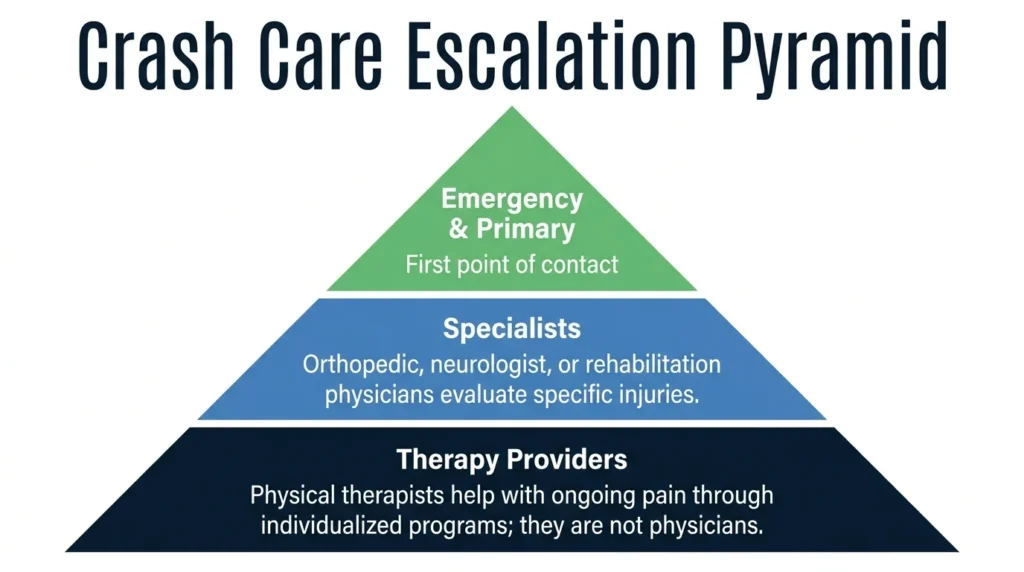
Emergency & Primary Care Clinicians
Emergency clinicians handle urgent problems. According to the American Academy of Orthopaedic Surgeons, an open fracture, inability to bear weight or move a limb, severe bleeding, or intense pain belongs in emergency care.
For non-emergency symptoms, your regular clinician is often the first stop. They can provide an initial assessment and decide whether you need more specialized care.
Specialists & Therapy Providers
Orthopedic physicians treat problems with bones, joints, muscles, ligaments, and tendons. Their care often includes nonsurgical treatment and rehabilitation. A referral to an orthopedist does not automatically mean surgery.
Depending on your symptoms, a clinician may refer you to a neurologist, who treats brain, spine, and nerve conditions. Another option is a physical medicine and rehabilitation physician, who treats muscle and joint problems without surgery.
A physical therapist may help with ongoing pain or limited movement through an individualized program. Physical therapists are not medical physicians.
Each referral documents why your clinician recommended further evaluation or treatment. That record can show why your care continued or changed and may also support a Texas car accident claim.
How Do Your Treatment Records Help Explain What Happened?
Your records show what you reported, what clinicians observed, why they ordered tests or referrals, and how your care changed over time. They create a medical timeline, but they do not prove on their own that the crash caused every condition or later expense.
22 Tex. Admin. Code § 163.1 generally requires physicians to keep legible records created at or near the time of treatment.
A well-organized file usually includes:
- The crash history as you reported it
- Your symptoms and when they started
- Relevant prior injuries or conditions
- Examination findings
- Diagnoses
- The treatment plan
- Each referral reason and the specialist’s response
- Imaging orders and reports
- Follow-up observations and instructions
You can help keep that history accurate by reporting your symptoms and prior problems honestly. Attend recommended follow-up visits and keep copies of your records, referral paperwork, and imaging reports.
What Imaging Can & Cannot Show
Your clinician orders imaging for medical reasons. Mayo Clinic explains that whiplash itself does not show up on imaging, though imaging can identify or rule out other problems. An MRI can reveal some soft-tissue damage.
A normal result does not rule out every injury. Imaging also cannot establish on its own that an injury resulted from the crash. Examination notes, reported symptoms, medical history, and follow-up records provide context.
When Treatment Records Are Not Enough To Prove Causation
Texas law often requires expert evidence to connect a crash to a medical condition. In Guevara v. Ferrer, the Supreme Court of Texas held that expert evidence is generally needed when the medical cause of a condition lies beyond jurors’ ordinary knowledge.
Medical causation asks whether the crash caused the condition and treatment for which you are seeking compensation.
Immediate Care Versus Later Treatment
The Court recognized a limited exception for uncomplicated situations that jurors can understand without medical expertise. In Guevara, the evidence supported a connection between the collision and the immediate emergency evaluation.
The evidence did not adequately connect the crash to all later conditions, treatment, and expenses. The timing of the symptoms, medical histories, and bills alone could not establish those links.
What This Means for Your Records
A treating doctor’s records can support your claim, but they do not automatically establish every medical connection. Not every case requires a separately hired expert. Your lawyer can determine whether you need a qualified medical opinion for the conditions and care included in your claim.
Accurate notes about diagnoses, examination findings, prior conditions, and the reasons for continued care provide a foundation for that review. Give your clinicians complete and honest information about your symptoms and medical history.
What Does a Texas Medical-Charge Affidavit Prove?
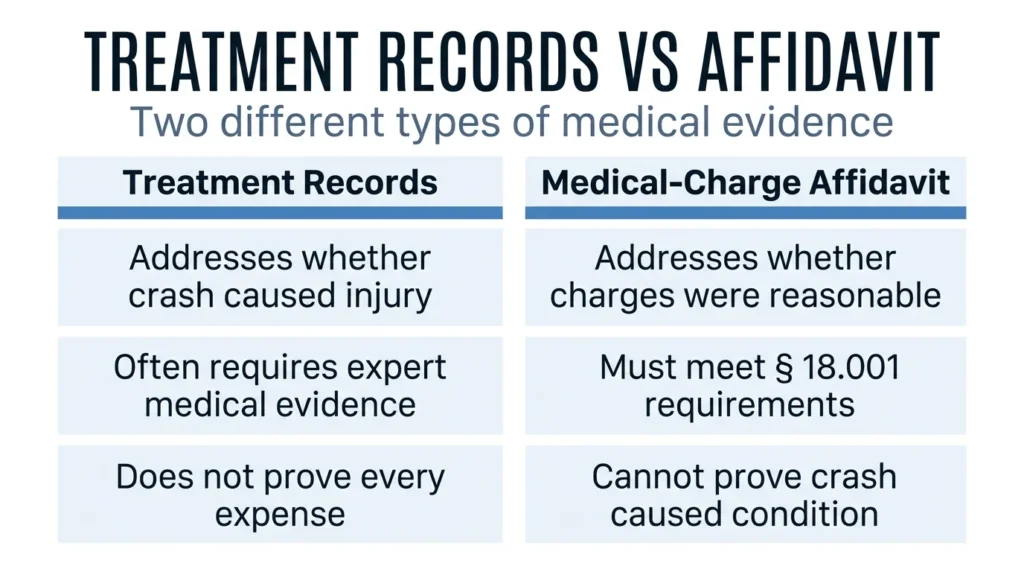
A medical-charge affidavit can help prove that medical services were necessary and the charges were reasonable. Under Texas Civil Practice and Remedies Code § 18.001, a qualifying affidavit may serve as evidence of those points when it includes an itemized statement and meets the statute’s requirements.
The affidavit cannot prove that the crash caused the condition or treatment.
How the Affidavit Differs From Treatment Notes
A medical-charge affidavit is separate from your doctor’s treatment notes. The two address different questions.
- Causation: Did the crash cause the condition that made this care necessary?
- Charges and necessity: Were the billed services necessary and the charges reasonable?
Treatment records and, when needed, medical opinions address causation. A § 18.001 affidavit addresses whether the services were necessary and the charges were reasonable.
Procedures Your Lawyer Handles
The statute sets requirements for serving affidavits, providing notice, addressing continuing care, and filing counteraffidavits. Your lawyer handles those procedures.
Under subsection (f), a counteraffidavit cannot be used to dispute causation. Even when no counteraffidavit is filed, the original affidavit does not guarantee payment or prove that every billed service resulted from the crash.
Get Help Reviewing Your Car Accident Claim
Gather any treatment notes, referral records, imaging reports, and medical bills you have. Angel Reyes & Associates can review your care history and walk you through your options. We are available 24/7 to discuss your case, and with more than 30 offices throughout Texas, help is not far away.
Contact Angel Reyes & Associates for a free consultation.
Past results do not guarantee future outcomes.
Medical Care After a Crash FAQs
Can you use health insurance for medical treatment after a car accident in Texas?
Yes. Depending on your coverage, health insurance may pay for crash-related treatment, and PIP or medical payments coverage under an auto policy may also cover eligible medical expenses.
What if a car accident makes a preexisting injury or medical condition worse?
A preexisting condition does not necessarily prevent a Texas injury claim when a crash aggravates it. Medical records from before and after the collision can help distinguish the prior condition from new or worsened symptoms.
Can you change doctors while receiving treatment for car accident injuries?
Yes. You may seek care from another qualified provider, although unexplained changes or gaps in treatment can make the medical history more difficult to evaluate.
How long do you have to file a car accident injury lawsuit in Texas?
Texas Civil Practice and Remedies Code § 16.003 generally gives a person two years from the date a personal injury claim accrues to file suit, although exceptions can change the deadline.
Should you keep a record of symptoms after a car accident?
Keeping notes about when symptoms appear or change can help you accurately describe your condition to healthcare providers. Personal notes are not a substitute for medical records or a professional medical evaluation.
About the Authors

Spencer Browne
Writer
Spencer Browne is a partner at Angel Reyes & Associates and a Board Certified personal injury trial lawyer with nearly 100 jury trials across Texas. He focuses on car, truck, and wrongful death cases, with notable verdicts including a landmark win in the Choctaw Casino bus crash case. A recognized speaker and legal educator, Spencer is a member of the American Board of Trial Advocates and has been honored as a Texas Super Lawyer and one of D Magazine’s Best Lawyers in Dallas. He brings deep trial experience and relentless advocacy to every client he represents.

Kyle Nicolas
Editor
Kyle Nicolas is the Web Content & SEO Manager at Angel Reyes & Associates. He has more than 10 years of experience as a marketing co...

Angel Reyes
Reviewer
Angel L. Reyes, III is the Founder and Managing Partner of Angel Reyes & Associates. A nationally recognized trial attorney and business...