What Is a Manufacturing Defect?


Every article on this site is researched by our internal team, reviewed for legal accuracy against current Texas law, and held to State Bar of Texas advertising standards before publication. We do not publish content that overstates outcomes or makes promises about results.
Learn more about our
editorial standards .
Key Takeaways
- A manufacturing defect means one unit deviated from the maker's own specification
- Proving a defect requires the failed part itself, not just proof that it failed
- Texas sets a 2-year injury deadline and a 15-year products liability repose period
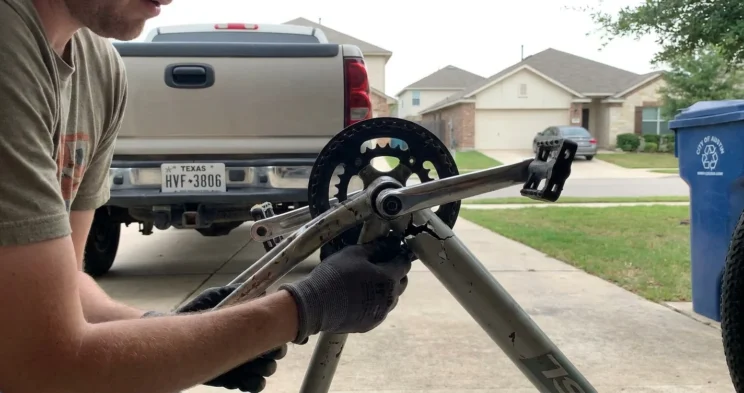
A manufacturing defect is one unit of a product that came off the line different from what the manufacturer’s plans called for, in a way that made it unreasonably dangerous. The design was fine. This particular one was not.
That distinction matters more than most injured Texans realize when they file a manufacturing defect claim. You’re not asking a jury to second-guess an engineering department or argue about how a product should have been built. You’re showing that the part that hurt you failed to match the standard the manufacturer set for itself.
The hard part is not the legal theory. The hard part is holding onto the physical evidence long enough to prove it.
What Counts as a Manufacturing Defect Under Texas Law
A manufacturing defect exists when a product “deviates, in its construction or quality, from the specifications or planned output in a manner that renders it unreasonably dangerous.” The Texas Supreme Court set out that language in Ford Motor Co. v. Ledesma, where it sent a case back for a new trial because the jury charge left the deviation element out.
Claims like this stem from Texas Civil Practice and Remedies Code (CPRC) § 82.001, which defines a “products liability action” broadly, covering any suit against a manufacturer or seller for injury, death, or property damage allegedly caused by a defective product, on any theory. Strict liability, negligence, misrepresentation, and breach of warranty all fall inside that definition.
The benchmark is the manufacturer’s own specification. A manufacturing defect claim asks one question: Did this unit match the blueprint the company itself drew up?
Design defect claims work the other way around. Under § 82.005, a design defect claimant has to prove a safer alternative design existed and that the defect was a producing cause of the harm.
Manufacturing defect claims skip that fight entirely. You have to prove that the individual product that caused your injury was defective compared to the design.
How a Deviation Is Proved Against the Manufacturer’s Specification
Proving a product defect comes from comparing the actual injury-causing unit to the manufacturer’s documented specification, planned output, or quality records. Not to industry custom. Not to what a better company might have done.
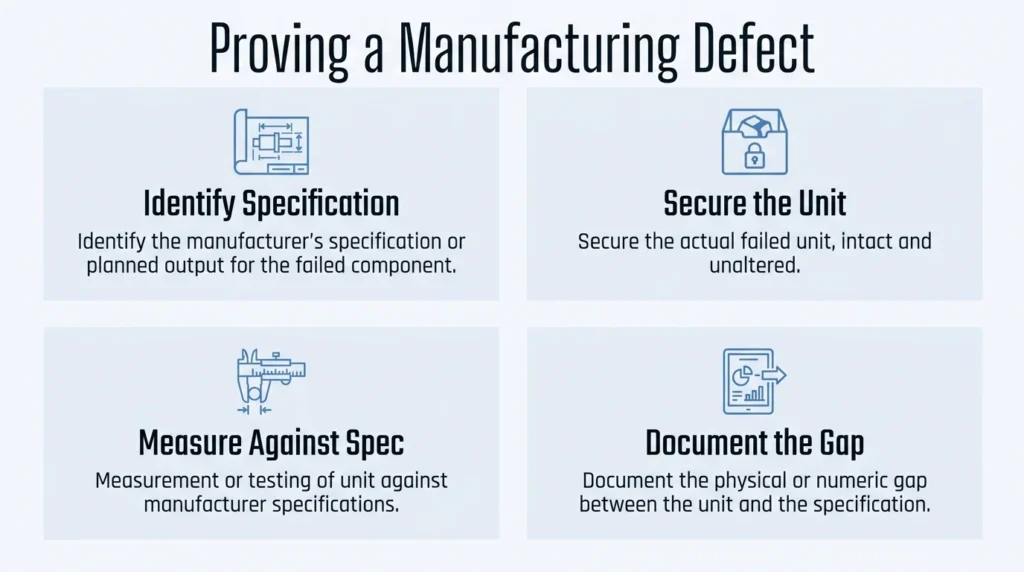
The work follows these steps:
- Identify the manufacturer’s specification or planned output for the component that failed.
- Secure the actual failed unit, intact and unaltered.
- Measure or test that unit against the specification.
- Document the physical or numeric gap between the two.
BIC Pen Corp. v. Carter shows the mechanic clearly. BIC’s own 1995 specifications, filed with the Consumer Product Safety Commission, set minimum fork-force and sparkwheel-force values for a specific lighter model. Measurements taken from the actual lighter after the incident came in below those minimums.
The case also carries a warning. The Texas Supreme Court ultimately ruled for BIC because the claimant did not separately prove that the reduced force was what allowed a child to operate the lighter.
Showing the deviation is one element. Showing the deviation caused the injury is a second, independent element. A claim can clear the first and still fail on the second.
Why the Failed Part Has To Be Preserved and Examined
Texas law does not let you reach a jury by saying the product broke. In Nissan Motor Co. v. Armstrong, the Texas Supreme Court reversed a plaintiff’s verdict built on unintended-acceleration testimony and similar complaints from other owners. Without competent expert testimony identifying a specific defect, that evidence amounted to no evidence at all.
Failure is not proof of a defect. The defect has to be found, named, and tied to the manufacturer’s specification by someone qualified to examine the part.
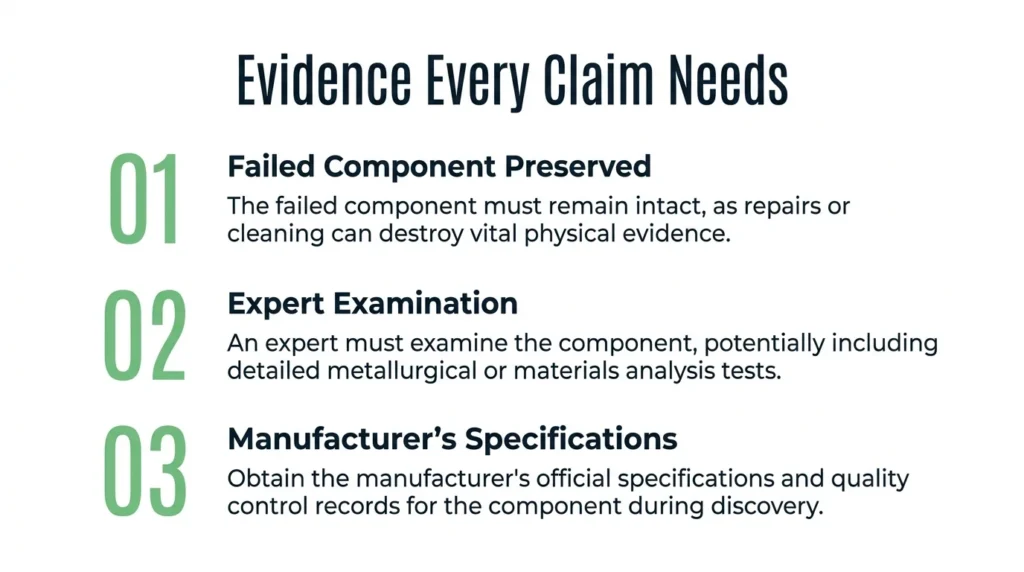
A manufacturing defect claim usually depends on three pieces of evidence:
- The failed component, preserved intact and not repaired, cleaned, or scrapped.
- Expert examination of that component, including metallurgical or materials analysis when the failure calls for it.
- The manufacturer’s specification and quality records for that component, obtained in discovery.
As a general matter of engineering practice, failure analysis usually starts with visual and dimensional examination of the part, moves to comparison against the original specification or drawing, and proceeds to materials testing when the first two steps point that direction. None of that is possible once the part is gone.
This is where claims related to defective-part crashes go wrong most often. The vehicle gets towed off I-35, the insurer declares it a total loss, the salvage yard strips it, and the brake assembly or steering component that caused the accident disappears within weeks. A car accident claim, a truck accident claim involving a failed brake or tire, and a motorcycle accident claim all run the same risk.
Texas law offers limited help once that happens. Under Brookshire Bros., Ltd. v. Aldridge, the harshest spoliation remedy—a jury instruction against the party who destroyed evidence—is available only where that party acted with intent to conceal, or where negligent destruction irreparably deprived the other side of any meaningful ability to present its case.
No Texas rule guarantees a remedy for a part that was lost, altered, or thrown away. Preservation is a threshold requirement in these cases, not a backup plan.
Deadlines for Bringing a Manufacturing Defect Claim in Texas
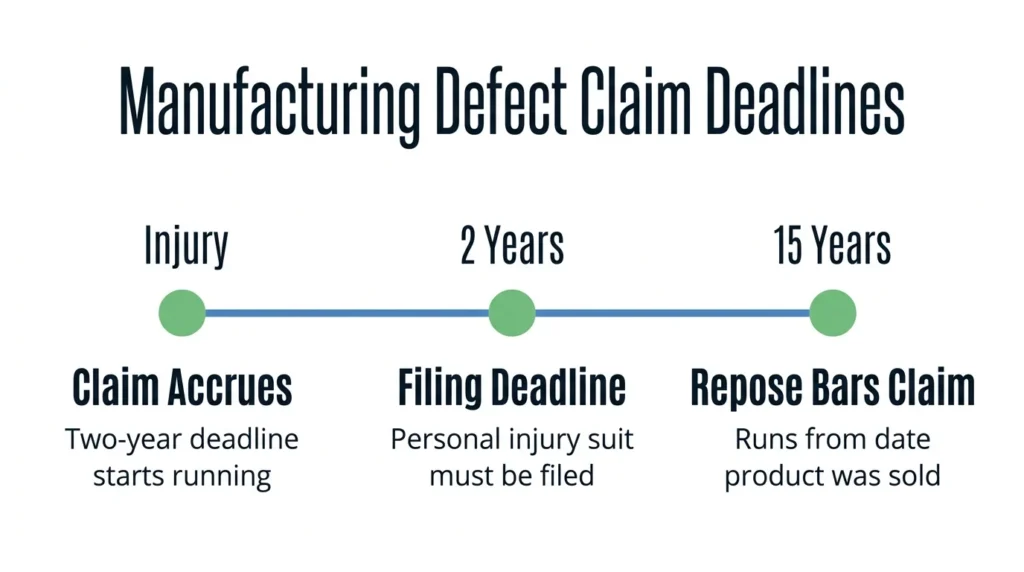
Two separate clocks run on these claims, and both have to be satisfied. Clearing one does nothing for you if the other has expired.
- § 16.003 requires a personal injury suit to be filed within two years of when the claim accrues. For a wrongful death claim, the two years generally run from the date of death.
- § 16.012 bars most products liability actions brought more than 15 years after the date the defendant sold the product. Statutory exceptions exist, including an express written warranty of a longer useful safe life and certain disease-latency exposure claims.
The 15-year period is a statute of repose, which means it sits on top of the two-year deadline rather than replacing it. For example, filing three years after your injury bars the claim even though the product was sold last year. Filing six months after an injury doesn’t help if the product was sold in 2005, and no exception applies.
Deadlines are also the reason preservation and filing pressure tend to arrive together. The evidence disappears on a much shorter timeline than the law allows for filing.
Talk to Angel Reyes & Associates About Your Defective Part Crash
If a component failure caused your accident, the window to protect the evidence is measured in days and weeks, not years. Getting a lawyer involved early keeps the failed part from being repaired, salvaged, or discarded before anyone qualified has looked at it.
At Angel Reyes & Associates, our team has guided injured Texans through situations like this for over 30 years, with board-certified personal injury attorneys, investigators, and accident reconstruction specialists on the team. You can reach the firm 24/7 or visit us at one of our 18 locations throughout Texas.
Contact Angel Reyes & Associates for a free consultation to review your options.
Past results do not guarantee future outcomes.
Manufacturing Defect Claim Frequently Asked Questions
What do I have to prove to win a manufacturing defect claim in Texas?
You have to show the specific unit that injured you deviated from the manufacturer’s own specifications, and that the deviation caused your injury. Deviation and causation are separate elements, and proving one does not prove the other.
Is it enough to show that a product simply malfunctioned or failed?
No. Texas courts have held that a malfunction alone, even with similar complaints from other owners, is not evidence of a defect. A specific defect must be identified through expert examination of the actual failed part.
What happens if the defective part was lost, repaired, or not preserved after the crash?
Losing the failed component can seriously damage a manufacturing defect claim, since there is nothing left to test against the manufacturer’s specifications. Texas only penalizes lost evidence when a party intentionally concealed it or negligently destroyed it in a way that left the other side no real way to present its case. No rule guarantees that remedy, so preserving the part immediately matters most.
About the Authors

Angel Reyes
Writer
Angel L. Reyes, III is the Founder and Managing Partner of Angel Reyes & Associates. A nationally recognized trial attorney and business leader, Angel has helped over 70,000 injury victims recover more than $1 billion since founding the firm in 1993. Named to the Texas Super Lawyers list annually since 2008, Angel brings Wall Street experience, Ivy League education, and a deep commitment to client advocacy. He is a frequent legal commentator and published author with extensive contributions to legal scholarship, trial strategy, and consumer protection.

Graham Griffin
Editor
Graham Griffin is the Web & Content Manager at Angel Reyes & Associates, where he oversees content strategy, AI-powered workflows, a...

Angel Reyes
Reviewer
Angel L. Reyes, III is the Founder and Managing Partner of Angel Reyes & Associates. A nationally recognized trial attorney and business...