Can Fuel Tax Records Show Where a Truck Really Went?


Every article on this site is researched by our internal team, reviewed for legal accuracy against current Texas law, and held to State Bar of Texas advertising standards before publication. We do not publish content that overstates outcomes or makes promises about results.
Learn more about our
editorial standards .
Key Takeaways
- IFTA quarterly filings log a truck's mileage state by state, not just its fuel.
- IRP apportioned records give a second, audited mileage ledger by jurisdiction.
- A gap between the driver's log and the carrier's own records is real evidence.
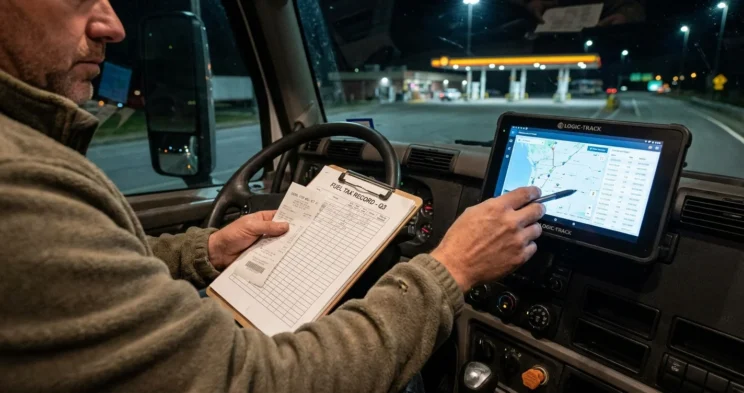
The trucking company’s version of the crash sounds tidy. The driver was on schedule, running the route dispatch assigned, well inside his hours. Your memory of that morning on I-35 says something different, and the log the company handed over says the truck was never where you know it was.
Fuel tax records can show where a truck really went. An interstate carrier files a quarterly fuel tax return that breaks its mileage out state by state, and that return sits on top of trip sheets, odometer readings, and fuel receipts the company created long before anyone thought about a lawsuit.
Those records were never built to explain a collision. That is exactly what makes them worth having.
Here is what each system holds, and how the pieces fit together when the carrier’s paperwork and the truck’s real route do not agree.
Why a Truck Even Has These Records
An interstate carrier does not track mileage out of goodwill. Federal law places it inside a registration system, and that system pulls the mileage paperwork along with it.
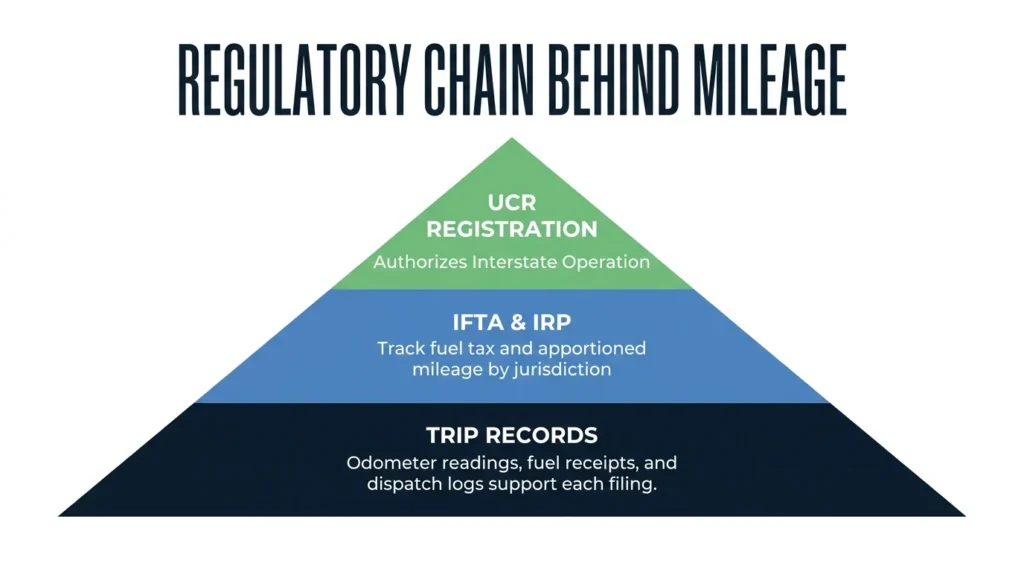
The Unified Carrier Registration (UCR) Act of 2005, codified at 49 U.S.C. § 14504a, requires interstate motor carriers to register every year under the Unified Carrier Registration Plan. The requirement reaches private carriers, brokers, freight forwarders, and leasing companies, not just the fleets you see stacked up on the Dallas North Tollway.
UCR itself does not record a single mile. It establishes that a carrier is authorized to operate across state lines, and that fact is what triggers everything else.
Once a truck crosses jurisdiction lines, two agreements attach. The International Fuel Tax Agreement (IFTA) handles fuel taxes, administered in Texas by the Texas Comptroller. The International Registration Plan (IRP) handles apportioned plates, administered here by the Texas Department of Motor Vehicles.
Both of those systems demand what UCR does not: distance, broken out by state.
What IFTA Fuel Tax Records Actually Show
IFTA fuel tax records show a truck’s mileage jurisdiction by jurisdiction, plus where and when the carrier bought fuel for it.
A carrier licensed under IFTA in Texas files one consolidated quarterly return instead of separate state-by-state filings. The requirements behind that return are specific:
- Quarterly returns are due the last day of the month following each calendar quarter: April 30, July 31, October 31, and January 31.
- A licensed carrier must file even in a quarter when the truck logged no miles at all.
- Behind each return sits a per-vehicle, per-trip mileage report showing the vehicle identification, trip dates and routes, beginning and ending odometer readings, and miles driven in each jurisdiction.
- Fuel purchase records must show the date of purchase, gallons, fuel type, and the vehicle unit number, with equivalent detail for withdrawals from bulk storage.
Those record requirements come from the national IFTA framework every member jurisdiction operates under, Texas included. Virginia’s DMV, a fellow member jurisdiction, spells out the same record content.
None of it is created for a courtroom. The carrier builds it to satisfy a tax agency, using its own fuel cards, telematics vendors, and trip sheets, separate from whatever the driver wrote in a logbook.
An odometer reading and a fuel receipt do not revise their story after a crash.
What IRP Apportioned-Mileage Records Add
IRP gives you a second mileage ledger, generated independently of the first and exposed to state audit.
Apportioned registration through TxDMV charges a carrier registration fee in proportion to the distance its fleet actually ran in each member jurisdiction. That system carries its own obligations:
- Reported mileage must reflect actual distance operated in each jurisdiction, not estimates or rounded figures.
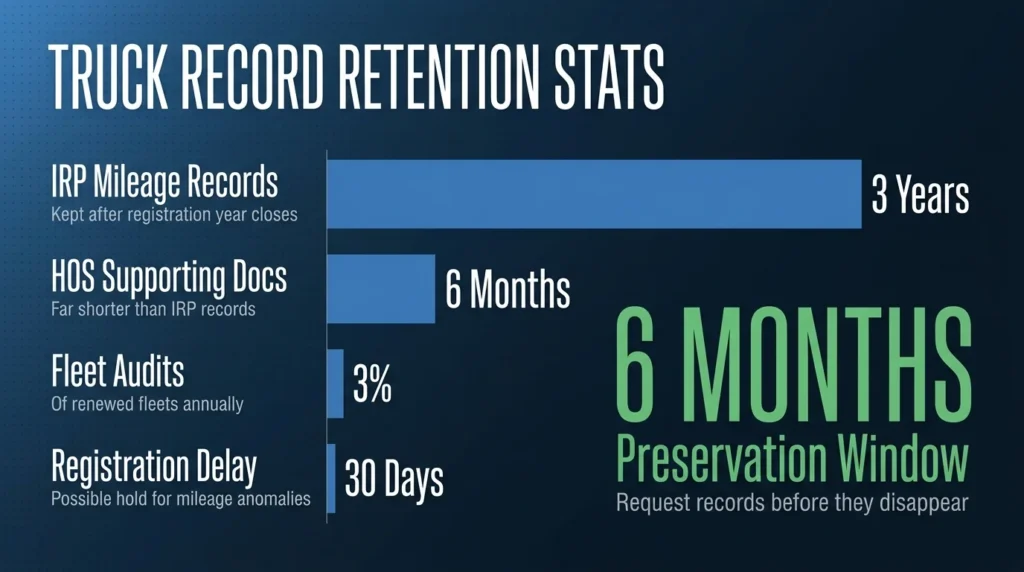
- Rounded-looking or repeated year-over-year mileage triggers a compliance review that can delay registration by up to 30 days.
- The carrier must be able to corroborate reported mileage with IFTA returns, mileage logs, or a detailed explanation.
- IRP records are subject to state audit, and Texas audits an average of 3% of renewed fleets annually.
- Under IRP, mileage records are generally retained for three years following the close of the registration year.
Two ledgers built for two different agencies ought to agree with each other. When the IFTA distances, the IRP distances, and the trip the carrier describes do not line up, someone has to account for the difference.
How Hours-of-Service Logs Compare to the Carrier’s Supporting Documents
A driver’s hours-of-service log is one account of the trip. The carrier’s supporting documents are a separate set of records that federal rules require to be matched against that account.
What the driver’s log has to show. Under 49 CFR 395.8, a record of duty status must capture the time and the location of every duty-status change, identified by city or town and state or by highway and milepost. It also has to show total miles driven, the vehicle identification, and the carrier’s name and address.
What the carrier has to keep alongside it. 49 CFR 395.11 requires motor carriers to retain supporting documents capable of being matched to the driver’s record of duty status:
- Bills of lading, itineraries, and schedules
- Dispatch records and trip records
- Expense receipts tied to on-duty, not-driving time
- Electronic mobile communication records from a fleet management system, which carry location and timing data
- Payroll and settlement records
- Toll receipts, specifically required for drivers running paper logs
Carriers may not obscure, deface, or alter any of it. These documents also live on a much shorter clock than IRP’s three-year mileage records, because 49 CFR 395.11 requires carriers to keep supporting documents for six months.
That six-month window is why timing matters so much. Electronic data pulled from the truck itself, sometimes called black box or event data recorder data, can disappear even sooner if no one asks the carrier to preserve it.
The contrast is the useful part. The log is the driver’s account of the trip. The supporting documents are the company’s own paper trail, kept for the purpose of checking that account.
A gap between the two is a gap the carrier created and is required to preserve.
Putting the Records Together to Reconstruct the Truck’s Actual Route
No single record system was designed to reconstruct a crash route. Cross-referencing several of them is what gets you there.
Each set exists for a different regulator: interstate authority, fuel tax, plate apportionment, and hours-of-service compliance. That independence between systems is the entire value.
IFTA itself is governed by its member jurisdictions through IFTA, Inc., with Texas participating as a member, so a Texas-based carrier’s fuel tax filings follow the same framework as the states its trucks drive through.
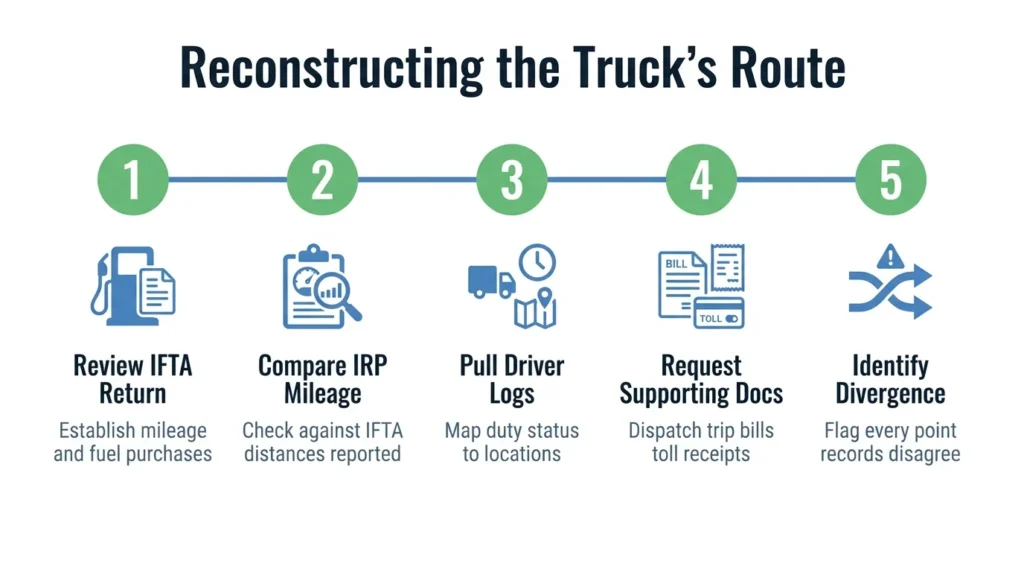
Reconstructing a truck route generally follows this order:
- Start with the carrier’s IFTA quarterly return and the trip and fuel records behind it, which establish how far the truck traveled in each state and where fuel was purchased.
- Compare the IRP apportioned-mileage figures for the same period against those IFTA distances, since two independently reported numbers should agree.
- Pull the driver’s record of duty status and map the time and location of each duty-status change against those distances.
- Request the carrier’s supporting documents: dispatch and trip records, bills of lading, expense and toll receipts, and electronic mobile communication records from the fleet management system.
- Set the timing and location detail from those documents against the log and the mileage ledgers, then identify every point where the accounts diverge.
A fuel receipt from a truck stop off I-20 stamped at a time the driver’s log places him on a break two counties away is not an opinion. It is the carrier’s own document.
A mismatch like that does not decide a case on its own. It changes the conversation. The trucking company and its insurer have to explain records they generated for regulators, kept in the ordinary course of business, and never intended as evidence.
Getting those records usually takes a prompt preservation demand and, in many cases, litigation. Texas truck accident claims turn on evidence the carrier controls, and the request has to be specific enough to reach trip records and telematics data, not just the duty-status log.
Talk to a Texas Truck Accident Lawyer About the Carrier’s Records
After a wreck with an 18-wheeler, the records that matter most are sitting in a trucking company’s files, and some of them are on a six-month clock. You should not have to figure out which ones to demand while you are still recovering.
Angel Reyes & Associates has guided injured Texans for more than 30 years from over 20 locations across the state, backed by more than 20 attorneys on staff and over $1 billion recovered for our clients. Our team and investigators know how a carrier’s IFTA, IRP hours-of-service, and supporting-document trail fits together, and clients don’t pay any legal fees unless we win.
Get a free consultation to review what the carrier’s own records show about your crash. Contact Angel Reyes & Associates to talk through your options, we offer services in English and Spanish.
Past results do not guarantee future outcomes.
Tracking Trucks via Fuel Records FAQs
Does a carrier's UCR registration by itself prove where a truck traveled on a given day?
No. Unified Carrier Registration (UCR) under the Unified Carrier Registration Act of 2005 establishes that a carrier is authorized to operate across state lines; it does not create mileage, route, or timing records for any specific day or trip. That authority is what triggers a carrier’s separate obligations to keep fuel tax (IFTA) and apportioned-mileage (IRP) records, which are the sources that actually document where a truck traveled. So UCR can confirm a carrier is set up to run interstate, but proving where a specific truck went on a specific day requires the jurisdiction-by-jurisdiction mileage and fuel records generated under IFTA and IRP, along with hours-of-service supporting documents.
How long must a carrier keep IFTA or IRP mileage records after the reporting period ends?
The retention period depends on which system the record comes from. Under IRP, mileage records generally must be retained for three years following the close of the registration year, and those records remain subject to state audit. FMCSA’s separate hours-of-service rule, 49 CFR 395.11, requires carriers to retain hours-of-service supporting documents for six months, which covers a different category of records on a much shorter clock. No single figure covers all of these systems, so a fuel tax record should not be assumed to sit on the same clock as an hours-of-service supporting document. The safer approach after a crash is a prompt preservation request rather than reliance on any particular retention timeline.
Can toll records be used as evidence in a Texas truck accident case?
Yes. Federal hours-of-service rules require carriers using paper logs to keep toll receipts as one of the “supporting documents” that must be capable of being matched against a driver’s record of duty status under 49 CFR 395.11. Because those receipts are timestamped and tied to a specific location, they can confirm or contradict where a truck was at a given point on its route. Toll records work alongside fuel receipts, IFTA and IRP mileage figures, and electronic mobile-communication data as one more independently generated data point a carrier is required to keep, rather than something created after a crash to support one side’s account.
What can an injured driver do if a carrier is slow to produce its IFTA, IRP, or dispatch records after a crash?
These records belong to the carrier and are not automatically turned over on request. The practical step is a prompt, specific written demand naming the categories needed: IFTA quarterly filings and trip mileage reports, IRP mileage records, dispatch and trip records, and electronic mobile-communication data. If a carrier still does not produce them voluntarily, formal discovery through litigation can compel production of its own regulatory records. Acting early matters because some categories, particularly hours-of-service supporting documents, are only required to be kept for six months, so records tied to a specific trip can become harder to obtain the longer a request is delayed.
How is GPS or electronic mobile-communication data different from a driver's electronic logging device (ELD) record?
An ELD record, governed by 49 CFR 395.8, documents a driver’s duty status and captures the time and location only at each change of duty status, along with total miles driven. Electronic mobile-communication records are a separate category carriers must retain under 49 CFR 395.11 as a “supporting document.” They are location and timing data generated by a fleet-management system, and they must be capable of being matched against the driver’s duty-status record. In practice, the ELD record shows snapshots tied to duty-status changes, while electronic mobile-communication data can fill in the route and timing detail in between those snapshots, which is why the two are compared together rather than treated as duplicates of each other.
About the Authors

Angel Reyes
Writer
Angel L. Reyes, III is the Founder and Managing Partner of Angel Reyes & Associates. A nationally recognized trial attorney and business leader, Angel has helped over 70,000 injury victims recover more than $1 billion since founding the firm in 1993. Named to the Texas Super Lawyers list annually since 2008, Angel brings Wall Street experience, Ivy League education, and a deep commitment to client advocacy. He is a frequent legal commentator and published author with extensive contributions to legal scholarship, trial strategy, and consumer protection.

Kyle Nicolas
Editor
Kyle Nicolas is the Web Content & SEO Manager at Angel Reyes & Associates. He has more than 10 years of experience as a marketing co...

Angel Reyes
Reviewer
Angel L. Reyes, III is the Founder and Managing Partner of Angel Reyes & Associates. A nationally recognized trial attorney and business...