What Causes a Truck Tire Blowout?


Every article on this site is researched by our internal team, reviewed for legal accuracy against current Texas law, and held to State Bar of Texas advertising standards before publication. We do not publish content that overstates outcomes or makes promises about results.
Learn more about our
editorial standards .
Key Takeaways
- Most truck tire blowouts begin with heat from under-inflation or overloading.
- Federal rules bar retreads only on bus front wheels, not on truck steer axles.
- Driver inspection reports are kept only three months, so demand records early.
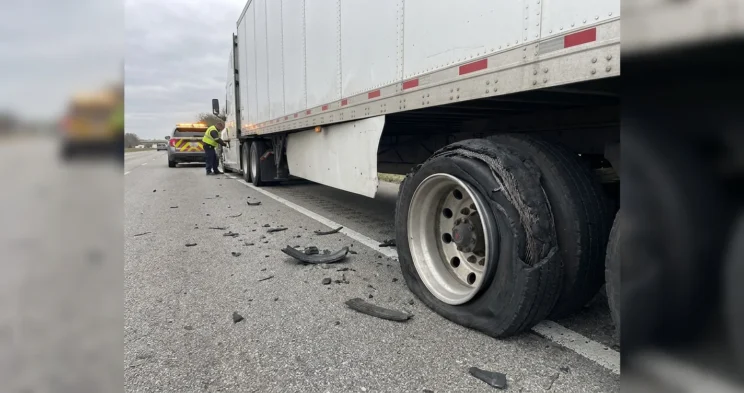
You were beside an eighteen-wheeler on I-35 when the tread came off its trailer. The failure happened in seconds, although the damage may have been developing for weeks. A truck tire blowout usually results from damage that builds up over time, most often due to heat accumulating inside the tire.
How Heat & Road Damage Lead to Tire Failure
An underinflated tire flexes more than it was designed to. Over-deflection creates excessive heat buildup that degrades the tire from the inside, according to the U.S. Tire Manufacturers Association’s bulletin on commercial tire operating temperatures. Overloading produces the same over-deflection and the same heat.
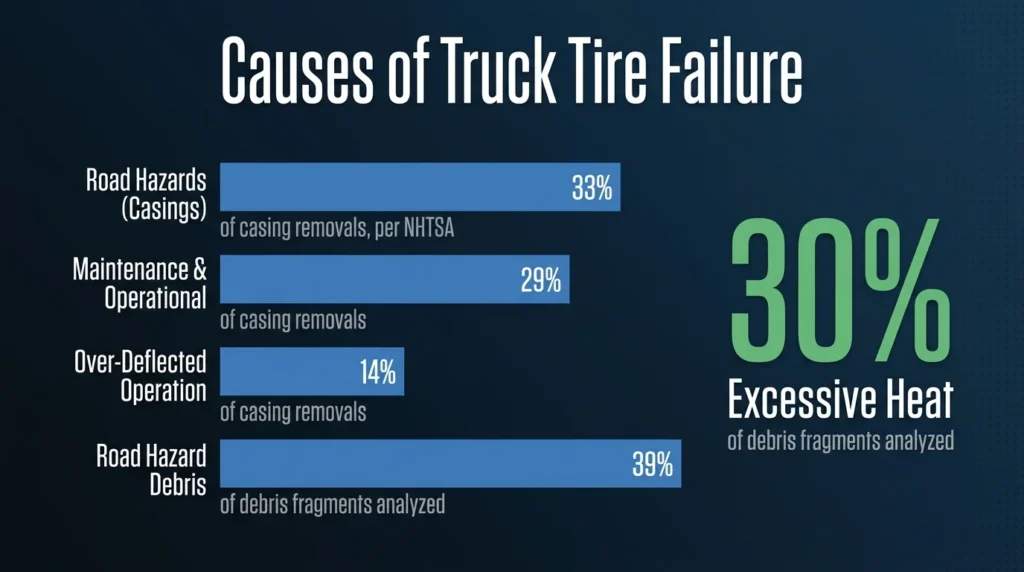
Heat damage is cumulative and irreversible. A tire can be structurally ruined and still look serviceable, then separate at the tread and belt later, before the tread is even worn.
Operating temperature depends on speed, load, inflation pressure, ambient temperature, road temperature, and heat from the engine, exhaust, brakes, and emissions equipment. During a Texas summer, several of these factors can raise the tire’s temperature at the same time.
Higher speeds generate additional heat. Commercial tires have maximum speed ratings, and posted limits on some highways may exceed those ratings.
Road hazard damage is the other major cause. NHTSA’s Commercial Medium Tire Debris Study attributed 33 percent of casing removals to road hazards, 29 percent to maintenance and operational factors, and 14 percent to over-deflected operation.
What Federal Law Requires of Truck Tires, & How Texas Adopts It
49 CFR 393.75 establishes the minimum tire-condition requirements for commercial motor vehicles. No motor vehicle may be operated on a tire that:
- Has body ply or belt material exposed through the tread or sidewall
- Has any tread or sidewall separation
- Is flat or has an audible leak
- Is cut to the point of exposing ply or belt material
- Carries more weight than the load rating marked on its sidewall, outside a narrow state permit capped at 50 mph
- Has a cold inflation pressure below what the load being carried requires
- Is marked for a maximum speed of 55 mph or less and is run above it
Tread-depth requirements depend on the tire’s position. Tires on the front wheels of a bus, truck, or truck tractor must have at least 4/32 inch of tread in every major groove. All other tires must have at least 2/32 inch of tread depth.
Federal law generally permits retreaded tires on trucks. Section 393.75(d) bars regrooved, recapped, or retreaded tires only on the front wheels of a bus, and 393.75(e) bars a regrooved tire rated at or above 4,920 pounds from the front wheels of any truck or truck tractor.
A carrier that never crosses a state line meets the same standard. Texas incorporates the Federal Motor Carrier Safety Regulations by reference through 37 Tex. Admin. Code § 4.11, and Parts 393 and 396 sit inside that adoption.
Part 393 sets no maximum tire age. A truck accident claim may therefore depend on evidence of the carrier’s inspections, inflation practices, loading decisions, repairs, and maintenance history.
The Carrier’s Inspection & Maintenance Duties Under 49 CFR Part 396
49 CFR 396.3 requires every motor carrier to systematically inspect, repair, and maintain all vehicles subject to its control, and to keep parts and accessories in safe and proper operating condition at all times.
It also requires a paper trail. For any vehicle controlled for 30 consecutive days or more, the file must include identifying information, including tire size, a schedule of inspections with type and due date, and the inspection, repair, and maintenance records themselves.
Tires, wheels, and rims are express line items on the driver vehicle inspection report under 49 CFR 396.11, and the carrier must certify that any defect likely to affect safe operation was corrected before the vehicle runs again.
Before driving, 49 CFR 396.13 requires the driver to be satisfied that the vehicle is safe, review the last inspection report when required, and sign an acknowledgment of that review and the repair certification. Every vehicle, including each unit of a combination, also needs a periodic inspection at least once every 12 months meeting the Minimum Periodic Inspection Standards, documented on the vehicle.
Those standards live in Appendix A to Part 396, the checklist an inspector works from. On a steering axle, a tire fails for any of the following:
- Less than 4/32 inch tread depth
- Exposed body ply or belt material
- Any tread or sidewall separation
- A cut exposing ply or belt material
- A “Not for Highway Use” marking
- Mixed bias and radial tires on the same axle
- A regrooved tire, subject to an urban and suburban service exception
- A boot, blowout patch, or other ply repair
- Weight carried in excess of the tire load limit
- A flat tire or a noticeable leak
- Mounting or inflation that lets the tire contact any part of the vehicle
The Real Liability Question Is the Casing & the Inspection, Not the Retread
Retreading is legal for trucks and is not, by itself, evidence of negligence. NHTSA’s Commercial Medium Tire Debris Study found retreads were not overrepresented in collected highway tire debris.
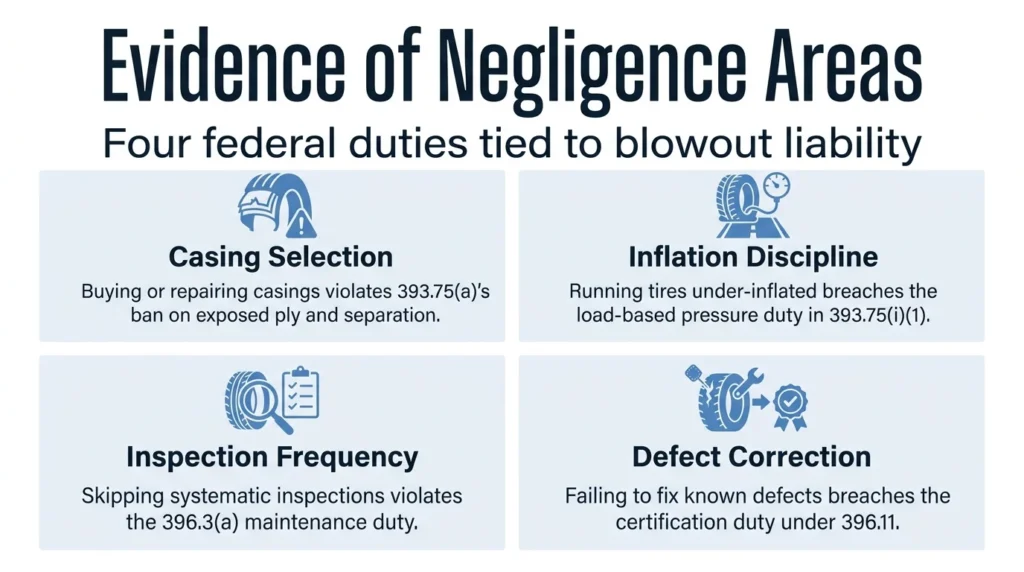
Four areas may provide evidence of negligence, and each corresponds to an existing federal duty. Casing selection and repair quality under the 393.75(a) prohibitions on separation and exposed ply, inflation discipline under 393.75(i)(1), inspection frequency under the 396.3(a) maintenance duty, and defect correction under 396.11.
A carrier that bought a cheap casing, ran it under-inflated, and rarely checked it is responsible for each of those choices, whether or not the tire had ever been recapped.
What Preserves the Case After a Blowout Crash
Proving a blowout claim often depends on preserving the physical tire and its date code, as well as the carrier’s purchase, retread, inspection, and maintenance records. Each sits on a clock, and the shortest runs three months.
Preserve the tire, and put the demand in writing. In Brookshire Brothers, Ltd. v. Aldridge, the Texas Supreme Court held that the duty to preserve arises only when a party knows or reasonably should know there is a substantial chance a claim will be filed and that evidence in its control will be material and relevant.
An early written preservation request after a truck accident helps document when the carrier received notice that the tire and related records may be relevant to a claim.
Read the DOT date code. Under 49 CFR 574.5, a new tire’s identification number consists of 13 symbols and ends with a four-digit date code. The first two symbols give the week of the year, and the last two give the year. The regulation’s own example: 0109 means the first full calendar week of 2009.
A retread uses a different identification mark. Its seven-symbol number combines a three-symbol plant code with a four-digit date code and is molded or branded into at least one sidewall. The date code shows when the tire was retreaded, while purchase, inspection, and retread records are needed to establish the age and history of the original casing.
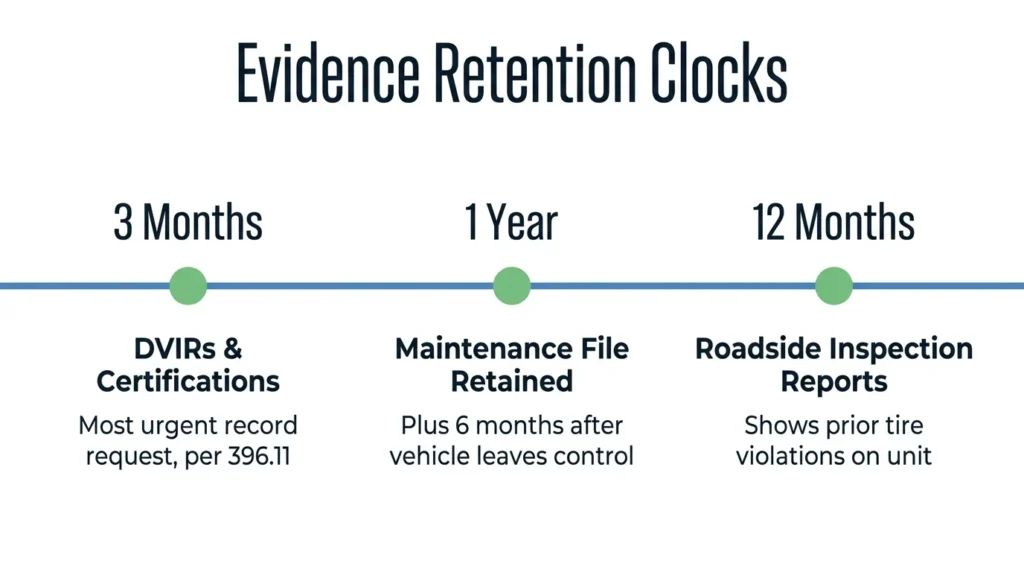
Demand the records on their retention clocks. The windows are short, and they start the day of the crash:
- Driver vehicle inspection reports, repair certifications, and driver review certifications: three months under 396.11. The most urgent request.
- The vehicle maintenance file: one year where the vehicle is housed or maintained under 396.3(c), plus six months after the vehicle leaves the carrier’s control. A tractor sold, traded, or scrapped after the crash starts that six month clock.
- Roadside inspection reports, with the carrier’s certification that violations were corrected within 15 days: 12 months. Prior tire violations on the same unit surface here.
- The annual periodic inspection report and its supporting documentation.
Retreader invoices, casing acceptance records, and tire purchase invoices are ordinary business records, not regulatory filings, and they belong in the same request. They show whether the carrier bought on price and skipped the inspections in between.
Tex. Civ. Prac. & Rem. Code § 16.003 requires a personal injury suit no later than two years after the cause of action accrues, and gives wrongful death claims the same two years, accruing on the death of the injured person.
Under Tex. Civ. Prac. & Rem. Code § 33.001, a claimant may not recover damages if their percentage of responsibility is greater than 50 percent.
Talk to Angel Reyes & Associates About Your Truck Tire Blowout Crash
Angel Reyes & Associates has guided injured Texans for more than 30 years, across the entire state, and the firm has recovered more than $1 billion for clients.
If a tire came apart on the truck that hit you, contact Angel Reyes & Associates for a free consultation while the tire and its records are still available.
Past results do not guarantee future outcomes, and every case is different.
Truck Tire Blowout FAQs
Can a trucking company be liable if a third-party maintenance provider caused a tire blowout?
Potentially. Depending on the facts, liability may extend beyond the motor carrier to a maintenance contractor, tire dealer, retreader, or other party whose negligent work contributed to the tire failure.
Can a defective truck tire lead to a product liability claim in Texas?
Yes. If evidence shows that a defect in the tire’s design, manufacture, or warnings contributed to the crash, a claim may involve the tire manufacturer or another company in the tire’s distribution chain.
What evidence can show that a truck tire was overloaded before a blowout?
Bills of lading, weight tickets, dispatch records, cargo documents, and electronic vehicle data may help establish the truck’s load weight and how it was distributed among the axles.
Can electronic logging or telematics data help prove the cause of a truck tire blowout?
Sometimes. GPS, speed, braking, mileage, and other vehicle or fleet data can help reconstruct the truck’s operation before the tire failed and provide context for whether speed, prolonged operation, or other conditions contributed to the failure.
Who may be responsible when tire debris from another truck causes a crash?
Responsibility depends on why the tire failed and who contributed to that condition. Potentially responsible parties can include the motor carrier, vehicle owner, maintenance provider, retreader, or tire manufacturer, depending on the evidence.
About the Authors

Angel Reyes
Writer
Angel L. Reyes, III is the Founder and Managing Partner of Angel Reyes & Associates. A nationally recognized trial attorney and business leader, Angel has helped over 70,000 injury victims recover more than $1 billion since founding the firm in 1993. Named to the Texas Super Lawyers list annually since 2008, Angel brings Wall Street experience, Ivy League education, and a deep commitment to client advocacy. He is a frequent legal commentator and published author with extensive contributions to legal scholarship, trial strategy, and consumer protection.

Kyle Nicolas
Editor
Kyle Nicolas is the Web Content & SEO Manager at Angel Reyes & Associates. He has more than 10 years of experience as a marketing co...

Angel Reyes
Reviewer
Angel L. Reyes, III is the Founder and Managing Partner of Angel Reyes & Associates. A nationally recognized trial attorney and business...