Who Accepts Legal Papers for an Out-of-State Trucking Company?


Every article on this site is researched by our internal team, reviewed for legal accuracy against current Texas law, and held to State Bar of Texas advertising standards before publication. We do not publish content that overstates outcomes or makes promises about results.
Learn more about our
editorial standards .
Key Takeaways
- Interstate for-hire carriers must name a BOC-3 process agent in each state of authority.
- SAFER does not show the BOC-3 filing; FMCSA's Licensing and Insurance system does.
- An MCS-150 date well past the 24-month cycle can signal a defunct or sold carrier.
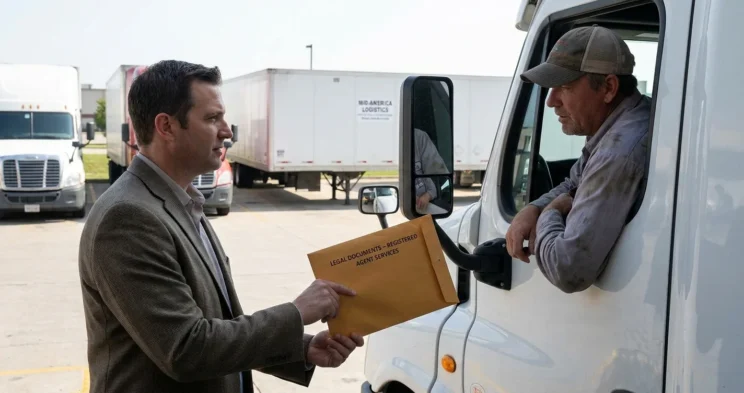
The tractor-trailer that hit you on I-35 had out-of-state plates, and the address printed on the crash report leads to a terminal hundreds of miles from Texas. Your claim belongs in a Texas court. The company you need to hold accountable has never kept an office anywhere near you.
Federal law already named someone to receive court papers for that carrier. Every interstate for-hire trucking company must designate a process agent in each state where it holds operating authority, and that designated agent, not the corporate headquarters, is the recipient built into federal law for papers tied to the carrier’s interstate operations.
Locating that agent is the practical first move. Getting papers served in a way a Texas court will honor is a separate step, with legal counsel recommended.
What Is a BOC-3 Process Agent, and Why Does an Out-of-State Carrier Need One in Texas?
A BOC-3 process agent is the person or company an interstate carrier names to receive legal papers on its behalf inside a specific state. Under 49 CFR Part 366, every interstate for-hire motor carrier, broker, and freight forwarder must keep a current Form BOC-3 on file with the Federal Motor Carrier Safety Administration naming that agent in each state where it holds authority, Texas included.
The requirements are narrow and specific:
- Only one current BOC-3 may be on file per company, and it must list every state where a designation is required (49 CFR 366.2).
- The designated agent must reside in or maintain an office in the state it covers, and a post office box does not satisfy the rule (49 CFR 366.3T).
- A motor carrier must designate agents for all 48 contiguous states and the District of Columbia unless its operating authority is limited to fewer states. A broker must designate an agent in each state where it maintains an office (49 CFR 366.4).
- A company may satisfy the rule through a blanket agent, meaning an association or corporation that has filed its own master list of process agents covering every state (49 CFR 366.5).
That last option is how most small and mid-size carriers comply. The name on the filing is often a national service company rather than a person sitting in a Dallas office.
The filing is not optional paperwork. FMCSA will not grant, reinstate, or maintain operating authority without a current BOC-3 on file, and the American Trucking Associations warns carriers that letting the listed contact information go stale creates a real risk of a default judgment, because the company never learns about papers served to its own agent.
How to Find the Process Agent a Specific Carrier Actually Has on File
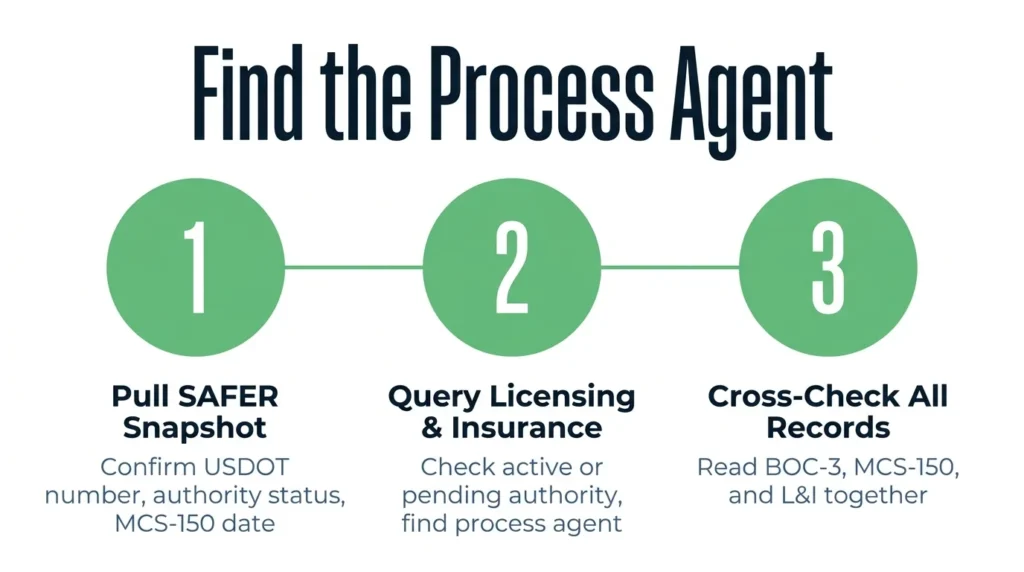
FMCSA’s free SAFER Company Snapshot will not show you which process agent a carrier designated. That record sits in a separate FMCSA system called Licensing & Insurance, and anyone can search it.
Working through the public records in order gives you the fullest picture:
- Pull the carrier’s SAFER Company Snapshot by name or USDOT number to confirm the USDOT number, operating authority status, and MCS-150 filing date. SAFER draws its data from FMCSA’s MCMIS and Licensing & Insurance systems, as the agency explains in its SAFER FAQ.
- Query the FMCSA Licensing & Insurance public system to confirm whether the carrier’s authority is active or pending and to reach the process agent designations on file.
- Read the BOC-3 filing, the MCS-150 update history, and the Licensing & Insurance record together rather than relying on any single lookup.
Those three records form the evidence spine for identifying the right defendant and the right address. Each one answers a different question, and a carrier that looks fine in one system can look very different in another.
The Biennial MCS-150 Update: What a Stale or Missing Filing Signals

A filing date well outside a 24-month window is a checkable warning sign that a carrier may have stopped operating, been sold, or reorganized under a new registration. Under 49 CFR 390.19T, interstate motor carriers must file Form MCS-150 before beginning operations and then update it every 24 months on a schedule tied to their USDOT number.
The schedule works this way:
- The next-to-last digit of the USDOT number sets the year. An odd digit means an odd-numbered year, and an even digit means an even-numbered year.
- The last digit of the USDOT number sets the month.
- The requirement reaches carriers domiciled in the United States, Canada, and countries outside North America that operate in interstate commerce.
- A carrier that fails to complete the biennial update faces the penalties the regulation points to at 49 U.S.C. 521(b)(2)(B), along with deactivation of its USDOT number. Furnishing false or misleading information on the form carries the same penalties.
This pattern is easy to verify yourself. One live SAFER Company Snapshot shows an MCS-150 form date of 01/18/2007, roughly two decades past the required cycle on a record still viewable to the public today.
A stale date suggests a problem, it does not prove one. A carrier can be out of compliance with the update rule while still running freight every day, so read the MCS-150 date next to the operating authority status and USDOT status fields on the same snapshot.
Suing an Out-of-State Trucking Company: Where Service of Process Actually Has to Land in Texas
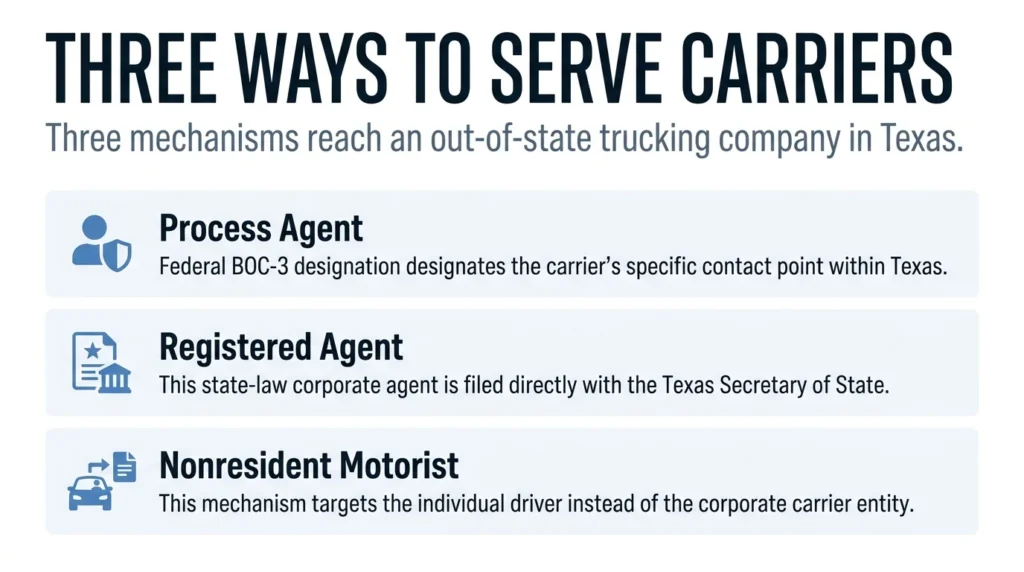
Three separate mechanisms can put legal papers in front of an out-of-state carrier or its driver, and they are not interchangeable. Sorting out which one fits your facts is one of the first questions a lawyer handling Texas truck accident claims works through.
The Process Agent the Carrier Designated to FMCSA
This is the federal, carrier-specific route. It gives you a physical point of contact inside Texas for a company headquartered somewhere else, which is often the most direct way to learn where the carrier can actually be reached.
Its strength is identification. Federal law requires the designation, so you get a name and address the carrier itself put on file rather than one pieced together from a crash report.
The Registered Agent on File With the Texas Secretary of State
If the trucking company is registered to do business in Texas, it also has an ordinary corporate registered agent on file with the state. That is a state-law designation governed by Texas entity and service rules, not by Part 366.
The Texas Secretary of State explains that the office itself can act as a statutory process agent in certain circumstances, including when an entity fails to maintain a registered agent. That path runs through state law and stands entirely apart from the federal BOC-3 designation.
The Nonresident Motorist Statute for the Driver Behind the Wheel
Texas has its own substituted-service statute aimed at out-of-state drivers. Under Tex. Civ. Prac. & Rem. Code § 17.062, the chairman of the Texas Transportation Commission is an agent for service of process on a nonresident, or a nonresident’s agent, in a suit growing out of a collision involving a motor vehicle operated in this state.
TxDOT says to send two copies of the citation and petition, the defendant’s out-of-state address, and the accident location to the Commission chair. No fee applies to the basic service, and a $25 fee applies if you need a certificate of service.
This statute targets the individual nonresident operator or agent involved in the crash. It is a genuine tool, and it is not a substitute for reaching the corporate carrier through its own designated agent.
Why Locating the Agent Is Not the Same as Completing Service
Finding the BOC-3 agent tells you where the carrier can be reached. Whether service on that federally designated agent, standing alone, is an expressly permitted method sufficient to support a Texas default judgment against the company is a contested question under Texas Rules of Civil Procedure 106 and 108.
Texas appellate authority on the closely related question of serving an out-of-state entity’s home-state registered agent has cut against plaintiffs in at least one Dallas Court of Appeals decision, and commentators disagree about how the rules should apply. That disagreement has real consequences, because a judgment built on defective service can be attacked later.
Treat the process agent designation as the practical starting point for locating and reaching the carrier. Have a licensed Texas attorney decide which mechanism to use and execute service correctly.
Talk to an Attorney About Serving an Out-of-State Carrier
You should not have to reconcile three service mechanisms and two federal databases while you are still recovering from your injuries. That work belongs to your legal team.
Angel Reyes & Associates has guided injured Texans through the legal process for more than 30 years, including claims against carriers based well outside the state. Our team can confirm which process agent, registered agent, or nonresident motorist route fits your case, then handle service the way the rules require.
Contact Angel Reyes & Associates for a free consultation about your out-of-state trucking claim.
Past results do not guarantee future outcomes.
Out-of-State Trucking Company Legal Paper FAQs
Do freight brokers have to file a BOC-3 too, or is it only required for motor carriers?
Yes. Under 49 CFR Part 366, the BOC-3 filing requirement applies to freight brokers and freight forwarders as well as motor carriers. A broker must designate a process agent in each state where it maintains an office, while a motor carrier generally must designate agents for all 48 contiguous states and D.C. unless its operating authority is limited to fewer states.
What's the difference between FMCSA's SAFER system and its Licensing & Insurance (L&I) system?
SAFER’s Company Snapshot is FMCSA’s free public lookup. It shows a carrier’s USDOT number, operating authority status, and MCS-150 filing date, but it does not show which process agent the carrier designated under its BOC-3 filing. That information sits in FMCSA’s separate Licensing & Insurance (L&I) system, which lets anyone check whether a carrier, broker, or freight forwarder is active or has authority pending and reach the process-agent designations tied to that authority.
Does the nonresident-motorist statute let me serve the trucking company itself, or only the driver involved in the crash?
It targets the individual driver, not the company. Texas’s nonresident-motorist statute, Tex. Civ. Prac. & Rem. Code § 17.062, makes the chairman of the Texas Transportation Commission an agent for service of process on a nonresident, or that nonresident’s agent, in a suit arising from a collision involving a vehicle operated in Texas. By its terms, it reaches the individual nonresident operator involved in the crash, not necessarily the corporate carrier that employed or contracted with that driver.
If a trucking company is registered in Texas, does it still need a BOC-3 process agent on top of its regular registered agent?
Yes. The BOC-3 process agent and a corporate registered agent serve two different purposes, and one does not substitute for the other. The BOC-3 filing is a federal requirement under 49 CFR Part 366 that applies to an interstate for-hire motor carrier, broker, or freight forwarder holding operating authority in a state, whether or not the company is also formally registered to do business there.
What should I do if the BOC-3 agent's listed address is outdated or belongs to a blanket-agent service rather than a real office?
An address tied to a blanket-agent service is not a problem by itself. Most small and mid-size carriers satisfy the BOC-3 requirement this way, referencing an association or corporation that has filed its own master list of process agents covering every state rather than naming an individual agent. What matters is whether the listed agent still has a valid, current address, since federal rules require the agent to reside in or maintain an office in the state, and a stale or wrong address defeats the purpose of the filing.
About the Authors

Angel Reyes
Writer
Angel L. Reyes, III is the Founder and Managing Partner of Angel Reyes & Associates. A nationally recognized trial attorney and business leader, Angel founded the firm in 1993, which has gone on to help over 70,000 injury victims recover more than $1 billion. Named to the Texas Super Lawyers list annually since 2008, Angel brings Wall Street experience, Ivy League education, and a deep commitment to client advocacy. He is a frequent legal commentator and published author with extensive contributions to legal scholarship, trial strategy, and consumer protection.

Kyle Nicolas
Editor
Kyle Nicolas is the Web Content & SEO Manager at Angel Reyes & Associates. He has more than 10 years of experience as a marketing co...

Angel Reyes
Reviewer
Angel L. Reyes, III is the Founder and Managing Partner of Angel Reyes & Associates. A nationally recognized trial attorney and business...