How Long Does It Take a Semi-Truck to Stop?


Every article on this site is researched by our internal team, reviewed for legal accuracy against current Texas law, and held to State Bar of Texas advertising standards before publication. We do not publish content that overstates outcomes or makes promises about results.
Learn more about our
editorial standards .
Key Takeaways
- A loaded semi at 55 mph needs more than 450 feet of total stopping distance.
- Texas law measures following distance by whether the truck could safely stop.
- ECM speed data and roadway measurement can show the truck's gap was too short.
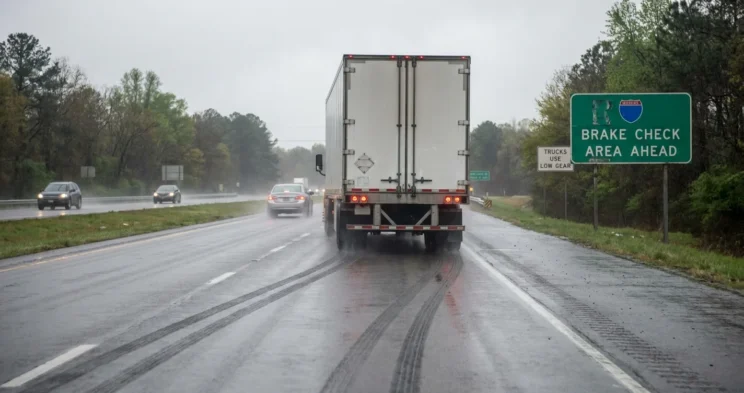
You’re slowing down for stopped traffic on I-35 when a loaded tractor-trailer fills your rearview mirror. How long does it take this truck to stop, and does the rig behind you have enough room?
Under the commercial driver’s license (CDL) standard, a heavy truck traveling 55 mph on dry pavement, with good brakes and an alert driver, needs about 419 feet to stop. Because tractor-trailers run on air brakes, brake lag adds roughly 32 more feet at that speed. Real-world total stopping distance passes 450 feet, close to 1.5 football fields.
These figures assume everything goes right, and this distance decides fault after a rear-end crash.
How Long a Semi-Truck Actually Takes to Stop at Highway Speed
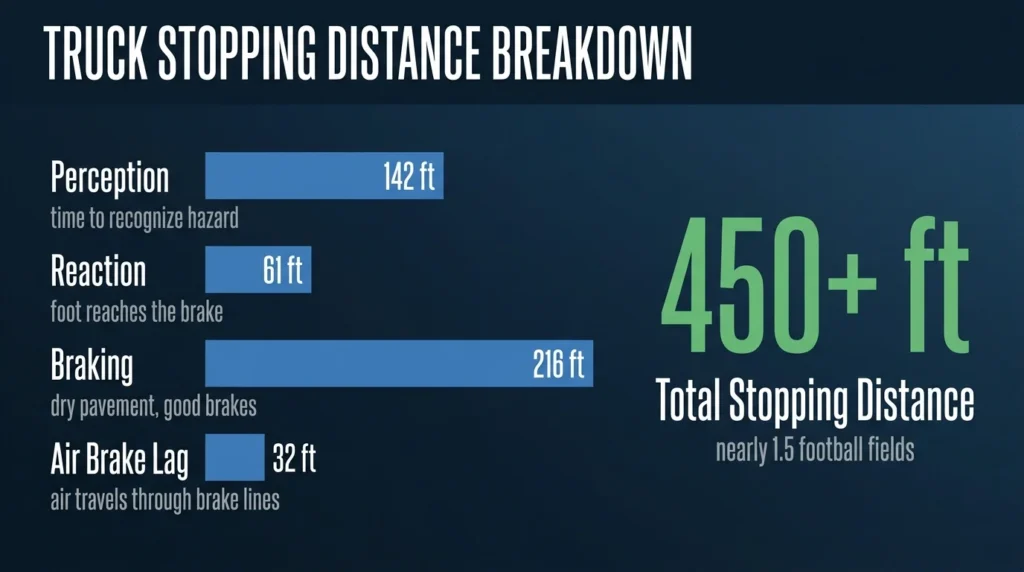
Truck stopping distance is not one measurement. The CDL manual breaks it into three parts, and air brakes add a fourth component.
- Perception distance: about 142 feet at 55 mph. An alert driver averages 1 3/4 seconds between the eyes seeing a hazard and the brain recognizing it.
- Reaction distance: about 61 feet at 55 mph, covering the 3/4 second to 1 second before the driver’s foot reaches the brake.
- Braking distance: about 216 feet at 55 mph on dry pavement with good brakes.
- Air brake lag: air takes 1/2 second or more to travel through the lines after the pedal is pushed, adding about 32 feet at 55 mph.
The first three parts add up to roughly 419 feet, or the published total at 55 mph in Section 2.6 of the CDL manual. Add air brake lag and Section 5.4 puts the real total at over 450 feet.
Both figures describe ideal conditions, which can change if there’s wet pavement, worn linings, a downgrade, or weight riding behind the cab.
What Federal and Texas Law Require of Truck Brakes
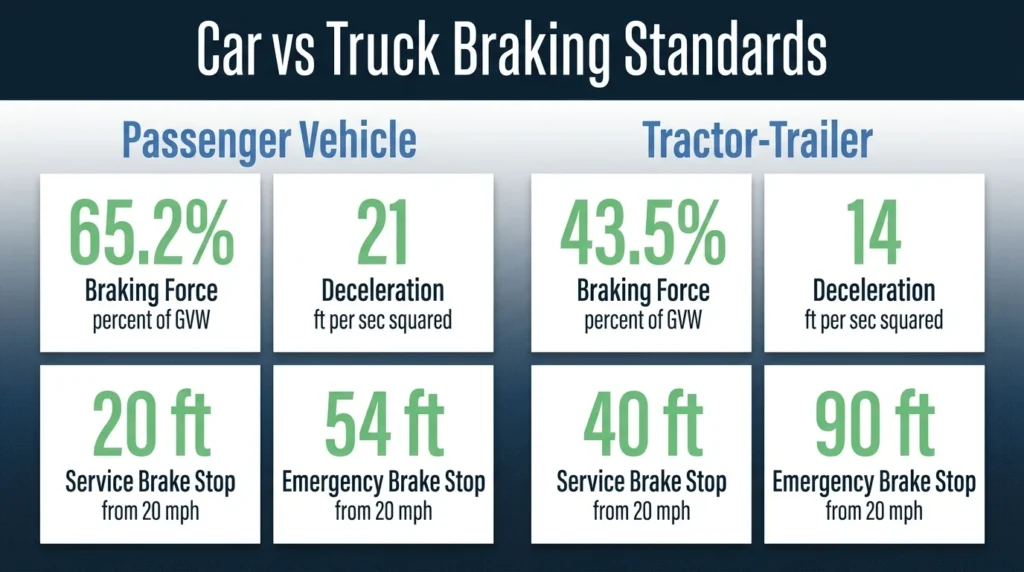
Federal law already concedes the point that a loaded commercial vehicle cannot stop like a car. The brake performance rule at 49 CFR 393.52 sets a braking force as a percentage of gross weight, a minimum deceleration rate, and a maximum stopping distance. These are measured on a hard, level, dry, and smooth surface that’s free of loose material, with the vehicle staying inside a 12-foot lane.
Two rows in the 49 CFR 393.52 table, both measured from just 20 mph, show the gap.
| Vehicle category | Braking force (% of GVW) | Deceleration | Service brake stop from 20 mph | Emergency brake stop from 20 mph |
|---|---|---|---|---|
| Passenger-carrying, 10 or fewer persons, car chassis | 65.2 | 21 ft/sec/sec | 20 ft | 54 ft |
| All other property-carrying vehicles and combinations (tractor-trailers) | 43.5 | 14 ft/sec/sec | 40 ft | 90 ft |
A loaded combination is allowed twice the stopping distance at a crawl speed, on a surface prepared for the test. That is the least demanding row in the table.
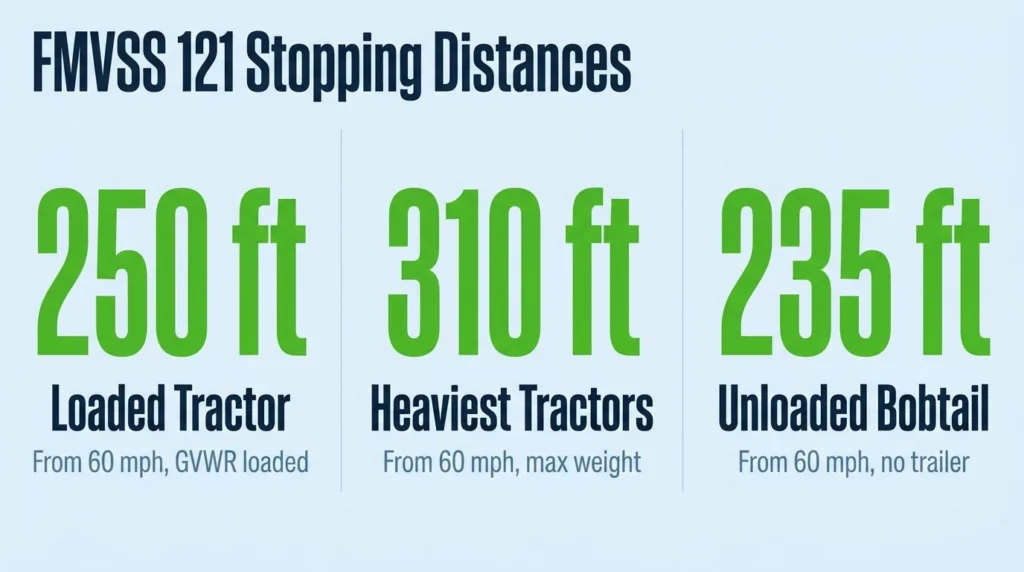
The build standard says the same thing at highway speed. Under FMVSS No. 121, at 49 CFR 571.121, a truck’s tractor loaded to its gross vehicle weight rating must stop from 60 mph within 250 feet, and the heaviest tractors within 310 feet, on a test surface with a peak friction coefficient of 1.02. An unloaded tractor running bobtail gets 235 feet.
Those numbers don’t conflict with the 419 feet above. The CDL figures describe a driver and truck working together in traffic, including human perception. The federal figures describe a controlled compliance test with a professional driver, not counting perception or reaction time.
Brakes also must work. 49 CFR 393.48 requires that all brakes on a motor vehicle are capable of operating at all times, subject to a few listed exceptions.
A carrier that’s only operating in Texas doesn’t escape any of these requirements. 37 Tex. Admin. Code Sec. 4.11 incorporates the Federal Motor Carrier Safety Regulations, including Parts 390 through 393, by reference. The federal brake standard is a Texas standard.
Why a Loaded Truck Cannot Stop in the Same Space as a Car
One contrast is in the federal standards. Under the cold effectiveness test in 49 CFR 571.135, a light vehicle must stop from about 62 mph within 230 feet. A loaded truck’s tractor is allowed to stop from the lower speed of 60 mph at 250 to 310 feet.
A loaded truck gets more room from less speed on a high-friction surface and with a professional test driver, not including perception or reaction time.
Federal interstate limits allow 80,000 pounds of gross vehicle weight subject to the bridge formula, 20,000 pounds on any single axle, and 34,000 pounds on tandem axles, according to 23 CFR 658.17. A fully loaded combination runs roughly 20 times the mass of a passenger car.
Three other factors work against the truck.
- An empty truck may stop worse than a loaded one. The CDL manual explains that empty vehicles have less traction, because the brakes and tires are engineered to perform best at full load.
- Speed punishes braking distance out of proportion. Doubling from 20 mph to 40 mph multiplies impact force and braking distance by about four. Tripling to 60 mph multiplies them by about nine, and the resulting distance runs longer than a football field.
- Heat takes braking power away. Brake fade comes from excessive heat causing chemical changes in the lining that reduce friction, along with expansion of the brake drums. Brakes that are out of adjustment stop doing their share, which overloads the brakes still working.
If you were in the passenger vehicle, that mismatch is why a claim against a trucking company gets investigated differently than a Texas car accident claim between two passenger vehicles.
What This Means for Drivers Sharing the Road With Trucks in Texas
The gap in front of a tractor-trailer is not simply unused road. It’s the truck’s stopping distance, and merging into it takes away the margin the driver needs.
A trailer that looks empty is not a trailer that stops faster. What you see from behind says little about how fast that rig can come to rest.
On long interstate downgrades and the grades west of Austin, a professional driver controls speed before the descent starts. Service brakes fade with heat, so a driver still braking hard at the bottom has fewer options than one who slowed at the top.
Following Distance, Assured Clear Distance, and Fault in Texas Rear-End Truck Crashes
Texas doesn’t measure following distance in car lengths or seconds. Texas Transp. Code Section 545.062 instead sets a performance standard. The stopping-distance figures above are how you test whether a truck met this standard.
- Subsection (a) requires that an operator following another vehicle “maintain an assured clear distance between the two vehicles so that, considering the speed of the vehicles, traffic, and the conditions of the highway, the operator can safely stop without colliding with the preceding vehicle or veering into another vehicle, object, or person on or near the highway.”
- Subsection (b) adds a duty no passenger car carries. Outside a business or residential district, a truck operator following another truck or combination shall, if conditions permit, leave enough space for a passing vehicle to safely enter and occupy it. This subsection doesn’t prohibit passing.
Because the statute depends on whether the operator “can safely stop,” the required gap changes with the vehicle. A distance that’s plenty for a sedan isn’t enough for a loaded combination that needs more than 450 feet at 55 mph.
The standard defense is that the driver in front cut in, brake-checked, or stopped abruptly. The answer is that the truck’s assured clear distance duty is measured against the truck’s own stopping capability, not a car’s.
Shared fault is why that argument gets made. Under Texas Civ. Practice & Remedies Code Section 33.001, a claimant may not recover damages if their percentage of responsibility is greater than 50 %. Shifting even part of that blame onto the injured driver is worth money to the defense, which is why the physics evidence matters.
Fault after a rear-end collision is less automatic than most people assume, and the details of [who’s at fault in a Texas rear-end collision often decide the claim.
Proving It: Reconstruction, Engine Control ModuleElectronically Commutated Motor Speed Data, and Roadway Measurement
Two sets of measurements turn the stopping-distance standard into a fact anyone can check: what the truck’s own electronics recorded, and what the roadway shows.
Where a heavy truck is equipped with an engine control module or event data recorder, that record is the starting point. A USDOT report on crash event data recorder requirements for vehicles over 10,000 pounds gross vehicle weight rating identified the priority reconstruction elements as vehicle speed, throttle position time history, brake status and pressure time history, engine speed, and transmission gear selection.
The same report stresses that a time standard linking all the data is critically important to a crash timeline. Across 133 real crash cases, speed and the throttle, brake, and steering histories were useful in roughly 96 to 99 % of cases USDOT crash event data recorder final report.
The roadway supplies other information, including skid and scuff marks, gouge marks, final rest positions, and the gap visible in surveillance or dashcam footage.
Put together, the reconstruction becomes arithmetic rather than opinion:
1. Establish the truck’s speed at the moment of brake application from the engine control moduleelectronically commutated motor (ECM) record.
2. Add the published perception and reaction distances for that speed.
3. Add the braking distance the truck was certified to achieve.
4. Compare the total against the gap that actually existed on the road.
Brake maintenance records belong in the same file. Because 49 CFR 393.48 requires every brake to be capable of operating at all times, the inspection, adjustment, and repair history are direct evidence of whether the truck could stop in the distance the law assumes.
Timing works against the injured driver. A motor carrier must retain records of duty status and supporting documents for each of its drivers for no less than 6 months from the date of receipt under 49 CFR 395.8, which specifically covers hours-of-service paperwork.
ECM memory is a separate problem, because the buffers keep recording as the truck keeps running and older data can be overwritten. Getting a preservation letter out early in a Texas truck accident claim is what keeps both categories of evidence intact.
Talk With Angel Reyes & Associates About Your Texas Truck Crash
Whether the truck behind you could have stopped in the space available is a measurable question. The measurements fade, and the records with answers have a retention floor counted in months.
Angel Reyes & Associates has guided injured Texans through claims like this for over 30 years, with offices across the state, staff available 24/7, and service in Spanish. Most of a case can be handled remotely, so getting started doesn’t mean driving across Texas.
The initial consultation is free. Bring whatever you already have, including photos, the crash report, and the name of the carrier, and ask what it would take to reconstruct the stop.
Contact Angel Reyes & Associates to have your crash reviewed.
Every case is different, and past results do not guarantee future outcomes.
Frequently Asked Questions
How long do I have to file a truck accident claim in Texas?
Generally two years. Under Texas Civ. Practice & Remedies Code Section 16.003, a personal injury suit must be brought no later than two years after the day the cause of action accrues. Likewise, a claim for injury resulting in death must be brought within two years, accruing on the death of the injured person. That is the general rule, not a universal one. The statute cross-references exceptions, and deadlines can shift with the circumstances of a particular crash, so talk with a lawyer promptly rather than assuming you have the full two years.
Do wet or slick Texas roads change how far a semi needs to stop?
Yes, and the direction is always worse. Every published figure in this article, including the roughly 419 feet under the CDL standard and the more than 450 feet once air brake lag is counted, assumes dry pavement, good brakes, and an alert driver. Wet or slick pavement, worn linings, a downgrade, and the weight riding behind the cab all extend that distance. There is no single reliable multiplier to apply, which is one reason a reconstruction measures the actual roadway and conditions instead of relying on a published table.
How much room should I leave before merging back in front of a tractor-trailer?
Treat the space ahead of a tractor-trailer as occupied. That gap is the truck’s stopping distance, not spare road, and a loaded combination at highway speed needs several hundred feet to come to rest once perception, reaction, air brake lag, and braking are added together. Merging into that gap removes the margin the driver needs and leaves you in the one position where the truck’s size works entirely against you. Also keep in mind that a trailer that looks empty isn’t a trailer that stops faster.
Can the trucking company be responsible even if the driver did nothing else wrong?
It’s possible, because the carrier has its own equipment duties. 49 CFR 393.48 requires that all brakes with which a motor vehicle is equipped be capable of operating at all times, subject to a few listed exceptions, and Texas also incorporates those federal rules for in-state carriers. This makes inspection, adjustment, and repair records evidence in their own right. Brakes that are out of adjustment stop doing their share and overload the brakes that are still working, so a truck that couldn’t stop in the distance the law assumes may point to a maintenance problem rather than a driving error. Whether that is what happened in any particular crash is a question for the evidence in that case.
Does a connected braking system change a truck's following distance duty in Texas?
It doesn’t remove the duty. A 2017 amendment added subsection (d) to Texas Transp. Code Section 545.062, which provides that a vehicle equipped with a connected braking system that is following another so equipped may be assisted by that system in maintaining an assured clear distance. The statute defines a connected braking system as one in which the braking of one vehicle is electronically coordinated with the braking system of a following vehicle. The underlying standard in subsection (a) is unchanged: the operator must still maintain an assured clear distance judged against the speed of the vehicles, traffic, and the conditions of the highway, so that the operator can safely stop. The technology is treated as an aid in meeting that obligation, not a substitute for it.
About the Authors

Alex Ivanov
Writer
Alex Ivanov is a personal injury attorney at Angel Reyes & Associates, focused on car, truck, and motorcycle accident cases. Licensed in Texas and multiple federal districts, Alex brings international legal experience and a global education to his practice. He earned his LL.M. from Texas A&M University School of Law after graduating from Belarussian State University in 2016. Alex is fluent in Russian, English, Ukrainian, and Belarussian, and is recognized by multiple national trial lawyer associations for his results and leadership under 40.

Kyle Nicolas
Editor
Kyle Nicolas is the Web Content & SEO Manager at Angel Reyes & Associates. He has more than 10 years of experience as a marketing co...

Angel Reyes
Reviewer
Angel L. Reyes, III is the Founder and Managing Partner of Angel Reyes & Associates. A nationally recognized trial attorney and business...