What Does a Bill of Lading Reveal After a Truck Crash?


Every article on this site is researched by our internal team, reviewed for legal accuracy against current Texas law, and held to State Bar of Texas advertising standards before publication. We do not publish content that overstates outcomes or makes promises about results.
Learn more about our
editorial standards .
Key Takeaways
- A bill of lading names the shipper, consignee, carrier, origin, and destination of the shipment.
- Failing to issue a bill of lading does not excuse a carrier from liability.
- Rate confirmations and dispatch records show which broker picked the carrier.
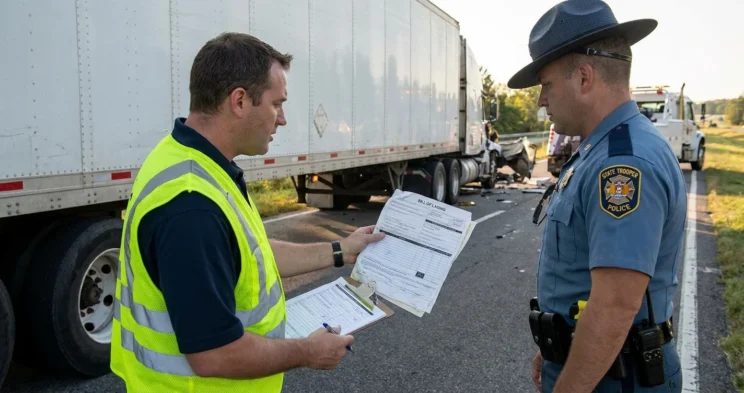
The 18-wheeler that hit you on I-35 had a company name painted on the door, but that name may not be the company that is legally responsible for the load it was hauling, or even the company that employed the driver.
This is where the truck’s freight documents come into play. A bill of lading is created when freight is handed over for transportation. It typically identifies the shipper, receiver, carrier, origin, destination, and cargo. When you examine the bill of lading alongside the delivery receipt, freight bill, and rate confirmation, you can begin to trace the companies involved in moving the load. This may include the broker who arranged the shipment and the carrier who dispatched the driver.
In a serious Texas truck accident claim, it’s important to identify these relationships because you will need to establish who was involved in the shipment and what role each company played before you can determine who is legally responsible for your injuries.
What Information Does a Bill of Lading Contain?
A bill of lading is a receipt and shipping document that records key details about a freight shipment. Under 49 CFR § 373.101, the bill of lading must include the shipper, receiver, origin, destination, type of cargo, and its weight or volume (if applicable). For certain negotiable bills or lading, it can also serve as proof of ownership or control of the goods.
The driver typically signs the bill of lading when the shipment is picked up, and the receiving party signs it when the shipment is delivered.
Bill of Lading Requirements Under the Carmack Amendment
The Carmack Amendment, 49 U.S.C. § 14706 requires certain interstate carriers to issue a bill of lading. A carrier’s failure to provide a bill of lading does not eliminate its liability for cargo loss or damage. In other words, a missing bill of lading is not a legal defense.
One important limitation is that the Carmack Amendment applies to lost or damaged cargo in interstate commerce, not personal injury claims. However, bills of lading can still be used in an injury case to show which carrier was responsible for transporting a particular shipment.
Carmack liability generally applies to the carrier that issued the bill of lading and to certain carriers that transported or delivered the shipment. In Texas truck accident cases, this distinction can help separate the motor carrier that is responsible for the truck and the driver from a broker that only arranged the shipment.
Four Documents to Request After a Truck Accident
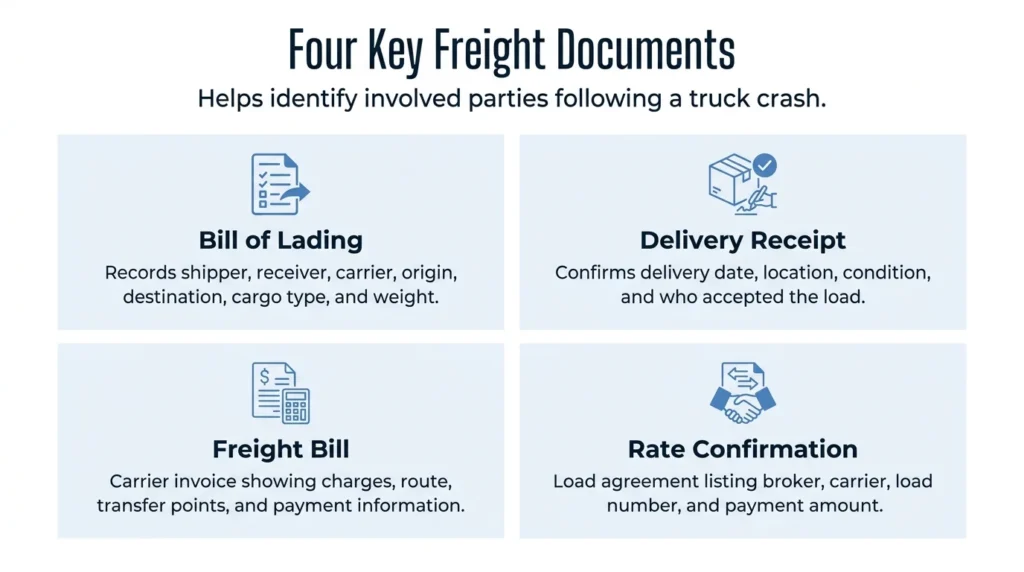
Four documents, when reviewed together, can help identify the parties involved in a particular shipment. Each document provides different information that can help fill in the gaps left by the others:
- Bill of lading: This is issued by the carrier to the shipper and provides a record of the goods being transported. It identifies the shipper, recipient, carrier, origin, destination, and the type, number, and weight of the goods. It also serves as evidence of the agreement to transport the shipment.
- Delivery receipt or proof of delivery: This may be the bill of lading signed again at delivery. It confirms the date, location, condition of the shipment, and the person who accepted and signed for the load.
- Freight bill or expense bill: This is the carrier’s invoice for transporting the shipment. Under 49 CFR § 373.103 it must show the charges, route, participating carriers, transfer points, and payment information. For shipments handled by multiple carriers, it can help identify each company involved in transporting the freight. The National Motor Freight Traffic Association explains how a bill of lading and a freight invoice have different purposes.
- Rate confirmation: The rate confirmation is the load-specific agreement between a broker or shipper and the trucking company. It may identify the broker, carrier, load number, equipment type, pickup and delivery times, and agreed-upon payment amount. It also confirms that the carrier is authorized to transport the shipment. A rate confirmation is a private contract, not a federal regulatory filing, so federal law does not require it to contain specific information. However, it can be one of the most useful documents for identifying the parties involved because it often lists the broker and carrier assigned to the shipment.
Broker vs. Motor Carrier
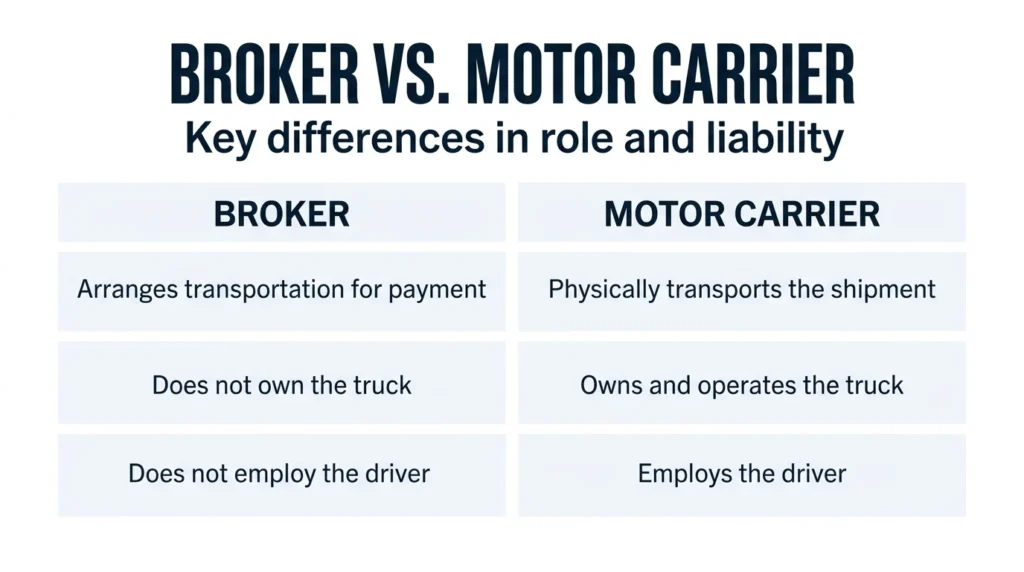
Under 49 U.S.C. § 13102, a broker and a motor carrier are two different things:
- A broker arranges or negotiates transportation with a motor carrier for payment.
- A motor carrier is the company that transports the shipment.
A broker arranges the shipment but typically does not own the truck or employ the driver. That distinction can affect which parties may be involved in a lawsuit.
The bill of lading and freight bill can show who received and transported the shipment, while the rate confirmation and broker-carrier agreement can show which company was hired and assigned to move it.
The broker-carrier agreement determines the contractual relationship between the broker and trucking company. It typically explains how loads are assigned, what insurance and safety requirements the carrier must meet, and what standards the broker uses when choosing a carrier.
Dispatch records and load tenders show which driver and truck were assigned to a shipment and when they were assigned. This can help establish who was driving and which company had control of the truck when the crash occurred.
What the 2026 Supreme Court Decision Means for Freight Broker Liability
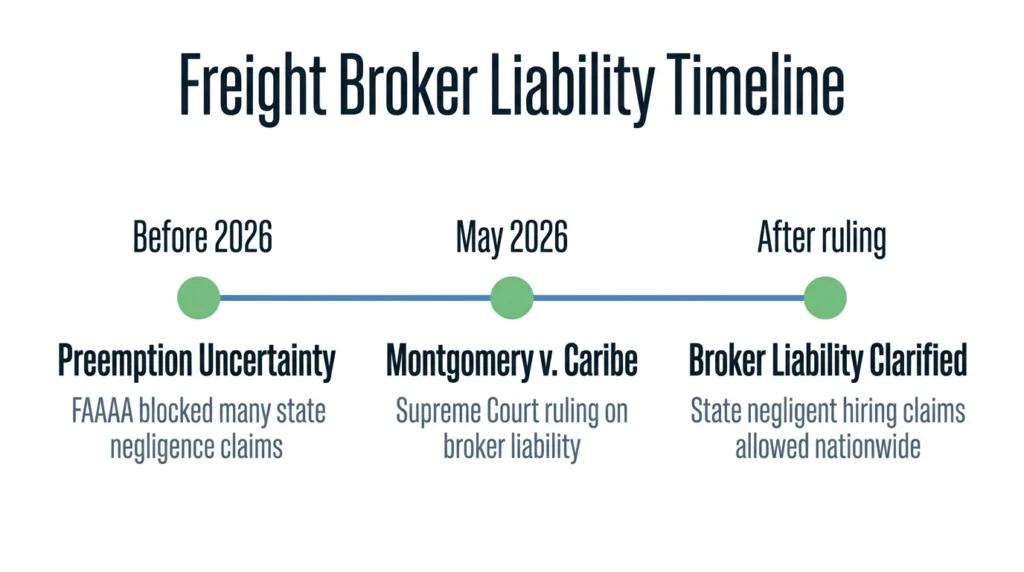
Determining whether a freight broker could face a state law negligence claim used to be complicated by federal preemption rules, but the law changed on May 14, 2026. In Montgomery v. Caribe Transport II, LLC No. 24-1238, the U.S. Supreme Court unanimously held that the Federal Aviation Administration Authorization Act of 1994 does not prevent state law claims alleging that freight brokers negligently hire or select unsafe motor carriers. The Court found that these claims fall within the federal law’s safety exception for motor vehicles.
This decision means that a broker may potentially face a negligent hiring claim if its selection of a trucking company creates a safety risk. However, this does not automatically make a broker liable for every truck accident involving carriers they select. The Court’s decision leaves room for a broker to defend themselves by showing that they acted reasonably when selecting the carrier, such as by choosing a reputable and properly vetted trucking company.
This is why the underlying documents are so important. Whether a broker reasonably vetted the carrier it hired is a factual question that can be evaluated through records such as the broker-carrier agreement, rate confirmation, and dispatch records, rather than relying solely on competing arguments about what the broker should have done.
Montgomery applies nationwide, including Texas. However, the Supreme Court’s decision does not determine whether a particular broker was negligent. The strength of a claim still depends on the facts and records of the individual case.
Talk to an Attorney About the Freight Paperwork in Your Texas Truck Accident Claim
If you were injured in a commercial truck crash in Texas, the records behind the shipment may help reveal who was responsible and whether important evidence has been preserved.
Angel Reyes & Associates can help you identify which documents to request, and which company to request them from. We have guided injured Texans through this legal process for more than 30 years, and we have recovered more than $1 billion for our clients.
We have offices across Texas, and our team of personal injury attorneys, investigators, and accident reconstruction professionals are available 24/7. Consultations are free, and we work on contingency, which means you pay no fee unless we win your case.
Contact Angel Reyes & Associates today for a free consultation.
Past results do not guarantee future outcomes.
Bill of Lading FAQs
How can my attorney get a copy of the bill of lading, rate confirmation, or dispatch records after a truck crash?
Carriers and brokers may not provide all these documents just because you ask for them. Federal rules require carriers to keep records of bills of lading and freight bills for specified periods, but obtaining all of them (including the rate confirmation, broker-carrier agreement, and dispatch records) often requires an attorney to send preservation requests and requests for formal discovery. It’s important to do this quickly because some freight records are retained for a limited time. Your attorney can send an early request to the carrier and broker involved in the shipment to help preserve important records before they are lost.
What evidence should I preserve after a truck accident?
Photographs and videos of the crash scene, vehicles, road conditions, visible injuries, and the surrounding area can help document what happened. You should also keep your medical records and bills, insurance correspondence, witness information, and any documents from the trucking company or its insurer.
What should I do if I'm not sure which trucking company was involved in my accident?
You may still be able to identify the company using the police report, truck markings, license plate information, photographs, witness accounts, and other records. Commercial truck crashes can involve multiple companies, so identifying every potentially responsible party may require additional investigation.
About the Authors

Angel Reyes
Writer
Angel L. Reyes, III is the Founder and Managing Partner of Angel Reyes & Associates. A nationally recognized trial attorney and business leader, Angel has helped over 70,000 injury victims recover more than $1 billion since founding the firm in 1993. Named to the Texas Super Lawyers list annually since 2008, Angel brings Wall Street experience, Ivy League education, and a deep commitment to client advocacy. He is a frequent legal commentator and published author with extensive contributions to legal scholarship, trial strategy, and consumer protection.

Kyle Nicolas
Editor
Kyle Nicolas is the Web Content & SEO Manager at Angel Reyes & Associates. He has more than 10 years of experience as a marketing co...

Angel Reyes
Reviewer
Angel L. Reyes, III is the Founder and Managing Partner of Angel Reyes & Associates. A nationally recognized trial attorney and business...