How Do You Find Out Who Owns the Truck That Hit You?


Every article on this site is researched by our internal team, reviewed for legal accuracy against current Texas law, and held to State Bar of Texas advertising standards before publication. We do not publish content that overstates outcomes or makes promises about results.
Learn more about our
editorial standards .
Key Takeaways
- A DOT number lookup in SAFER shows the carrier's operating status and safety record.
- FMCSA's Licensing and Insurance record shows the legal name, DBA, and insurer on file.
- Naming the wrong trucking entity can dismiss your claim if Texas's two-year deadline has passed.
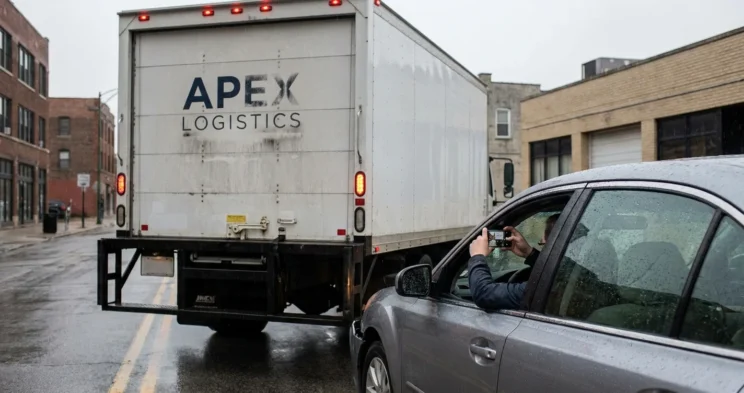
A collision with a loaded tractor-trailer on I-35 leaves you with more than just serious injuries and lost income. You are also left staring at the company name painted on the truck, wondering whether that company is responsible for the vehicle. Before you can determine who may be liable for your injuries, you need to know who owns and operates the truck, and whether it is the same company. In Texas, that process starts at the scene of the crash and follows a federal paper trail to the courtroom.
The company name painted on the truck is not always enough to identify the legal entity that you need to pursue. The truck’s USDOT number can provide a more reliable starting point. A search through the FMCSA’s free SAFER Company Snapshot can identify the carrier associated with the USDOT number, while the FMCSA’s Licensing and Insurance system can confirm the carrier’s registered legal name and insurance information.
This federal information is especially important in Texas, where state vehicle title and registration records are not generally available to the public.
Why the Name on the Truck Isn’t Proof of Who Owns It
The name on the truck may be a trade name, a leased carrier’s logo, or a brand that is different from the company registered with federal regulators. The USDOT number is usually more reliable. FMCSA assigns this number to identify regulated motor carriers and track information such as their size and safety record.
The USDOT number is generally displayed on the truck, which makes it especially useful information to gather when documenting a crash scene. A single USDOT number can provide an important starting point for identifying the company involved in a Texas truck accident claim.
The USDOT and MC numbers serve different purposes:
- The USDOT number identifies the trucking company and provides information about their safety history.
- The MC number and operating authority show whether the company is allowed to transport goods or passengers for payment across state lines.
However, neither number guarantees that the name on the truck will match the company’s legal name. This can create problems when you try to identify the right company after a crash.
How to Identify a Trucking Company by USDOT Number
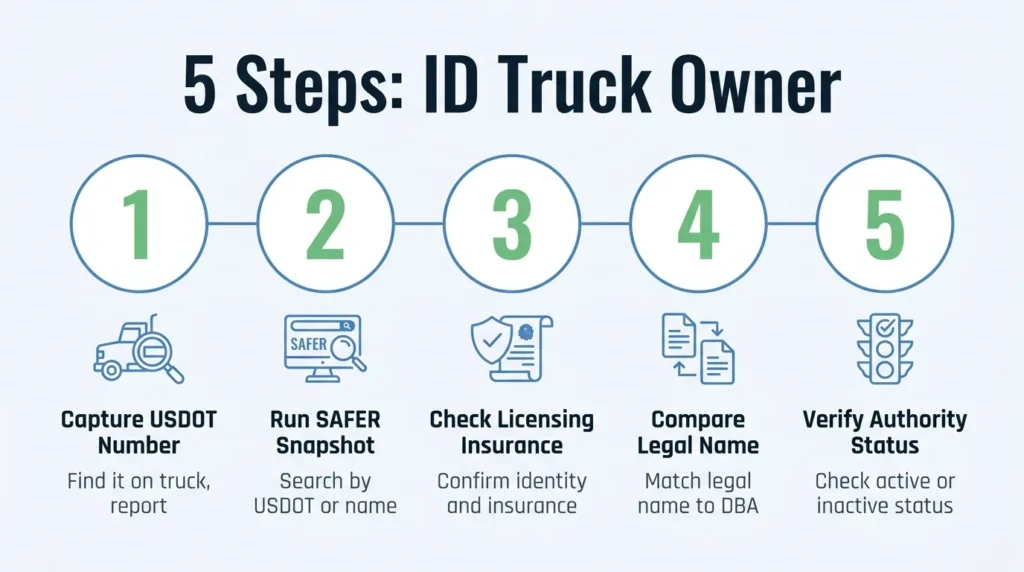
Here’s how to identify the company operating the truck and start determining who may be legally responsible:
- Capture the USDOT number. Look for it on the truck itself, in the police crash report, or in any shipping and insurance paperwork provided at the scene.
- Run the SAFER Company Snapshot. FMCSA’s [Company Snapshot](https://safer.fmcsa.dot.gov/CompanySnapshot.aspx) lets you search by USDOT number, MC number, or company name. The results show the company’s identifying information, operating status, safety rating (if one has been assigned), inspection summary, and crash history.
- Cross-check the same number in Licensing and Insurance. FMCSA’s Licensing and Insurance system provides official information about a carrier’s operating authority and insurance filings. Use the same USDOT or MC number to confirm the carrier’s licensing and insurance details.
- Compare the Legal Name to the DBA. The Motor Carrier Details page lists the company’s registered legal name separately from its DBA (or “doing business as”) name. This can help you determine whether the name on the truck matches the company’s legal name.
- Check the authority status and insurance history. The system may list a carrier’s operating authority as Active, Inactive, or None, alongside its insurance filings going back to 1995. An Active status generally means the carrier’s authority is currently in effect, while Inactive means their authority is no longer active.
Identifying the Insurer and Legal Entity
Identifying the trucking company is only half the process. You will also need to determine which company carries the insurance, and which company can be legally served with a lawsuit.
Here’s what to use to help you determine these:
- BMC-91 and BMC-91X filings: These are insurance filings submitted to FMCSA by an insurer on behalf of a trucking company. The BMC-91X is used when multiple insurers share the risk. These filings show which insurance company is providing coverage for the registered carrier. These filings also ensure active operating authority. FMCSA lists them among its registration forms.
- BOC-3 process-agent designation: A trucking company subject to federal operating authority requirements must designate agents who can receive legal documents on its behalf. The filing can help confirm the entity’s registered process agent.
How Truck Leases Affect Liability
You also need to determine whether the trucking company owns the truck or is merely operating equipment leased from someone else.
If a trucking company operates equipment that it does not own, then a written lease is required to be kept in the vehicle, under 49 CFR Part 376. The lease establishes the carrier’s possession, control, and use of the equipment and details the carrier’s liability insurance requirements during the term of the lease.
This means a truck can be owned by one company but operated by another under the operator’s authority and markings. The name or logo on the truck can provide useful evidence, but it does not always determine who is legally responsible. In other words, owning the truck and operating the truck are not always the same thing.
How to Use a Texas Crash Report to Identify a Truck Owner
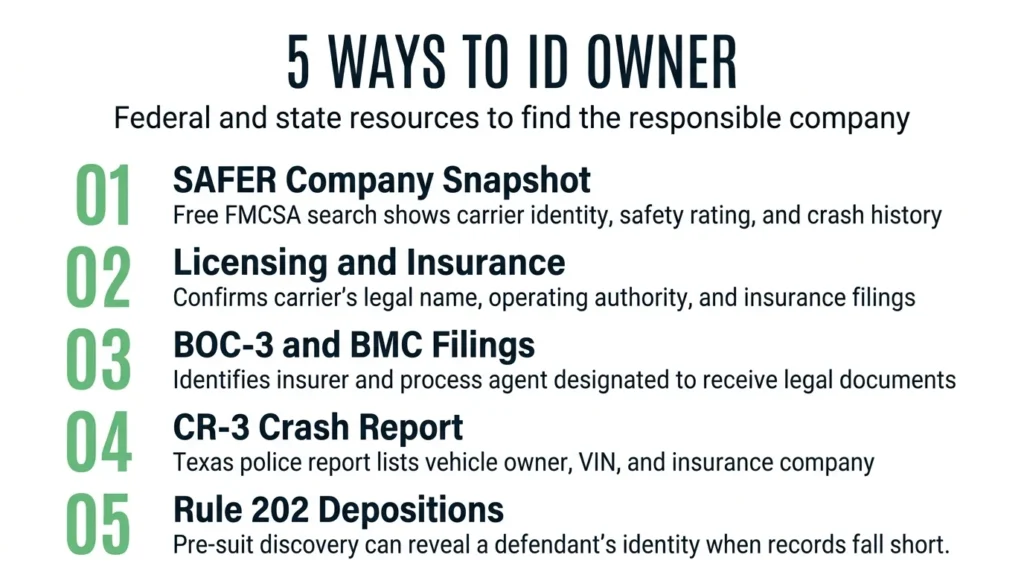
Federal carrier information is generally available to the public, but access to Texas vehicle records is more limited. To get a complete picture, you may need to use state documents along with the federal carrier information.
Under Texas Transportation Code Chapter 730, Texas title and registration records are protected by privacy laws. Unlike SAFER, you cannot use a Vehicle Identification Number (VIN) to publicly look up the registered owner through TxDMV.
A practical alternative is the CR-3 Texas Peace Officer’s Crash Report. It records each vehicle’s license plate, VIN, make, model, and year, along with the owner and insurance company identified by the investigating officer.
Texas crash reports are also not available to the general public. Only those with a direct interest in the crash (such as a driver, passenger, vehicle owner, or their legal representative) can obtain an unredacted copy through TxDOT’s Crash Records Information System or by submitting Form CR-91.
What to Do When You Still Can’t Identify the Responsible Company
Sometimes, these records still may not reveal who was operating or legally responsible for the truck, particularly when leased equipment, independent owner-operators, or recently changed carriers or insurers are involved.
In these situations, Texas Rule 202 pre-suit depositions may help you obtain the testimony and documents you need to identify a potential defendant before filing a lawsuit. However, courts may limit the use of this procedure when the defendant’s identity is genuinely unknown.
Misnomer vs. Misidentification
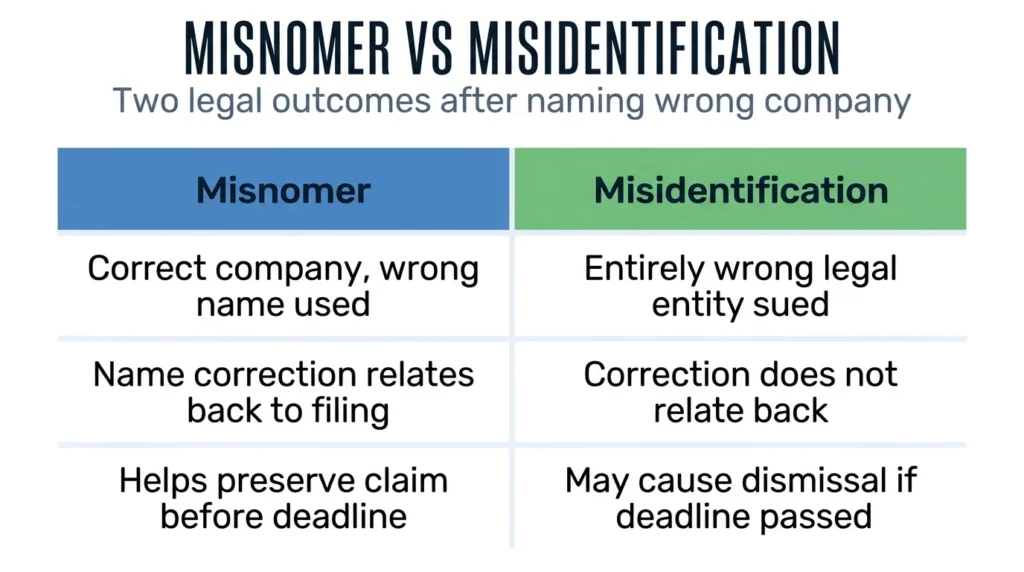
Texas law distinguishes between suing the right company under the wrong name (also known as “misnomer”) and suing the wrong company entirely (also known as “misidentification”). These two situations may look similar at first, but they can have very different consequences for your case.
- Misnomer means you sued the correct company but used the wrong name (such as a company’s DBA or the name shown on the truck). Texas courts generally allow the name to be corrected, and the change may relate back to the original filing date, which can help preserve your claim before the statute of limitations expires.
- Misidentification means you sued a completely different legal entity (such as a related company, a former carrier, or another company with a similar name). In this situation, changing the defendant generally does not relate back to the original filing date. If the two-year statute of limitations has expired, then the newly named company may be able to get your claim dismissed.
Get Legal Help Identifying the Right Company Before It’s Too Late
Identifying the correct trucking company may require checking several sources, including SAFER, Licensing and Insurance records, insurance and BOC-3 filings, and the CR-3 crash report. In some cases, pre-suit discovery may also be necessary.
These steps take time, so it is important to start early, especially because Texas only gives you two years to file a personal injury claim, and identifying the correct legal entity before the deadline approaches can help prevent problems with your case.
Angel Reyes & Associates has guided injured Texans through this exact legal process for over 30 years, and we have recovered more than $1 billion for our clients. Our team includes investigators and accident reconstruction specialists who work on a contingency basis, which means you pay no fee unless we win your case.
Contact Angel Reyes & Associates for a free consultation to review your options while there is still time to act.
Past results do not guarantee future outcomes.
Truck Owner FAQs
Can I still file a lawsuit if the trucking company says I caused the accident?
Yes. Texas follows a modified comparative responsibility rule. You may still be able to recover compensation if you were partially responsible for the crash, as long as your percentage of fault does not exceed 50%. Your compensation may be reduced according to your share of fault. However, be aware that if you are found to be 51% or more at fault, then you lose the right to recover damages completely.
Can I recover damages if my injuries appeared days after the truck accident?
Possibly. Some injuries (including certain soft-tissue and traumatic brain injuries) may not cause noticeable symptoms immediately after a crash. Prompt medical evaluation can help document the connection between the accident and your injuries and identify problems that may otherwise go untreated.
What happens to my case if the trucking company repairs or destroys the truck after the accident?
Potentially important evidence could be lost. The truck’s electronic data, maintenance records, and inspection records may help establish what caused the crash. This is why it’s important to hire legal counsel immediately after the crash, as an attorney may send a preservation letter requesting that relevant evidence be maintained while your claim is investigated.
About the Authors

Angel Reyes
Writer
Angel L. Reyes, III is the Founder and Managing Partner of Angel Reyes & Associates. A nationally recognized trial attorney and business leader, Angel has helped over 70,000 injury victims recover more than $1 billion since founding the firm in 1993. Named to the Texas Super Lawyers list annually since 2008, Angel brings Wall Street experience, Ivy League education, and a deep commitment to client advocacy. He is a frequent legal commentator and published author with extensive contributions to legal scholarship, trial strategy, and consumer protection.

Graham Griffin
Editor
Graham Griffin is the Web & Content Manager at Angel Reyes & Associates, where he oversees content strategy, AI-powered workflows, a...

Angel Reyes
Reviewer
Angel L. Reyes, III is the Founder and Managing Partner of Angel Reyes & Associates. A nationally recognized trial attorney and business...