What Do Spinal Cord Injury Levels Mean?


Every article on this site is researched by our internal team, reviewed for legal accuracy against current Texas law, and held to State Bar of Texas advertising standards before publication. We do not publish content that overstates outcomes or makes promises about results.
Learn more about our
editorial standards .
Key Takeaways
- Level plus ASIA grade decides function, ventilator needs, and daily independence.
- C1 to C4 injuries often need ventilator support, while C5 to C8 injuries rarely do.
- A life care plan and economist testimony prove lifetime cost in a Texas claim.

A doctor tells you the injury is “C5, incomplete,” and then moves on to the next room. You are left holding two pieces of information that will shape the rest of your family’s life, and no one has explained either one.
Spinal cord injury levels describe how high on the cord the damage sits. The higher the level, the more of the body loses its signal from the brain, which is why a neck injury can take away breathing while a lower back injury may not take away walking.
Level alone does not tell the whole story. Paired with a completeness grade, it predicts independence, ventilator needs, and the lifetime cost of care that a Texas claim has to prove.
How Doctors Classify a Spinal Cord Injury on the ASIA Impairment Scale
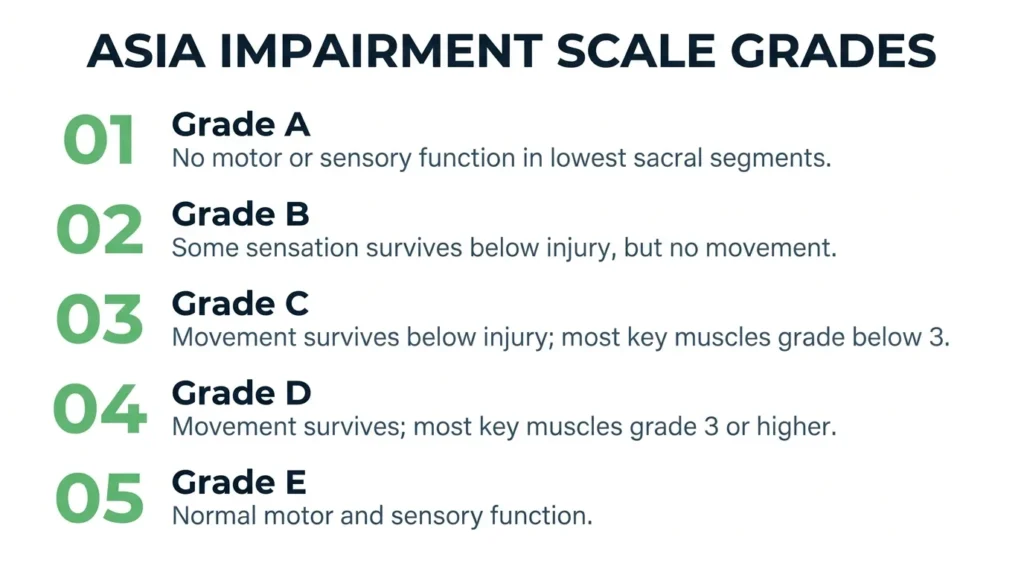
Classification comes from a standardized bedside exam called the International Standards for Neurological Classification of Spinal Cord Injury, and its output is a single letter grade on the ASIA Impairment Scale. The standard is maintained by the American Spinal Injury Association, which most recently revised it in 2019.
The exam has two halves. A physician grades muscle strength in 10 key muscle groups on each side of the body on a 0 to 5 scale, then tests light touch and pinprick sensation at 28 points on each side.
Those results produce the five ASIA Impairment Scale grades:
- A (complete): no motor or sensory function remains in the lowest sacral segments, S4 and S5.
- B (sensory incomplete): some sensation survives below the injury, but no movement.
- C (motor incomplete): movement survives below the injury, but most key muscles grade below 3.
- D (motor incomplete): movement survives and most key muscles grade 3 or higher.
- E: normal motor and sensory function.
The exam also fixes the neurological level of injury, meaning the lowest spinal segment that still has normal function on both sides of the body. That is the number people repeat as “a C6 injury.”
This grading is done on admission, and it becomes the first fact in both the medical prognosis and, later, the damages proof. Two people can both have a C6 injury and live very different lives if one is graded A and the other is graded D.
Why C1 Through C4 Injuries Often Require a Ventilator
Injuries in the top four cervical segments reach the nerves that drive the diaphragm, so breathing itself is affected. C1 through C3 injuries are typically ventilator dependent around the clock, while a C4 injury preserves partial diaphragm function and often needs intermittent or nighttime ventilatory support.
Hand and arm function is absent at this level. Feeding, dressing, bathing, and wheelchair mobility all require total assistance, which in practice means paid attendant care for most or all of the day.
This is the severity band that follows high-energy collisions, including commercial truck crashes on I-35 and the LBJ Freeway. When an injury at this level proves fatal, the family’s case becomes a Texas wrongful death claim instead.
What a C5 or C6 Injury Means for Independence
At C5 and below, the diaphragm is preserved, so ventilator dependence is rare. Function then returns segment by segment, which is why the difference between a C5 and a C6 injury matters so much to daily life.

Even at C7 and C8, most people still need help with bowel and bladder care and with many activities of daily living. A C5-C6 injury usually means ongoing assistance for hours each day, not a ventilator.
Passenger-vehicle collisions are a common mechanism here, which is why these injuries often surface in car accident claims rather than catastrophic-only litigation.
How Thoracic, Lumbar, & Sacral Injuries Cause Paraplegia
Below the neck, arm and hand function survives, and that is the line separating tetraplegia from paraplegia. The loss shifts to the legs, the trunk, and bowel and bladder control:
- Thoracic (T1 to T12): arm and hand function is preserved. The injury causes paraplegia, and depending on the level it can affect trunk and core control enough to change sitting balance. Bowel and bladder control is lost, and wheelchair independence is a realistic goal.
- Lumbar and sacral (L1 to S5): hand, arm, and trunk function are unaffected. Hip and leg function ranges from weakness to paralysis depending on the exact level, and lower sacral injuries may preserve walking ability. Bowel and bladder control is commonly affected either way.
Falls produce a meaningful share of these lower-level and incomplete injuries, which often points toward a premises liability claim against the property owner. Motorcycle crashes show up across the whole severity range, from sacral injuries to high cervical ones.
Why Injury Level Drives the Value of a Texas Spinal Cord Injury Claim
Injury level and ASIA grade set the medical needs, the medical needs set the life care plan, and the life care plan is where most of the claim’s value lives. Attendant care hours, home modifications, and equipment are line items inside that plan, and they scale directly with severity.
The federally funded National Spinal Cord Injury Statistical Center groups severity the same way clinicians do, and its 2025 data sheet reports average expenses in 2024 dollars:

Estimated lifetime costs follow the same pattern. For someone injured at 25, the estimate runs from $6,256,937 for high tetraplegia down to $2,090,344 for a motor functional AIS D injury, discounted at 2 percent. For someone injured at 50, the range is $3,438,706 down to $1,475,423.
Those averages exclude indirect losses such as wages, fringe benefits, and lost productivity, which the same data sheet puts at an average of $95,309 per year in 2024 dollars.
Texas law decides how much of that a jury ever hears. Three pieces of proof carry the weight:
- The ASIA classification on admission. It documents level and completeness at the start, before any dispute about how much function was really lost.
- The life care plan. A life care planner converts physician recommendations into itemized, costed future care. The planner must be qualified under Texas Rule of Evidence 702, and recommendations risk exclusion unless a treating or examining physician independently supports them.
- Economist testimony. Texas requires future damages to be stated in present value, so an economist applies medical cost trend and life expectancy assumptions to the plan’s future costs and reduces them to a present-value figure.
The standard those three have to satisfy is set by Texas case law. In Sanmina-SCI Corp. v. Ogburn, No. 05-03-01576-CV, the Dallas Court of Appeals held in 2004 that recovering future medical expenses requires showing a reasonable probability that the expenses will be incurred, supported by evidence of both the reasonable need for the care and its reasonable cost.
That court also acknowledged what every family in this position already knows. Future costs are uncertain by their nature, and once the evidence is in, appellate courts defer heavily to the jury on the amount.
Talk to a Lawyer at Angel Reyes & Associates
Your injury level and ASIA grade drive both the prognosis and the case, which is why a generic valuation of a spinal cord injury claim is worth very little to you.
Angel Reyes & Associates has guided injured Texans through the legal process for over 30 years, with board-certified personal injury attorneys, investigators, and accident reconstruction professionals on the team. The firm works on contingency, so there is no upfront cost to you, and someone is available 24/7.
Request a free consultation to review the medical record, the life care plan, and your options.
Past results do not guarantee future outcomes.
Spinal Cord Injury Level FAQs
What are some top causes of spinal cord injuries?
Leading causes include vehicle crashes, acts of violence, falls, and sports/recreational activities. In terms of violent acts, most spinal cord injuries occur because of gunshot wounds.
What is paraplegia?
This term describes the inability to move lower bodily parts, including the legs, feet, and toes. It may also include the abdomen, depending on where the injury occurred on the spine.
Who is qualified to serve as a life care planner in a Texas lawsuit?
A life care planner must be qualified under Texas Rule of Evidence 702 based on knowledge, skill, experience, training, or education. Nurse life-care-planners face a higher risk of exclusion if they recommend treatment that no treating or examining physician has independently supported.
About the Authors

Angel Reyes
Writer
Angel L. Reyes, III is the Founder and Managing Partner of Angel Reyes & Associates. A nationally recognized trial attorney and business leader, Angel founded the firm in 1993, which has gone on to help over 70,000 injury victims recover more than $1 billion. Named to the Texas Super Lawyers list annually since 2008, Angel brings Wall Street experience, Ivy League education, and a deep commitment to client advocacy. He is a frequent legal commentator and published author with extensive contributions to legal scholarship, trial strategy, and consumer protection.

Kyle Nicolas
Editor
Kyle Nicolas is the Web Content & SEO Manager at Angel Reyes & Associates. He has more than 10 years of experience as a marketing co...

Angel Reyes
Reviewer
Angel L. Reyes, III is the Founder and Managing Partner of Angel Reyes & Associates. A nationally recognized trial attorney and business...