How Much Is a Scarring Settlement Worth in Texas?


Every article on this site is researched by our internal team, reviewed for legal accuracy against current Texas law, and held to State Bar of Texas advertising standards before publication. We do not publish content that overstates outcomes or makes promises about results.
Learn more about our
editorial standards .
Key Takeaways
- Texas law treats disfigurement as its own damages category, separate from pain and suffering.
- Scars take twelve to eighteen months to mature, so settling early undervalues the claim.
- Serial photos, a plastic surgery consult, and impact testimony prove scar value.
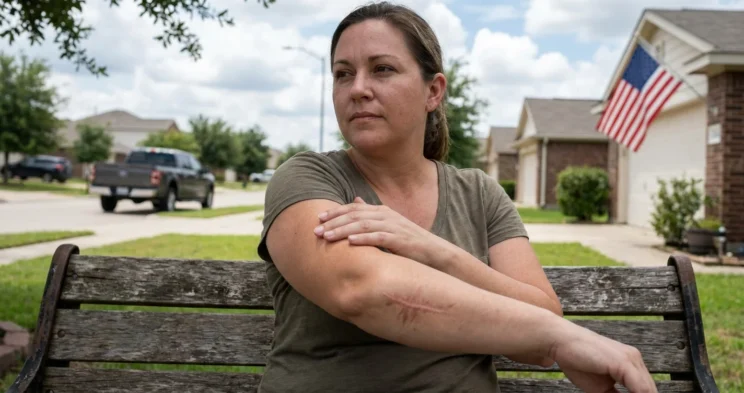
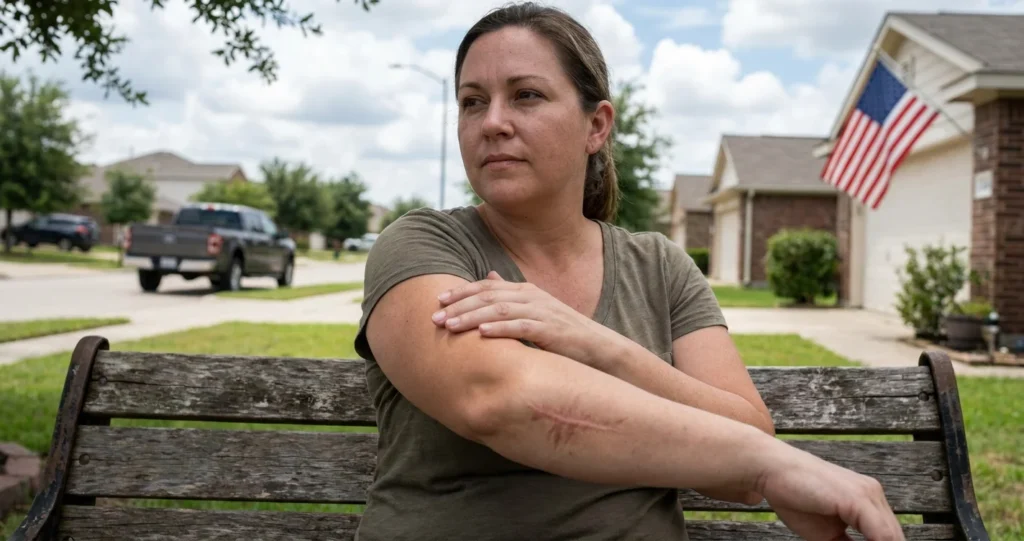
A scar is the part of an injury you carry in public. Long after the stitches come out and the last bill is paid, it is still there in the mirror, in photographs, and in the way people look at you.
Texas law does not put a price tag on that. There is no formula, table, or standard settlement amount for a scar in Texas. What a scarring settlement in Texas is worth depends on where the scar sits, whether it is permanent, how visible it is, and how it changes your life and your work.
The one thing that moves the number in a predictable direction is proof.
Disfigurement Is Its Own Category of Damages Under Texas Law
In Texas, disfigurement is a separate item of compensation, not a piece of pain and suffering. Texas Civil Practice and Remedies Code Section 41.001 defines noneconomic damages by listing each item on its own, including physical pain and suffering, mental or emotional pain or anguish, physical impairment, and disfigurement.
That separation is not a technicality. In Golden Eagle Archery, Incorporated versus Jackson, the Supreme Court of Texas confirmed that Texas juries answer those categories as distinct questions, under an instruction to consider each element separately and not include damages for one element in any other.
The definition Texas courts apply comes from Goldman versus Torres, a 1960 Supreme Court of Texas decision. Disfigurement is that which impairs or injures the beauty, symmetry, or appearance of a person, or which renders a person unsightly, misshapen, or imperfect.
The Court of Appeals of Texas in Houston used that same definition in 2008 in The Kroger Company versus Brown, noting that the pattern jury charge supplies no definition of its own, so courts rely on the commonly understood meaning of the word.
Two practical points follow. Your scar does not have to be visible every hour of the day to count, because how easily it can be covered affects what the disfigurement is worth rather than whether it qualifies at all. Texas juries also answer past disfigurement and future disfigurement as separate questions, so a permanent scar is valued across the years you will live with it.
Scars that reach this category often come from high-energy collisions. Car accident injury claims and truck accident injury claims regularly involve facial lacerations, burns, and damage to the hands and forearms.
Why There Is No Fixed Dollar Amount for a Scar
No Texas statute sets a dollar ceiling on disfigurement damages in an ordinary injury case. The cap people hear about, Texas Civil Practice and Remedies Code Section 74.301, limits noneconomic damages to $250,000 per claimant against an individual physician or a single health care institution, rising to a $500,000 aggregate when multiple institutions are defendants.
That cap is confined to health care liability claims. It does not limit what you can recover for disfigurement after a car crash, a fall, a dog bite, or a defective product.
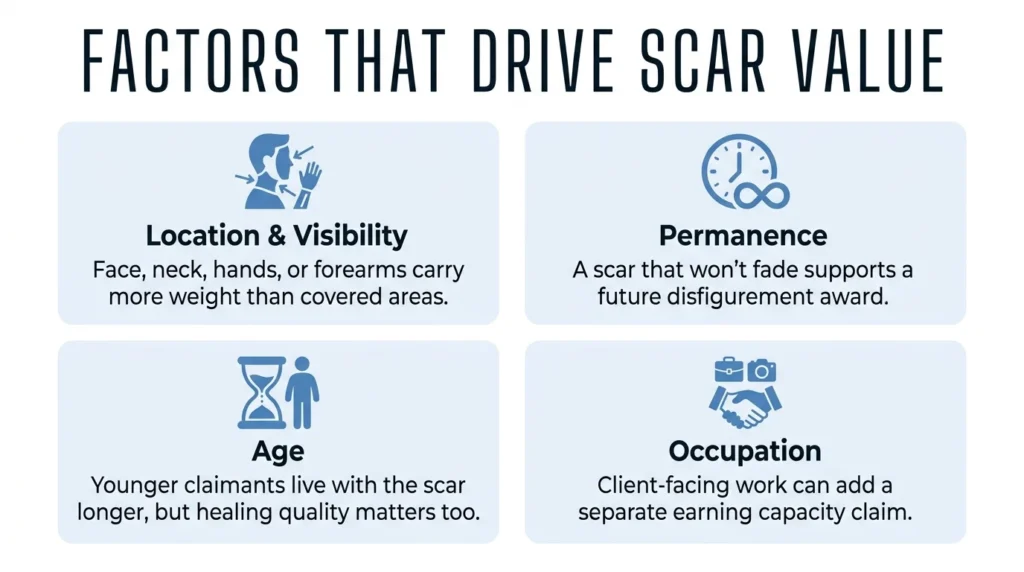
Value turns instead on the facts of your scar:
- Location and visibility. A scar on the face, neck, hands, or forearms carries more weight than one covered by clothing, though a concealable scar still qualifies as disfigurement.
- Permanence. A scar that will not fade supports an award for future disfigurement, which the jury answers separately from the past.
- Age. A younger claimant lives with a visible scar for more remaining years, which practitioners commonly cite as supporting a larger award. Younger skin can also heal to a less noticeable result, so the medical record matters more than the birth date.
- Occupation. If your work puts you in front of clients, customers, or an audience, the scar can also reach your earning capacity. That is a separate damages category from disfigurement, and it needs its own proof.
This is why two people with similar-looking scars can end up in very different places. A forearm scar on a welder and a cheek scar on a restaurant host are not the same claim. Motorcycle accident injury claims often involve road rash and laceration scarring across large areas, and premises liability claims from falls and dog bites frequently leave visible marks on the face and hands.
Why Timing & Documentation Matter for Your Claim’s Value
Settling early is the most common way a scarring claim gets undervalued. A scar is not finished when the wound closes.
The American Society of Plastic Surgeons describes scar healing as a collagen remodeling process that commonly runs 12 to 18 months, and longer when healing is delayed. Over that period the scar flattens, fades, and softens.
Surgeons typically wait up to a full year before assessing a scar for surgical revision, and 12 to 18 months before nonsurgical treatment such as laser or microneedling, because working on an immature scar risks complications including permanent pigment changes.
An adjuster values the scar you can prove. A demand finalized at month three rests on an appearance that no longer exists at month 18, and once you sign a release, you cannot go back and ask for more.
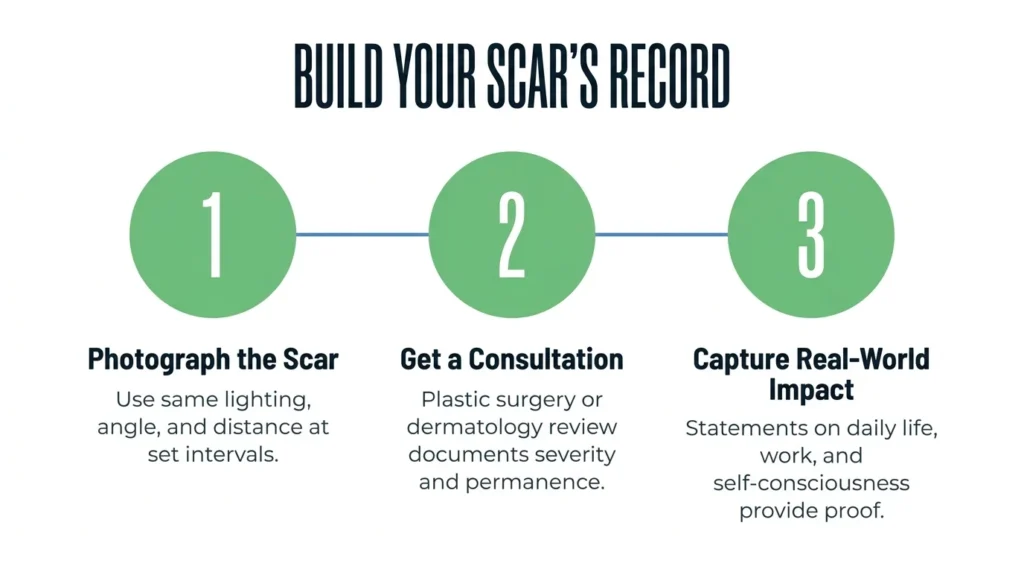
Three steps build the record that supports full value:
- Photograph the scar on a schedule. Take pictures at set intervals in the same lighting, from the same angle and the same distance, so the series shows both the healing curve and the point where it stopped.
- Get a plastic surgery or dermatology consultation. A treating physician’s assessment of revision options such as surgical excision, laser, microneedling, or steroid injection for raised and keloid scarring documents severity and permanence. The projected cost can also support a separate claim for future medical expenses.
- Capture the real-world impact. Statements from you, your family, and your coworkers about self-consciousness, activities you now avoid, and effects at work give a jury or an adjuster something concrete to weigh.
What Texas Juries Have Awarded for Disfigurement
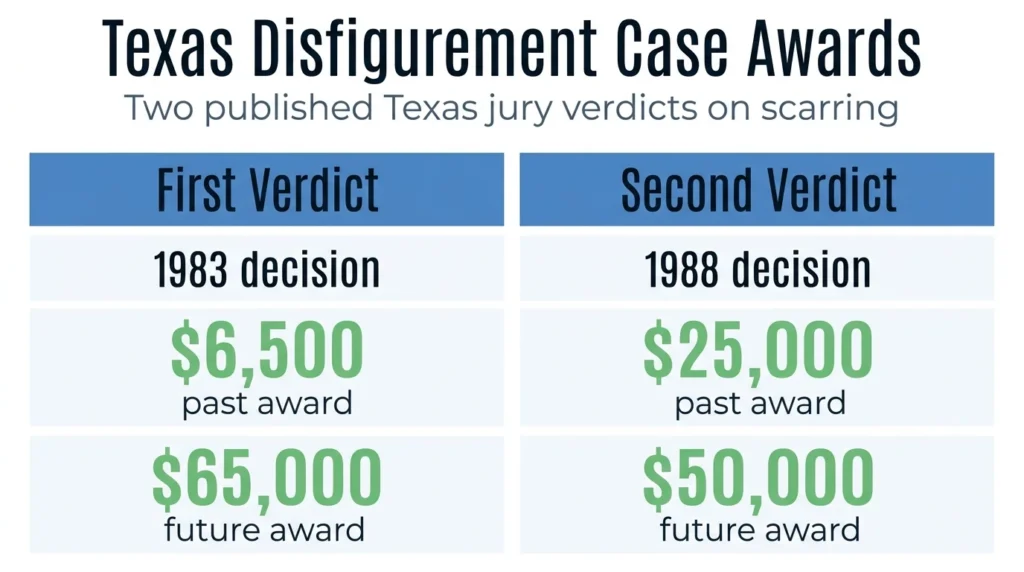
Published Texas decisions show that juries have placed real money on disfigurement. They are individual cases, though, not a range you can apply to your own.
In Amoco Production Company, Incorporated versus Thompson, a 1983 decision of the Court of Appeals of Texas at Corpus Christi, the court affirmed a judgment, after a remittitur, that included $6,500 for past cosmetic disfigurement and $65,000 for future cosmetic disfigurement. The claimant was a welder who suffered severe burns to his face, arms, and hands.
In Hopkins County Hospital District versus Allen, a 1988 Texas appellate decision, the reported jury award included $25,000 for past disfigurement and $50,000 for future disfigurement, alongside separate amounts for pain, mental anguish, physical impairment, and medical expenses.
Both awards are decades old, rest on the specific facts and evidence of those cases, and are not adjusted for inflation. Neither one is a typical, average, or current value for a scarring claim in Texas. Settlement values vary widely and are driven by the factors above, and no chart can tell you what your scar is worth.
Talk to a Lawyer Before You Settle
The decision that shapes a scarring claim is usually made early, before anyone knows what the scar will finally look like. That is when a conversation is worth the most.
Angel Reyes & Associates has guided injured Texans through the claims process for over 30 years. The team can review where your scar sits in the healing process, what documentation you should be building right now, and how your occupation and daily life factor into disfigurement damages. You can reach the firm 24 hours a day.
Contact Angel Reyes & Associates for a free consultation before you accept any offer on a scarring injury.
Past results do not guarantee future outcomes
Scarring in Texas Personal Injury Claim FAQs
Is disfigurement the same thing as pain and suffering in a Texas injury claim?
No, Texas treats disfigurement and pain and suffering as separate, non-duplicative damages categories. Texas Civil Practice and Remedies Code Section 41.001(12) lists each as its own item, and in Golden Eagle Archery, Incorporated versus Jackson, the Supreme Court of Texas confirmed juries answer these as distinct questions and may not fold one element’s damages into another. A jury can award disfigurement damages in addition to, not instead of, pain and suffering or mental anguish.
Does a scar affect a Texas workers' compensation claim differently than a personal injury lawsuit?
It can, because workers’ compensation benefits and third-party personal injury claims are governed by different rules and available damages; whether disfigurement is separately compensable depends on the type of claim and applicable workers’ compensation law.
What evidence can help prove the value of a scar in a Texas personal injury claim?
Medical records, photographs showing the scar’s progression, testimony about how it affects daily life, and medical opinions about permanence or possible revision can help establish the extent of disfigurement and future damages.
If I get scar-revision surgery, can I still recover disfigurement damages?
Yes, pursuing revision treatment does not erase a disfigurement claim. A plastic surgery or dermatology consultation on options such as surgical excision, laser, microneedling, or steroid injection helps establish the scar’s severity and permanence, and its projected cost can support a separate future-medical-expense claim. Disfigurement remains its own distinct damages category even when revision is pursued or planned.
About the Authors

Angel Reyes
Writer
Angel L. Reyes, III is the Founder and Managing Partner of Angel Reyes & Associates. A nationally recognized trial attorney and business leader, Angel has helped over 70,000 injury victims recover more than $1 billion since founding the firm in 1993. Named to the Texas Super Lawyers list annually since 2008, Angel brings Wall Street experience, Ivy League education, and a deep commitment to client advocacy. He is a frequent legal commentator and published author with extensive contributions to legal scholarship, trial strategy, and consumer protection.

Graham Griffin
Editor
Graham Griffin is the Web & Content Manager at Angel Reyes & Associates, where he oversees content strategy, AI-powered workflows, a...

Angel Reyes
Reviewer
Angel L. Reyes, III is the Founder and Managing Partner of Angel Reyes & Associates. A nationally recognized trial attorney and business...