What Is a Car Insurance Declarations Page?


Every article on this site is researched by our internal team, reviewed for legal accuracy against current Texas law, and held to State Bar of Texas advertising standards before publication. We do not publish content that overstates outcomes or makes promises about results.
Learn more about our
editorial standards .
Key Takeaways
- Your car insurance declarations page summarizes drivers, vehicles, coverages, limits, and dates.
- If PIP or UM/UIM is missing, request the written rejection and the policy from the crash date.
- Texas crash-information duties under §550.023 do not include exchanging declarations pages.

A car insurance declarations page is the summary sheet of your auto policy. After a Texas crash, it helps you find coverage that may pay medical bills, vehicle repairs, or other covered losses. It lists named insureds, drivers, vehicles, selected coverages, limits, applicable deductibles, policy dates, and references to endorsements that change the policy.
Use the declarations that applied on the crash date. The full policy and its endorsements explain whether a particular loss is covered.
What Does a Car Insurance Declarations Page Show?
A declarations page summarizes the people, vehicles, coverages, and dates associated with one auto policy. Layouts differ among insurers. The Texas Department of Insurance declarations guide recommends checking the policy number, dates, drivers, vehicles, coverage amounts, premiums, and deductibles.
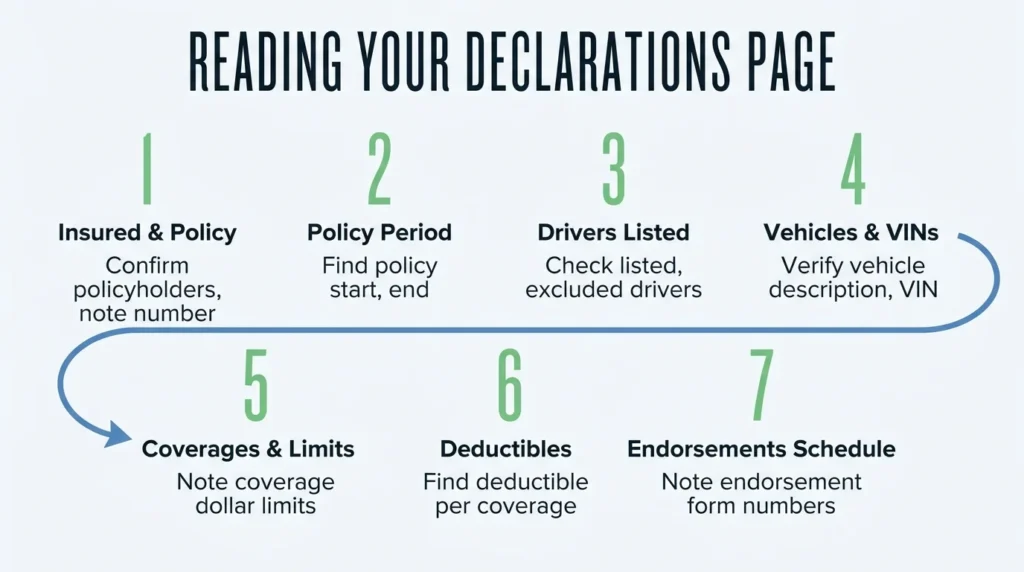
Read yours in this order:
- Named insured and policy number. Confirm the policyholders named on the policy and note the number for your claim.
- Policy period. Find the start and end dates of the policy term.
- Listed and excluded drivers. The TDI Consumer Bill of Rights identifies excluded drivers as information your declarations should show.
- Vehicles. Check each vehicle’s description and VIN, then read that vehicle’s coverage entries separately.
- Coverages and limits. Note each coverage and the dollar limit next to it.
- Deductibles. Find any deductible tied to a coverage. Not every coverage carries one.
- Endorsements or forms schedule. Note the form numbers so you can request the actual documents.
According to the TDI auto insurance glossary, your premium is what the insurance costs, and your
deductible is your share of a covered loss. An endorsement changes the policy’s benefits; a form number alone does not explain its effect.
Texas policyholders can ask their insurer for a complete copy of the policy at any time. After a crash, ask your insurer or agent for the declarations and full policy that applied on the crash date, including amendments.
How Do You Read Your Own Declarations Page After a Crash?
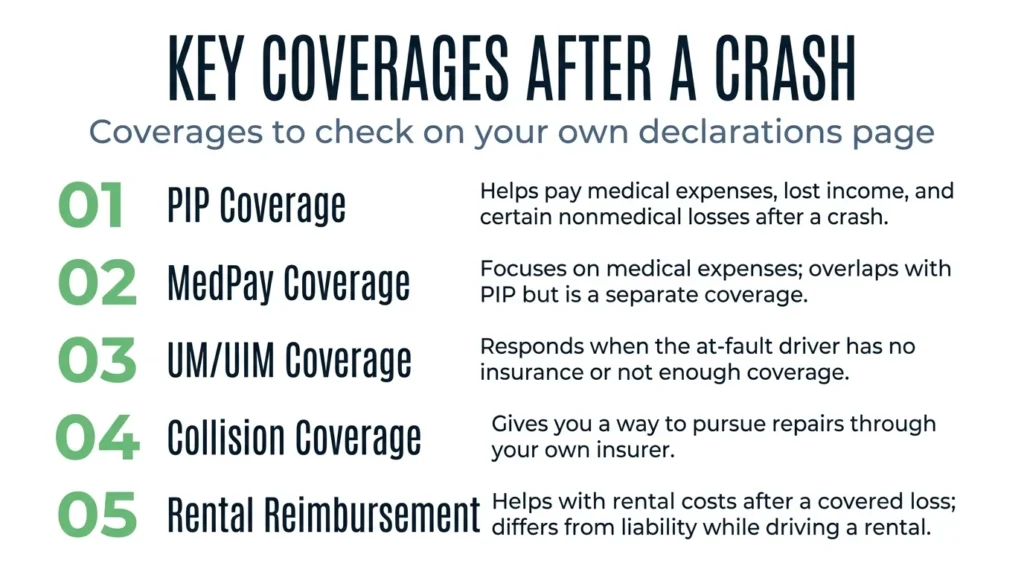
Find each benefit listed for the vehicle involved, then confirm its terms in the full policy. The TDI auto insurance guide describes these coverages and explains that exact coverage varies by policy.
- Personal injury protection (PIP). Look for the PIP limit. PIP can help pay medical expenses, lost income, and certain other nonmedical losses after a crash.
- Medical payments (MedPay). Look for medical payments coverage and its limit. MedPay focuses on medical expenses; it overlaps with PIP in that role but is a separate coverage.
- Uninsured/underinsured motorist (UM/UIM). Find the bodily injury and property damage entries and their limits. UM/UIM can respond when the driver who caused the crash has no insurance or not enough, subject to your policy and Texas law.
- Collision. Check whether you carry collision coverage and find the deductible for damage to your vehicle. Collision gives you a way to pursue repairs through your own insurer.
- Rental reimbursement. Check whether you bought it and note any stated daily or total limits. This coverage helps with rental costs after a covered loss; it differs from liability protection while you drive a rental car.
Your own liability entry generally covers damage you cause to others. When another driver hits you, check the coverages above for benefits under your own policy.
What If PIP or UM/UIM Is Missing or Marked Rejected?
A missing or rejected PIP or UM/UIM entry calls for the written rejection records and the policy documents. The declarations page alone cannot establish whether a disputed rejection is valid.
Under Texas Insurance Code §§1952.101 and 1952.152, covered auto liability policies must include
UM/UIM and PIP unless an insured named in the policy rejects the coverage in writing. A qualifying earlier rejection can carry forward to a renewed or reinstated policy under the statute’s conditions, so a new signature is not always required.
The TDI personal automobile checklist confirms these requirements and explains that selection and rejection forms are separate from the policy itself.
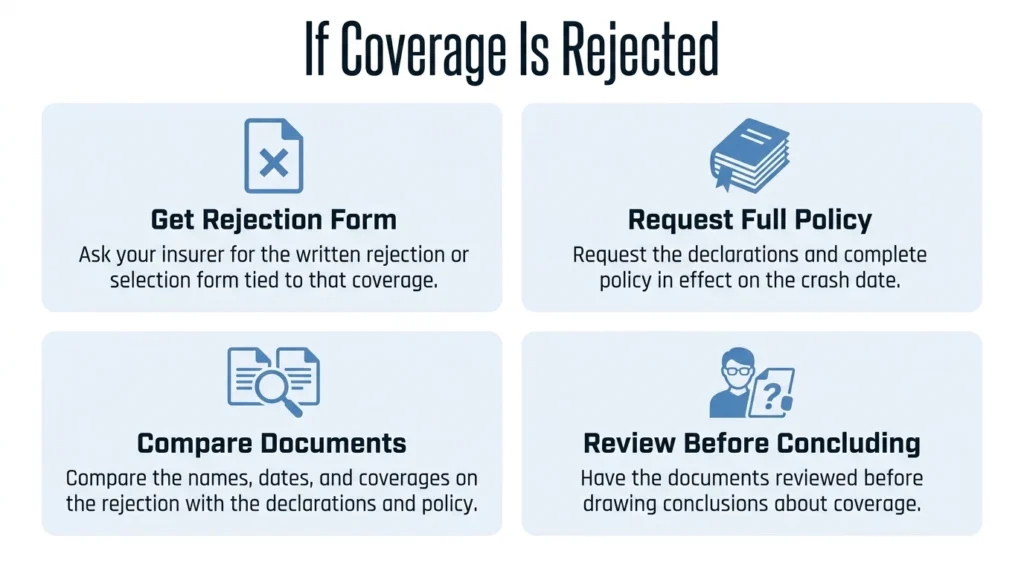
If an entry is missing or marked rejected:
- Ask your insurer for the written rejection or selection form tied to that coverage.
- Request the declarations and complete policy in effect on the crash date.
- Compare the names, dates, and coverages on the rejection with the declarations and policy.
- Have the documents reviewed before drawing conclusions about coverage.
Not having a rejection form in your records does not settle whether coverage applies. The insurer’s records and the applicable law also matter. MedPay, collision, and rental reimbursement do not share these statutory written-rejection requirements.
What Can You Learn About the Other Driver’s Insurance?
The insurer information exchanged after a qualifying Texas crash identifies the company to contact. It does not provide the coverage details found on a declarations page.
Texas Transportation Code §550.023 applies to a collision that causes injury or death or damages a vehicle that is driven or attended. In that situation, the law requires a driver to:
- Give their name and address, vehicle registration number, and “the name of the operator’s motor vehicle liability insurer” to the injured people and vehicle operators, occupants, or attendants specified in the statute.
- Show their driver’s license if asked and if it is available.
- Provide reasonable aid to anyone injured.
The statute does not require exchanging a declarations page, policy limits, the full policy, or a policy number. Use the insurer’s name exchanged at the scene or recorded in available crash paperwork to start the insurance inquiry.
The other driver’s declarations page would summarize that policy’s insureds, vehicles, dates, and limits. It does not prove fault or guarantee payment. You may need to request it during the claim or in litigation, rather than obtain it at the scene.
Why Do Policy Dates, Drivers, Vehicles & Endorsements Matter?
Comparing the crash date, driver, and vehicle with your policy documents helps identify coverage questions. A match or mismatch on the declarations page does not decide coverage by itself.
- Dates. Check whether the crash falls within the listed policy period, then look for amendments or cancellation notices. A mid-term cancellation can affect coverage even when the original declarations show a later end date. The TDI Consumer Bill of Rights distinguishes cancellation before a term ends from nonrenewal at its end.
- Drivers. The listed-driver roster is not always the full definition of who is insured; policy terms addressing permission to use the vehicle also matter. The TDI personal automobile checklist requires a named-driver exclusion to identify the excluded person and be accepted in writing. If the insurer intends the exclusion to reach PIP or UM/UIM, corresponding rejection language is also required.
- Vehicles and endorsements. Compare the vehicle in the crash with the listed vehicles and VINs. Read the endorsement schedule and attached forms, including exclusions, before deciding what a difference means.
To prepare for a coverage review, gather your crash-date declarations, any signed PIP or UM/UIM rejection forms, and the endorsement schedule with its attached forms. Add the other driver’s insurer information exchanged at the scene or found in available crash paperwork.
Get Help Reviewing Insurance Coverage After a Texas Crash
Your declarations page identifies possible benefits; the full policy and rejection records help explain what those entries mean for your crash. Angel Reyes & Associates has guided injured Texans for over 30 years.
Gather your declarations, any rejection forms or endorsements, and available information about the other driver’s insurer. Contact Angel Reyes & Associates for a free consultation. You can reach the firm 24/7. Our attorneys are here to help.
Past results do not guarantee future outcomes.
Car Insurance Declarations Page FAQs
Does the other driver have to give me their declarations page at the crash scene?
No. For a crash covered by Texas Transportation Code §550.023, the driver must give the specified people their name and address, vehicle registration number, and liability insurer’s name; the law does not require handing over a declarations page or policy limits. You may need to request the other driver’s declarations page during the claim or litigation.
What happens if your car insurance policy was canceled before a crash, even though the declarations page shows active dates?
A cancellation that took effect before the crash may affect whether coverage applies, even if the original declarations page lists a later policy expiration date. The cancellation notice, its effective date, applicable Texas law, and the policy records should be reviewed to determine the status of coverage.
Can an insurance company change your coverage limits after a car accident?
An insurer generally evaluates a claim under the policy terms and limits applicable to the loss, rather than simply changing those limits after a crash. The policy in effect on the accident date, along with any valid amendments or endorsements, helps determine the available coverage.
About the Authors

Angel Reyes
Writer
Angel L. Reyes, III is the Founder and Managing Partner of Angel Reyes & Associates. A nationally recognized trial attorney and business leader, Angel has helped over 70,000 injury victims recover more than $1 billion since founding the firm in 1993. Named to the Texas Super Lawyers list annually since 2008, Angel brings Wall Street experience, Ivy League education, and a deep commitment to client advocacy. He is a frequent legal commentator and published author with extensive contributions to legal scholarship, trial strategy, and consumer protection.

Kyle Nicolas
Editor
Kyle Nicolas is the Web Content & SEO Manager at Angel Reyes & Associates. He has more than 10 years of experience as a marketing co...

Angel Reyes
Reviewer
Angel L. Reyes, III is the Founder and Managing Partner of Angel Reyes & Associates. A nationally recognized trial attorney and business...