Multiple Claimants, Same Insurance Policy: What Should You Do?


Every article on this site is researched by our internal team, reviewed for legal accuracy against current Texas law, and held to State Bar of Texas advertising standards before publication. We do not publish content that overstates outcomes or makes promises about results.
Learn more about our
editorial standards .
Key Takeaways
- Your per-person limit is a ceiling, not a share reserved for you when several are hurt.
- Texas insurers may reasonably settle one claim first, even if less remains for others.
- Interpleader puts remaining funds under court control but adds no extra coverage.

When multiple claimants compete for the same insurance limits in Texas, the insurer may make a reasonable settlement with one person even if it reduces or uses up what remains for the others. The insurer may also ask a court to hold the remaining money and resolve competing claims through interpleader.
If you are facing medical bills after a crash, learning that other injured people need the same policy can be unsettling. The per-person limit does not reserve a share for you, so the timing and terms of your settlement demand can matter.
What Happens When Several Injury Claims Exceed One Policy?
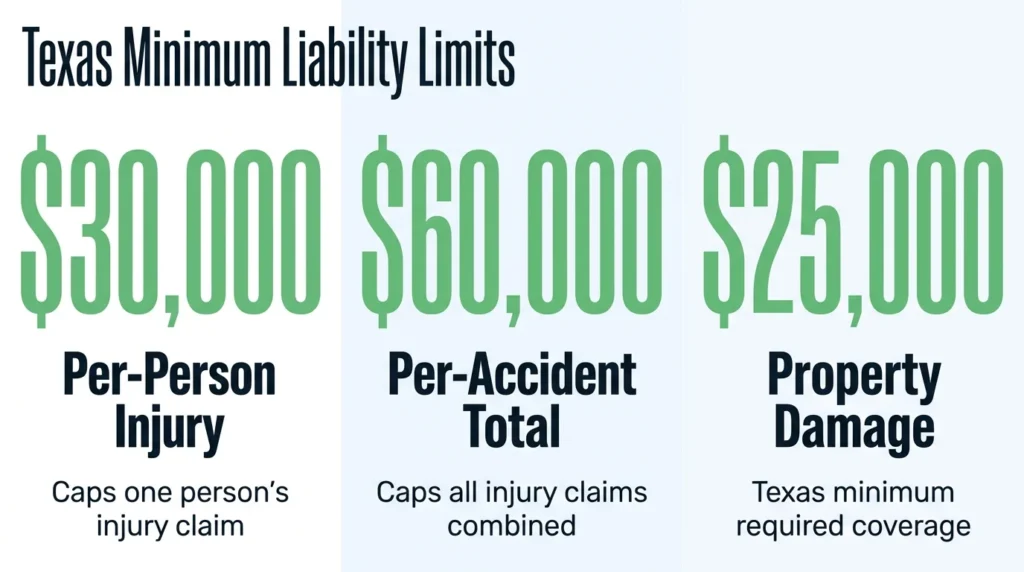
When injury claims add up to more than the policy covers, the per-person limit is only a ceiling. It is not money set aside for each injured person. Both the per-person and per-accident limits affect what any one person can receive.
The Texas Department of Insurance describes the state’s minimum liability coverage as $30,000 for injuries per person, $60,000 total per accident, and $25,000 for property damage. A driver’s actual policy may carry higher limits.
The per-person limit caps payment for one person’s bodily-injury claim. The per-accident limit caps payment for all bodily-injury claims from the same crash combined.
For a hypothetical example, say three people each have a $30,000 injury claim against a driver who carries the 30/60/25 minimum. Together they seek $90,000, but the shared bodily-injury limit is $60,000. These illustrative amounts do not establish equal shares or an automatic payment order.
Payments already made also count against the limits. If the insurer has settled one claim, less remains for everyone else. That is why someone pursuing a car accident claim involving several injured people needs the coverage and payment records early.
Your own coverage may help. TDI explains that uninsured/underinsured motorist coverage can apply when the responsible driver’s insurance is insufficient, and personal injury protection can pay certain losses. Whether either applies depends on your policy and its terms.
Can the Insurer Settle With One Person First?
Yes, if the settlement is reasonable. In Texas Farmers Insurance Co. v. Soriano, the Texas Supreme Court held that an insurer facing several claimants may settle with one of them even if the settlement reduces or exhausts the money left for the others.
The court judged that settlement on its own merits and the insured driver’s exposure, rather than the claimants’ relative injury severity. A person with a serious injury can still face a smaller remaining fund if someone else’s claim settled first.
Soriano does not create an unrestricted first-come, first-served rule. The court recognized two ways an insurer might act negligently: unreasonably rejecting a proper demand within limits or making an unreasonable competing settlement. An excess-liability claim also requires proof that the insurer’s negligence proximately caused damages to the insured.
For an injured person, the practical consequence is that insurers do not have to reserve proportional shares for everyone. Reasonable settlements can leave less coverage available for your claim.
Why Can the Timing & Terms of a Demand Matter?
A prompt, supported demand can count because other reasonable settlements may reduce the available limits before your claim is resolved. Notice alone does not secure payment. A demand must meet Texas settlement standards and account for both the per-person cap and the remaining per-accident limit.
Soriano shows why the actual demand date counts. The insurer settled one claim for $5,000, leaving $15,000; the other claimants demanded $20,000 only afterward. Evidence that they might have accepted $20,000 earlier did not count as an earlier demand.
Those were historical case amounts, not today’s minimum limits.
In American Physicians Insurance Exchange v. Garcia, the Texas Supreme Court described the conditions for a settlement demand to trigger the insurer’s duty under the Stowers doctrine:
- The claim must fall within the policy’s coverage.
- The demand must be within the applicable policy limits.
- The terms must be ones an ordinarily prudent insurer would accept, considering the insured driver’s potential exposure to a judgment above the limits.
Generally, the proposal must offer a full release of the insured in exchange for a stated amount or policy limits. Calling a letter a “Stowers demand” does not establish these conditions.
Stowers protects the insured against negligent failure to settle. It does not give each injured claimant an automatic direct right to the policy money.
Before preparing a demand, counsel evaluates liability evidence, documented damages, release language, the insurer’s reasonable opportunity to respond, and the applicable limits. No particular deadline automatically makes an insurer liable, and acting promptly does not mean accepting too little just to beat other claimants.
What If the Insurer Files Interpleader?
Interpleader lets an insurer ask a court to take control of disputed funds. Under Texas Rule of Civil Procedure 43, a party facing or potentially facing multiple liability can bring competing claimants into one case. An insurer can seek to deposit remaining policy proceeds so the court can address the competing claims.
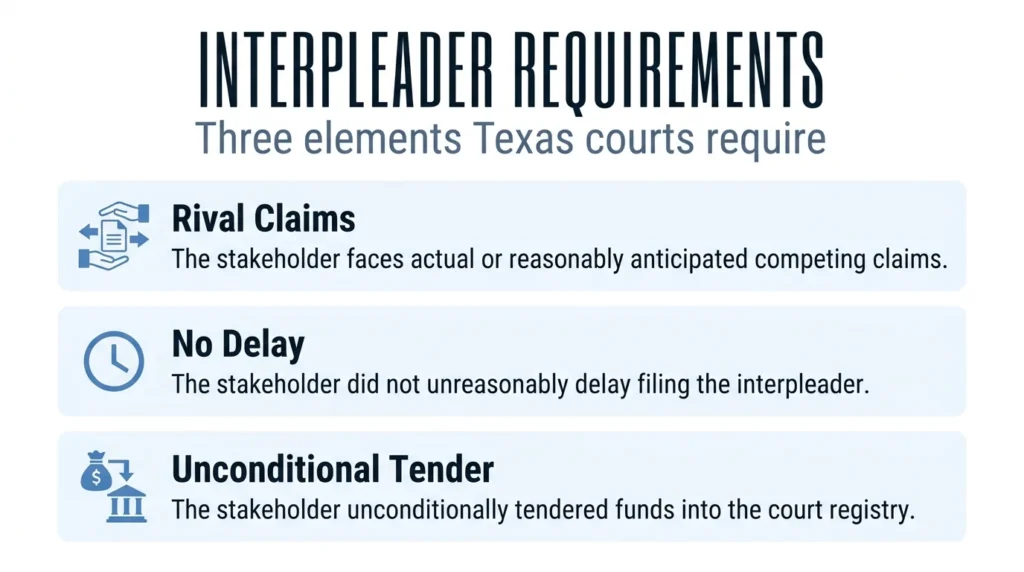
In Fort Worth Transportation Authority v. Rodriguez, the Texas Supreme Court described three interpleader elements:
- The stakeholder faces actual or reasonably anticipated rival claims.
- The stakeholder did not unreasonably delay filing.
- The stakeholder unconditionally tendered the funds into the court registry.
In Tri-State Pipe & Equipment, Inc. v. Southern County Mutual Insurance Co., a Texarkana appeals
court upheld an auto liability insurer’s interpleader of remaining policy proceeds while dissolving an injunction against other litigation. Depositing money with the court does not automatically stop every other claim.
If an insurance interpleader case names you, read the petition and applicable court orders, identify response requirements, and gather evidence supporting your claim to the deposited money.
Interpleader creates no extra coverage and no equal-share formula. Filing it does not automatically cure an earlier refusal to settle, release the at-fault driver, or end that driver’s personal exposure.
What Records Help Show Where Your Claim Stands?
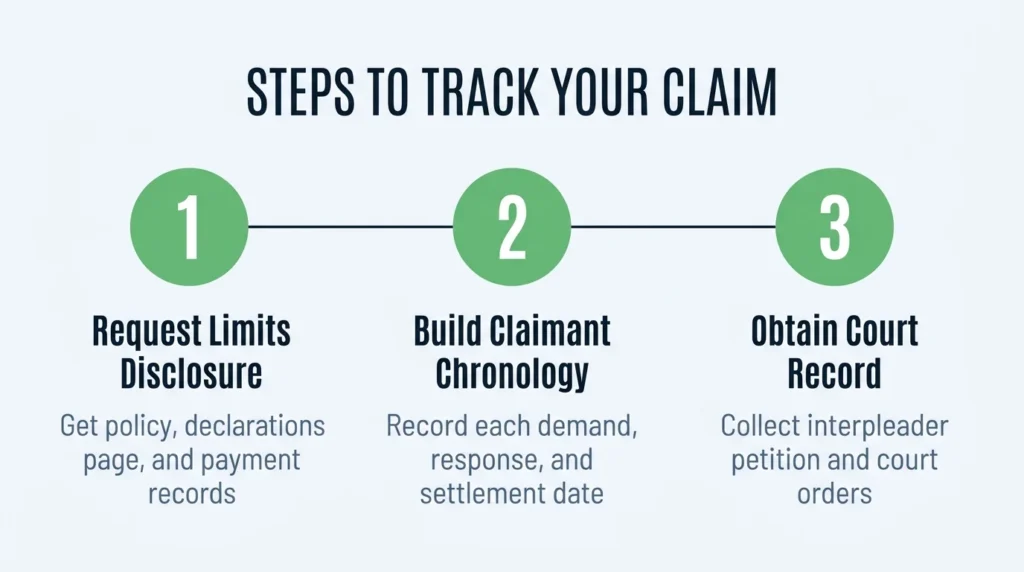
Coverage and payment records, a dated claimant chronology, and any interpleader court file help show what funds may remain and what needs attention. They do not, by themselves, establish priority. Start with these steps:
- Request the limits disclosure and payment records. Seek the policy, declarations page, endorsements, coverage position, original per-person and per-accident limits, and a written accounting of payments and remaining funds.
- Build the claimant chronology. Record each known claimant, each demand’s receipt date, amount, expiration and release terms, the insurer’s responses, and each settlement’s date and amount.
- Obtain the court record. Collect any interpleader petition, named parties and service details, proof of deposit, requested discharge or injunction, and court orders.
A declarations page alone does not prove today’s available balance. Preserve demand letters and transmission records instead of relying only on an adjuster’s summary. Compare any court deposit with the remaining limit the insurer reports.
In litigation, Texas Rule of Civil Procedure 192.3(f) and (g) permits discovery of potentially responsive insurance agreements and relevant portions of settlement agreements. This is a litigation discovery rule, not an unconditional right to disclosure before a lawsuit.
Early legal help focuses on evaluating limits, preparing a supported demand, and responding to interpleader. Those steps help you make decisions using the actual coverage and claim history.
Talk With Angel Reyes & Associates About a Limited Policy
When several people were hurt in the same Texas crash, you do not have to sort out a limited policy alone. Angel Reyes & Associates can help evaluate the limits, the demand and settlement timeline, and any interpleader filing.
Bring the insurance documents, letters, and court papers you have to a free consultation. Contact Angel Reyes & Associates to discuss your options. Our attorneys are here to help.
Past results do not guarantee future outcomes.
Multi-Claim Insurance Policy FAQs
What happens if an injured person rejects a settlement and the remaining policy limits are exhausted?
The injured person may still pursue a claim against the at-fault driver, but there may be little or no liability coverage left to pay a judgment. Other potential recovery sources, such as applicable underinsured motorist coverage, depend on the policies and circumstances involved.
Can an insurance company withdraw a settlement offer if other claimants are competing for the same limits?
Whether an offer can be withdrawn depends on its terms, whether it was accepted, and applicable contract law. An injured person should review the offer’s expiration date and acceptance requirements rather than assume the insurer will keep it open.
What happens if the at-fault driver's insurance limits are disputed during an interpleader case?
The parties may need to present policy documents, payment records, and other evidence to establish the amount of coverage available and the funds properly deposited with the court. The court can address the disputed issues according to the pleadings, evidence, and applicable procedural rules.
About the Authors

Angel Reyes
Writer
Angel L. Reyes, III is the Founder and Managing Partner of Angel Reyes & Associates. A nationally recognized trial attorney and business leader, Angel has helped over 70,000 injury victims recover more than $1 billion since founding the firm in 1993. Named to the Texas Super Lawyers list annually since 2008, Angel brings Wall Street experience, Ivy League education, and a deep commitment to client advocacy. He is a frequent legal commentator and published author with extensive contributions to legal scholarship, trial strategy, and consumer protection.

Kyle Nicolas
Editor
Kyle Nicolas is the Web Content & SEO Manager at Angel Reyes & Associates. He has more than 10 years of experience as a marketing co...

Angel Reyes
Reviewer
Angel L. Reyes, III is the Founder and Managing Partner of Angel Reyes & Associates. A nationally recognized trial attorney and business...