ICE & Border Patrol Vehicle Crashes in Texas


Every article on this site is researched by our internal team, reviewed for legal accuracy against current Texas law, and held to State Bar of Texas advertising standards before publication. We do not publish content that overstates outcomes or makes promises about results.
Learn more about our
editorial standards .
Key Takeaways
- Photograph plates, agency markings, and the scene, and get the police report number.
- An ICE or CBP crash claim goes to the agency in writing, with a dollar amount, within two years.
- You can seek legal help after a crash regardless of your immigration status.
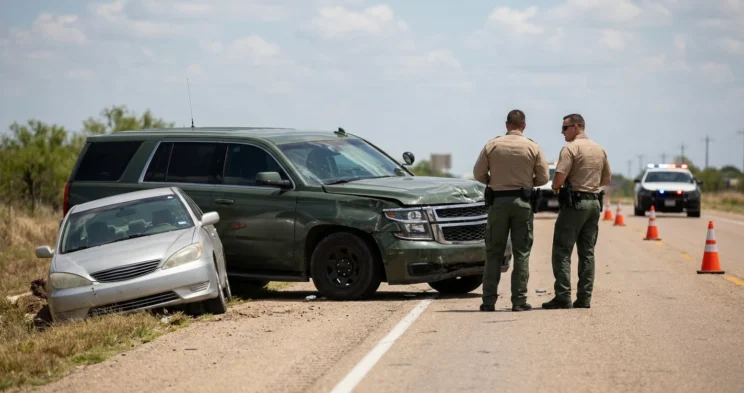
A crash with an ICE or Border Patrol vehicle can leave you hurt and unsure whether you can do anything about it. You may assume the federal government can’t be held responsible, or that speaking up could create problems for your family. You may think the government will retaliate for pursuing action against them.
There is some good news: federal law gives you a way to seek compensation, but it runs on strict rules that start the day of the crash.
Evidence You Save Now Shapes the Claim
After a crash with a federal vehicle, your first job is getting to safety and seeking medical care. Always get checked out by a medical professional immediately and get documentation for your condition.
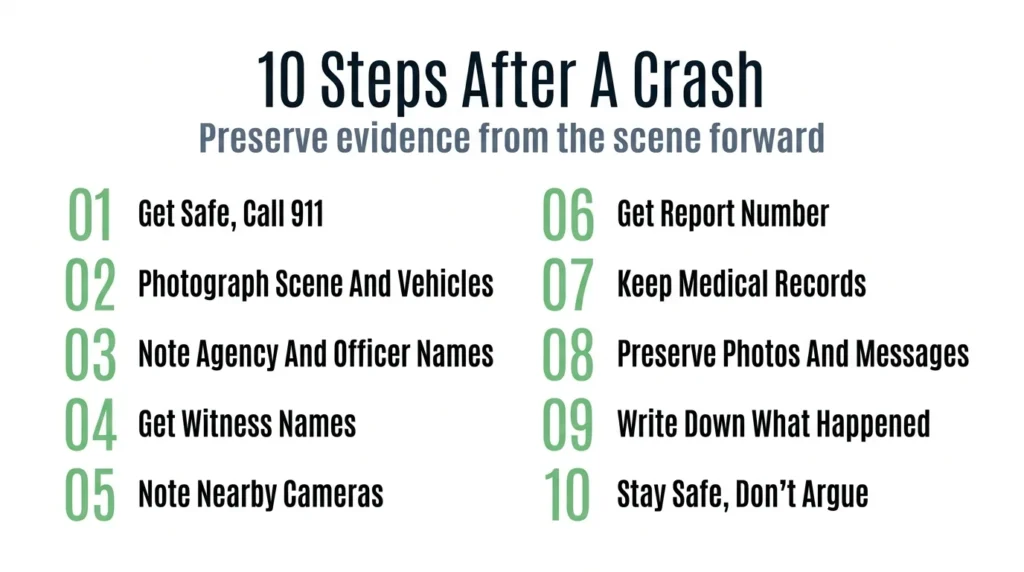
Your second job is saving proof of what happened because the agency will judge your claim on the records you provide. The agency will demand medical records, day-of evidence, and plenty of other documentation to support your claim, and you won’t have a ton of time to assemble and provide it.
Work through these steps at the scene and in the days after:
- Get safe; call 911 and get medical care for any injury.
- Photograph or record the scene, all vehicles, license plates, any markings, and injuries.
- Write down the agency name and any officer names you are told or can see.
- Get witness names and phone numbers.
- Note nearby cameras (businesses, homes) and save any footage you can.
- Get the police or incident report number.
- Keep all medical records, bills, and receipts.
- Do not delete photos, messages, or posts, and do not post details online.
- Write down what you remember as soon as you can.
- Do not argue with or try to stop anyone; stay safe.
U.S. Government plates, agency markings, and unit numbers help route your claim to the right office. If the vehicle had no markings, the police report and witness details can help you identify it.
Under Texas Transportation Code § 550.026, you must immediately report a crash that injures someone or leaves a car unsafe to drive. Calling 911 is the fastest way to do that.
The agency will want your records later. ICE’s claims page asks for photos, medical records, police or witness reports, and employee names if you know them. A lawyer can help you gather and preserve this evidence while you focus on getting better.
Your Claim Is Against the United States
When a federal employee causes a crash on the job, your claim generally goes against the United States. Under 28 U.S.C. § 2679, the agent is not personally on the hook.
Whether the agent was on the job is often the main dispute in one of these claims. In Barrier v. United States, a CBP agent driving out of a Del Rio station struck a pedestrian. A federal trial court ruled for the government, but the Fifth Circuit reversed in July 2026 and sent the case back. The ruling didn’t decide the case, but it shows the agent’s task at the moment of the crash can decide whether your claim moves forward.
Your claim is federal, but the crash happened in Texas. Under 28 U.S.C. § 1346(b)(1), Texas law decides who was at fault, which can affect how much you recover.
Not every enforcement vehicle in Texas is federal. If a state or local vehicle, such as a DPS patrol car, hit you, your claim falls under the Texas Tort Claims Act instead. Our guide to suing a Texas government entity explains that separate process.
Where ICE & CBP Claims Go
Your case starts with a written claim to the agency whose employee was driving. You can’t skip this step and go straight to court, and where you send the claim depends on the agency.
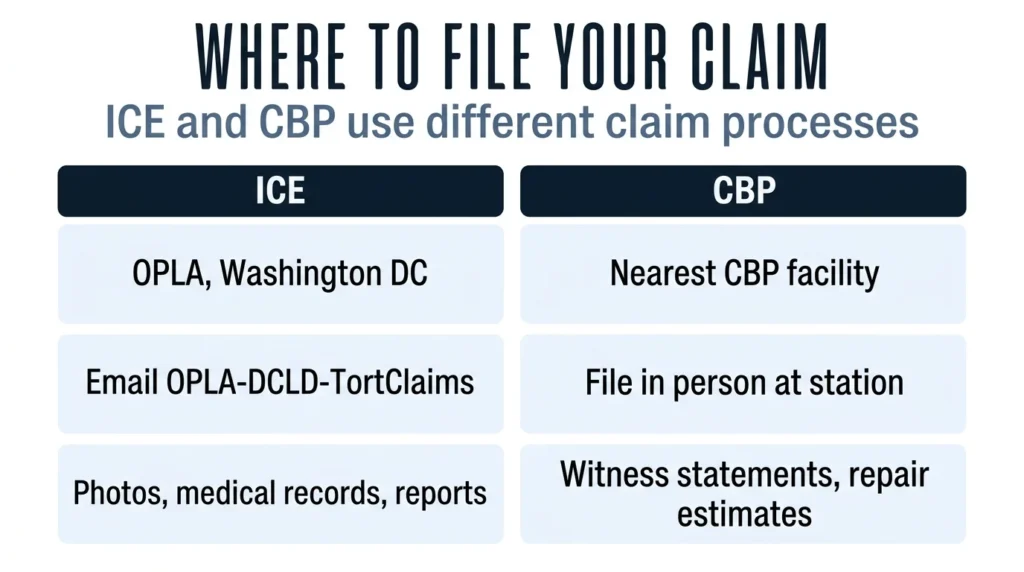
For an ICE vehicle, your claim goes to ICE’s Office of the Principal Legal Advisor, District Court Litigation Division. The mailing address is 500 12th Street SW, Mailstop 5900, Washington, DC 20536. Questions go to [email protected].
The United States Border Patrol is part of U.S. Customs and Border Protection (CBP). Under CBP’s claims instructions, you file at the port of entry, Border Patrol station, or other CBP facility nearest the crash. Include supporting documents such as witness statements, police reports, and repair estimates.
If you aren’t sure which agency was involved, use the police report and vehicle markings to find out before you file. Under 28 C.F.R. § 14.2, an agency that gets a misdirected claim must forward it if it can identify the right one. This transfer does not stop your clock, and many federal agencies don’t forward things right away. Don’t count on a transfer to meet your deadline.
Every claim must name a specific dollar amount, called a sum certain. That number usually caps what you can recover later, so a low early estimate can cost you.
Under 28 U.S.C. § 2401(b), the agency must receive your claim within two years of the crash. A claim mailed on the last day can arrive too late.
While your claim is pending, your own auto policy may help. Texas Insurance Code § 1952.152 requires insurers to include personal injury protection (PIP) unless you rejected it in writing.
PIP can help with medical bills and lost income no matter who caused the crash. Our overview of how Texas car accident claims work covers PIP and other early steps.
A lawyer can help you identify the right agency and calculate the full amount before you file.
Help Is Available Regardless of Status
You can reach out for legal help regardless of your immigration status, and you should not be afraid to seek assistance after an accident. At Angel Reyes & Associates, we have spent more than 30 years advocating for injured Texans, with more than $1 billion recovered for clients.
We take Texas car accident cases, including crashes with government vehicles, and you pay no fee unless we win. Our team is available 24/7, and we offer service in Spanish. Reach out for a free case review.
Past results do not guarantee future outcomes.
ICE & US Border Patrol Crash FAQs
Does the two-year deadline pause if my child was hurt?
No. Texas usually pauses injury deadlines until a child turns 18, but that pause doesn’t apply to federal claims, so the agency must still receive the claim within two years of the crash.
Who can file a claim if someone was killed in the crash?
Texas wrongful death law decides who can recover: the surviving spouse, children, and parents. They still have to send a written claim to the agency within two years of the death.
What if I was a passenger in an ICE transport vehicle?
If a federal employee was driving, you can file a federal claim like any other person hurt in the crash. If a private contractor ran the transport, the claim usually goes to that company and its insurer instead.
What if the agent was off duty in a personal car?
The claim usually goes against the driver and their insurance under Texas’s normal two-year rules. A federal claim generally applies only when the agent was acting within the job at the time.
Can the agency settle my claim without a lawsuit?
Yes. The agency can settle while it reviews your claim, but any settlement over $25,000 needs approval from the U.S. Department of Justice.
About the Authors

Angel Reyes
Writer
Angel L. Reyes, III is the Founder and Managing Partner of Angel Reyes & Associates. A nationally recognized trial attorney and business leader, Angel has helped over 70,000 injury victims recover more than $1 billion since founding the firm in 1993. Named to the Texas Super Lawyers list annually since 2008, Angel brings Wall Street experience, Ivy League education, and a deep commitment to client advocacy. He is a frequent legal commentator and published author with extensive contributions to legal scholarship, trial strategy, and consumer protection.

Kyle Nicolas
Editor
Kyle Nicolas is the Web Content & SEO Manager at Angel Reyes & Associates. He has more than 10 years of experience as a marketing co...

Angel Reyes
Reviewer
Angel L. Reyes, III is the Founder and Managing Partner of Angel Reyes & Associates. A nationally recognized trial attorney and business...