How Does the Car Accident Claim Process Work in Texas?


Every article on this site is researched by our internal team, reviewed for legal accuracy against current Texas law, and held to State Bar of Texas advertising standards before publication. We do not publish content that overstates outcomes or makes promises about results.
Learn more about our
editorial standards .
Key Takeaways
- Insurers must accept or reject a documented claim within 15 business days.
- A demand letter should wait until treatment reaches a clear endpoint.
- Texas law gives crash victims exactly two years to file a lawsuit.
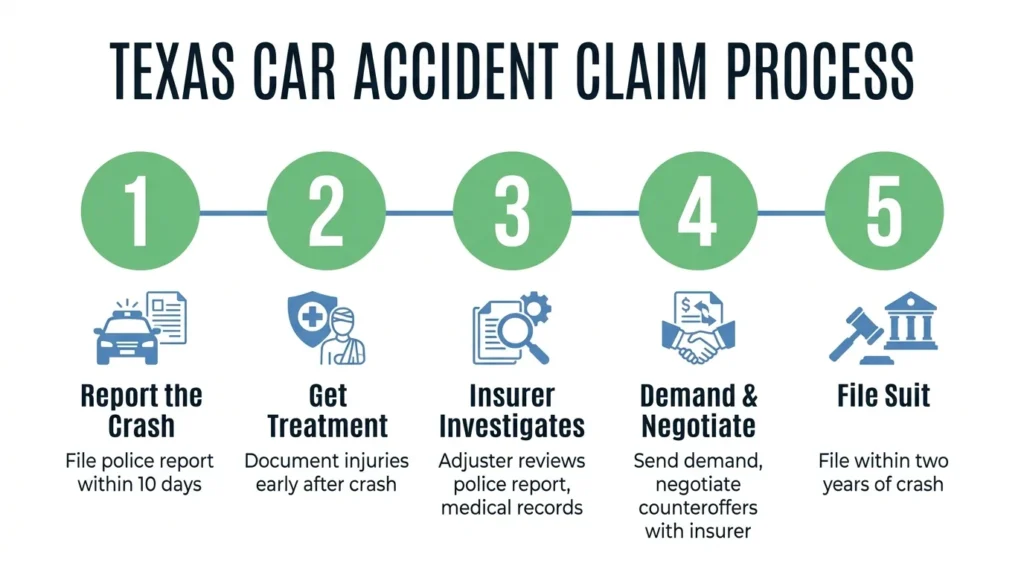
You’re sitting in your kitchen in Houston with a stack of medical bills, a totaled car, and no idea what happens next. A car accident claim in Texas moves through a predictable sequence.
Knowing each stage, and its realistic timeline, helps you avoid the mistakes that slow a claim down.
Reporting the Crash & Getting the Report
Report the crash to police when anyone is hurt or damage looks like it tops $1,000. An officer who investigates must file a written collision report within 10 days under Texas Transportation Code Section 550.062.
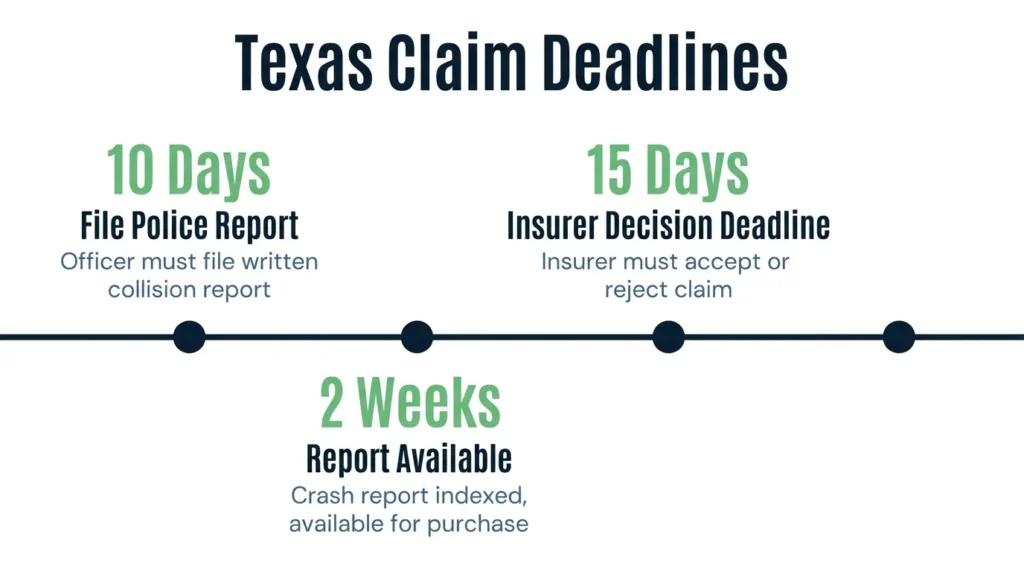
If no officer responds and that same damage or injury threshold is met, you must file your own written report with the state within the same 10-day window.
Once a report exists, you can request your copy through TxDOT’s crash report system, online or by mailed form. Plan on roughly two weeks after the crash before the report is indexed and available to buy.
The most common stall point here is skipping the official report entirely. Reporting only to your own insurer leaves no independent record once the other driver’s insurer starts questioning fault.
Getting the Medical Treatment Your Claim Needs
Get evaluated right after the crash, even if you feel fine. Adrenaline can mask injury symptoms that surface over the following days.
An early medical record also ties your injury to the crash date. From there, follow through on the full course of treatment your provider recommends.
A straightforward soft-tissue injury often improves within a few weeks, though moderate cases can take 6 to 12 weeks to fully resolve. More serious injuries can take several months to a year to reach maximum medical improvement, the point where a doctor confirms your condition has stabilized.
Treatment gaps are the biggest stall point in this stage. Skipping appointments, or switching providers without a clear reason, gives an insurer an opening.
That opening lets them argue something other than the crash explains your ongoing pain.
How the Insurer Investigates Your Claim
Once you report your claim, the adjuster starts building a file. That file draws on the police report, your medical records, photos, and any witness statements.
This is a document-gathering process, not an instant decision. Texas law still puts a real clock on this stage.
Under Texas Insurance Code Section 542.056, an insurer must accept or reject your claim within 15 business days. That clock starts once the insurer has everything it needs to evaluate the claim.
The window can stretch to the 45th day if the insurer explains the delay in writing. In practice, most investigations wrap up within that statutory window, though more complex claims can take longer.
Missing paperwork is the single biggest reason this stage stalls. An investigation cannot close until the insurer has the police report, complete medical records, and proof of lost wages.
Adjusters sometimes point to those documentation gaps, not the crash facts, to justify underpaying an otherwise valid claim. Getting your file organized early keeps this stage from dragging on.
The Demand & Negotiation
Sending the Demand Letter
A demand letter formally lays out liability, your injuries, and an itemized total. Most go out once your treatment picture is clear, close to maximum medical improvement.
Sending the demand before treatment ends is the main stall point here. It forces guesswork about future medical costs, which usually undervalues the claim.
Negotiating with the Insurer
The insurer typically responds to your demand with a counteroffer below your number. Negotiation runs from there, through a series of back-and-forth offers rather than a single response.
Negotiation commonly takes anywhere from a few weeks to several months, depending on how quickly both sides agree on the numbers. Disputed-liability or high-value claims can stretch that settlement timeline considerably longer.
A fault dispute is the most common stall point. Texas follows a modified comparative negligence rule under Texas Civil Practice and Remedies Code Section 33.001.
Under that rule, you recover a reduced amount if you share some fault. You recover nothing once your own share passes 50%.
Insurers know this, so they often argue for a bigger share of fault on your side. That argument alone can stall talks for weeks while both sides work out the numbers.
Filing Suit When the Claim Doesn’t Resolve
Filing a lawsuit becomes the realistic path once negotiation stalls without a fair offer. It often restarts settlement talks, since insurers take a filed case more seriously than one still in negotiation.
The deadline here is firm. Suit must be filed within two years of the crash date under Texas Civil Practice and Remedies Code Section 16.003.
Miss that date, and the court dismisses the case. That happens regardless of how clear the other driver’s fault was.
After filing, the case moves into discovery, where both sides exchange records and take sworn testimony. A straightforward filed case often reaches trial in 12 to 18 months.
A backed-up county docket, or a genuinely complex dispute, can push that timeline to 2 or 3 years.
Most filed cases still settle before trial, and trials stay the exception even after suit is filed.
Crowded dockets and drawn-out discovery are the main reasons this stage runs long. Neither side’s single decision usually causes the delay on its own.
Speak with an Experienced Attorney About Your Claim
Angel Reyes & Associates has guided Texas accident victims through this process for more than 30 years. That experience means we know how to keep your claim moving at every stage.
We handle the documentation, deadlines, and negotiation so you can focus on recovering. Our case results reflect more than $1 billion recovered for clients, and you pay nothing unless we win.
Contact us for a free consultation, and let’s get your claim moving toward a fair resolution.
Past results do not guarantee future outcomes.
Car Accident Claim Process FAQs
What if the other driver has no insurance?
Your own uninsured or underinsured motorist coverage typically becomes your main source of compensation, since Texas requires insurers to include that coverage on every policy unless you reject it in writing under Texas Insurance Code Section 1952.101.
Will my own insurance pay my medical bills while the claim is still pending?
Yes, if you carry personal injury protection, since Texas auto policies include it automatically unless you reject it in writing under Texas Insurance Code Section 1952.152. PIP pays regardless of who caused the crash.
Does a shorter deadline apply if a government vehicle caused the crash?
Yes. Claims against a governmental unit require written notice within six months of the crash under Texas Civil Practice and Remedies Code Section 101.101, and some cities set an even shorter local deadline.
Do I need a police report if the crash happened in a parking lot?
The same $1,000 damage or injury threshold applies, but officers sometimes decline to respond on private property, so you may need to file your own report and gather other evidence.
Does a rideshare crash follow different insurance rules than a regular accident?
Yes. Once an Uber or Lyft driver has accepted a ride or has a passenger, Texas law requires at least $1 million in liability coverage under Texas Insurance Code Section 1954.053, far above the standard minimum.
About the Authors

Angel Reyes
Writer
Angel L. Reyes, III is the Founder and Managing Partner of Angel Reyes & Associates. A nationally recognized trial attorney and business leader, Angel has helped over 70,000 injury victims recover more than $1 billion since founding the firm in 1993. Named to the Texas Super Lawyers list annually since 2008, Angel brings Wall Street experience, Ivy League education, and a deep commitment to client advocacy. He is a frequent legal commentator and published author with extensive contributions to legal scholarship, trial strategy, and consumer protection.

Kyle Nicolas
Editor
Kyle Nicolas is the Web Content & SEO Manager at Angel Reyes & Associates. He has more than 10 years of experience as a marketing co...

Angel Reyes
Reviewer
Angel L. Reyes, III is the Founder and Managing Partner of Angel Reyes & Associates. A nationally recognized trial attorney and business...