Can a Bike Defect Cause Your Crash?


Every article on this site is researched by our internal team, reviewed for legal accuracy against current Texas law, and held to State Bar of Texas advertising standards before publication. We do not publish content that overstates outcomes or makes promises about results.
Learn more about our
editorial standards .
Key Takeaways
- Keep the bicycle and failed part unrepaired so an engineer can investigate what failed first.
- A matching recall identifies a hazard but does not prove the defect caused your injury.
- Texas Chapter 82 rules on design, sellers, and federal compliance shape potential liability.

You decided to take a ride on your new bike, only to end up on the pavement and in pain. You are certain a defect in the bike’s design caused the crash, and are now left wondering if you have a personal injury claim.
Yes, a bicycle defect can cause a crash without another vehicle. If your bike failed on a Dallas bike lane or a Texas farm road, the damaged component may help explain why you fell. A Texas bicycle defect lawsuit requires evidence connecting the defect to your injury. Keep the bicycle and detached parts unrepaired so an engineer can investigate what happened.
How Can a Bicycle Defect Cause a Crash When No Vehicle is Involved?
A component that cracks, loosens, or stops working can cause loss of control. But damage after a crash does not prove the part failed before impact; installation, maintenance, and other causes also need evaluation.
The federal bicycle requirements in 16 CFR Part 1512 address mechanical integrity, brakes, wheel hubs, forks, and frames. They cover bicycles as defined in the regulation, with exclusions for track and one-of-a-kind bicycles.
The Consumer Product Safety Commission’s bicycle guidance explains the requirements for products offered for sale, including assembly according to instructions. Do not recreate regulatory tests on a crashed bicycle.
Which Bicycle Parts Can Fail & Cause a Crash?
Frames, fork components, quick-release wheels, and brakes have documented crash hazards. Converted e-bikes also require review of the kit and installation.
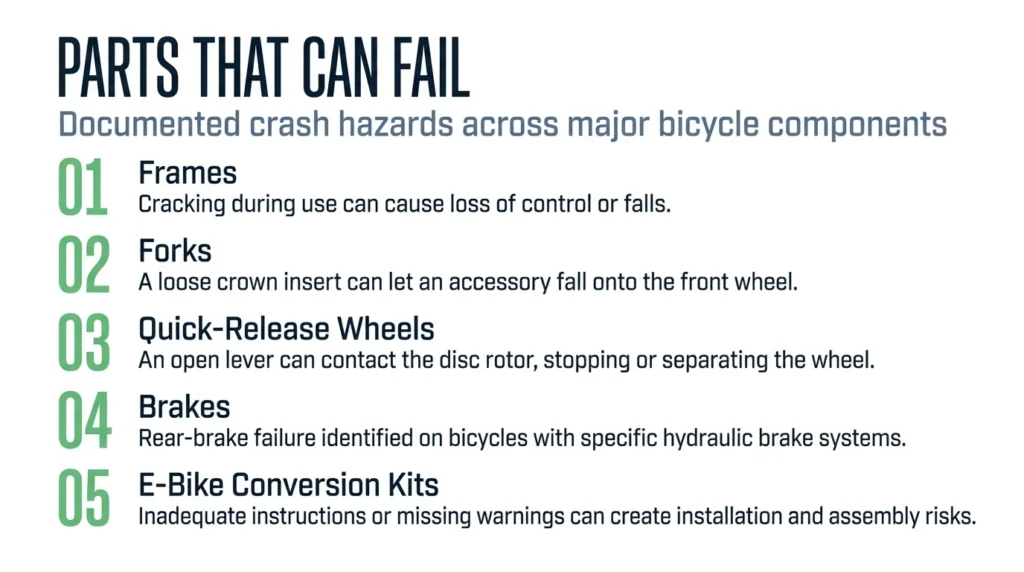
- Frames. A Dynacraft recall described frames cracking during use, causing loss of control, falls, or collisions. It illustrates a failure mechanism without proving that every cracked frame was defective before impact.
- Forks. Part 1512 addresses fork and frame strength, including fracture and deformation that limits steering. The Ritchey carbon fork recall involved a different mechanism: a loose crown insert could allow an accessory to fall onto the front wheel.
- Quick-release wheels. A 2015 recall involving multiple companies described an open front quick-release lever contacting a disc rotor, potentially stopping or separating the wheel. It did not cover every quick-release bike, and the lever’s post-crash position alone does not establish rider fault.
- Brakes. The Open Cycle recall identified rear-brake failure on specified bicycles and framesets with Campagnolo hydraulic brakes. An inspection must evaluate the actual system and its condition.
- E-bike conversion kits. Compatibility, instructions, and installation count. A Jersey government safety notice identified inadequate assembly instructions and missing warnings as risks from unsafe conversion; it is not a U.S. recall. Preserve the original bicycle, kit, instructions, seller details, and installation records together for inspection.
When Does Texas Law Support a Bicycle Defect Lawsuit?
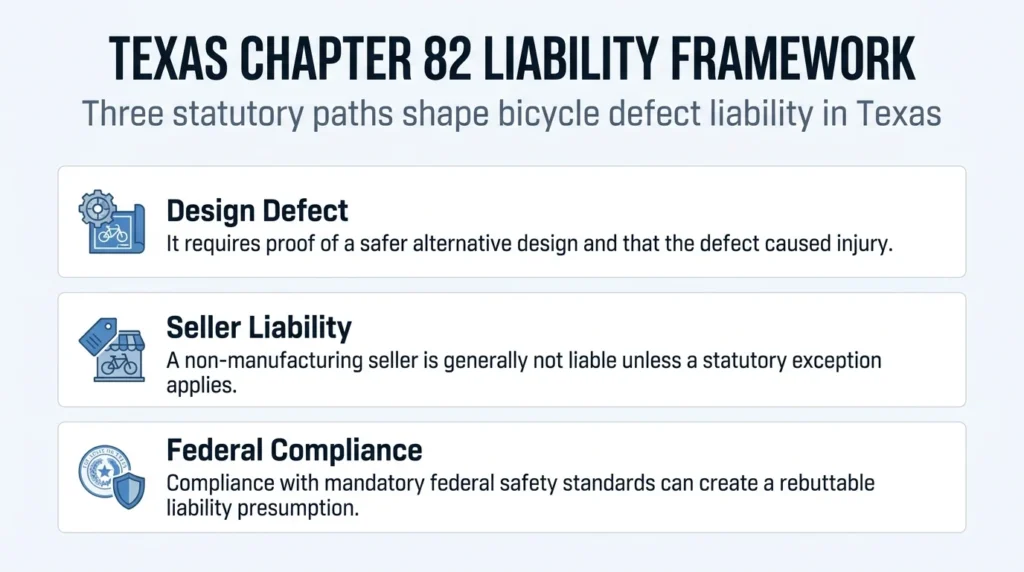
Chapter 82 of the Texas Civil Practice and Remedies Code provides rules about responsibility and proof. The requirements depend on the defect theory and the parties involved.
For a design-defect claim, §82.005 requires proof of a safer alternative design and that the defect was a producing cause of injury. The alternative must reasonably prevent or substantially reduce the injury risk without substantially impairing the product’s usefulness, and must have been economically and technologically feasible when the product left the manufacturer’s or seller’s control. These are design-specific requirements.
Under §82.003, a seller that did not manufacture the product generally is not liable unless a statutory exception is proved. Possible exceptions include design participation, harmful modification or installation onto another product, or actual knowledge of a defect that caused harm. A shop’s sale or installation of a conversion kit alone does not settle liability.
Under §82.008, a manufacturer or seller can establish a rebuttable presumption against liability for covered formulation, labeling, or design aspects by proving compliance with mandatory federal safety standards. Those standards must have applied at manufacture and governed the risk alleged to have caused harm.
A claimant can rebut the presumption by establishing that the standards inadequately protected the public from unreasonable risks, or that the manufacturer withheld or misrepresented information relevant to the federal determination of their adequacy. The presumption does not apply to manufacturing flaws or defects.
Part 1512 includes qualifying low-speed electric bicycles with operable pedals, a motor below 750 watts, and motor-only speed below 20 mph under its specified test. This federal product definition differs from Texas road-use classifications; not every converted bicycle qualifies.
Does a Bike Recall Prove the Defect Caused Your Injury?
No. A recall identifies a hazard, but a bike recall injury claim still needs evidence connecting the failure to your crash and injury. Compare your model, serial range, component, and the notice date; the brand name alone is insufficient.
A recall describes how a part could fail. An engineering inspection investigates whether your part failed before the fall or broke during impact. Federal compliance can also affect some claims under section 82.008, but neither a recall nor compliance resolves every liability question.
How Should You Preserve a Bicycle After a Suspected Defect Crash?
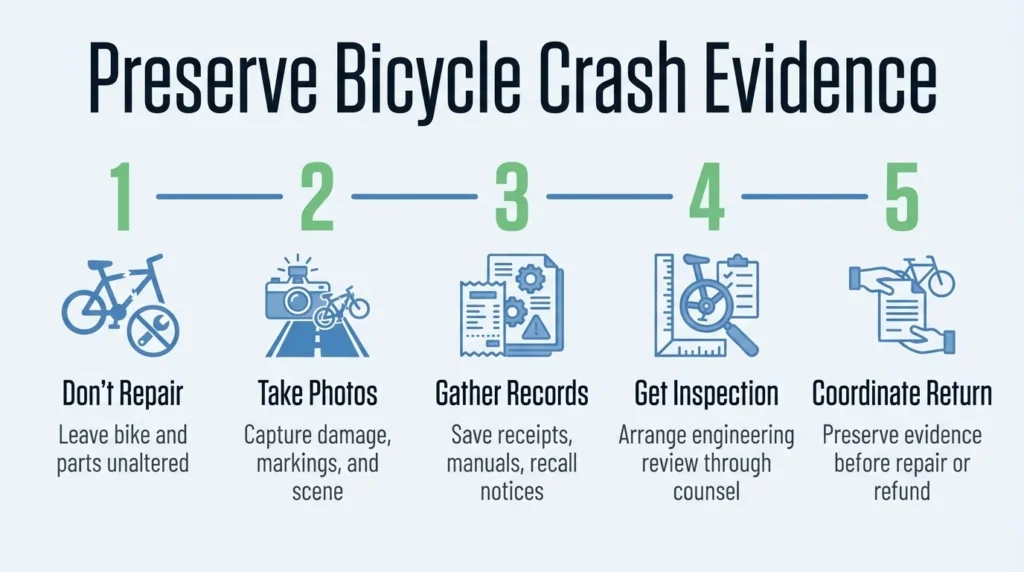
Stop riding and keep the bicycle and detached parts in their post-crash condition. Photos, records, and a documented inspection can help establish the failure sequence:
- Keep the bike unrepaired. Do not clean, straighten, adjust the quick release, disassemble, or perform home tests.
- Photograph the evidence. Capture the whole bicycle, damaged parts, serial and model markings, scene, and resting positions without altering them. Record necessary moves and who holds the bike.
- Gather records. Save receipts, listings, warranties, manuals, assembly instructions, service invoices, maintenance history, modification and installation records, and messages about earlier problems.
- Keep recall notices. Save the notice showing the affected model, serial range, and date.
- Arrange an engineering inspection through counsel. Use a documented protocol and preserve removed parts. Evaluate installation, maintenance, competing causes, and whether failure preceded impact.
- Coordinate before repair or return. Arrange inspection and evidence retention before surrendering the bicycle for a refund or allowing recall repairs. A damaged e-bike battery requires safe handling based on its condition.
Losing the bicycle can seriously weaken technical proof. In Brookshire Brothers, Ltd. v. Aldridge, the Texas Supreme Court explained that a preservation duty arises when a party knows or should know there is a substantial chance of a claim and controls relevant material evidence. Consequences for lost evidence depend on the facts.
Talk to a Lawyer About Your Possible Bicycle Defect Claim
Bring your photos, purchase and maintenance records, and any recall notice to a consultation. Keep the bicycle and parts unrepaired.
At Angel Reyes & Associates, we’ve been helping injured Texans with their cases for over 30 years. Our team speaks both English and Spanish, and we’re available 24/7 to assist with your case from more than 30 office locations across Texas.
Contact Angel Reyes & Associates for a free consultation to discuss your crash and options. Our experienced attorneys are here to assist you.
Past results do not guarantee future outcomes.
Bike Defect Injury Claim FAQs
Can I file a bicycle defect claim if my bike was purchased secondhand?
Potentially, yes. Under Texas law, liability depends on the circumstances of the sale, the nature of the defect, and whether the seller or manufacturer meets the applicable legal requirements.
Can poor bicycle maintenance prevent me from recovering compensation for a defect-related crash in Texas?
It can affect a claim if inadequate maintenance contributed to the failure or injury, but it does not automatically eliminate liability for a genuine product defect. Investigators must evaluate maintenance history alongside the component’s condition and other potential causes.
How long do I have to file a bicycle product liability lawsuit in Texas?
Texas generally imposes a two-year statute of limitations for personal injury claims, including many bicycle product liability cases, although the applicable deadline can depend on the circumstances. Texas also has a separate 15-year statute of repose for many product liability claims, subject to statutory exceptions, so the relevant deadlines should be evaluated promptly.
About the Authors

Angel Reyes
Writer
Angel L. Reyes, III is the Founder and Managing Partner of Angel Reyes & Associates. A nationally recognized trial attorney and business leader, Angel founded the firm in 1993, which has gone on to help over 70,000 injury victims recover more than $1 billion. Named to the Texas Super Lawyers list annually since 2008, Angel brings Wall Street experience, Ivy League education, and a deep commitment to client advocacy. He is a frequent legal commentator and published author with extensive contributions to legal scholarship, trial strategy, and consumer protection.

Graham Griffin
Editor
Graham Griffin is the Web & Content Manager at Angel Reyes & Associates, where he oversees content strategy, AI-powered workflows, a...

Angel Reyes
Reviewer
Angel L. Reyes, III is the Founder and Managing Partner of Angel Reyes & Associates. A nationally recognized trial attorney and business...