What Is the Texas Move Over Law?


Every article on this site is researched by our internal team, reviewed for legal accuracy against current Texas law, and held to State Bar of Texas advertising standards before publication. We do not publish content that overstates outcomes or makes promises about results.
Learn more about our
editorial standards .
Key Takeaways
- Texas drivers must vacate the closest lane or meet the applicable reduced speed limit.
- A Move Over violation that causes bodily injury is a Class A misdemeanor in Texas.
- Preserve video, lights proof, vehicle data, and lane evidence after a shoulder crash.
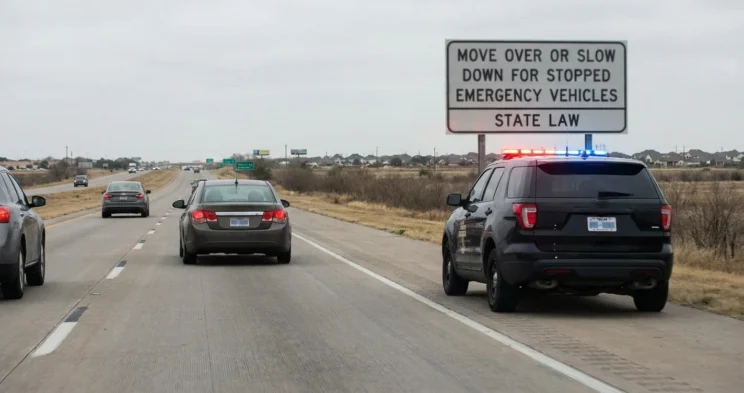
Texas Transportation Code § 545.157 requires drivers approaching qualifying roadside vehicles to vacate the closest lane or slow to the statutory maximum. The lane-change option applies on highways with at least two lanes in the same direction.
If you were struck while waiting beside a tow truck on I-35, that duty matters. A supported violation can become evidence of fault, but the vehicle’s category, the required signals, and the passing driver’s actions all need review.
What Does the Texas Move Over Law Require Drivers to Do?
Under the Texas Move Over Law, drivers can comply by changing lanes or reducing speed.
The statute sets out these alternatives:
- Vacate the closest lane on a highway with two or more lanes traveling in the same direction.
- Slow to 20 mph below the posted limit when the limit is 25 mph or more.
- Slow to 5 mph when the posted limit is below 25 mph.
The law does not require both a lane change and a 20 mph reduction. Either action satisfies the rule. The 20 mph figure is subtracted from the posted limit. It is not a universal travel speed.
On a 70 mph stretch of I-10, a driver who stays in the closest lane must slow to no more than 50 mph. On a 45 mph road, the maximum becomes 25 mph.
TxDOT’s Move Over or Slow Down campaign recommends moving over when you can do so safely.
When a safe lane change isn’t available, or there is no extra lane, slowing down is the lawful alternative. Never swerve into occupied traffic to move over.
This rule governs passing a vehicle that is already stopped. It is a separate obligation from yielding to an emergency vehicle that is approaching you.
Which Stopped Vehicles Does the Law Cover?
The law covers specific vehicle categories, each with its own operating conditions. The current list comes from Senate Bill 305, the 2025 amendment to §545.157.
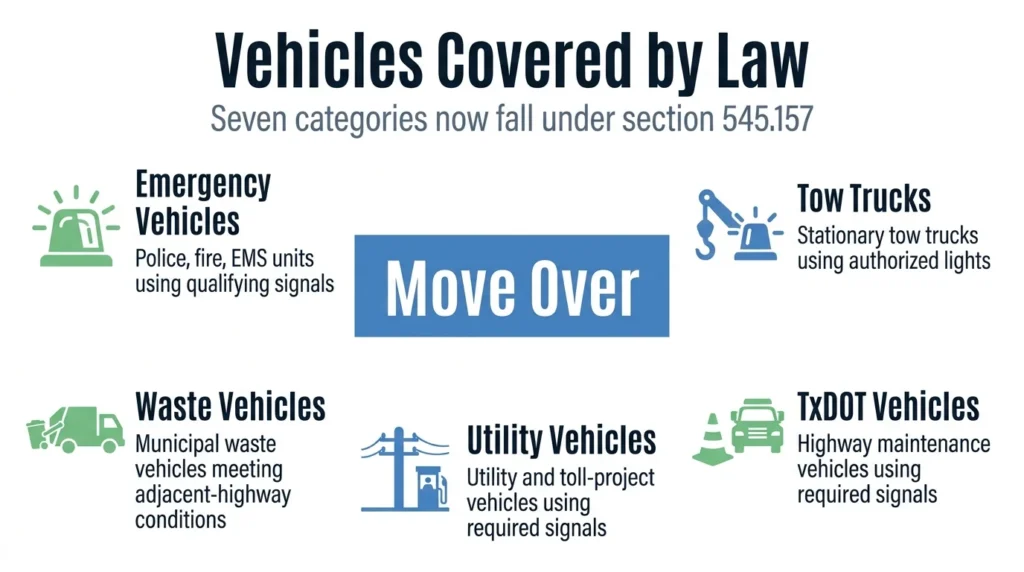
Covered vehicles include:
- Stationary authorized emergency vehicles, such as police, fire, and EMS units, using qualifying visual signals.
- Stationary tow trucks using authorized lights.
- TxDOT vehicles and qualifying contracted highway maintenance or construction vehicles using required signals, when no traffic-control channelizing device separates them from the roadway.
- Utility service vehicles and qualifying toll-project vehicles using required signals.
- Stationary municipal waste or recycling vehicles used exclusively for that purpose and meeting the statute’s adjacent-highway collection or transport conditions.
- Vehicles operated by animal-control officers removing an animal or carcass from a roadway, or authorized carcass-removal operators removing a carcass, using required signals.
- Vehicles operated by local-authority employees while issuing parking citations, using required signals.
The last two categories took effect September 1, 2025. Coverage turns on the task and the signals, not simply on who owns or drives the vehicle. The waste and recycling category has its own conditions and does not carry the same lights requirement as the others.
TxDOT describes the law’s purpose as protecting roadside workers, law enforcement, and first responders. That same buffer of space can protect people standing near those vehicles, including a driver receiving roadside help. Whether a particular bystander has a civil claim depends on the facts.
An ordinary disabled car is not a listed vehicle just because its hazard lights are on. DPS still encourages drivers to give stranded motorists the same courtesy.
What Are the Penalties for Violating the Move Over Law?
An ordinary violation carries a misdemeanor fine. A violation causing bodily injury carries a higher criminal classification. House Bill 898 set the current penalty structure, effective September 1, 2023.
The penalties are:
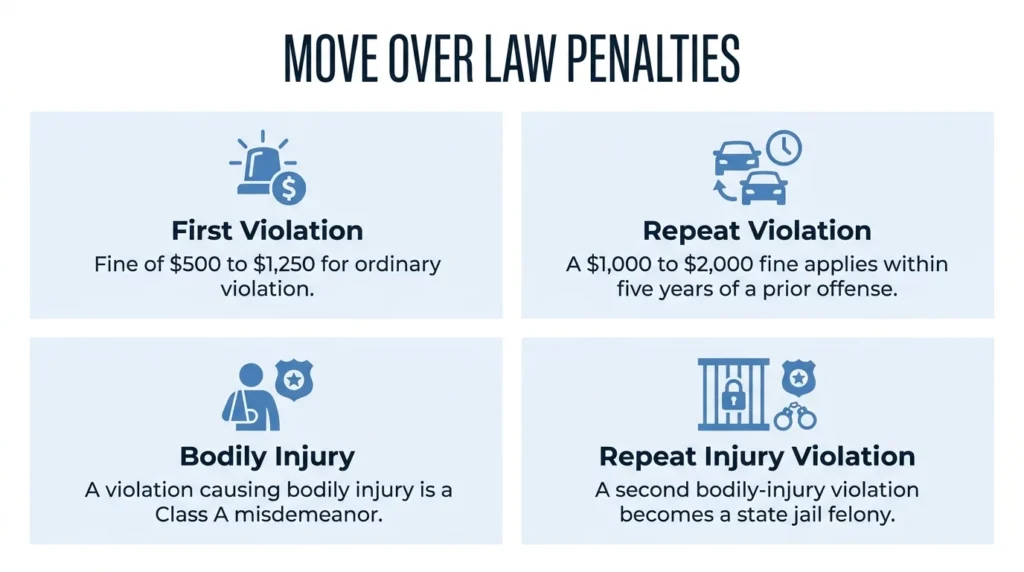
- Ordinary violation: a fine of $500 to $1,250.
- Second or subsequent ordinary violation within five years of the most recent prior offense: a fine of $1,000 to $2,000.
- Violation resulting in bodily injury to another person: a Class A misdemeanor.
- Second or subsequent bodily-injury violation: a state jail felony.
The trigger is bodily injury, not only serious injury. A first injury offense is a Class A misdemeanor, not a felony.
These penalties punish the driver. A criminal fine is not money paid to the person who was hurt. An injured person may seek compensation for medical bills, lost income, and other losses through a separate civil claim.
Can a Move Over Violation Help Prove Fault After a Shoulder Crash?
Yes, a supported violation can be evidence that the passing driver fell below a required safety standard. It does not prove liability or damages on its own. The facts must still connect that driver’s conduct to your injury and your documented losses.
The first task is matching the crash to the statute’s elements:
- The stopped vehicle’s category and the task it was performing.
- Whether the required signals were active, where the category requires them.
- The road layout, including how many lanes traveled in the same direction.
- Which lane the passing driver occupied.
- How fast that driver was going compared with the posted limit.
- Whether a police officer directed traffic differently.
A roadside collision alone does not prove a §545.157 violation.
Texas courts also look at whether the injured person falls within the group the law protects and whether the harm is the kind it aims to prevent. In Perry v. S.N., the Texas Supreme Court explained that not every statutory violation automatically creates civil liability. Perry is not a Move Over case, but it shows why the details of your situation mean so much.
Your exact circumstances matter, including where you stood and how the crash happened.
What Evidence Counts After Someone Is Struck on the Shoulder?
Focus on required warning lights, available video, vehicle data, and lane position at impact. These sources can help reconstruct what happened, but not every record will exist:
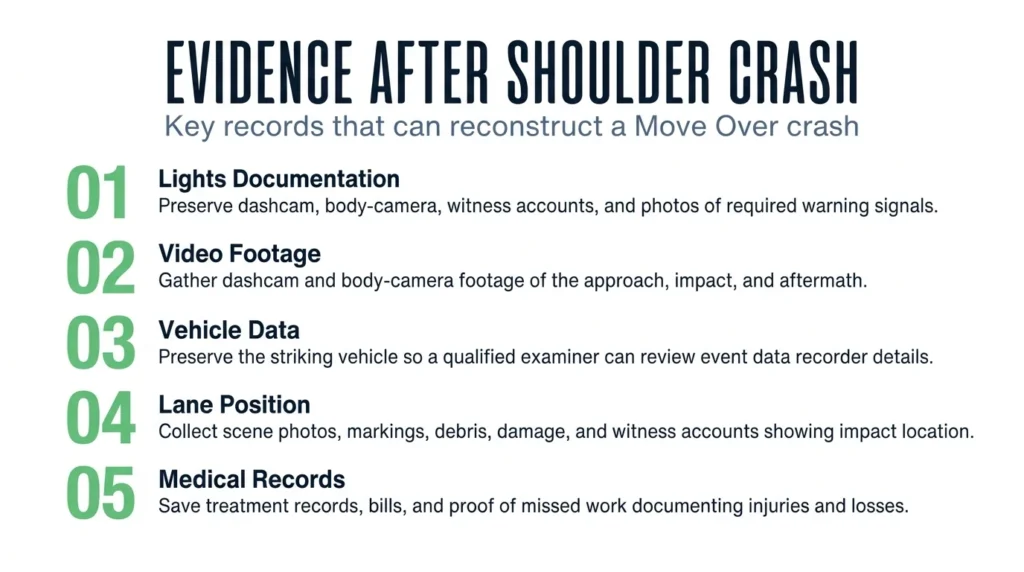
- Document whether required lights were active. Preserve original dashcam files, available body-camera recordings, witness accounts, and photos of the stopped vehicle and its signals. Video can show when lights were on during the approach. A photo taken later may not.
- Gather dashcam and body-camera video. Seek footage of the approach, the impact, and the moments after, with original files and timestamps. Compare angles and timing, because no single camera may have captured the impact.
- Request body-camera footage correctly. Texas Attorney General guidance under Code of Criminal Procedure Article 2B.0112 says a written request must include the date and approximate time, the specific location, and the name of at least one known person involved. Release limits can still apply.
- Preserve the striking vehicle for qualified examination. NHTSA explains that event data recorders capture technical data around a crash, including pre-crash dynamics and driver inputs. A qualified examiner may use available data to reconstruct speed and braking. An EDR does not record audio or video, and it cannot determine lane position, lights, or fault alone.
- Establish lane position at impact. Collect wide scene photos, lane and shoulder markings, debris and impact points, vehicle damage, and witness accounts. Compare them with the video and electronic data.
- Keep medical and loss records. Save treatment records, bills, and proof of missed work. These documents help establish your injuries and losses.
Talk With Angel Reyes & Associates About a Roadside Crash
If you were hurt in a Texas shoulder collision, gather any photos, video, and medical records you already have. At Angel Reyes & Associates, we have been helping injured Texans for over 30 years. Our team is here to assist you, and we’re available 24/7 at more than 30 office locations throughout Texas.
Contact Angel Reyes & Associates for a free consultation about what happened and the available evidence.
Past results do not guarantee future outcomes.
Texas Move Over Law FAQs
Can I recover compensation if I was partially responsible for a roadside accident in Texas?
Possibly. Under Texas’s proportionate responsibility rules, an injured person generally may recover damages if their percentage of responsibility does not exceed 50%, but their compensation is reduced by their share of fault.
How long do I have to file a personal injury lawsuit after a Texas shoulder accident?
In most cases, Texas law provides a two-year statute of limitations for personal injury claims, measured from the date the cause of action accrues. Certain circumstances may change the deadline, so identifying any applicable exceptions is important.
Does the Texas Move Over Law apply on city streets as well as highways?
Yes, Texas Transportation Code § 545.157 is not limited to interstate highways; its application depends on the roadway and the qualifying stopped vehicle. Drivers should check the applicable lane configuration, required warning signals, and statutory conditions to determine which requirements apply.
Does a police citation for violating the Texas Move Over Law guarantee compensation after a crash?
No, a citation does not automatically establish civil liability or guarantee compensation. A personal injury claim still requires evidence supporting the applicable legal elements, including the connection between the driver’s conduct and the injuries claimed.
About the Authors

Spencer Browne
Writer
Spencer Browne is a partner at Angel Reyes & Associates and a Board Certified personal injury trial lawyer with nearly 100 jury trials across Texas. He focuses on car, truck, and wrongful death cases, with notable verdicts including a landmark win in the Choctaw Casino bus crash case. A recognized speaker and legal educator, Spencer is a member of the American Board of Trial Advocates and has been honored as a Texas Super Lawyer and one of D Magazine’s Best Lawyers in Dallas. He brings deep trial experience and relentless advocacy to every client he represents.

Kyle Nicolas
Editor
Kyle Nicolas is the Web Content & SEO Manager at Angel Reyes & Associates. He has more than 10 years of experience as a marketing co...

Angel Reyes
Reviewer
Angel L. Reyes, III is the Founder and Managing Partner of Angel Reyes & Associates. A nationally recognized trial attorney and business...