Are Blinding Headlights Making Texas Roads More Dangerous?


Every article on this site is researched by our internal team, reviewed for legal accuracy against current Texas law, and held to State Bar of Texas advertising standards before publication. We do not publish content that overstates outcomes or makes promises about results.
Learn more about our
editorial standards .
Key Takeaways
- A March 2026 AAA survey found that six in ten U.S. drivers report headlight glare as a nighttime problem, with 73% saying it has worsened over the past decade.
- Headlights that comply with Texas and federal standards can still expose a driver to legal liability if they are improperly aimed or used negligently, such as leaving high beams on near oncoming traffic.
- Crashes caused by headlight glare may support claims against a negligent driver, a vehicle manufacturer, or both, depending on the specific facts of the case.
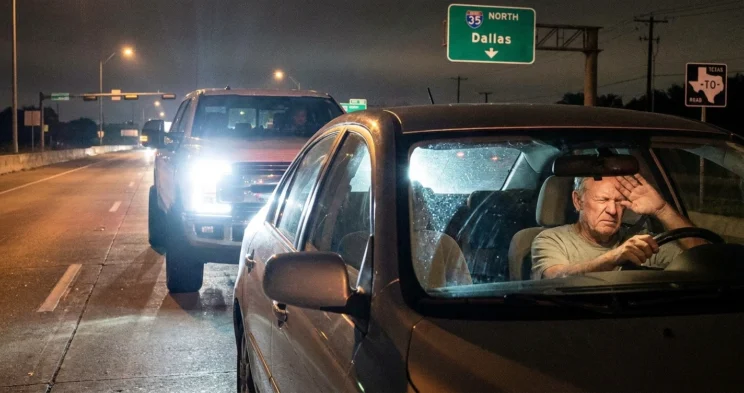
Driver Survey Shows Ultra-Bright Headlights Are Causing Problems on Roads
You’re heading home on I-35E after a late night out in Dallas. Traffic is light, the road ahead looks clear, and then it happens: a wall of intense white light floods your windshield from an oncoming vehicle. Your eyes water. The lane lines vanish. For a full second, you’re essentially driving blind.
That experience is more common than you might think, and according to new research, it’s getting worse.
Why Headlight Glare Is Getting Worse
A March 2026 survey from AAA found that six in ten U.S. drivers report glare from blinding headlights as a problem after dark. Among those affected, 73% said the issue has worsened over the past decade. Additionally, 92% of those drivers identified oncoming headlights as their primary concern, while about one-third also reported glare from rearview or side mirrors.
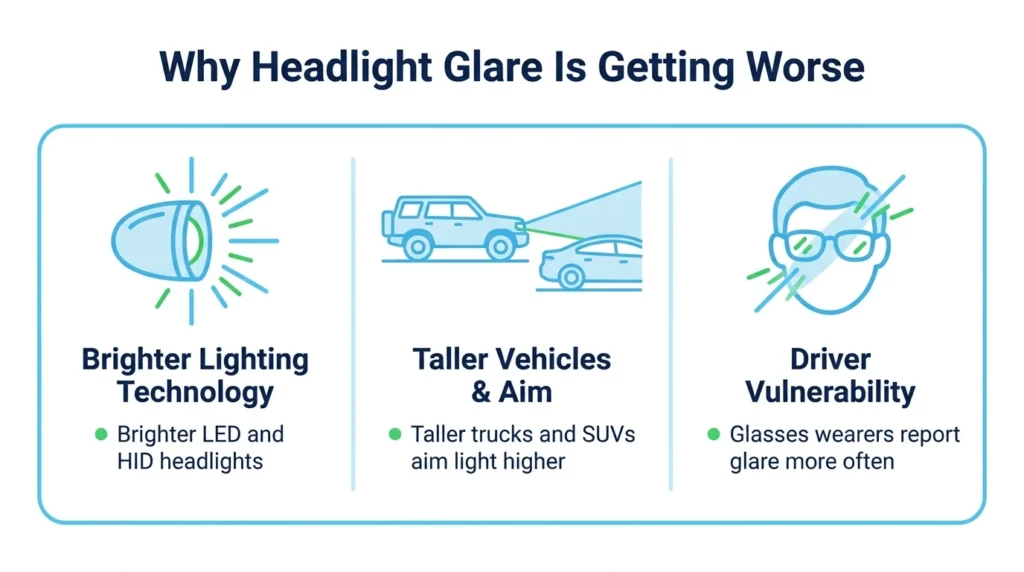
Modern lighting technology is a significant part of the reason. LED and HID (high-intensity discharge) headlights are dramatically brighter than older halogen designs. Taller vehicle profiles, especially pickup trucks and SUVs, make it worse. Their headlamps sit higher off the ground and direct intense light straight into the eye level of drivers in smaller cars.
The AAA data also revealed that drivers who wear prescription glasses experience glare at higher rates, 70% versus 56% among those who don’t. If you regularly drive during DFW’s long winter evenings, you may already feel that gap acutely.
Are Bright Headlights Legal in Texas?
The short answer: often yes, even when they’re blinding you.
Texas Transportation Code § 547.3215 requires that vehicle lighting comply with federal standards under 49 C.F.R. Section 571.108. In plain terms, if a manufacturer certifies that its headlights meet the applicable federal safety standards, those lights are legal in Texas.
The problem is that federal headlight standards have not kept pace with the rapid evolution of lighting technology. Manufacturers self-certify their own compliance, and there is no mandatory pre-market testing by a federal agency to confirm that certified lights actually perform safely in real-world conditions.
Texas Transportation Code § 547.333 requires vehicles to be equipped with multi-beam lighting (high and low beams) and requires drivers to dim their high beams within 500 feet of an oncoming vehicle. Failing to dim when required is a traffic violation.
But a low beam that is engineered to be ultra-bright is different. Texas law does not impose a specific brightness ceiling on standard headlamps the way it does for other vehicle lighting. A headlight can be technically legal and still create a serious hazard for other drivers.
When a Driver’s Headlights Create Legal Liability
Legal compliance and legal liability are not the same thing.
Even if a driver’s headlights meet federal and state standards, that driver can still be found negligent under Texas law if their lighting choices or practices contributed to a crash. Texas’ standard for negligence requires showing that a person failed to act with reasonable care and that the failure caused the injury.
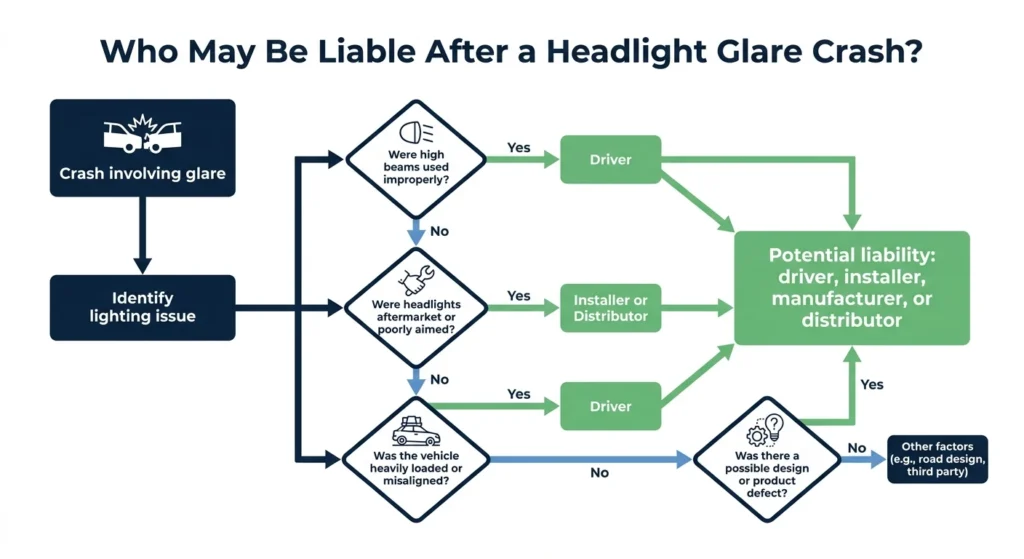
To put it in simple terms: a driver who knows or reasonably should know about a problem and fails to correct it may bear responsibility for crashes that result.
Here are a few real-world examples:
- A driver installs aftermarket LED headlights and never has them properly aimed.
- A driver on a two-lane county road leaves their high beams engaged as traffic approaches, triggering a head-on collision.
- A vehicle’s headlights aim higher when it is heavily loaded down, and the problem goes uninspected for months.
In each case, a jury could reasonably find that the at-fault driver failed to exercise reasonable care, even if no individual component was technically illegal.
Improperly aimed headlamps are a specific area of concern. Headlights that point too high, whether from a bad aftermarket installation, suspension wear, or cargo loading, can direct intense light directly at oncoming traffic.
Could a Manufacturer Be Liable for Defective Headlight Design?
In some cases, the manufacturer is at least partially liable. If a vehicle’s headlights were defectively designed from the factory, or if a third-party headlight kit failed to perform as warranted, an injured driver may have a product liability claim against the manufacturer or the distributor.
These cases are more complex than standard car accident claims because they require proving that the product itself was defective, not just that it was bright. Product liability cases involving vehicle lighting often turn on specific factual questions:
- Did the headlights meet the manufacturer’s own performance claims?
- Was the beam pattern designed in a way that created a foreseeable risk to other road users?
- Did a defect in mounting hardware cause the headlights to aim incorrectly over time?
Answering these questions requires expert analysis of the vehicle and its lighting system. Our team has experience working with accident reconstruction specialists and engineering experts to build these kinds of cases.
What to Do After a Crash You Believe Was Caused by Headlight Glare
If you have been in an accident and headlight glare was at least partially responsible, start collecting and documenting evidence immediately. Note the time, weather, and lighting conditions. Photograph the other vehicle’s headlights if you can do so safely.
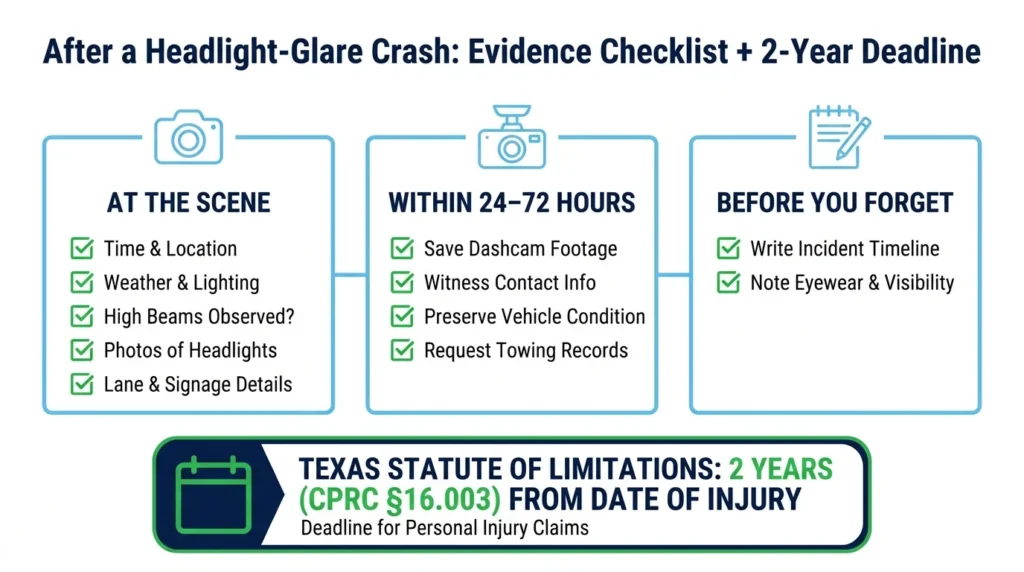
Also, look for any witnesses and ask what they observed. Whether the other driver’s high beams were on at the moment of impact, and what kind of headlights their vehicle was equipped with, may become central issues in your case.
Keep in mind that Texas’s statute of limitations for personal injury claims is two years from the date of injury, under Texas Civil Practice and Remedies Code § 16.003. Missing that window almost always means losing your right to seek compensation entirely.
Angel Reyes & Associates has recovered more than $1 billion for injured Texans across more than 30 years of practice. We offer free initial consultations, work on contingency (meaning you pay no legal fees unless we win), and are available 24/7.
We serve the entire state of Texas from our more than 20 office locations, and most cases can be handled remotely. If a crash left you injured and you believe another driver’s headlights were a factor, contact us today to talk through what happened and what your options may be.
Headlight Glare Accident FAQs
Can headlight glare still matter if the police report does not mention it?
Yes. A police report can help, but glare can also be proven through witness statements, dashcam footage, vehicle inspections, scene photos, and expert analysis of beam angle or aftermarket modifications.
What if I crashed because I swerved or braked after being temporarily blinded by another driver’s lights?
Under Texas law, the case can still turn on whether the other driver acted unreasonably by using high beams improperly, failing to aim headlights correctly, or driving with unsafe equipment. Texas also uses modified comparative fault, so partial blame does not necessarily bar recovery unless you are more than 50% responsible.
Are aftermarket LED headlight conversions legal in Texas?
Not automatically. Texas requires vehicle lighting to comply with federal standards, and NHTSA says manufacturers self-certify compliance with FMVSS No. 108 rather than receiving pre-market approval, which is one reason aftermarket setups can become a dispute point after a crash.
Can a body shop, installer, or parts seller be liable for a glare-related crash?
Potentially yes. If a shop or installer improperly mounted or aimed the headlights, or a replacement lighting product was defective, liability may extend beyond the driver depending on the facts and the evidence.
Can headlight glare lead to a claim even if no one received a traffic ticket?
Yes. In Texas, civil liability does not depend on whether an officer issued a citation, because the main question is whether the other driver’s conduct or vehicle condition unreasonably contributed to the crash.
About the Authors

Angel Reyes
Writer
Angel L. Reyes, III is the Founder and Managing Partner of Angel Reyes & Associates. A nationally recognized trial attorney and business leader, Angel has helped over 70,000 injury victims recover more than $1 billion since founding the firm in 1993. Named to the Texas Super Lawyers list annually since 2008, Angel brings Wall Street experience, Ivy League education, and a deep commitment to client advocacy. He is a frequent legal commentator and published author with extensive contributions to legal scholarship, trial strategy, and consumer protection.

Kyle Nicolas
Editor
Kyle Nicolas is the Web Content & SEO Manager at Angel Reyes & Associates. He has more than 10 years of experience as a marketing co...

Angel Reyes
Reviewer
Angel L. Reyes, III is the Founder and Managing Partner of Angel Reyes & Associates. A nationally recognized trial attorney and business...