Waymo & Autonomous Vehicle Accidents in Texas: Who’s Liable & What to Do Next


Every article on this site is researched by our internal team, reviewed for legal accuracy against current Texas law, and held to State Bar of Texas advertising standards before publication. We do not publish content that overstates outcomes or makes promises about results.
Learn more about our
editorial standards .
Key Takeaways
- Texas's fault-based system applies to autonomous vehicle crashes, but liability may involve the AV company, manufacturers, other drivers, or multiple parties sharing responsibility.
- Under Texas proportionate responsibility rules, you cannot recover compensation if you're found more than 50% at fault for the crash.
- AV-specific evidence (like sensor logs and video footage) can be overwritten quickly, which makes immediate preservation requests essential to proving your case.
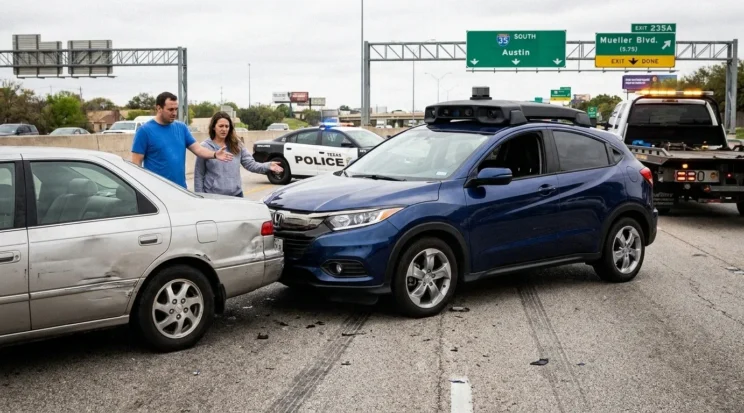
You were driving home on I-35 through Austin when a Waymo robotaxi changed lanes directly into your path. There was no driver behind the wheel. Now, you’re dealing with injuries, vehicle damage, and a confusing question: who do you hold responsible when the car was driving itself?
Autonomous vehicle (AV) crashes raise unique legal challenges in Texas. The state’s fault-based system still applies, but identifying the responsible party requires understanding how Texas law treats self-driving vehicles and their operators.
What Makes Autonomous Vehicle Crashes Different in Texas
Texas remains a fault-based state for car accidents. This means you must prove someone else caused the crash to recover compensation. This fundamental rule doesn’t change just because software was controlling the vehicle.
However, it does complicate the process of identifying who’s responsible for the crash.
In a traditional crash, you’d typically look to the other driver. In an AV crash, potential defendants may include:
- The AV company operating the vehicle (like Waymo)
- The vehicle owner or fleet operator
- Remote monitoring personnel
- Software and sensor manufacturers
- Maintenance contractors
- Other drivers involved in the collision
Each crash scenario creates different liability questions. A Waymo passenger injured when the vehicle fails to yield will face different issues than a cyclist struck by a driverless car on Congress Avenue, or a driver rear-ended by an AV on the MoPac Expressway.
How Texas Law Treats Automated Motor Vehicles
Texas Transportation Code Chapter 545 establishes the framework for automated motor vehicles operating on Texas roads. The code addresses how these vehicles interact with traffic laws and who bears responsibility for compliance.
Under this framework, the automated driving system (ADS) can be treated as the “operator” for certain traffic-law purposes when the vehicle is operating autonomously. This doesn’t automatically determine civil liability, but it shapes how violations are assessed and who receives citations.
The Texas Department of Motor Vehicles Chapter 220 rules further clarify authorization requirements for AV operations. Companies operating autonomous vehicles in Texas must meet specific registration and identification requirements. Understanding which entity holds authorization to operate will help you identify the correct defendant in a liability claim.
Who Qualifies as the “Operator”
When a human sits behind the wheel, it’s clear who the vehicle operator is. However, when an automated driving system controls the vehicle, it’s a little harder to figure out.
Texas law recognizes that the ADS itself may function as the operator for traffic-rule purposes. However, civil liability still requires that you prove traditional elements, including duty, breach, causation, and damages. The company deploying the AV typically owes a duty of reasonable care in how it programs, monitors, and maintains its vehicles.
Real-world AV operations involve multiple layers of human oversight: remote assistance centers monitor vehicles, technicians perform maintenance, engineers update software, and dispatchers route vehicles. Any of these functions could involve negligence that contributes to a crash.
How Fault Is Determined Under Texas Proportionate Responsibility
Texas uses a modified comparative fault system called “proportionate responsibility.” Under Texas Civil Practice & Remedies Code Chapter 33, fault is assigned as a percentage to each party involved in causing the crash.
The critical threshold: if you’re found more than 50% responsible, you cannot recover any compensation. If you’re found 50% or less at fault, your recovery is reduced by your percentage of responsibility.
In AV crashes, fault allocation often involves multiple parties. Consider a collision at a traffic light in Hyde Park in which a Waymo failed to stop and another driver was speeding. An investigation might assign 70% fault to the AV operator and 30% to the speeding driver. The speeding driver could still recover 70% of their damages from the AV company.
What Partial Fault Means for Your Recovery
The proportionate responsibility system creates real consequences for how your case is investigated and valued.
If your damages total $100,000, and you’re found 20% at fault, you’ll recover $80,000. If you’re found 51% at fault, you’ll recover nothing. This means early evidence preservation is critical. Objective AV data that shows exactly what happened can prevent defendants from successfully arguing that you caused the crash.
Insurance companies and defense attorneys commonly argue victim fault in AV cases. They may claim that you made a sudden lane change, were distracted, failed to take evasive action, or violated traffic laws. Strong evidence from the AV’s sensors and logs can counter these arguments.
Who Can Be Held Liable in a Waymo or AV Accident
Determining liability requires understanding what went wrong and who had control over the vehicle’s operation.
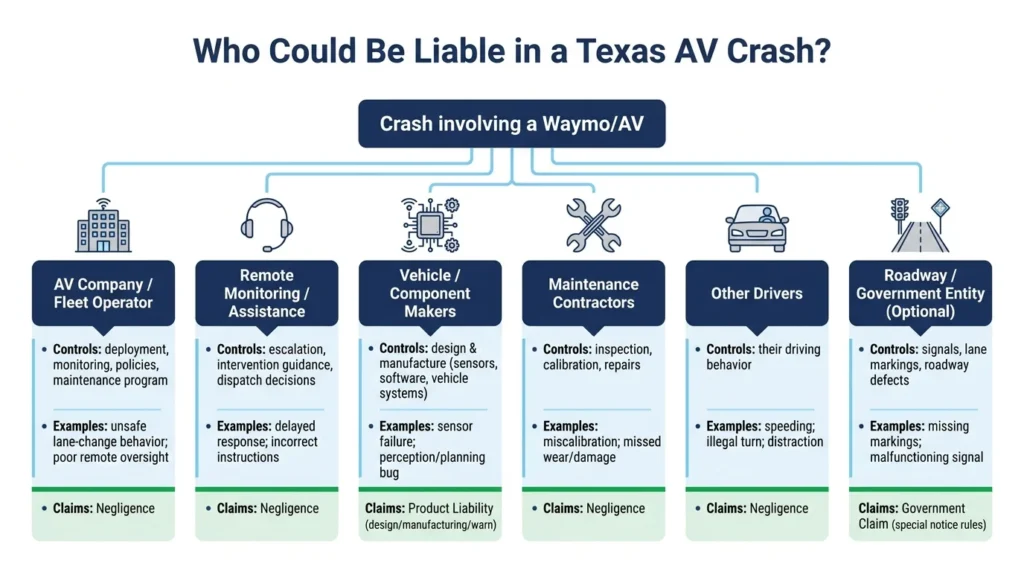
The AV company or fleet operator may be liable for negligent operations. This includes unsafe driving behaviors programmed into the system, inadequate monitoring, poor maintenance, or improper deployment decisions.
Vehicle and component manufacturers may face product liability claims if a defect in the vehicle, sensors, or software caused the crash. These claims focus on design defects, manufacturing defects, or inadequate warnings.
Other drivers remain potentially liable when their negligence contributes to the crash. A car accident involving an AV and a human driver may result in shared fault.
Maintenance contractors could be liable if improper service contributed to a malfunction.
Negligence Claims Against AV Operators
Negligence claims focus on whether the AV company or its personnel failed to exercise reasonable care. Examples include:
- Programming that caused unsafe lane changes or failure to yield
- Inadequate remote monitoring when intervention was needed
- Deploying vehicles in conditions outside of their safe operating parameters
- Poor maintenance or inspection practices
- Failure to address known software issues
The standard is what a careful and sensible AV operator would do under similar circumstances. As the industry develops, this standard continues to evolve.
Product Liability Claims
When the crash results from a defect rather than operational negligence, product liability theories apply. These claims don’t require that you prove negligence. Instead, you must show that the product was defective, and the defect caused your injuries.
Potential AV system defects include sensor failures, perception errors in which the system misidentifies objects, planning failures in which the system makes unsafe decisions, and software bugs. Multiple companies may share responsibility: the vehicle manufacturer, sensor suppliers, and software developers.
Product liability claims require that you preserve evidence of the specific software version, sensor configurations, and system state at the time of the crash.
Insurance & Who Pays After a Driverless Crash
AV collisions involve multiple potential insurance sources. Understanding the coverage landscape will help you pursue the right claims efficiently.
The AV company’s commercial policy typically provides primary coverage for crashes caused by the autonomous system. Companies like Waymo carry substantial commercial liability coverage for their fleet operations.
Other drivers’ liability policies apply when another driver is also at fault for the crash.
Your own policy may provide coverage through uninsured/underinsured motorist (UM/UIM) provisions, medical payment coverage, or collision coverage while liability is being determined.
When reporting the crash to insurers, stick to the facts. Describe what happened without speculating about whether the AV “malfunctioned.” Premature statements can complicate your claim before the evidence is properly preserved.
For detailed guidance on handling insurance communications, review our guide on what to do after a car accident in Texas.
Evidence to Preserve in an Autonomous Vehicle Crash
AV crashes require that you preserve both traditional evidence and digital data that may be overwritten quickly.
Standard evidence includes photos of the scene and vehicle damage, witness contact information, the police report, medical records documenting your injuries, and documentation of lost wages and expenses.
AV-specific evidence can be decisive in proving what happened, including:
- Telemetry logs showing vehicle speed, steering, and braking
- Sensor data from cameras, lidar, and radar
- Internal and external video footage
- Mapping and localization data
- Remote assistance logs
- Disengagement records showing when the system requested human intervention
This data may be stored temporarily and overwritten. A formal preservation letter sent to the AV company and other relevant parties should be a priority. This letter requires the preservation of all data from the relevant time window and vehicle.
Critical Timeline for Evidence Preservation
First 24 hours: Seek medical attention. Document the scene and your injuries with photos. Identify the AV by its company branding and any visible unit numbers. Note whether the vehicle was occupied. Get witness contact information.
First 7 days: Obtain the crash report from law enforcement. Preserve any dashcam or phone footage that you captured. Start a symptom journal documenting your injuries. Notify your insurance company with the basic facts only.
First 30 days: Send formal preservation demands to the AV company and other parties. Get a complete damage evaluation for your vehicle. Document wage losses using employer records. Consult with an attorney about multi-party liability and required evidence.
Deadlines & When to Talk to a Lawyer
Texas imposes deadlines for filing injury claims. Under Texas Civil Practice & Remedies Code Chapter 16, most personal injury claims must be filed within two years of the accident date. Missing this deadline typically prevents your claim from being filed.
Certain situations call for immediate legal consultation, including:
- Serious or permanent injuries
- Disputed fault between multiple parties
- Commercial vehicles or policies involved
- Any indication that AV data may be deleted or withheld
- Rapid settlement offers that seem too low
- Crashes involving government vehicles or roadway defects
AV cases often require specialized investigation and expert analysis. Hiring a lawyer early will help protect key evidence from being lost or destroyed.
How Angel Reyes & Associates Can Help
Autonomous vehicle crashes require an understanding of both traditional injury law and emerging AV technology. With over 30 years of experience handling complex vehicle accident cases across Texas, our firm has the resources to investigate multi-party claims and pursue full compensation.
We offer free initial consultations, and we work on contingency. You pay no fee unless we win. Our team includes investigators and reconstruction specialists who can help preserve and analyze the evidence needed to prove your case.
If you’ve been injured in a crash involving a Waymo or other autonomous vehicle anywhere in Texas, contact us to discuss your situation and learn about your options.
Self-Driving Vehicle Liability FAQs
Do police handle a crash with a driverless car differently in Texas?
Police still investigate the crash much like any other collision, but automated vehicles may have special identification and company contact information tied to their authorization to operate. This can help officers and insurers identify the right entity even if no human was driving.
Can a Waymo passenger make a claim after a crash in Texas?
Yes, a passenger may have a claim if another party caused the crash, including the AV operator, another driver, or both. Passengers are often less likely to face fault disputes, but the facts are still a deciding factor.
What if the self-driving car was involved in a hit-and-run or the responsible party is still unclear?
Your own uninsured/underinsured motorist coverage may help in some situations while the investigation continues, depending on your policy. It is also important to keep photos, app trip details, and any notice from the AV company that confirms the ride and timing.
Could a road defect or broken traffic signal matter in an autonomous vehicle crash?
Yes, sometimes a poorly maintained road, missing lane markings, or malfunctioning signal can be part of the cause. Claims involving a government entity can follow different notice rules and shorter timelines than an ordinary car accident case.
Do recalls matter after a driverless car accident?
They can, because a recall or service bulletin may show there was a known problem with the vehicle or one of its components. A recall does not automatically prove fault, but it can become important evidence in a product-related claim.
About the Authors

Spencer Browne
Writer
Spencer Browne is a partner at Angel Reyes & Associates and a Board Certified personal injury trial lawyer with nearly 100 jury trials across Texas. He focuses on car, truck, and wrongful death cases, with notable verdicts including a landmark win in the Choctaw Casino bus crash case. A recognized speaker and legal educator, Spencer is a member of the American Board of Trial Advocates and has been honored as a Texas Super Lawyer and one of D Magazine’s Best Lawyers in Dallas. He brings deep trial experience and relentless advocacy to every client he represents.

Kyle Nicolas
Editor
Kyle Nicolas is the Web Content & SEO Manager at Angel Reyes & Associates. He has more than 10 years of experience as a marketing co...

Angel Reyes
Reviewer
Angel L. Reyes, III is the Founder and Managing Partner of Angel Reyes & Associates. A nationally recognized trial attorney and business...