How Self-Driving Vehicle Black Box Data Can Help Your Accident Case


Every article on this site is researched by our internal team, reviewed for legal accuracy against current Texas law, and held to State Bar of Texas advertising standards before publication. We do not publish content that overstates outcomes or makes promises about results.
Learn more about our
editorial standards .
Key Takeaways
- Autonomous vehicles record continuous sensor, camera, LiDAR, and AI decision data that can prove fault in crash cases.
- Accessing manufacturer data often requires court orders and fast action before logs are overwritten.
- Experienced legal teams use accident reconstruction experts to translate complex sensor data into clear evidence for your case.
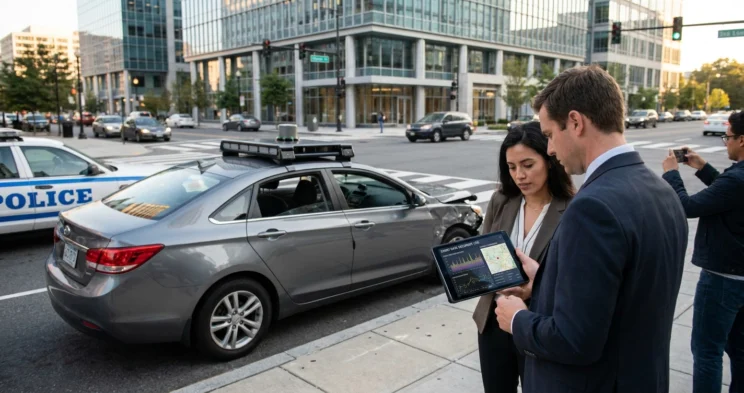
You were driving down I-35 near downtown Austin when a self-driving car changed lanes without warning and struck your vehicle. The other driver blames the software. The manufacturer is silent. You are left wondering how to prove what really happened.
Here is the good news. That self-driving vehicle recorded almost every moment leading up to the crash. The right data can tell the story for you.
What Data Do Autonomous Vehicles Record During Accidents?
Self-driving cars are rolling computers. They collect far more information than traditional vehicles do. Every second on the road, sensors scan the environment and store what they see.
Most autonomous vehicles carry four main sensor types. Cameras capture visual footage. LiDAR maps objects in 3D using laser pulses. Radar tracks speed and distance. GPS logs location and route.
The car also saves driving logs that show steering inputs, braking force, and acceleration. These records can confirm how fast the car was moving and when it tried to stop.
How AV Black Box Data Differs from Traditional Car Recorders
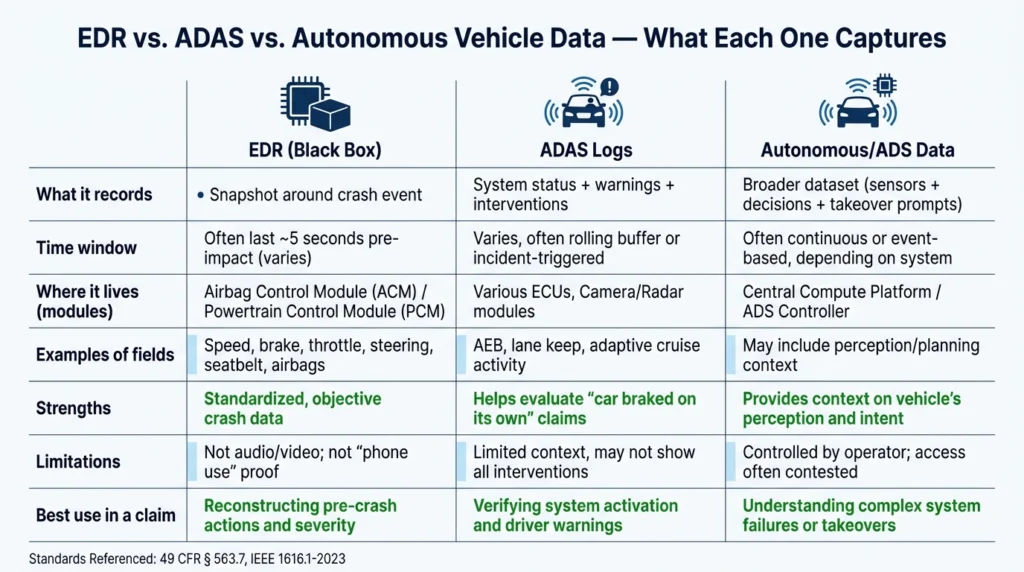
Older vehicles use event data recorders, often called EDRs. These save a short snapshot of data, usually just seconds before and after impact. The information is useful but limited.
Self-driving vehicles run a much deeper recording system. Many models log data continuously, not just at the moment of a crash. That means you may have access to minutes or even hours of driving behavior leading up to the collision.
The biggest difference is the AI decision log. Self-driving systems record why the car made each choice. That data can show whether the software saw you, how it classified your vehicle, and what action it took in response.
Types of Evidence Available from Self-Driving Car Sensors
Each sensor creates its own kind of proof. Together, they paint a detailed picture of the crash.
- Camera footage shows the road, traffic signals, and other vehicles in real time.
- LiDAR point clouds reveal the exact position of every object within range.
- Radar data measures the speed and distance of nearby vehicles.
- GPS tracking confirms the route, lane changes, and location at impact.
This level of detail is hard to dispute. A witness might forget details. Sensor data does not.
AI Decision Logs & System Response Records
The software inside a self-driving car keeps a running record of its choices. These logs can show when the system first detected your vehicle. They also show how long it took to respond and what action it chose.
Software version history matters too. If the manufacturer pushed a faulty update before your crash, that record can support a product liability claim. Proving fault in a self-driving car case often starts with pulling this exact data.
Legal Challenges in Accessing Manufacturer Data
Getting the data is not always easy. Manufacturers control access and often treat their systems as trade secrets. They may resist handing over logs without a court order.
Texas courts can compel production through a subpoena or discovery request. Under the Texas Rules of Civil Procedure 205.1, parties can compel discovery from non-parties through subpoenas and court orders during litigation. Acting quickly matters because some data gets overwritten.
Data retention periods vary by company, with manufacturers implementing different policies for storing autonomous vehicle data. A car accident attorney can send preservation letters right away to protect the evidence you need.
How AV Data Strengthens Your Accident Case
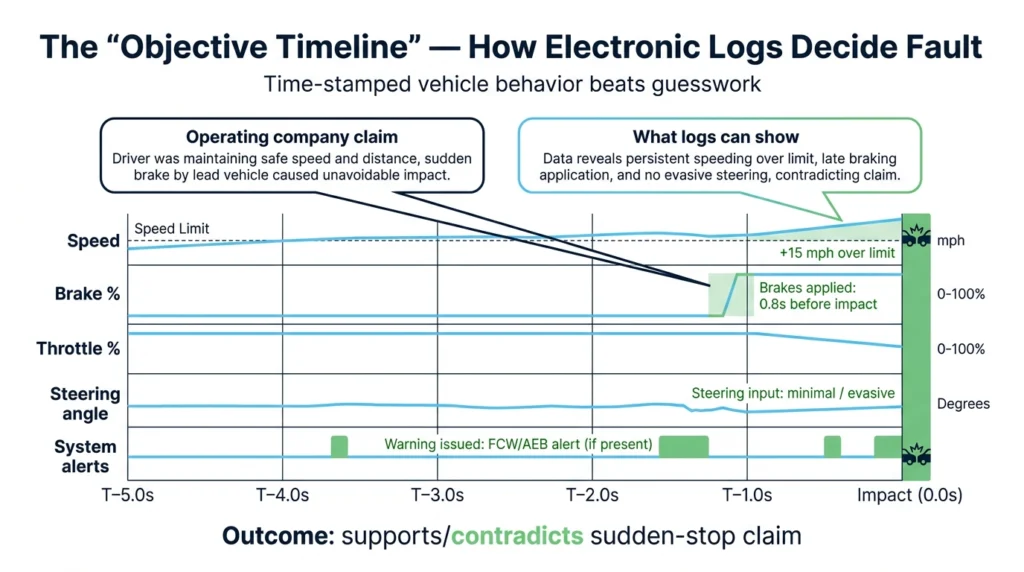
Sensor data offers something witness testimony cannot. It is objective. It does not change its story or forget details under pressure.
This evidence helps in four key ways:
- It establishes fault with measurable facts about speed, braking, and positioning.
- It supports damages claims by showing the severity of the impact.
- It counters insurance company disputes with hard numbers.
- It exposes software errors that point to manufacturer liability.
Insurance companies are businesses. Their goal is to pay as little as possible on your claim. Detailed sensor data makes lowball offers harder to justify.
Working with Experts to Interpret AV Evidence
Raw sensor data is not easy to read. LiDAR files, AI logs, and radar outputs need specialized software to analyze. That is why experienced legal teams work with accident reconstruction experts who focus on autonomous vehicle technology.
These expert witnesses translate technical files into clear evidence. They build animations, timelines, and reports that a jury can follow. A well-prepared expert can turn a confusing dataset into a convincing story.
Texas law also protects certain personal information, and courts balance disclosure with data privacy protections. A lawyer who knows the personal injury process can work within these rules while still securing the data you need.
Talk to a Team That Understands Self-Driving Car Cases
Autonomous vehicle crashes are new territory for many law firms. At Angel Reyes & Associates, we bring over 30 years of experience handling complex auto cases across Texas, from Houston to Austin and beyond. We work on a no fee unless we win basis, so you pay nothing upfront. Consultations are always free.
We serve the entire state of Texas from over 20 office locations and offer services in Spanish. Most of your case can be handled remotely, which means you can focus on healing. Schedule a free consultation to learn what your claim may be worth.
Self-Driving Vehicle Black Box Data FAQs
Can autonomous vehicle data be used if the car was in manual mode during the crash?
Yes, most self-driving cars continue recording sensor data even when a human driver has control. This information can still show vehicle speed, braking patterns, and environmental conditions at the time of impact.
What happens if the autonomous vehicle manufacturer refuses to provide crash data?
Texas courts can issue protective orders that require manufacturers to preserve and produce relevant data while protecting legitimate trade secrets. Rule 192.6 of the Texas Rules of Civil Procedure allows courts to balance discovery needs with confidentiality concerns.
How long after an accident can you still recover autonomous vehicle sensor data?
Data recovery windows vary significantly by manufacturer, with some companies purging non-crash data within 30 days while others retain it for six months. Immediate legal action to preserve evidence is critical for maximum data recovery.
Does weather affect the reliability of autonomous vehicle sensor evidence?
Heavy rain, snow, or fog can impact sensor accuracy, but this creates valuable evidence about system limitations. Courts generally admit sensor data with expert testimony explaining any environmental factors that affected performance.
Can you access autonomous vehicle data without filing a lawsuit?
Manufacturers typically require formal legal proceedings before releasing detailed sensor logs and AI decision data. Insurance claims alone rarely provide access to the comprehensive technical data needed for complex accident analysis.
About the Authors

Spencer Browne
Writer
Spencer Browne is a partner at Angel Reyes & Associates and a Board Certified personal injury trial lawyer with nearly 100 jury trials across Texas. He focuses on car, truck, and wrongful death cases, with notable verdicts including a landmark win in the Choctaw Casino bus crash case. A recognized speaker and legal educator, Spencer is a member of the American Board of Trial Advocates and has been honored as a Texas Super Lawyer and one of D Magazine’s Best Lawyers in Dallas. He brings deep trial experience and relentless advocacy to every client he represents.

Kyle Nicolas
Editor
Kyle Nicolas is the Web Content & SEO Manager at Angel Reyes & Associates. He has more than 10 years of experience as a marketing co...

Angel Reyes
Reviewer
Angel L. Reyes, III is the Founder and Managing Partner of Angel Reyes & Associates. A nationally recognized trial attorney and business...