Are Car Accident Settlements Taxable in Texas?


Every article on this site is researched by our internal team, reviewed for legal accuracy against current Texas law, and held to State Bar of Texas advertising standards before publication. We do not publish content that overstates outcomes or makes promises about results.
Learn more about our
editorial standards .
Key Takeaways
- Most compensation tied to physical injuries is usually not taxable, but the settlement’s allocation should match the facts.
- Punitive damages, interest, and reimbursement of previously deducted medical expenses are common taxable pieces.
- Clear settlement paperwork and strong records help you defend the intended tax treatment if questions come up later.

Will Your Settlement or Award be Taxed Federally or in Texas?
One of the most common questions that comes up immediately upon coming into a windfall of additional cash is “How is this going to impact my taxes for this year?” Injury settlements can be tens or hundreds of thousands of dollars, and more in the case of serious injuries.
Some good news: Texas does not charge state income tax for individuals. That removes a degree of complexity. The vast majority of tax issues for car accident settlements come from federal rules.
However, a settlement is not taxed the same way across the board. The IRS looks at what each payment in a settlement replaces, and that makes determining tax exemption and eligibility a more complex question.

What Isn’t Taxable?
According to the IRS, most compensatory damages for personal physical injuries or physical sickness are usually not taxable at the federal level. This often includes medical costs, pain and suffering, and emotional distress tied to your physical injuries.
Compensation for the following is generally exempt from being considered taxable income at the federal level:
- Compensation for medical care tied to the injuries, as long as you did not previously deduct those same expenses on a tax return
- Pain and suffering tied to physical injuries
- Emotional distress tied to physical injuries
- Compensation for the damaged vehicle up to your financial loss in the vehicle
With that being said, some aspects of these forms of compensation could be taxable depending on whether you took the standard or an itemized deduction on your taxes for a particular year, and whether or not you wrote off your losses from the incident in a previous tax year. We strongly recommend talking to a tax expert about your situation if there is any uncertainty.
What Is Taxable?
Some elements of a personal injury settlement typically are taxable. While these situations or awards are not always present and some are downright rare, it’s important to anticipate any tax burden that may emerge from any of these:
- Punitive damages
- Interest paid on top of the settlement amount
- Reimbursement for medical expenses you deducted in a prior year, to the extent the deduction reduced your taxes
- Emotional distress payments that are not connected to a physical injury
- Amounts paid to resolve non-injury claims folded into the same settlement, such as contract or business disputes
You can find more information on any of these potentially taxable elements on the IRS’s website. If any of these items apply, talk to a tax advisor about your potential liability and plan ahead for an increased tax burden.
Steps That Reduce Tax Surprises
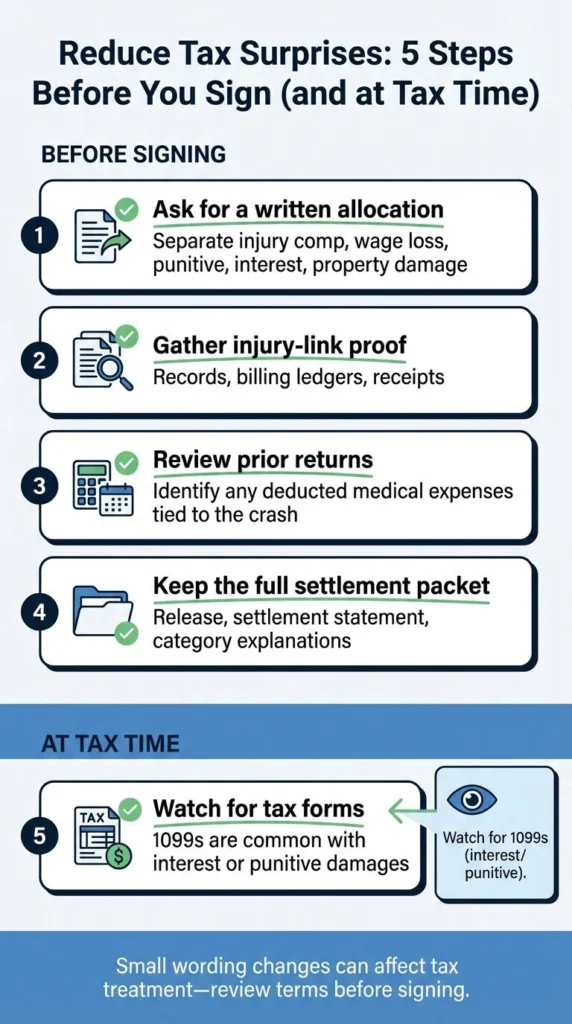
Use the steps below before signing any settlement agreement, and again at tax time to reduce the risk of a surprise bill.
- Ask for a written settlement allocation that separates injury compensation, wage loss, punitive damages, interest, and property damage.
- Gather proof of the injury link, including medical records, billing ledgers, and payment receipts.
- Review prior tax returns for medical deductions related to the crash so you can identify any reimbursement that may become taxable.
- Keep the full settlement packet, including the release, the settlement statement, and any correspondence that explains what each category is paying for.
- Watch for tax forms such as a 1099, especially when there is interest or punitive damages.
Get Your Settlement Terms Reviewed Before You Sign
If your settlement paperwork mixes taxable and non-taxable compensation categories, small wording changes can affect what you are able to keep after taxes. Angel Reyes & Associates can review your settlement terms, push for clear allocations, and protect the value of your recovery. With over 30 years of experience, we have helped more than 70,000 injured Texans get the relief they need after an accident. Contact us today for more information about your options.
Witness Statement FAQs
Are lost wages from a Texas car accident settlement taxable?
Usually not if the lost wage payment is part of a settlement for personal physical injuries or physical sickness, because the IRS says compensatory damages received on account of physical injury can be excluded from gross income. That differs from employment-case back pay, which the IRS generally treats as taxable wages.
If I receive a Form 1099 for part of my settlement, does that automatically mean I owe tax on it?
No. The IRS says taxability depends on what the payment was intended to replace, so information reporting does not by itself decide whether the amount is taxable.
Are attorney’s fees from a car accident settlement taxed separately from the rest of the recovery?
They can be, depending on how the settlement is characterized. The IRS says attorney fee reporting is tied to whether the underlying payment is includable in the claimant’s income, which is one reason clear allocation language in the settlement agreement matters.
What happens if the property damage portion of my settlement is more than my car’s tax basis?
The IRS says a property damage settlement up to your adjusted basis is generally not taxable, but any amount above that basis can become income. Even when it is not taxable, you generally must reduce your basis in the vehicle by the amount of the settlement.
Does a structured settlement change whether my injury recovery is taxable?
Not by itself. IRS guidance under Section 104(a)(2) applies whether damages for personal physical injuries are paid in a lump sum or in periodic payments, assuming the payments otherwise qualify for the exclusion.
About the Authors

Spencer Browne
Writer
Spencer Browne is a partner at Angel Reyes & Associates and a Board Certified personal injury trial lawyer with nearly 100 jury trials across Texas. He focuses on car, truck, and wrongful death cases, with notable verdicts including a landmark win in the Choctaw Casino bus crash case. A recognized speaker and legal educator, Spencer is a member of the American Board of Trial Advocates and has been honored as a Texas Super Lawyer and one of D Magazine’s Best Lawyers in Dallas. He brings deep trial experience and relentless advocacy to every client he represents.

Kyle Nicolas
Editor
Kyle Nicolas is the Web Content & SEO Manager at Angel Reyes & Associates. He has more than 10 years of experience as a marketing co...

Angel Reyes
Reviewer
Angel L. Reyes, III is the Founder and Managing Partner of Angel Reyes & Associates. A nationally recognized trial attorney and business...