What Texans Can Learn from Cruise & Waymo’s San Francisco Robotaxi Accidents


Every article on this site is researched by our internal team, reviewed for legal accuracy against current Texas law, and held to State Bar of Texas advertising standards before publication. We do not publish content that overstates outcomes or makes promises about results.
Learn more about our
editorial standards .
Key Takeaways
- Robotaxi crashes typically involve multiple potentially liable parties, including operators, remote assistance providers, and maintenance contractors.
- Texas's 51% comparative fault rule means that early evidence preservation and careful statements are critical to protecting your claim.
- AV-specific evidence (such as camera footage and driving logs) exists on company servers and requires prompt preservation requests to prevent deletion or data loss.
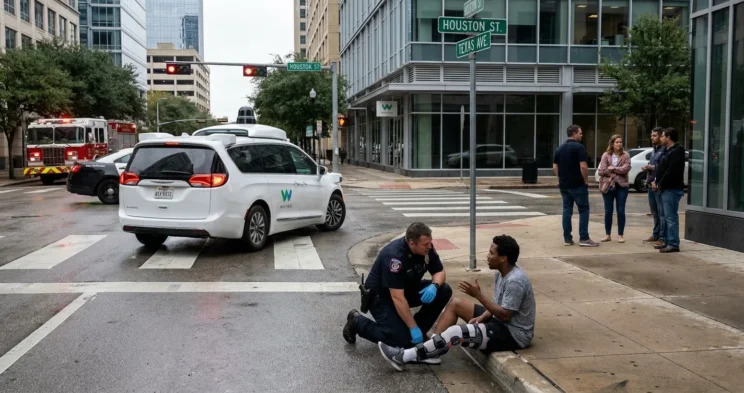
San Francisco has become ground zero for robotaxi safety incidents. In October 2023, the California DMV suspended Cruise’s autonomous vehicle permits after a pedestrian was struck and dragged by one of its robotaxis. The suspension cited immediate public safety concerns.
Just four months later, In February 2024, a driverless Waymo vehicle struck a cyclist in San Francisco. The injuries were reportedly minor, but the incident highlighted risks for vulnerable road users like cyclists and pedestrians.
The lessons from these crashes apply directly to cities in Texas that are preparing for wider autonomous vehicle (AV) rollouts. Understanding what went wrong in California can help protect your rights if something similar happens to you in Texas.
Why San Francisco Robotaxi Incidents Are Relevant in Texas
High-profile robotaxi incidents in San Francisco have created a practical roadmap for understanding liability, evidence preservation, and safety expectations. It’s important to learn these distinctions before autonomous vehicles become more common on I-35, Loop 610, or MoPac.
These incidents fall into clear categories: pedestrians and cyclists have been struck by robotaxis, AVs have stalled and blocked emergency responders, and companies have faced questions about their transparency and accountability after crashes. Each scenario raises specific legal questions that Texas crash victims will eventually have to face.
Legally speaking, Texas has its own tort rules, insurance requirements, and proportionate responsibility framework, but the San Francisco incidents show the types of evidence involved, who controls it, and how companies respond when things go wrong.
Lessons That Texas Crash Victims Can Learn From the San Francisco Incidents
The Cruise Pedestrian-Dragging Incident
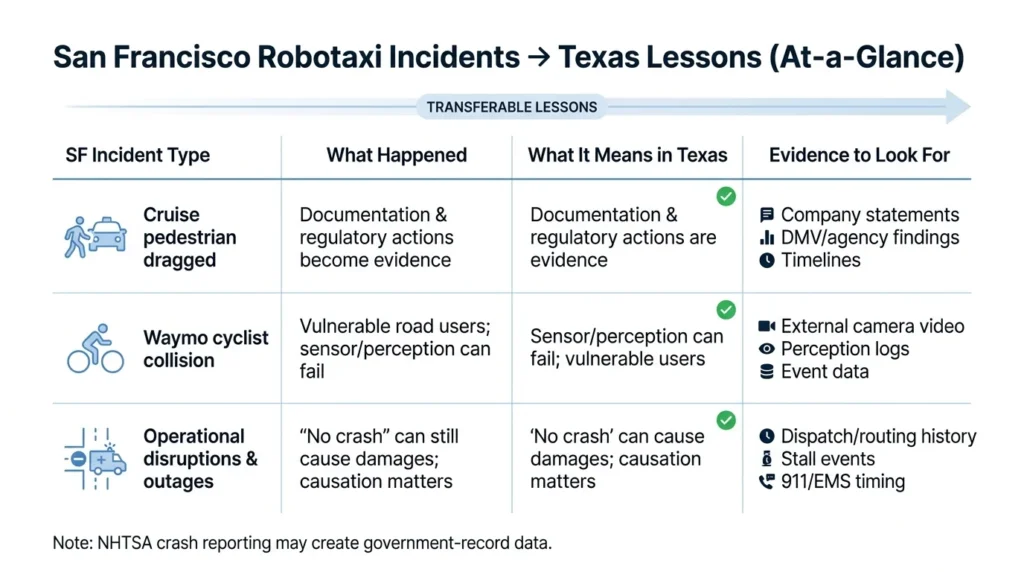
The lesson that Texas crash victims can take away from the 2023 incident that saw Cruise’s permits pulled is the importance of documentation. Regulatory investigations create paper trails, and company statements become evidence. Internal safety claims are measured against real-world results, so any enforcement action involving a robotaxi company may be considered in civil claims.
The Waymo Cyclist Collision
For Texas cyclists riding on Shepherd Drive in Houston or through SoCo in Austin, the incident involving Waymo striking a cyclist illustrates that robotaxi perception systems can fail to detect or properly respond to cyclists. The evidence that proves what happened exists in the vehicle’s cameras and decision logs, not just witness statements.
Operational Disruptions During Emergencies
Waymo vehicles have blocked San Francisco streets during power outages, creating traffic chaos and potentially delaying emergency response. In these cases, even though no collision occurred, the disruption still caused damages.
In Texas, this raises questions about foreseeability and causation. If a stalled robotaxi blocks an intersection in the Medical Center area of San Antonio and delays an ambulance, who is responsible? These scenarios require proof of the connection between the operational failure and the resulting damages.
Federal Crash Reporting Requirements
The NHTSA Standing General Order requires manufacturers and operators to report certain crashes involving automated driving systems. This federal reporting system means that data on AV crashes may exist in government records.
For Texas claimants, this is important during the discovery stage. Crash reports filed with NHTSA can provide information about what the vehicle’s systems were doing right before impact.
Texas AV Claims: What Changes & What Stays the Same?
The core elements of a negligence claim remain constant; you still need to prove duty, breach, causation, and damages. The fact that software was “driving” doesn’t eliminate these requirements. What changes is their complexity.
Robotaxi crashes typically involve more defendants. The robotaxi operator, remote assistance provider, maintenance contractors, and potentially the vehicle manufacturer may all share responsibility. More parties mean more insurance policies and more finger-pointing.
The evidence is also different. Instead of asking what the driver saw, you’re asking what the cameras recorded, and how the software interpreted that data. This information lives on servers controlled by the robotaxi company. Acting quickly to preserve this evidence is critical because it can be overwritten or access-restricted.
Who Can Be Liable in a Texas Robotaxi Crash
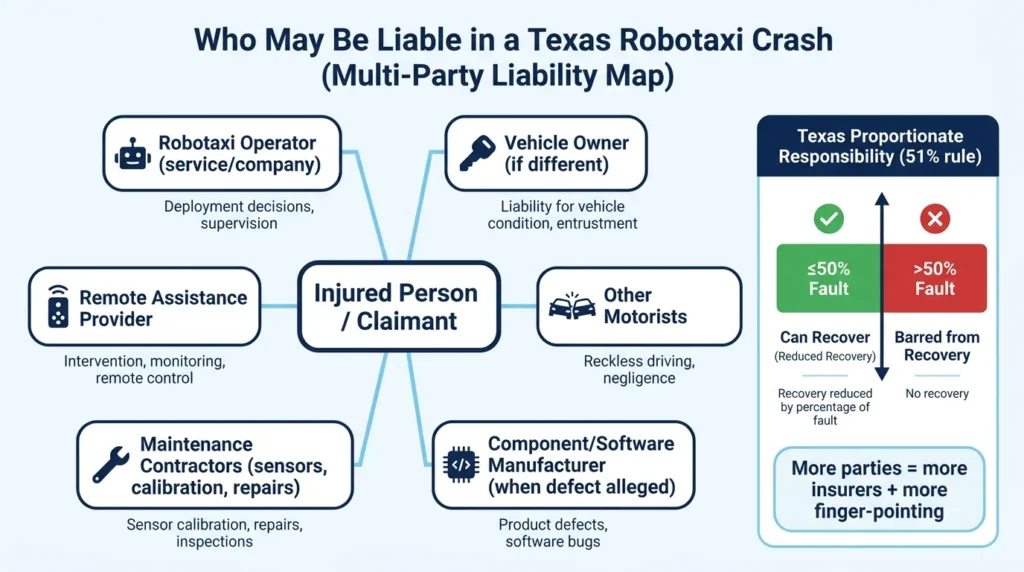
Robotaxi claims rarely involve just one responsible party. Potential defendants include:
- The robotaxi operator (the company running the service)
- The vehicle owner (sometimes different from the operator)
- Remote assistance providers who may have intervened
- Maintenance contractors responsible for sensors and systems
- Other motorists involved in the crash
- Component or software manufacturers (in some cases)
Texas law allows claims against multiple parties based on their respective fault. If a remote operator made a bad decision, the company employing that operator may be vicariously liable. If a sensor failed due to poor maintenance, the maintenance provider may share responsibility.
The 51% Rule & Proportionate Responsibility
Texas follows a modified comparative fault system under Texas Civil Practice and Remedies Code Chapter 33. This means if you’re found more than 50% at fault for the crash, you cannot recover damages. If you’re 50% or less at fault, your recovery is reduced by your percentage of responsibility.
Insurance companies and robotaxi operators use this rule aggressively. Common defenses in AV cases include claims that you “appeared suddenly,” that your movements were “unpredictable,” or that construction zones or other conditions caused “confusion.”
Your early statements and the evidence you preserve often determine where fault lands. This is why knowing what information to collect after a crash is so important.
Insurance Coverage in Robotaxi Crashes
Figuring out whose insurance will pay out can be complicated. Potential coverage sources include:
- The robotaxi operator’s commercial liability policy
- Another driver’s liability coverage (if a second vehicle was involved)
- Your own UM/UIM coverage
- MedPay or PIP coverage
- Health insurance (with potential subrogation issues)
Even minor injuries can involve significant disputes. Robotaxi companies fight claims aggressively because they’re concerned about setting precedents. Expect claims to move slower than typical car accident cases due to data review and layered vendors.
When You Need Early Legal Representation
Certain situations warrant legal guidance sooner rather than later, including:
- You sustained serious injuries that require ongoing treatment.
- There is disputed fault or conflicting accounts.
- Vulnerable road users (pedestrians or cyclists) were involved.
- Complex commercial insurance is involved.
- There is any indication that the operator is controlling key video footage or telemetry.
An attorney can send preservation letters, coordinate vehicle inspections, manage recorded statements, and identify all potentially responsible parties. Our case results demonstrate experience handling complex vehicle accident claims, and our client reviews reflect our commitment to the people we represent.
Evidence Preservation for Robotaxi Claims
In AV cases, what the vehicle “saw and decided” is just as important as the physical evidence at the scene of the crash.
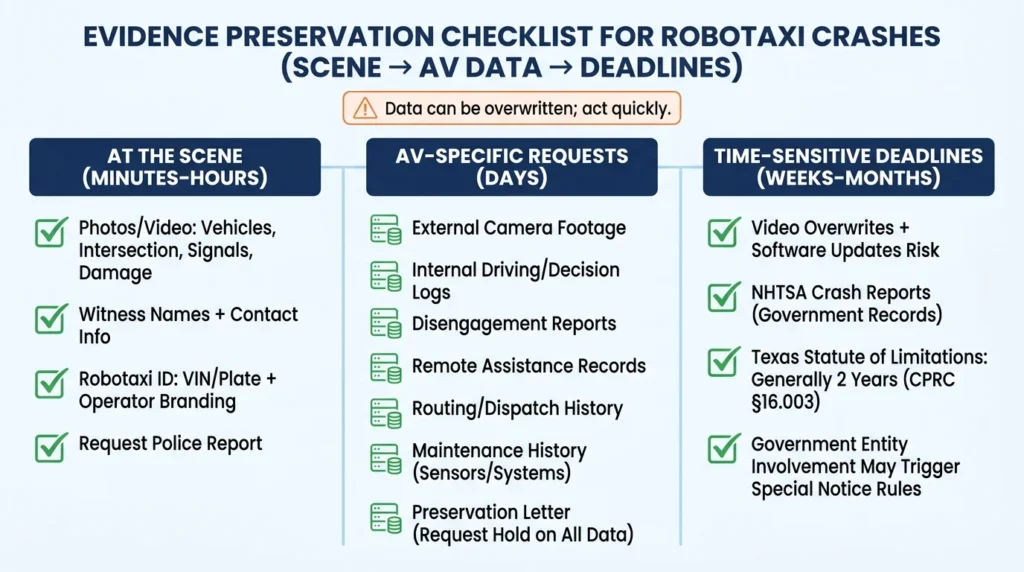
Immediate steps to take at the scene of the crash:
- Take photos and video of all vehicles, the intersection, and any visible damage.
- Get contact information from witnesses.
- Note the robotaxi’s vehicle identification and operator branding.
- Request a police report.
AV-specific evidence to request:
- External camera footage
- Internal driving logs and decision records
- Disengagement reports
- Remote assistance records
- Routing and dispatch information
- Maintenance history
Federal crash reporting requirements mean some data may exist in government records, but the most detailed information typically lives on company servers.
Don’t assume the police report captures AV data. Officers document what they observe at the scene, but the vehicle’s internal logs require separate preservation efforts. Following standard post-accident steps is important, but robotaxi crashes require additional action.
Important Deadlines For Texas Crash Victims
Many Texas personal injury and wrongful death claims are subject to a two-year statute of limitations under Texas Civil Practice and Remedies Code § 16.003. Missing this deadline typically prevents you from pursuing your claim.
However, waiting causes problems long before legal deadlines approach. Video footage gets overwritten, witnesses forget details, and vehicles receive software updates that change how their systems operate. The evidence that proves your case today may not exist six months from now.
If a city or government entity plays a role (for example: road design issues, signal timing, or emergency management failures), special notice rules may apply. These situations require prompt legal review.
Safety Expectations for Texas Metropolitan Areas
As robotaxis expand into Dallas-Fort Worth, Houston, Austin, San Antonio, and other Texas cities, the San Francisco incidents highlight what communities should expect from AV operators:
Emergency preparedness is vital. It’s important to know that vehicles should clear intersections, yield to first responders, and handle power or network outages without blocking traffic. The San Francisco outage incidents show what happens when these systems fail.
Complex traffic areas increase crash risk. Construction zones on I-35 through Austin, dense pedestrian areas in Deep Ellum, and busy cycling corridors along Buffalo Bayou in Houston all present challenges for AV perception systems. These environments amplify both crash risk and comparative fault disputes.
Accountability documentation helps claimants. When regulators take action against robotaxi operators, those records can support civil claims. For example, the Cruise permit suspension created a paper trail that documented safety concerns.
How Angel Reyes & Associates Can Help
Robotaxi crashes present unique challenges. Multiple potential defendants, proprietary evidence, and aggressive corporate defense strategies make these cases different from typical vehicle accidents.
Angel Reyes & Associates has over 30 years of experience handling complex vehicle accident claims across Texas. We offer free initial consultations and work on contingency, meaning you pay no fee unless we win. Our firm has recovered more than $1 billion for clients, and we have more than 20 locations across Texas to serve you. We’re available 24/7 and offer bilingual service in Spanish.
If you’ve been injured in a robotaxi crash or any vehicle accident, contact us to discuss your situation. Early action protects your rights and preserves critical evidence.
Robotaxi Liability FAQs
Does a robotaxi crash always count as a product liability case in Texas?
Not always. Many cases are handled as negligence claims, while a product defect claim may depend on whether the problem was tied to the vehicle, a sensor, software, or some other defective component.
Can you still make a claim if a robotaxi did not hit you directly?
Sometimes, yes. If a stalled or improperly operating robotaxi created a dangerous situation that led to a secondary crash or other injury, liability may depend on whether the damage was a foreseeable result of the vehicle’s failure.
Does a robotaxi company have to report the crash to the government?
Some crashes involving automated driving systems may have to be reported under federal rules, but that does not mean every detail will be easy for an injured person to obtain. Company-held video footage, telemetry, and internal records may still require separate legal steps to be preserved and requested.
What if the robotaxi company updates the vehicle’s software after the crash?
Post-crash updates can make it harder to compare the vehicle’s condition at the time of the incident, which is one reason early documentation is so important. In some cases, investigators may need to focus on preserving logs, version history, and other records showing how the system was operating before any changes were made.
Are pedestrian and cyclist claims different from other Texas crash claims?
The basic legal rules are similar, but these cases often hinge more heavily on right-of-way, visibility, speed, and what the vehicle’s sensors detected. In this case, there may be little physical protection for the injured person, so even a low-speed impact can still lead to significant damages.
About the Authors

Angel Reyes
Writer
Angel L. Reyes, III is the Founder and Managing Partner of Angel Reyes & Associates. A nationally recognized trial attorney and business leader, Angel has helped over 70,000 injury victims recover more than $1 billion since founding the firm in 1993. Named to the Texas Super Lawyers list annually since 2008, Angel brings Wall Street experience, Ivy League education, and a deep commitment to client advocacy. He is a frequent legal commentator and published author with extensive contributions to legal scholarship, trial strategy, and consumer protection.

Kyle Nicolas
Editor
Kyle Nicolas is the Web Content & SEO Manager at Angel Reyes & Associates. He has more than 10 years of experience as a marketing co...

Angel Reyes
Reviewer
Angel L. Reyes, III is the Founder and Managing Partner of Angel Reyes & Associates. A nationally recognized trial attorney and business...