What SB 2205 Means for Self-Driving Vehicle Accident Victims in Texas


Every article on this site is researched by our internal team, reviewed for legal accuracy against current Texas law, and held to State Bar of Texas advertising standards before publication. We do not publish content that overstates outcomes or makes promises about results.
Learn more about our
editorial standards .
Key Takeaways
- Texas SB 2205 permits autonomous vehicles on public roads but establishes specific operator, insurance, and crash-reporting requirements under the Transportation Code.
- The statutory "operator" designation for traffic-law purposes doesn't automatically determine civil liability, which may involve multiple parties, including fleet operators and manufacturers.
- Autonomous vehicle data can be critical evidence but may be overwritten quickly, making early preservation efforts essential for crash victims.
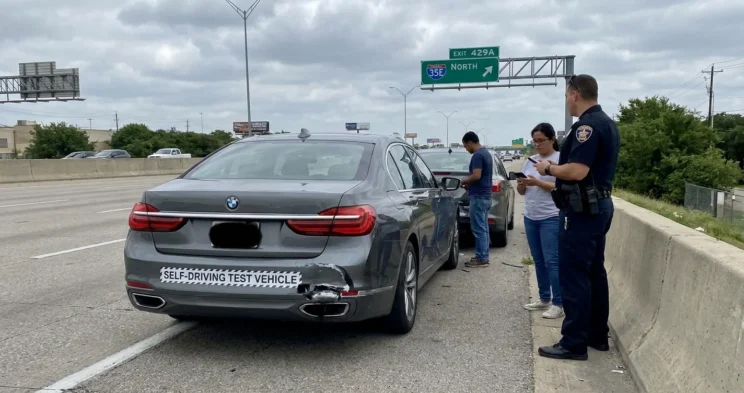
You were driving home on I-35E through Dallas when a vehicle with no one behind the wheel merged into your lane. The collision happened fast. Now you’re dealing with injuries, vehicle damage, and a confusing situation: who exactly is responsible when the other car was driving itself?
Texas allows autonomous vehicles on public roads, but that doesn’t mean there are no rules. A 2017 state law created a framework that affects everything from who counts as the “operator” to what data might exist after a crash. Understanding these rules can help you protect your claim.
What Is SB 2205?
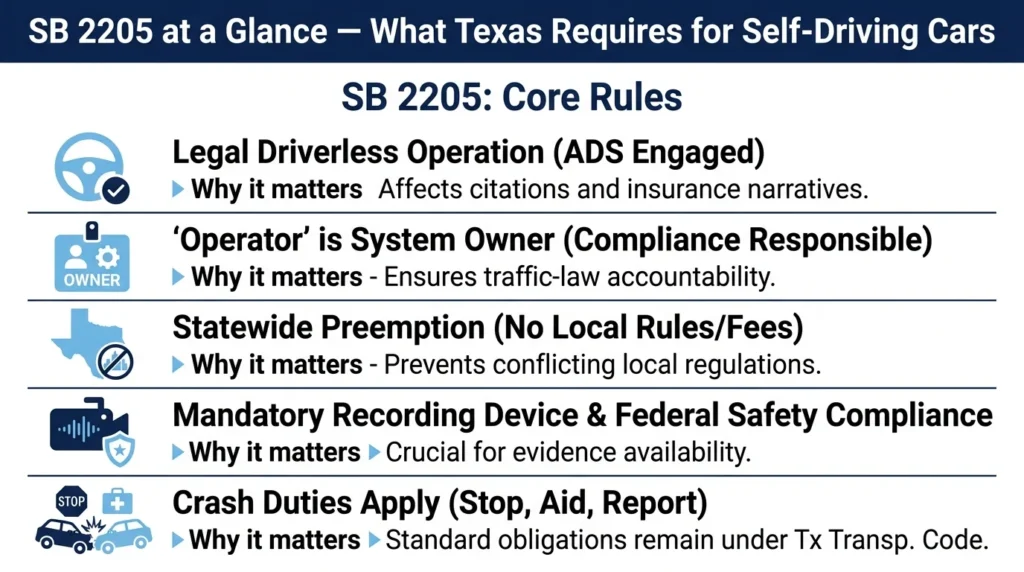
Texas Senate Bill 2205 (SB 2205) is the primary law that legalized and regulated autonomous vehicles (AVs) on Texas roads. Passed in 2017, it amended the Texas Transportation Code § 545.451 (which now includes Subchapter J) to create a unified statewide framework for automated motor vehicles.
These rules work alongside Texas Transportation Code § 550.021, which governs general crash duties like stopping, rendering aid, and reporting collisions.
Key provisions of SB 2205 include:
- Legalization of Driverless Operation: It explicitly allows a vehicle to operate on public roads without a human driver physically present, provided the automated system is engaged.
- The “Operator” Designation: Under SB 2205, the owner of the automated driving system is legally considered the “operator” of the vehicle for the purpose of assessing compliance with traffic laws.
- Statewide Preemption: It prohibits cities (like Dallas, Austin, or Fort Worth) from creating their own local regulations or franchise fees for self-driving cars. All oversight is handled at the state level.
- Mandatory Equipment: All autonomous vehicles must be equipped with a recording device (similar to a “black box”) and must comply with all applicable federal motor vehicle safety standards.
Recording Devices & AV Data
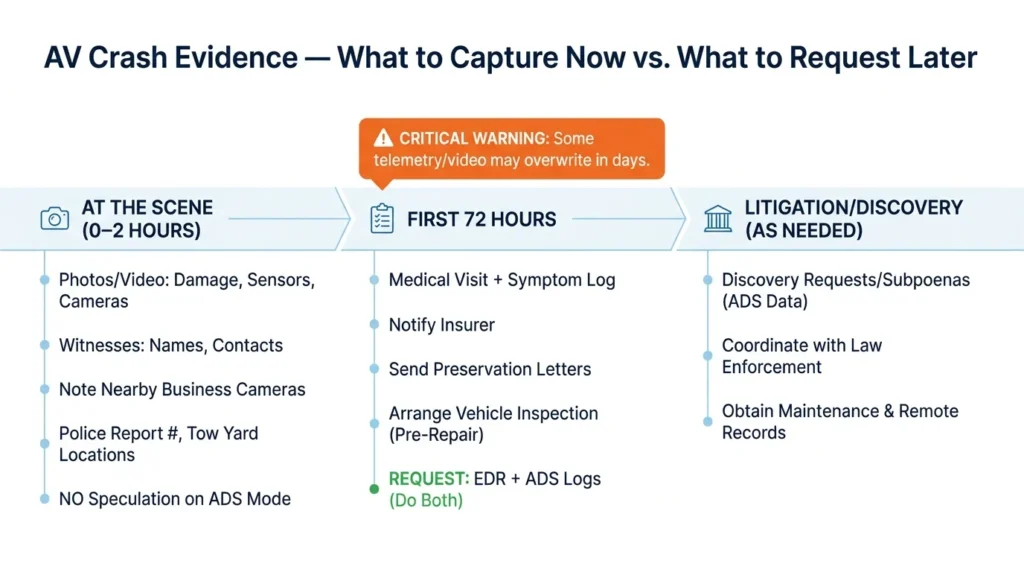
While standard cars have event data recorders (EDR), SB 2205 requires autonomous vehicles to have internal automated driving system (ADS) data logging. Both types of data should be requested, as the EDR tells us about the crash physics, and the ADS log tells us why the software failed to brake. This data can be crucial for proving what happened in a crash.
The challenge is access. You can’t download AV logs at the scene. Obtaining this information typically requires:
- Formal preservation letters to be sent to the AV company.
- Discovery requests through litigation.
- Coordination with law enforcement investigations.
Time matters. Some video and telemetry data gets overwritten within days. Vehicles may be repaired or returned to service quickly. If you’ve been injured in a crash with an autonomous vehicle, acting fast to preserve evidence is essential.
Data types worth requesting include:
- ADS engagement and disengagement logs
- Perception system alerts
- Camera and sensor footage
- Remote assistance logs
- Maintenance and diagnostic records
How Texas Crash Claims Work With Autonomous Vehicles
Civil liability in these cases can involve multiple parties, including the vehicle owner, the company operating the fleet, the manufacturer, or a maintenance contractor. A full investigation is needed to identify all potentially responsible parties. This can make pursuing claims more difficult.
Potential claim paths include:
- Third-party liability claims against the at-fault party’s insurance.
- Uninsured/underinsured motorist (UM/UIM) claims through your own policy.
- Commercial fleet coverage claims.
Damages in Texas car accident claims can include medical expenses, lost income, pain and suffering, and property damage. Careful documentation strengthens your position.
Key Factors That Affect Your Claim
Under the framework established by SB 2205, when an automated driving system is engaged, Texas can treat the person or entity associated with that system as the operator for traffic-law compliance. This affects how police write citations and crash reports, which can shape early insurance company narratives about fault.
Key questions to ask include:
- Was the automated driving system engaged at the time of impact?
- Was there a safety driver present in the vehicle?
- Was a remote operator monitoring the vehicle?
- Who or what entity is listed as responsible for the driving task?
Under the latest 2026 Texas Department of Motor Vehicles (TxDMV) regulations, the “operator” is typically the Authorization Holder. The Authorization Holder is the company permitted by the state to deploy the fleet.
Mistakes That Weaken AV Claims
Don’t assume “the robot is always at fault” or “no one is at fault.” Avoid speculating about software, driving mode, or blame at the scene.
Don’t delay medical care. Symptoms from car accidents can develop over days. Documentation matters for both your health and your personal injury claim.
Don’t let vehicles get repaired or salvaged before documenting damage. If the AV company or other parties later argue about impact severity, you’ll want that evidence preserved.
Operator for Traffic Laws vs. Civil Liability
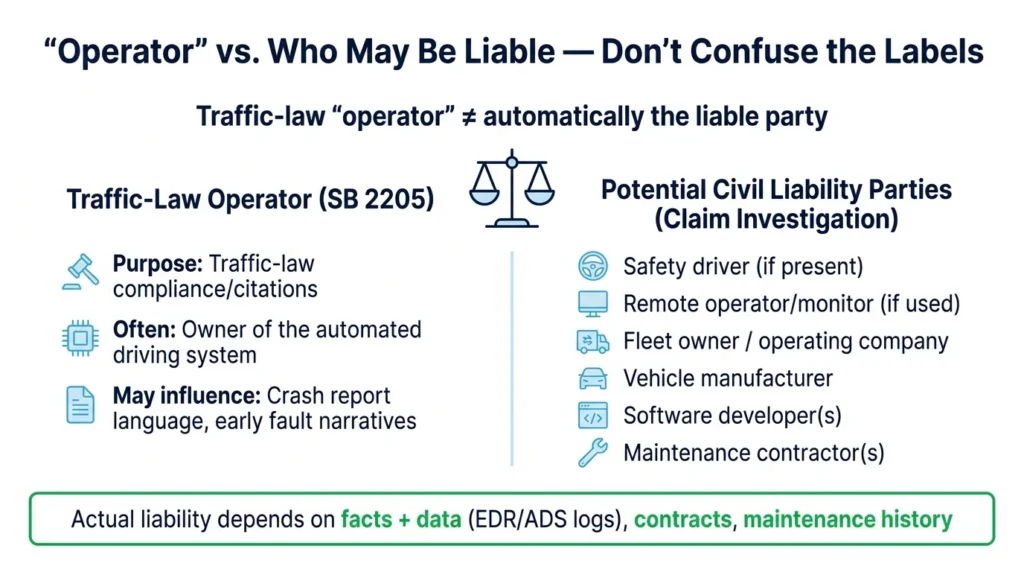
Insurance adjusters sometimes blur an important distinction. A statute can assign an “operator” for compliance with road rules, while civil liability involves entirely different parties.
Potential responsible parties in an autonomous vehicle crash may include:
- The safety driver (if present)
- The remote operator
- The fleet owner or operating company
- The vehicle manufacturer
- Software developers
- Maintenance contractors
This is similar to how truck accident claims can involve the driver, trucking company, and cargo loaders. The “operator” label doesn’t end the liability analysis.
Be cautious about early statements to police or insurers. These can lock in a narrative before anyone reviews the vehicle’s data. If you’ve been seriously injured, consider speaking with an attorney before giving a recorded statement.
What to Do After a Self-Driving Car Accident
Car accidents involving self-driving vehicles can be difficult to prove without the right evidence supporting your claim.
You should focus on collecting the following evidence:
- Photos and video of both vehicles, including the AV’s sensors and cameras.
- Witness names and contact information.
- Nearby business surveillance camera locations.
- Your own dashcam footage (if available).
- The reference number for your police report.
- The tow yard location for both vehicles.
The SB 2205 framework requires all parties involved to comply with post-crash duties. If an AV company representative tries to handle things informally, you can still insist on proper reporting, especially if you’re injured or there’s significant property damage.
In addition to collecting evidence at the scene, you should:
- Write brief factual notes about what happened.
- Obtain the crash report number from the responding agency.
- Notify your own insurance company.
- Avoid recorded statements if you’re uncertain about ADS-related facts.
- Start a medical file and symptom log.
- Work with an attorney on preservation letters and data requests.
- Arrange vehicle inspection before repairs.
- Document any missed work and gather wage records.
- Follow up with medical providers.
What to Do When There’s No Human Driver
Autonomous vehicles do not always have human operators.
If there’s no one to hand you insurance information, look for:
- A company contact number displayed on the vehicle.
- Remote support contact information.
- Fleet identification markings.
- The license plate (you can request insurance information through the police report).
Document whatever operator details are reported at the scene without speculating. Note whether a safety driver was present, whether anyone mentioned a remote operator, and what the responding officer records.
When to Talk to a Lawyer
If you suffered injuries from an accident with an autonomous vehicle, Angel Reyes & Associates can help you with your claim.
Consider legal help if you’re dealing with:
- Serious injuries requiring ongoing treatment.
- Fault is disputed between you and the AV company.
- A commercial autonomous vehicle with corporate insurance.
- Pressure for quick settlements or recorded statements.
- Concerns about evidence being lost or destroyed.
With over 30 years of experience handling complex vehicle accident claims across Texas, our attorneys at Angel Reyes & Associates understand how to investigate crashes involving new technology. We offer free consultations and work on a contingency basis, meaning there’s no fee unless we win. Our team serves clients across the state.
Contact us to discuss your autonomous vehicle crash and set up a free consultation.
SB 2205 FAQs
Can a city like Dallas or Fort Worth make its own self-driving car rules?
Texas law generally creates a statewide framework for automated vehicles, so cities usually cannot impose a conflicting patchwork of local operating rules. Local police still enforce general traffic and crash laws after a collision.
Will my own uninsured/underinsured motorist coverage still matter if a self-driving car hits me?
It can, especially if fault is disputed, coverage is unclear, or the at-fault party’s policy is not enough to cover your losses. Whether UM/UIM applies depends on your policy and the facts of the crash.
What if the autonomous vehicle was being used for deliveries or ride services?
That may mean commercial insurance and company records are involved, not just a personal auto policy. It can also broaden the list of parties that may need to be investigated.
Do I need to report the crash to Texas police if the damage seems minor?
Texas law does not require a report for every fender-bender, but crashes involving injury, death, or a disabled vehicle usually trigger reporting duties and a stronger need for official documentation. If you are unsure, calling law enforcement is often the safer choice.
Can road construction or bad signage affect a self-driving car crash claim?
Yes, roadway conditions, temporary lane shifts, cones, missing signs, or poor markings can matter in both human-driver and autonomous-vehicle crashes. Photos of the area taken right away can be important if the scene changes later.
About the Authors

Angel Reyes
Writer
Angel L. Reyes, III is the Founder and Managing Partner of Angel Reyes & Associates. A nationally recognized trial attorney and business leader, Angel has helped over 70,000 injury victims recover more than $1 billion since founding the firm in 1993. Named to the Texas Super Lawyers list annually since 2008, Angel brings Wall Street experience, Ivy League education, and a deep commitment to client advocacy. He is a frequent legal commentator and published author with extensive contributions to legal scholarship, trial strategy, and consumer protection.

Kyle Nicolas
Editor
Kyle Nicolas is the Web Content & SEO Manager at Angel Reyes & Associates. He has more than 10 years of experience as a marketing co...

Angel Reyes
Reviewer
Angel L. Reyes, III is the Founder and Managing Partner of Angel Reyes & Associates. A nationally recognized trial attorney and business...