Waymo Fatalities & Texas Wrongful Death Laws


Every article on this site is researched by our internal team, reviewed for legal accuracy against current Texas law, and held to State Bar of Texas advertising standards before publication. We do not publish content that overstates outcomes or makes promises about results.
Learn more about our
editorial standards .
Key Takeaways
- Public reports confirm fatal crashes where Waymo vehicles were "involved," but being involved doesn't automatically mean Waymo was legally at fault.
- Texas wrongful death claims generally must be filed within two years of death, regardless of whether federal investigations are still ongoing.
- Even when a robotaxi isn't at fault, its sensor logs and video data can serve as critical evidence for claims against other responsible parties.
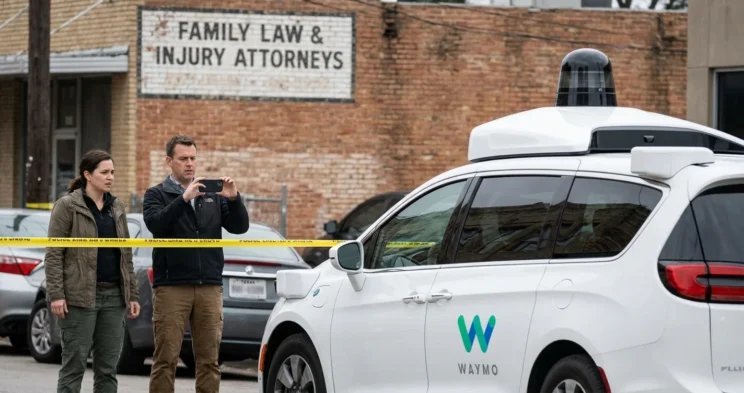
You lost a family member in a crash that involved a Waymo robotaxi. Now you’re searching for answers.
Was the self-driving car responsible? Can you file a lawsuit if Waymo wasn’t technically “at fault”?
These questions are important to ask, and the answers aren’t as straightforward as headlines suggest.
Texas families facing this situation need clarity on what’s actually been confirmed about Waymo fatalities, how liability works when there’s no human driver, and what deadlines apply to wrongful death claims. The distinction between a vehicle being “involved” in a fatal crash and being legally responsible for it can determine your entire case strategy.
What’s Confirmed About Waymo Fatalities vs. What’s Still Under Investigation
Public reporting has documented fatal crashes where Waymo robotaxis were present. That’s different from saying Waymo caused those deaths.
In January 2025, a multi-vehicle collision in San Francisco killed one person and a dog. A Waymo vehicle was among the cars involved. Early reports indicated Waymo was not being blamed for the crash, though the investigation was ongoing.
A separate incident in Tempe, Arizona involved a motorcycle fatality where Waymo was reportedly present but apparently not at fault. The distinction here is that the robotaxi was part of the crash sequence without necessarily causing it.
More recently, a January 2026 Santa Monica school-zone crash resulted in a Waymo vehicle striking a 9-year-old pedestrian, causing serious injury. The NTSB opened an investigation, and NHTSA launched a preliminary evaluation examining whether the vehicle exercised appropriate caution near schools.
For families evaluating potential claims, the key takeaway is this: “involved” can mean the Waymo was struck, was nearby, or took actions that became part of the chain of events. Liability requires a fact-specific investigation that goes far beyond initial news reports.
What “Involved” vs. “At Fault” Means
News coverage often uses “involved” and “at fault” interchangeably. They’re not the same thing, and understanding the difference shapes whether you have a viable wrongful death claim.
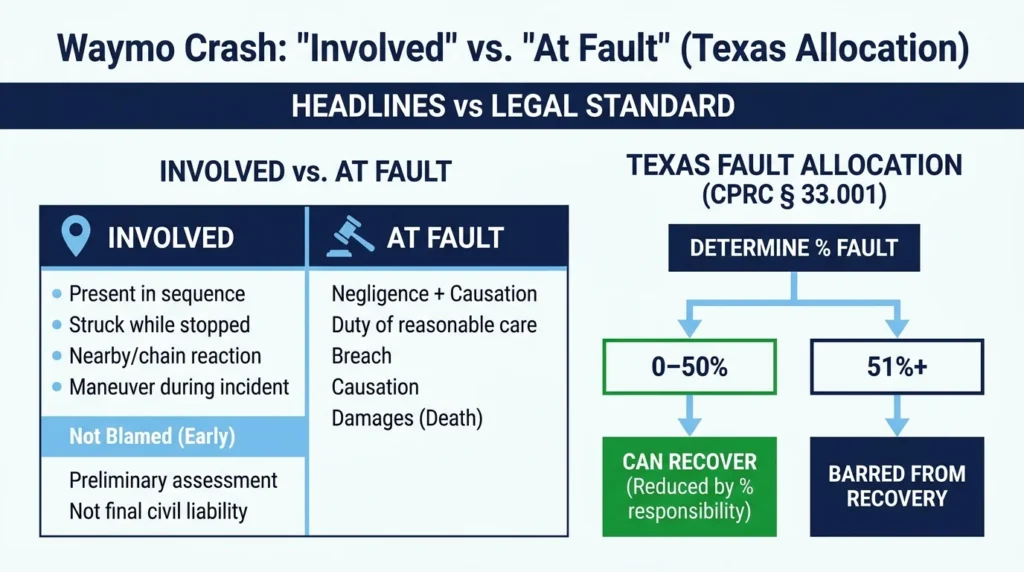
“Involved” means the vehicle was part of the incident in some way. It could have been struck while stopped at a light. It could have been rear-ended in a chain reaction. It could have made a maneuver that contributed to the sequence of events.
Being involved simply places the vehicle at the scene.
“At fault” requires proving negligence and causation. Someone (or some entity) failed to exercise reasonable care, and that failure directly caused the death. In autonomous vehicle cases, this analysis becomes more complex because there’s no human driver to blame.
When early reports say Waymo was “not blamed,” that typically reflects a preliminary police assessment. It doesn’t mean civil liability has been determined. Multi-car crashes often shift fault as evidence is analyzed. Witness statements, traffic camera footage, and vehicle telemetry can change the narrative weeks or months later.
Texas uses a modified comparative fault system. More than one party can share responsibility for a crash. Under Texas Civil Practice and Remedies Code § 33.001, fault is allocated among all responsible parties. If your family member was found partially responsible, recovery may be reduced proportionally. If they’re found more than 50% responsible, recovery could be barred entirely.
This means a Waymo crash where the robotaxi was “not at fault” might still support a claim against another driver, a maintenance provider, or even a roadway entity. The autonomous vehicle’s data could become critical evidence for proving what actually happened.
Who Can Be Held Liable When There’s No Human Driver?
The absence of a human behind the wheel doesn’t eliminate liability. It shifts the analysis to different potential defendants.
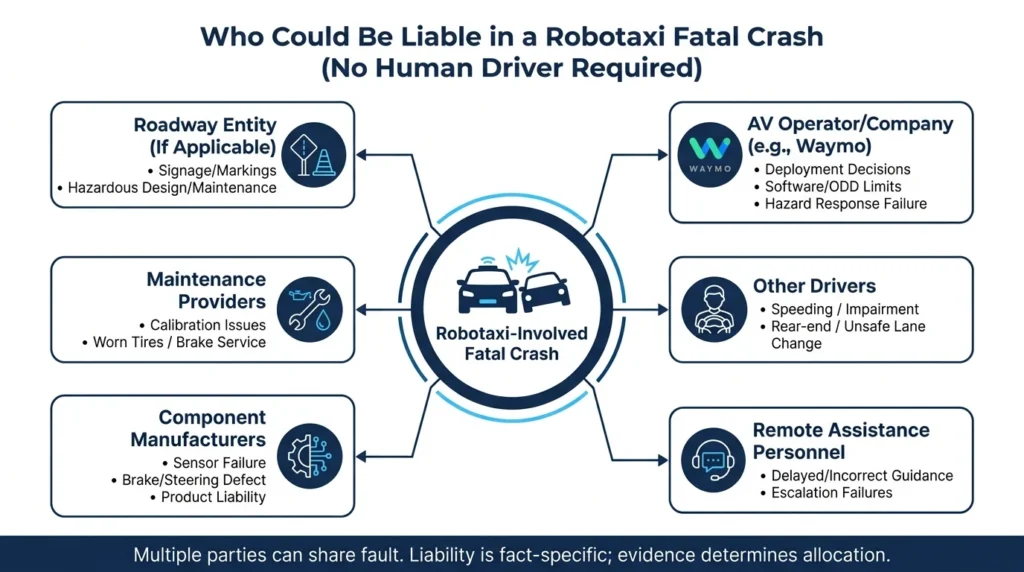
The AV operator/company: Waymo operates the vehicle and makes decisions about deployment, software updates, and operational parameters. If the system failed to respond appropriately to a hazard, the company could face negligence claims.
Other drivers: In multi-vehicle crashes, human drivers often bear primary responsibility. The Waymo may have been struck by a speeding driver or caught in a chain reaction started by someone else’s negligence.
Remote assistance personnel: Waymo vehicles can receive remote guidance. If a human operator made a poor decision that contributed to the crash, that could create liability.
Component manufacturers: If a sensor, brake system, or other component failed, product liability theories might apply against the manufacturer.
Maintenance providers: Negligent maintenance (failed brakes, worn tires, sensor calibration issues) can create liability separate from the AV technology itself.
For car accidents involving autonomous vehicles, the investigation must identify which parties’ actions (or failures to act) contributed to the death. “The car was autonomous” doesn’t answer who pays. Evidence does.
Pedestrian Crashes: Special Considerations
When a Waymo strikes a pedestrian, fault analysis examines right-of-way, speed, visibility, and whether the vehicle exercised appropriate caution. School zones receive heightened scrutiny because vehicles should anticipate children behaving unpredictably.
The Santa Monica incident highlights this issue. NHTSA’s preliminary evaluation specifically examined whether the Waymo system demonstrated adequate caution in a school-zone environment. These regulatory findings can inform civil cases, though they don’t replace the need to prove negligence independently.
If your family member was struck as a pedestrian, immediate priorities include:
- Obtaining the police report
- Identifying the operating entity
- Collecting witness contact information
- Preserving any video footage from nearby businesses or traffic cameras
- Documenting the exact location and conditions
Multi-Vehicle Crashes: Chain Reaction Complexity
The San Francisco fatality illustrates how multi-vehicle crashes complicate liability. When several cars collide in sequence, determining proximate cause requires reconstructing exactly what happened and when.
A Waymo stopped at a light that gets rear-ended by a speeding driver is different from a Waymo that made an unexpected lane change triggering a pileup. Both scenarios involve the robotaxi. Only one suggests Waymo liability.
Evidence priorities in these cases include intersection cameras, 911 call recordings, black-box data from all vehicles, and AV telemetry (when obtainable through legal process). Early blame assignments from police are starting points, not final answers.
Important Evidence in Robotaxi Cases
Autonomous vehicles generate extensive data that doesn’t exist in traditional crashes. This can help or hurt your case depending on what it shows.
AV-specific evidence includes:
- Vehicle sensor logs showing what the system “saw”
- Decision-making records showing how the system responded
- Remote assistance communications
- Software version and update history
- Prior incident reports for similar scenarios
Standard crash evidence remains critical:
- Police reports
- Witness statements
- Nearby security camera footage
- Medical records documenting injuries and cause of death
- Photos of the scene and all vehicles involved
Timing is crucial for preservation. Video footage gets overwritten. Vehicle logs may have retention limits. Sending a spoliation letter (a formal notice requiring evidence preservation) early can prevent critical data from being lost.
Families should avoid posting speculation on social media and should begin documenting economic impacts immediately: funeral costs, lost income, medical bills from any treatment before death.
Texas Wrongful Death Basics for Families Evaluating Claims
Texas law allows certain family members to pursue wrongful death claims when someone dies due to another party’s negligence. Understanding who can file, what must be proven, and what damages may be available helps families make informed decisions.
Who Can File?
Generally, a surviving spouse, children, or parents of the deceased may bring a wrongful death claim in Texas. The claim compensates these survivors for their losses. A separate “survival action” allows the deceased’s estate to recover for the person’s own losses (like pain and suffering before death).
What Damages May Be Available
Wrongful death damages in Texas typically include:
- Economic losses: Lost financial support, lost inheritance, funeral and burial expenses
- Non-economic losses: Loss of companionship, mental anguish, loss of guidance and nurturing
Documentation supporting these damages includes employment records, tax returns, evidence of the relationship, and receipts for all expenses incurred.
The Filing Deadline You Cannot Ignore
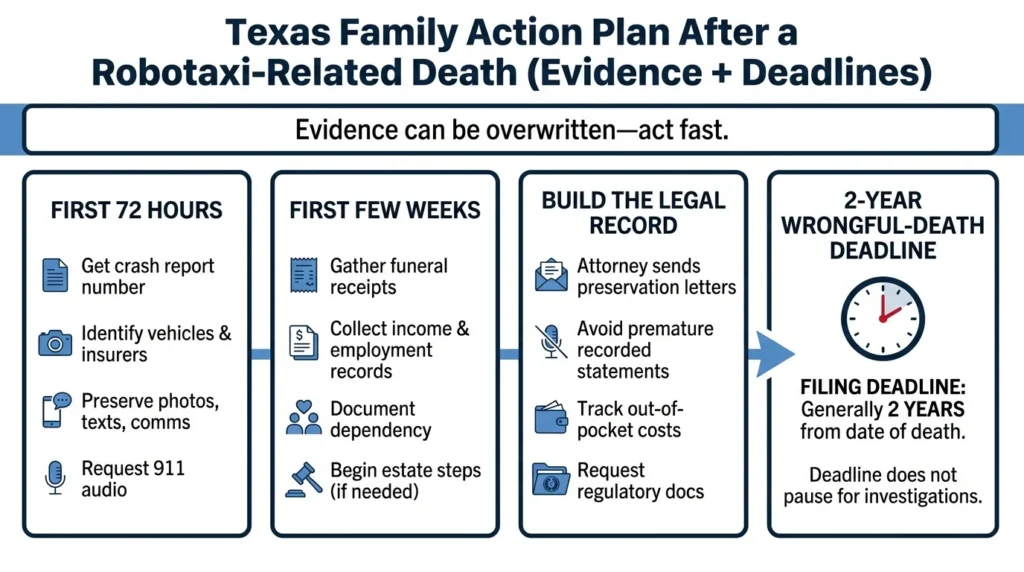
Texas wrongful death claims generally must be filed within two years of the date of death. This deadline exists regardless of whether NHTSA or NTSB investigations are ongoing. Regulatory investigations can take years.
Your filing window won’t wait.
Exceptions to this deadline are limited and fact-specific. Families should not assume they qualify for an extension without consulting an attorney.
If the crash occurred outside Texas but your family lives here, jurisdiction and venue questions add complexity. A motorcycle accident in Arizona involving a Texas resident may require analysis of which state’s laws apply and where the case can be filed.
Practical Next Steps for Texas Families
Whether or not Waymo is ultimately found liable, families facing a robotaxi-related fatality should take these steps:
Within the first 72 hours:
- Obtain the crash report number from law enforcement
- Identify all vehicles and insurance companies involved
- Preserve all photos, text messages, and communications
- Request 911 audio recordings if available
Within the first few weeks:
- Gather funeral documentation and receipts
- Collect employment records showing the deceased’s income
- Document dependency (who relied on the deceased financially)
- Begin estate administration if necessary
For building a legal case:
- Have an attorney send preservation letters to all parties
- Avoid giving recorded statements to insurance companies without legal guidance
- Track all out-of-pocket expenses and care costs
- Request copies of any regulatory investigation documents as they become available
When to Talk to a Texas Wrongful Death Attorney
Even if early reports suggest Waymo wasn’t at fault, consulting an attorney makes sense when:
- Fault is unclear or disputed
- Multiple vehicles were involved
- The crash occurred in a school zone or involved a pedestrian
- Statements from different parties conflict
- The crash happened outside Texas but your family lives here
An attorney can coordinate accident reconstruction experts, request vehicle logs and video through proper legal channels, handle insurance company communications, and evaluate all potential defendants. This work often needs to begin well before any regulatory investigation concludes.
At Angel Reyes & Associates, we’ve spent over 30 years helping Texas families navigate complex injury and wrongful death cases. We offer free consultations and work on contingency, meaning there’s no fee unless we win. Our team has helped clients recover more than $1 billion in compensation.
If your family is facing questions about a robotaxi-involved fatality, contact us to discuss your situation. Understanding your options now protects your ability to pursue justice later.
Waymo Wrongful Death FAQs
Can a family bring both a wrongful death claim and a survival claim in Texas?
Often yes. A wrongful death claim seeks compensation for certain surviving family members’ losses, while a survival claim belongs to the estate and covers losses the deceased could have claimed if they had lived.
Do police or NHTSA findings decide who wins a civil case?
No. Those findings can be important evidence, but civil liability is decided under a different process and may include facts that were not available in the early investigation.
What evidence should families try to preserve after a robotaxi-related fatal crash?
Useful evidence can include dashcam or security video, 911 recordings, witness contact information, phone photos, and records showing funeral costs or lost financial support. In self-driving vehicle cases, electronic logs and vehicle data may also become important in the case, so early preservation steps are important.
Can a crash outside Texas still lead to a claim for a Texas family?
Possibly. Where the lawsuit can be filed and which state’s law applies depends on the facts, including where the crash happened, who was involved, and the parties’ connections to each state.
Will insurance still apply if an autonomous vehicle was in self-driving mode?
Often yes, but which policy applies and how much coverage is available depends on the vehicle’s operator, the companies involved, and the facts of the crash. That question is separate from whether the autonomous system itself was actually at fault.
About the Authors

Angel Reyes
Writer
Angel L. Reyes, III is the Founder and Managing Partner of Angel Reyes & Associates. A nationally recognized trial attorney and business leader, Angel has helped over 70,000 injury victims recover more than $1 billion since founding the firm in 1993. Named to the Texas Super Lawyers list annually since 2008, Angel brings Wall Street experience, Ivy League education, and a deep commitment to client advocacy. He is a frequent legal commentator and published author with extensive contributions to legal scholarship, trial strategy, and consumer protection.

Kyle Nicolas
Editor
Kyle Nicolas is the Web Content & SEO Manager at Angel Reyes & Associates. He has more than 10 years of experience as a marketing co...

Angel Reyes
Reviewer
Angel L. Reyes, III is the Founder and Managing Partner of Angel Reyes & Associates. A nationally recognized trial attorney and business...