What to Do If You’re Injured on a Lime Scooter in Texas


Every article on this site is researched by our internal team, reviewed for legal accuracy against current Texas law, and held to State Bar of Texas advertising standards before publication. We do not publish content that overstates outcomes or makes promises about results.
Learn more about our
editorial standards .
Key Takeaways
- Lime scooter riders may be able to recover compensation, but how much may be reduced if they weren't compliant with Texas law at the time of the accident.
- Lime's user agreement may not block your claim if its waiver fails Texas fair notice rules, or if the nature of your injury falls outside the scope of the waiver's coverage.
- If you are injured while riding a Lime scooter, gather evidence and report the incident to Lime online or via the mobile app right away.
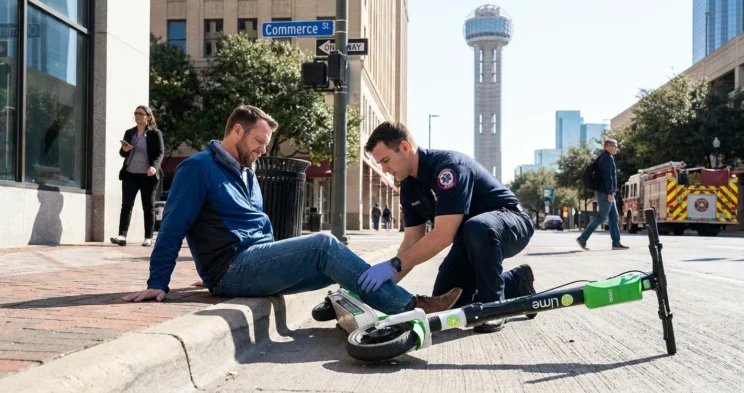
You were riding a Lime scooter down Congress Avenue one evening when the front wheel locked up without warning. The pavement came up fast, and the next thing you remember is sitting on the curb with a torn knee and a wrist that won’t bend the right way.
Your phone is cracked, the scooter is gone, and the medical bills haven’t even started yet. What do you do next?
How Texas Law Classifies Lime Scooters
Texas treats Lime e-scooters as motor-assisted transportation devices under state transportation law. Under Texas Transportation Code § 551.351, a motor-assisted scooter is a self-propelled device with:
- At least two wheels
- A braking system
- A gas or electric motor not exceeding 40 cubic centimeters
- A deck designed to allow a person to stand or sit while operating it
- The ability to be propelled by human power alone
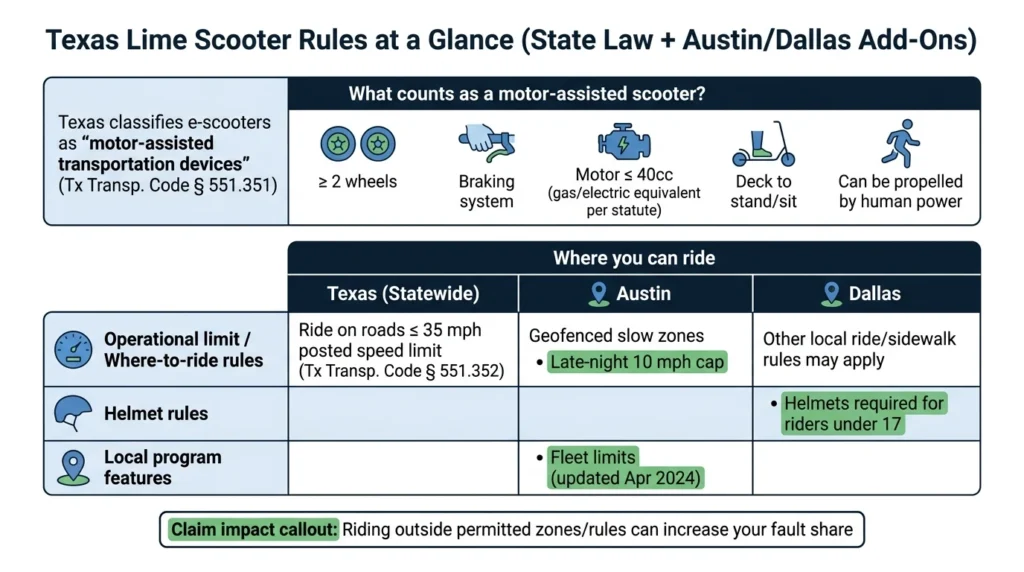
Operational limits come from Texas Transportation Code § 551.352. Riders must stay on roadways with posted speed limits at or below 35 mph. Additionally, cities can add their own rules on top. Both Austin and Dallas have local ordinances that affect where, when, and how you can legally ride, including sidewalk use.
Austin’s micromobility program adds geofenced slow zones, a 10 mph cap during late-night hours, and fleet size limits updated in April 2024. Riding outside a permitted zone can hurt your claim later.
Dallas requires helmets for riders under 17, though no statewide helmet mandate exists. Helmet use can still affect how a court splits fault.
Who Can Be Liable for a Lime Scooter Injury?
More than one party may share blame for a scooter injury. Lime itself, a driver who hit you, a property owner, or a city responsible for a roadway can each face liability depending on what caused the crash. Texas comparative fault rules then determine how much you can recover. The right defendant depends on the facts of your specific accident.
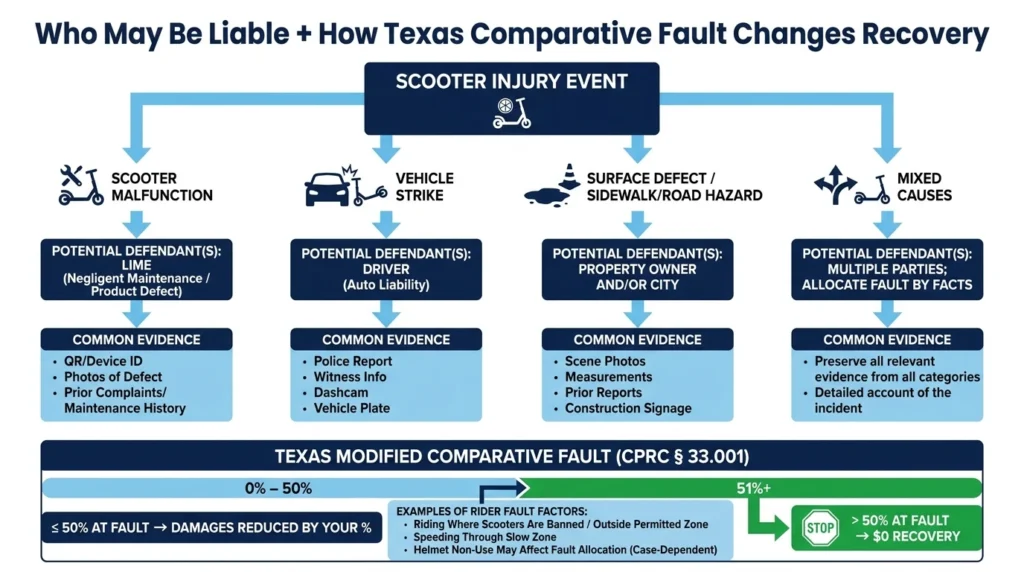
Lime has a legal duty to keep its fleet reasonably safe. A defective brake, a failing throttle, or a known maintenance gap can support a product liability or negligence claim against the company.
When a car or truck strikes a scooter rider, the driver’s auto liability coverage is usually the main recovery source. These claims look a lot like a pedestrian accident claim because the rider is the vulnerable party against a much larger vehicle.
Falls caused by potholes, unmarked construction, or broken sidewalk panels can involve the property owner or the city. A scenario rooted in road or surface defects often overlaps with premises liability cases, such as slip-and-fall accidents.
Texas uses modified comparative fault under Texas Civil Practice and Remedies Code (CPRC) § 33.001.If you are more than 50% at fault, you cannot recover anything. If you are partly at fault, your damages drop by that percentage. Speeding through a slow zone or riding where scooters are banned can raise your fault share.
A study conducted in tandem by Austin Public Health and the Austin Transportation Department with CDC assistance on dockless scooter related injuries in Austin found that road surface defects and helmet non-use were among the prominent contributing factors identified. That data backs up why several different parties may be on the hook in any one case.
Does Lime’s User Agreement Block Your Claim?
Tapping “I agree” on a scooter app does not automatically end your right to sue. Texas applies strict fair notice rules to liability waivers, and Lime’s click-through agreement faces challenges on multiple independent legal grounds. Whether the waiver bars your specific claim depends on the exact language, how it was presented, and the nature of Lime’s conduct.
The Express Negligence Rule
A waiver that does not expressly release a company from its own negligence is legally vulnerable on that point. Texas courts require exculpatory language to spell out, in plain terms, that the signer is giving up negligence claims against the drafter. Vague “assumption of risk” language typically fails this test.
If Lime’s agreement does not specifically disclaim liability for Lime’s own negligence, that portion of the waiver may not hold up.
The Conspicuousness Requirement
Even precise wording can fail if a reasonable person would not notice it. Texas courts examine font size, color contrast, placement relative to the acceptance button, and whether the language appeared before or after account creation. A mobile terms-of-service checkbox buried in a sign-up flow presents a genuine conspicuousness problem, and courts have not given these agreements a free pass simply because they are standard practice in the app economy.
The Unconscionability Problem
Beyond fair notice, Lime’s agreement is a contract of adhesion. When you sign up for Lime, you have no say in the terms. You cannot negotiate them, you cannot inspect the scooter beforehand, and you cannot use the service without agreeing.
Texas courts look at two things when deciding if an agreement like this is enforceable: whether the signing process was fair, and whether the terms themselves are unreasonably one-sided. Under In re Poly-America, L.P., 262 S.W.3d 337 (Tex. 2008), a contract can fail on either ground. Asking a rider to assume all risk for latent mechanical defects that no street-side glance would ever reveal makes a strong case on both.
Liability Waivers & Negligent Maintenance
Even if the waiver holds up, Lime may still be liable for failing to maintain its scooters properly. Texas law requires companies that put equipment in public hands to keep it in safe working condition. A brake that locks up at speed is the kind of failure that reasonable inspections are meant to prevent, and a waiver cannot simply erase that responsibility.
No Texas Supreme Court ruling has yet addressed Lime’s waiver as of publication. Whether a court would enforce it in full remains an open question. An attorney experienced in Texas motorcycle accident cases and similar two-wheel injury claims can review the agreement against your facts.
Steps to Take After a Lime Scooter Accident in Texas
The actions you take in the first hours and days shape your case. Evidence disappears fast, especially when Lime retrieves the device. Medical records start the paper trail insurers will scrutinize later. Texas also gives you a hard filing deadline, and missing it ends the claim no matter how strong it is.
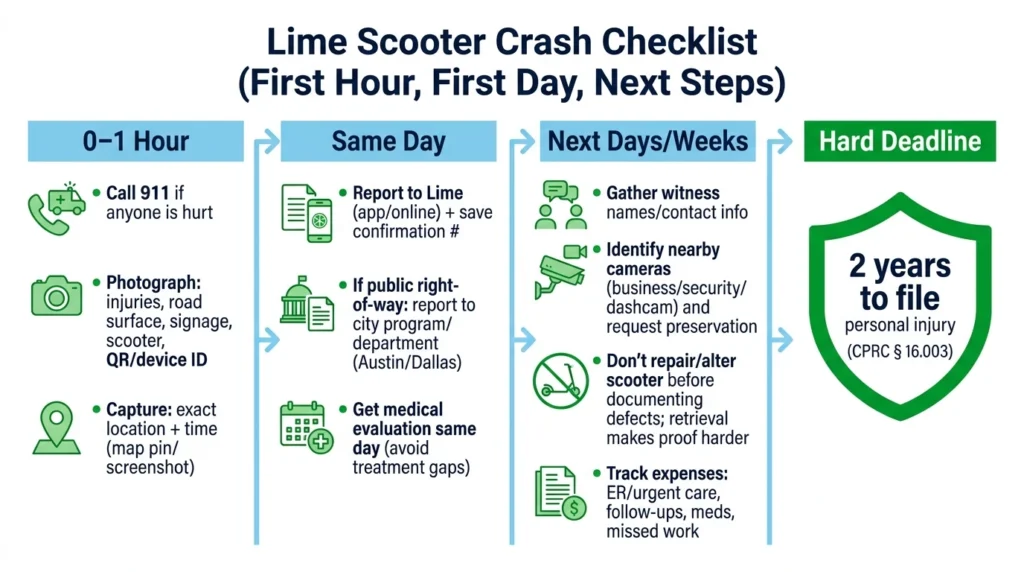
Call 911 if anyone is hurt. Photograph the scooter, your injuries, the road surface, nearby signage, and the scooter’s QR code or device ID before anyone moves it.
Report the incident online or through the Lime app right away and save the confirmation number. If a city right-of-way was involved, report it to Austin’s micromobility program or Dallas’s transportation department too.
See a doctor the same day, even if injuries feel minor. Delayed treatment creates gaps that insurers use to argue your injuries are not serious or are unrelated.
Get names and contact info for any witnesses. Look for nearby business security cameras or dashcam footage that might have captured the crash.
Do not adjust, repair, or return the scooter to a dock before documenting every visible defect. Once Lime retrieves the device, physical proof of a malfunction is hard to recover.
Texas sets a two-year deadline for personal injury lawsuits under Texas Civil Practice and Remedies Code (CPRC) § 16.003. Missing it permanently bars recovery.
Talk to a Texas Scooter Injury Attorney
Lime scooter injury cases combine product liability, premises rules, traffic law, and city ordinances. Sorting out who is responsible, what the user agreement actually waives, and how to value your damages is a heavy lift while you are healing.
Angel Reyes & Associates has more than 30 years of experience handling Texas personal injury claims, including in Austin and Dallas, where Lime currently operates. We work on contingency, meaning no fee unless we win, and our team has more than $1 billion recovered for clients.
Meet our personal injury attorneys or contact us today for a free case evaluation.
Past results do not guarantee future outcomes.
Lime Scooter Injury FAQs
Does Lime carry its own insurance that would cover an injured rider in Texas?
Lime holds commercial general liability insurance, but the policy limits and whether a rider can access that coverage directly depend on the facts of the accident and how the claim is presented. In most cases, an injured rider does not deal with Lime’s insurer the same way they would deal with a driver’s auto insurer after a car crash.
Can a passenger riding on a Lime scooter with another person file an injury claim?
Lime’s terms of service prohibit carrying passengers, so a second rider is operating outside the permitted use of the device. That violation can raise the injured passenger’s comparative fault percentage under Texas law, though it does not automatically bar a claim against other responsible parties.
What happens to a Texas Lime scooter injury claim if the scooter was involved in a hit-and-run and the driver is never identified?
If the at-fault driver cannot be identified, an injured rider may be able to seek compensation through their own uninsured motorist coverage if their personal auto policy includes that protection. Texas does not require drivers to carry uninsured motorist coverage, so whether this option is available depends on the rider’s own policy terms.
Can a minor who was injured on a Lime scooter in Texas still file a claim?
Lime’s terms of service require riders to be at least 18 years old, so a minor was using the service outside its permitted terms. However, the two-year statute of limitations under Texas Civil Practice and Remedies Code § 16.003 is tolled, meaning paused, until the minor turns 18, which gives additional time to file.
If a defective Lime scooter caused the injury, would the claim fall under product liability or negligence law?
Both theories can apply at the same time. A product liability claim targets the defective device itself, while a negligence claim targets Lime’s failure to inspect or maintain the fleet properly. Texas allows an injured rider to plead both and let the evidence determine which theory the facts support.
About the Authors

Angel Reyes
Writer
Angel L. Reyes, III is the Founder and Managing Partner of Angel Reyes & Associates. A nationally recognized trial attorney and business leader, Angel has helped over 70,000 injury victims recover more than $1 billion since founding the firm in 1993. Named to the Texas Super Lawyers list annually since 2008, Angel brings Wall Street experience, Ivy League education, and a deep commitment to client advocacy. He is a frequent legal commentator and published author with extensive contributions to legal scholarship, trial strategy, and consumer protection.

Kyle Nicolas
Editor
Kyle Nicolas is the Web Content & SEO Manager at Angel Reyes & Associates. He has more than 10 years of experience as a marketing co...

Angel Reyes
Reviewer
Angel L. Reyes, III is the Founder and Managing Partner of Angel Reyes & Associates. A nationally recognized trial attorney and business...