Who Is Liable for an E-Bike Accident in Texas?


Every article on this site is researched by our internal team, reviewed for legal accuracy against current Texas law, and held to State Bar of Texas advertising standards before publication. We do not publish content that overstates outcomes or makes promises about results.
Learn more about our
editorial standards .
Key Takeaways
- Texas law treats e-bikes under 750 watts and 28 mph as bicycles, not motor vehicles.
- Riders over 50% at fault recover nothing under Texas proportionate responsibility rules.
- Minors involved in accidents may still be held liable, and parents may bear a share of that responsibility.
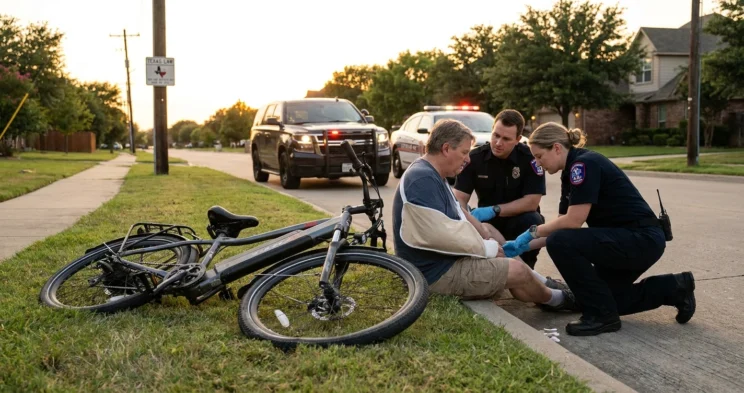
You were riding your e-bike home from work along Greenville Ave. when a driver swung open their door without looking, and you hit the pavement hard. Now you are nursing a broken wrist, staring at an ER bill, and wondering whether the rules that apply to a car crash also apply to you.
E-bike collisions do not fit neatly into the framework most people know. Who pays depends on what kind of e-bike you were riding, what each party did, and possibly whether the bike itself was defective.
How Texas Law Classifies E-Bikes
Texas treats most e-bikes like bicycles, not motor vehicles, but only if they meet specific limits. State law sorts e-bikes into three classes based on motor type and top speed, with all three capped at 750 watts. Bikes that exceed those limits get reclassified, which changes the rules that apply after a crash.
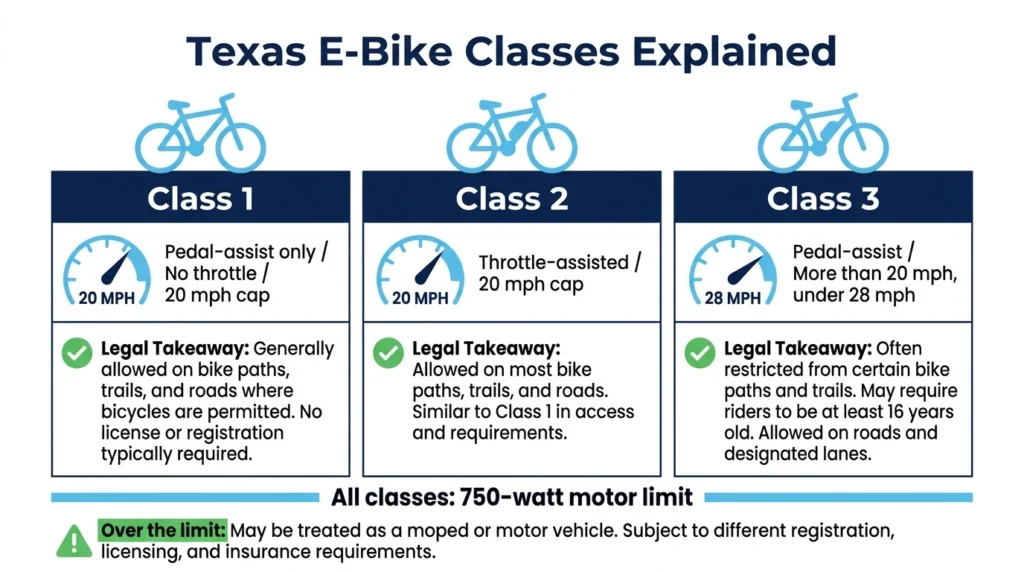
The three-class system was created by Texas Transportation Code Chapter 664.
- Class 1 is pedal-assist with no throttle and a 20-mph cap.
- Class 2 has a throttle and the same 20-mph cap.
- Class 3 is pedal-assist with a top assisted speed above 20 mph and less than 28 mph.
If your e-bike’s motor exceeds 750 watts or your assisted speed tops 28 mph, the law no longer treats it as a bicycle. It becomes a moped or motor vehicle, which means registration and insurance requirements kick in, and you have to have a driver’s license to ride it.
A rider operating an out-of-spec bike as if it were a regular bicycle can be treated like an unlicensed motor vehicle operator. That alone can sharply reduce or eliminate recovery. Those accidents are often more like motorcycle accident claims than bicycle accidents.
When a Motor Vehicle Driver Is at Fault
A car, truck, or SUV striking an e-bike rider is the most common scenario, and standard Texas negligence rules apply. The driver owes the same duty of care to a rider that they owe to any other road user, and breaching that duty in a way that causes injury is plain negligence.
Drivers who fail to yield, run red lights, change lanes unsafely, or drive distracted are routinely found at fault when they hit a rider. Recovery typically comes from the driver’s auto liability insurance as a third-party claim. You do not need your own auto policy to pursue this path. Underinsured motorist coverage, if you have it, can fill the gap when the driver’s limits fall short of your damages.
Evidence preservation is critical. Insurers will try to shift partial fault onto the rider, so police reports, traffic camera footage, and witness statements carry real weight. Photograph the scene, get names, and preserve the bike before anything is repaired or discarded.
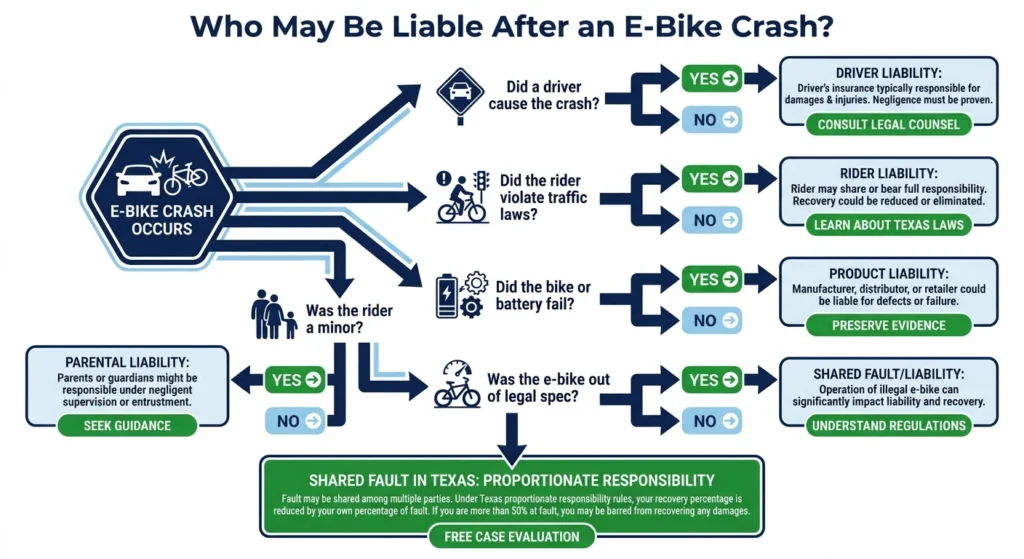
Texas applies proportionate responsibility under Texas Civil Practice and Remedies Code (CPRC) Chapter 33. A rider whose own conduct contributed to the crash can still recover, but only if their share of fault is 50% or less. Damages get reduced by that percentage.
If you believe a driver caused your crash, reviewing how fault apportionment works in bicycle accident claims can help frame what to expect.
When the E-Bike Rider Bears Fault
Riders are subject to Texas traffic laws the same way cyclists are. Running a red light, failing to yield, riding against traffic, or operating without lights at night can each constitute negligence. If your conduct caused the crash, you may be assigned a majority of the fault for the incident.
When a traffic violation directly caused the collision, Texas courts may apply negligence per se. That doctrine lets the injured party skip the usual proof of unreasonable conduct and rely on the violation itself to establish fault.
Proportionate responsibility still matters when more than one party contributed. Under CPRC Chapter 33, a rider whose share of fault tops 50% recovers nothing. At 50% or less, recovery is reduced by the fault percentage but not barred.
Riders on out-of-spec e-bikes face deeper exposure. Operating what the law treats as a motor vehicle without a license, registration, or insurance can produce independent grounds for fault. It may also affect whether your own insurer covers any part of the loss.
Defective E-Bike Parts & Manufacturer Liability
Sometimes the cause is not the rider or another driver. The bike itself fails. A battery overheats, brakes give out, or a frame cracks under normal use. When that happens, product liability rules come into play, and you may have a claim against the manufacturer, distributor, or retailer.
Types of Product Defects in E-Bike Cases
Three defect theories apply, and they require different evidence.
A design defect means the entire product line was dangerous as engineered. A battery management system that allows thermal runaway across every unit of a model is a design defect.
A manufacturing defect means a specific unit deviated from the intended design during production. The design was safe, but execution was not. A brake cable crimped wrong at the factory is a manufacturing defect.
A failure to warn claim arises when the maker knew about a risk and did not adequately disclose it. Selling a bike without warning that overnight charging in an enclosed space creates fire risk is a classic example.
Who Can Be Named in a Texas Products Liability Claim
Texas Civil Practice and Remedies Code Chapter 82 governs products liability and lets you sue any seller in the distribution chain. The manufacturer is the obvious target, but distributors and retailers can also be named.
Federal recalls strengthen these cases. The CPSC recall of VIVI e-bike lithium-ion batteries cited fire and burn hazards. A live recall helps establish that the manufacturer or a regulator already identified the hazard, which supports both design defect and failure-to-warn theories.
When a defect and rider conduct both contributed, proportionate responsibility still governs. The manufacturer’s share gets weighed alongside the rider’s, and neither shields the other from liability so long as fault is properly apportioned.
The deadline to file matters. Texas gives you two years from the injury date under CPRC § 16.003.
Liability When the E-Bike Rider Is a Minor
E-bikes are becoming increasingly prevalent with kids, and an accident involving an e-bike ridden by a minor could change the legal picture. A child’s own conduct (and thus, any fault they may bear for an accident) is not erased by their age. Texas courts can still find a minor negligent, applying a modified standard that asks what a child of similar age, experience, and capacity would have done.
Parental liability runs on two separate tracks, and people often confuse them.
Texas Family Code Chapter 41 imposes liability on parents for property damage caused by a child’s negligent conduct when that negligence is attributable to the parent’s own failure to exercise reasonable control and discipline. The $25,000 per occurrence cap in Chapter 41 applies to willful and malicious conduct only.
Personal injury claims against parents rely on common law theories instead. Negligent entrustment applies when a parent provided the e-bike to a child they knew or should have known could not operate it safely. Direct parental negligence applies when the parent failed to supervise or allowed an unreasonably dangerous activity.
No Texas appellate court has squarely addressed negligent entrustment in the e-bike context. The doctrine is well established for cars and motor vehicles, and courts would likely extend that framework, but the area remains unsettled.
Parents who hand a high-powered or out-of-spec e-bike to a minor face stacked exposure. The child is then operating what the law treats as a motor vehicle without a license, which adds a statutory violation that can strengthen a negligent entrustment claim.
Our discussion of whether Texas parents are liable for car accidents caused by their children offers useful background on how courts weigh these claims.
Talk to a Texas E-Bike Injury Attorney
E-bike liability cuts across traffic law, product liability, and family law in ways that catch most riders off guard. Before you accept an insurance offer or give a recorded statement, talk to a lawyer who handles these cases.
Angel Reyes & Associates has decades of experience handling Texas injury claims and has recovered substantial compensation for clients over the years. We work on contingency, so there is no fee unless we win, and consultations are free. You can read what past clients have said about working with our team or contact us today to discuss what happened.
Past results do not guarantee future outcomes.
Texas E-Bike Accident FAQs
Does Texas require e-bike riders to carry insurance?
Texas law does not require riders of Class 1, 2, or 3 e-bikes to carry liability insurance because those bikes are treated as bicycles rather than motor vehicles. If your e-bike exceeds the statutory limits and gets reclassified as a moped or motor vehicle, standard motor vehicle insurance requirements apply.
Can I file a claim if I was hit by an e-bike rider while I was walking?
Yes. A pedestrian injured by a negligent e-bike rider can pursue a personal injury claim against the rider using the same negligence framework that applies to other Texas injury cases. The rider’s fault percentage is weighed under CPRC Chapter 33, and recovery is reduced or barred based on how fault is apportioned.
Are e-bike accidents covered by Texas uninsured motorist benefits?
Most Texas auto policies define an uninsured motorist as the operator of a motor vehicle, and e-bikes that qualify as bicycles under state law may fall outside that definition. Whether your policy covers an e-bike collision depends on your specific policy language, so reviewing your declarations page or contacting your insurer directly is the best way to confirm coverage.
What evidence should I preserve after an e-bike accident if I think the bike was defective?
Keep the e-bike in its post-crash condition and do not allow anyone to repair or modify it before a lawyer or expert can inspect it. Also save any purchase records, warranty documents, and communications from the manufacturer or retailer, including any recall notices you may have received.
How does Texas handle an e-bike accident that happens on a private trail or parking lot rather than a public road?
Texas traffic statutes apply to public roadways, so the e-bike classification rules under Transportation Code Chapter 664 may not govern crashes on private property. Liability in those situations typically falls back on general negligence principles and, where applicable, premises liability law if a property condition contributed to the crash.
About the Authors

Angel Reyes
Writer
Angel L. Reyes, III is the Founder and Managing Partner of Angel Reyes & Associates. A nationally recognized trial attorney and business leader, Angel has helped over 70,000 injury victims recover more than $1 billion since founding the firm in 1993. Named to the Texas Super Lawyers list annually since 2008, Angel brings Wall Street experience, Ivy League education, and a deep commitment to client advocacy. He is a frequent legal commentator and published author with extensive contributions to legal scholarship, trial strategy, and consumer protection.

Kyle Nicolas
Editor
Kyle Nicolas is the Web Content & SEO Manager at Angel Reyes & Associates. He has more than 10 years of experience as a marketing co...

Angel Reyes
Reviewer
Angel L. Reyes, III is the Founder and Managing Partner of Angel Reyes & Associates. A nationally recognized trial attorney and business...