Rideshare Accidents at the Airport in Texas


Every article on this site is researched by our internal team, reviewed for legal accuracy against current Texas law, and held to State Bar of Texas advertising standards before publication. We do not publish content that overstates outcomes or makes promises about results.
Learn more about our
editorial standards .
Key Takeaways
- In airport pickup zones, most rideshare drivers are in Period 2, so the $1M policy applies.
- A claim against a Texas airport requires written notice within six months of the crash.
- You have two years to sue the driver and rideshare company under Texas injury law.
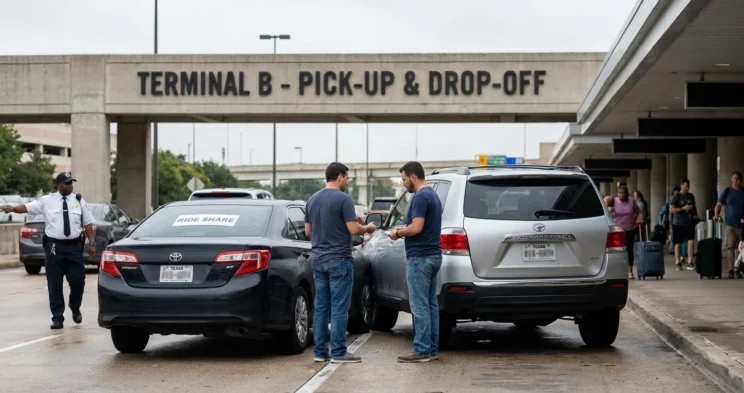
You just landed at DFW after a long flight, dragging your bag toward the rideshare lane on the terminal’s ground level. A rideshare driver swings into the pickup zone too fast and clips you near the curb, and now you are hurt, surrounded by strangers. You are left unsure who is even responsible.
Airport pickup zones run on their own rules, and that changes how your claim works.
How Airport Pickup Zones Work in Texas
Texas airports funnel Uber and Lyft traffic into tightly controlled zones, which concentrate cars, luggage, and pedestrians into small corridors under constant time pressure, which is what makes these types of accidents happen. These designated zones keep traffic predictable, but they also pack vehicles and travelers together in ways regular streets never do. The result is congestion, rushing, and the kind of split-second mistakes that injure passengers and bystanders.
Location-Specific Airport Operations
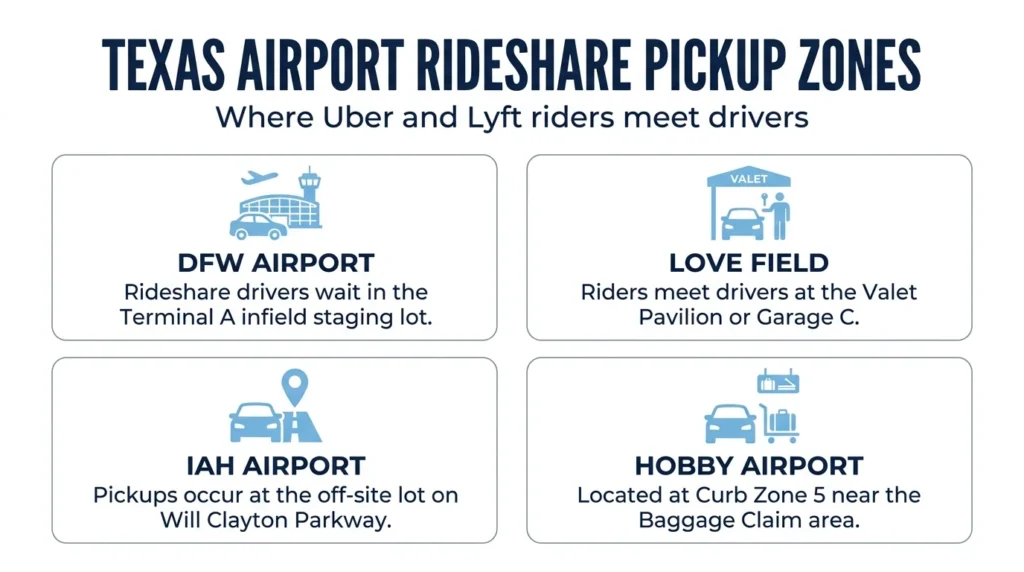
- Dallas Fort Worth International (DFW): Rideshare drivers wait in a staging lot in the Terminal A infield. Pickups happen on the ground level of each terminal in marked rideshare lanes.
- Dallas Love Field: Riders meet drivers at the valet pavilion and Garage C on the southeast side, about a six-minute walk from baggage claim as of January 3, 2025. Curbside drop-off is still allowed.
- George Bush Intercontinental (IAH): Drivers stage off-site at a first-in, first-out lot on Will Clayton Parkway, then pull up to terminal-specific zones to collect riders.
- Houston Hobby: Uber and Lyft pickups happen at Curb Zone 5, next to Baggage Claim Carousel 4. The airport added a shaded pickup area there in July 2025.
If you want a fuller picture of the immediate aftermath, our guide on what to do after a rideshare accident in Texas walks through the first moves.
Who Can Be Liable for an Airport Rideshare Crash
An airport rideshare crash often has more than one party on the hook. The driver, the rideshare company, and even the airport itself can each carry a share of the responsibility.
The Rideshare Driver & TNC Company
The driver’s liability turns on basic negligence: did careless driving cause your injury? The company’s exposure turns on a different question entirely, which is the driver’s app status at the moment of the crash.
Texas ties rideshare insurance to that app status under the Texas Insurance Code § 1954. The coverage breaks down into three periods, each of which carries a different level of coverage.
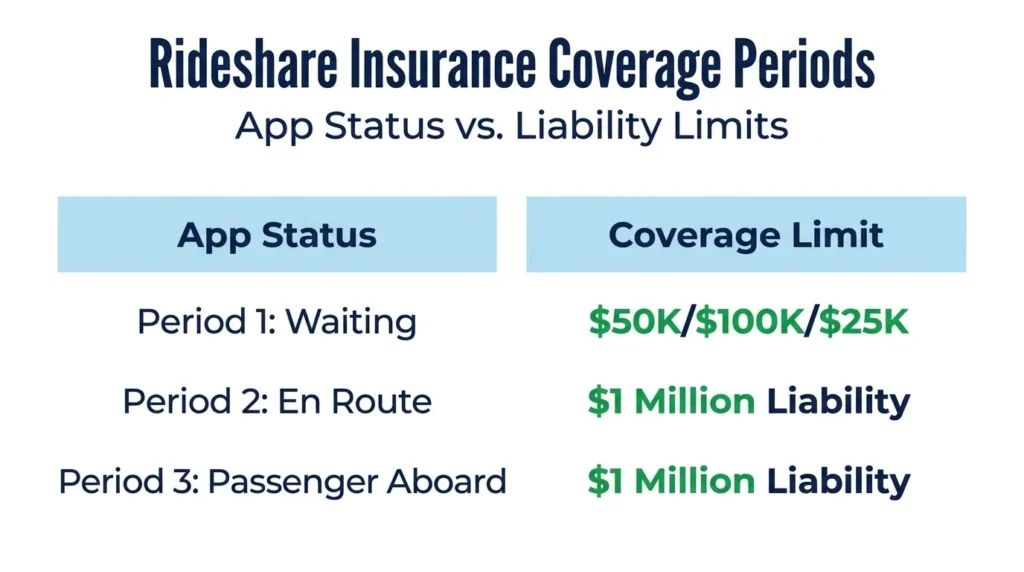
- Period 1 (app on, no ride accepted): contingent coverage up to $50,000 per person, $100,000 per incident, and $25,000 for property damage.
- Period 2 (ride accepted, driving to pickup): a minimum $1 million liability policy applies.
- Period 3 (passenger in the vehicle): the same $1 million coverage applies.
Here is why this matters at an airport. A driver entering the pickup zone has almost always already accepted your ride, which puts them in Period 2. In most airport crashes, the $1 million policy is the one in play.
Uber and Lyft call their drivers independent contractors, which limits how far you can reach the company directly. The insurance requirements apply no matter how the driver is classified, so the coverage stays available to you.
The Airport Authority
The airport can be a defendant too, but the rules are stricter. Texas’s four major airports are run by governmental bodies, so a claim against them follows the Texas Tort Claims Act.
- DFW is governed jointly by Dallas and Fort Worth through its airport board.
- Love Field belongs to the City of Dallas.
- Both IAH and Hobby are run by the Houston Airport System, a city department.
The Texas Civil Practice and Remedies Code (CPRC) § 101 gives a limited waiver of governmental immunity. You can bring a claim for a premises defect or a crash involving a government employee, but only within narrow limits.
Those limits cap what a government pays for bodily injury depending on the type of governmental entity involved. For a municipality such as the City of Dallas (Love Field) or the City of Houston (IAH and Hobby), the cap is $250,000 per person and $500,000 per incident, whereas other local governmental units like the DFW Airport Board, the cap is $100,000 per person and $300,000 per incident. Ultimately, poor zone design, confusing lane markings, bad lighting, or weak pedestrian separation can all support this kind of claim.
Texas Deadlines After an Airport Rideshare Crash
You face two clocks after an airport rideshare crash, and missing either one can end your claim. One runs for two years. The other runs for just six months.
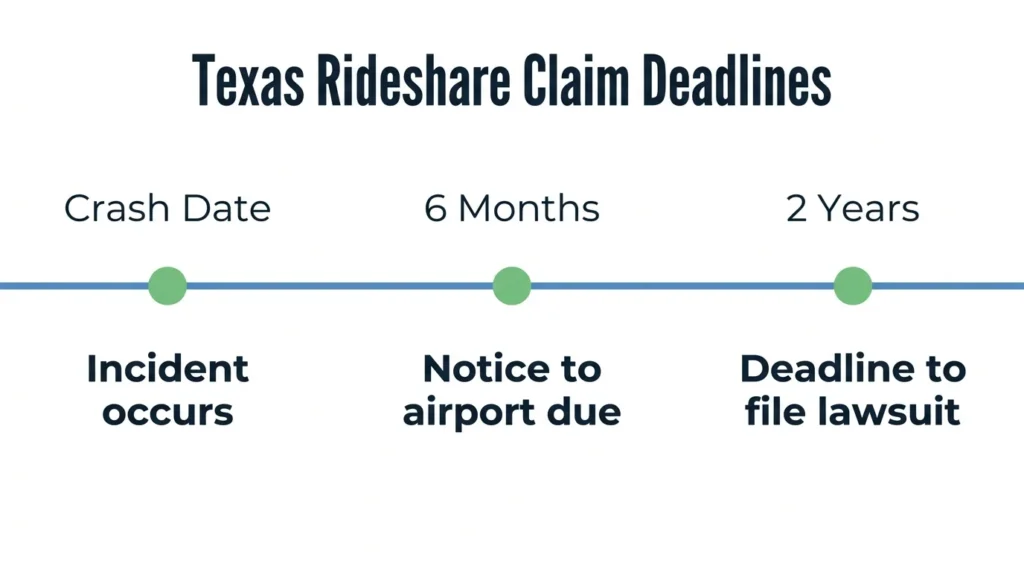
The longer deadline covers your claim against the driver and the rideshare company. Under CPRC § 16.003, you have two years from the crash date to file a personal injury lawsuit.
The shorter deadline applies the moment a government entity enters the picture, requiring you, under CPRC § 101.101, to give the airport authority written notice within six months. This notice must clearly describe the injury, the time and place, and what happened during the incident. A rideshare injury attorney can confirm whether the airport authority shares fault and get that notice filed before the coverage period that applies to your crash is even sorted out.
This six-month clock starts on the day of the crash, not the day you realize how badly you were hurt. There is a narrow exception when the government already had actual notice of the incident and its own possible fault, but Texas courts rarely apply it. Treat the six-month window as firm.
You do not have to choose between defendants. Texas lets you pursue the rideshare company and the airport at the same time, with each one’s share of fault judged on its own.
Steps to Take After a Rideshare Crash at a Texas Airport
The single most useful thing you can do is document everything before you leave the scene. Evidence in a busy pickup zone disappears within minutes. The steps below cover what matters most.
Step 1: Call 911 and request a police report. Airport police have jurisdiction inside the terminals and pickup zones. Their report is separate from a city or county crash report, so make sure one gets filed.
Step 2: Screenshot the Uber or Lyft app right away. Capture the driver’s name, the trip ID, and the app status. That status is what decides which insurance period and policy apply.
Step 3: Photograph the pickup zone. Get the lane markings, signage, lighting, vehicle positions, and pedestrian paths. These details support any claim that bad zone design contributed to the crash.
Step 4: Exchange information with every driver involved. Collect names, license plate numbers, and insurance cards from the rideshare driver and anyone else in the wreck.
Step 5: Get contact information from witnesses. Airport staff and ground transportation workers in the zone often saw what happened; their accounts can carry real weight.
Step 6: See a doctor, even if you feel fine. Adrenaline hides injuries. Documenting your treatment from day one connects your injuries to the crash.
Step 7: Report the crash to Uber or Lyft and save the confirmation. Use the app to file the report and write down the confirmation number.
Step 8: Say nothing recorded to any adjuster first. Do not give a recorded statement to the rideshare insurer or an airport representative before you talk to an attorney.
If you were riding in the vehicle when it crashed, you have your own path to recovery. Our overview of filing a claim as an injured passenger explains how that works, and our breakdown of what happens when an Uber gets in an accident covers the company’s side.
Get Legal Help After a Texas Airport Rideshare Accident
Angel Reyes & Associates has guided injured Texans for over 30 years, and airport rideshare crashes are exactly the kind of layered case where that experience counts. These claims can stack a $1 million rideshare policy, a possible government-entity claim, and a six-month notice deadline all at once. We can review which insurance period applies, whether the airport shares fault, and what you need to do to file and when.
We work on contingency, which means no fee unless we win, and your first consultation is free. We’ve recovered more than $1 billion for clients and are available 24/7. Reach out to us for a free consultation to understand your options after a crash.
Past results do not guarantee future outcomes.
Rideshare Accidents at the Airport FAQs
Does Uber's coverage apply if the driver was in the wrong lane or a parking garage instead of the marked pickup zone?
Yes. Texas law ties Transportation Network Company (TNC) coverage to the driver’s app status, not the physical location of the crash. If the driver had accepted a ride, the $1 million policy applies regardless of where on airport property the crash happened.
Can a pedestrian or bystander hit by an Uber in an airport pickup zone file a claim?
Yes. The TNC liability policy covers bodily injury to third parties, not just passengers in the vehicle. A bystander struck by a rideshare driver who was on an accepted trip can file a claim against the same $1 million policy.
What if another driver caused the crash, not the Uber driver?
You can file a claim against that driver’s personal insurance. Texas also requires TNC companies to carry uninsured and underinsured motorist coverage during an active trip, so Uber’s policy can step in if the at-fault driver had no insurance or not enough.
Does an injured passenger need their own auto insurance to collect after an airport rideshare crash?
No. Uber’s commercial policy covers passengers injured during an active trip without requiring you to use your own insurance first. Your own personal injury protection or uninsured motorist (UM) coverage can supplement the recovery if damages exceed the TNC policy’s limits.
Do you have to hire an attorney to file the six-month written notice with the airport authority?
No, the notice does not have to be filed by an attorney. However, it must describe the injury, the time and place of the incident, and what happened. An error or omission in that notice can give the governmental unit grounds to challenge your claim later, so getting the content right matters.
About the Authors

Angel Reyes
Writer
Angel L. Reyes, III is the Founder and Managing Partner of Angel Reyes & Associates. A nationally recognized trial attorney and business leader, Angel has helped over 70,000 injury victims recover more than $1 billion since founding the firm in 1993. Named to the Texas Super Lawyers list annually since 2008, Angel brings Wall Street experience, Ivy League education, and a deep commitment to client advocacy. He is a frequent legal commentator and published author with extensive contributions to legal scholarship, trial strategy, and consumer protection.

Kyle Nicolas
Editor
Kyle Nicolas is the Web Content & SEO Manager at Angel Reyes & Associates. He has more than 10 years of experience as a marketing co...

Spencer Browne
Reviewer
Spencer Browne is a partner at Angel Reyes & Associates and a Board Certified personal injury trial lawyer with nearly 100 jury trials a...