What to Do After a Waymo or Robotaxi Crash in Texas


Every article on this site is researched by our internal team, reviewed for legal accuracy against current Texas law, and held to State Bar of Texas advertising standards before publication. We do not publish content that overstates outcomes or makes promises about results.
Learn more about our
editorial standards .
Key Takeaways
- When the automated driving system is engaged, Texas law treats the ADS as the "operator," making engagement-status evidence central to any Robotaxi claim.
- Robotaxi crashes can involve multiple liable parties, and critical sensor and log data may be overwritten quickly without a preservation letter.
- Most Texas personal injury claims must be filed within two years, but government-entity notice deadlines can be far shorter, so act quickly.
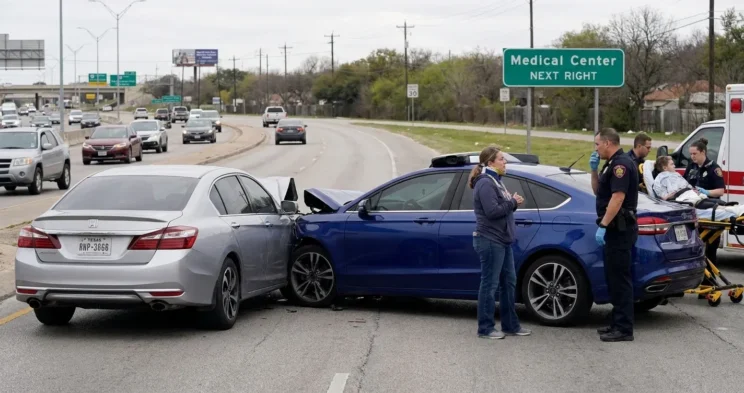
You just pulled off Congress Avenue in Austin, shaken after a Waymo with no one in the driver’s seat clipped your rear quarter panel. Your neck feels tight. A company representative is already on the phone asking questions, and you’re not sure what to say or who is even responsible when the car was driving itself.
Autonomous rideshare crashes raise questions ordinary fender-benders don’t. Here is what to do next, what Texas law says about fault, and how to protect your claim before key evidence disappears.
First Priorities at the Scene
The actions you take after a car accident are critical for not just your own safety and health but any potential claim you might file. Safety always comes first. Move to a safe location if you can, check yourself and passengers for injuries, and call 911. Ask for police and EMS if anyone is hurt.
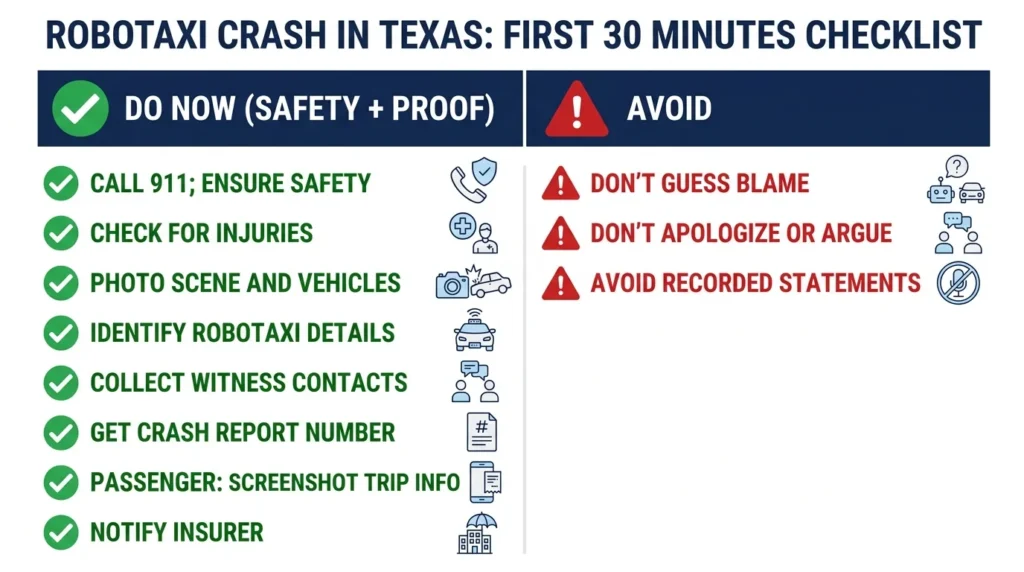
If it’s safe, photograph everything before vehicles move. Capture final resting positions, lane markings, traffic signals, debris, skid marks, and weather conditions.
Identify the robotaxi specifically. Note the vehicle number, license plate, any visible markings, and whether the car appeared to be in autonomous mode (no human in the driver’s seat, visible sensor array, dashboard indicators).
Get witness names and phone numbers. Ask each witness to text or email you a short summary of what they saw so you have a time-stamped account.
What to Say (And Not Say) at the Scene
Stick to facts with police and anyone else at the scene. Avoid guessing about software, sensors, speeds, or blame.
Don’t apologize or argue. Casual comments can be used later to shift responsibility toward you.
If a company representative or insurer calls quickly, you can decline a recorded statement until you’ve spoken with a lawyer. You are not required to give one on the spot.
Get Medical Care and Create a Clean Record
Medical documentation is the backbone of most injury claims. Accept EMS evaluation if offered, and go to urgent care or the ER if you have head, neck, or back pain, dizziness, numbness, or symptoms that worsen overnight.
Ask your doctors to take notes on every bodily area affected. Follow up consistently, and keep every discharge note and imaging report.
Track your out-of-pocket costs and missed work starting day one. Save receipts, note mileage to appointments, and keep any written work restrictions from your doctor.
Report the Crash & Secure the Right Documents
Get the responding agency’s name and the crash report number, and request the report when it becomes available through the Texas Department of Transportation’s C.R.I.S. system.
If you were a Waymo or Robotaxi passenger, preserve every trip detail you can: pickup and dropoff locations, timestamps, route, and the trip receipt in the app. Screenshot it before anything changes.
Notify your own insurer promptly, even if you believe you weren’t at fault. Ask about PIP, MedPay, and uninsured/underinsured motorist coverage on your policy.
Preserve Autonomous-Vehicle Evidence
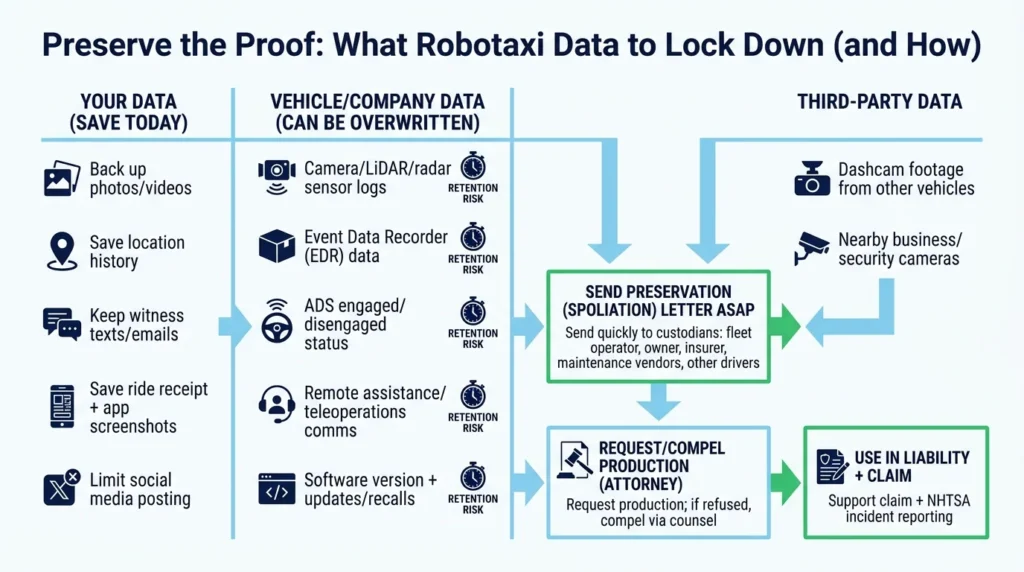
This is the step most people miss. Unlike an ordinary crash, the most important proof may live inside company-controlled systems: sensor logs, operation data, and remote assistance records. This evidence can be overwritten.
A preservation letter (sometimes called a spoliation letter) is a legal tool that demands the vehicle’s owner or operator preserve this data. One of these letters should go out quickly to likely custodians, including the fleet operator, insurers, maintenance vendors, and any other involved drivers. This is one reason to seek legal help early.
Preserve your own data too. Back up phone photos and videos, save location history, and keep messages and ride receipts. Be careful about social media after a crash.
Request any additional tech context while it’s fresh:
- Sensor and perception data from cameras, LiDAR, and radar
- Event data recorder logs from before and after impact
- Automated driving system engagement and disengagement status
- Remote assistance or teleoperations communications
- Software version and any active recalls or updates
Operating companies are not usually eager to grant access to this data, so you may need to work with an attorney to compel the operating company to turn it over to you.
Certain crashes involving automated driving systems must be reported to federal regulators under the NHTSA Standing General Order. Accurate incident details support both that reporting and your claim.
Who May Be Liable in a Texas Robotaxi Crash?
Liability in a Robotaxi collision can spread across several parties. Potential targets include other drivers, the fleet operator or authorization holder, the vehicle owner, manufacturers, software or component suppliers, maintenance contractors, and occasionally a government entity if a roadway condition contributed.
Corporate claims teams move fast, vehicles get repaired, and data retention windows close, so it is critical to start investigating early.
When the ADS Is Engaged, Who Is the “Operator”?
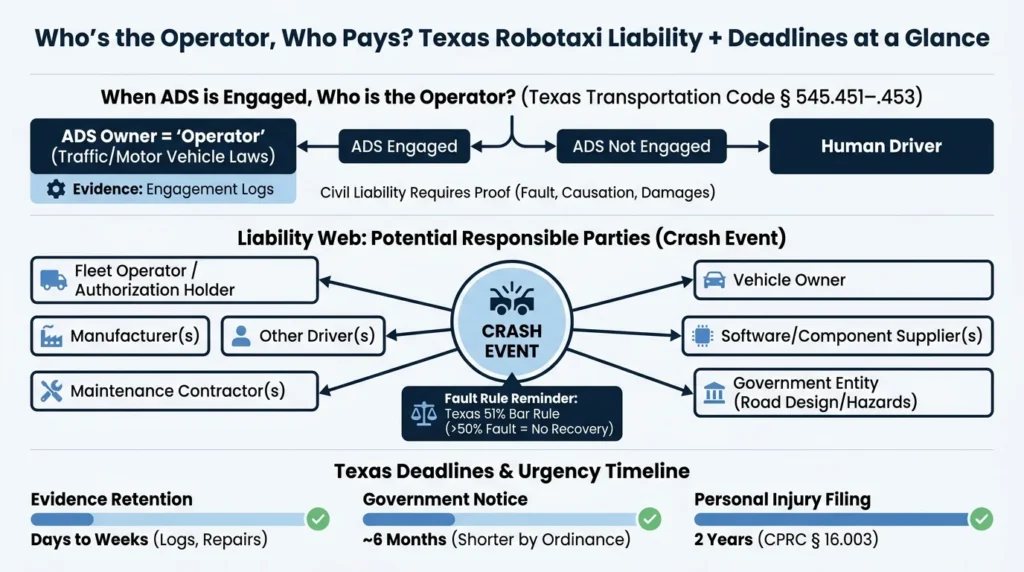
Texas addresses automated vehicles in Texas Transportation Code § 545.451–.453. When the automated driving system is engaged, Texas law treats the owner of the ADS as the ‘operator’ for purposes of applicable traffic and motor vehicle laws.
In practical terms, whether the ADS was engaged becomes a central fact. Evidence of engagement status (from company logs) often drives the liability analysis.
That statutory label doesn’t automatically decide civil liability. Fault, causation, and damages must still be proven. If you are assigned more than 50% of the fault, you are still barred from recovery under Texas’ “51% Bar Rule.”
Insurance & Claim Pathways
In an accident involving a self-driving taxi, expect multiple coverages and multiple adjusters. Common compensation routes include a third-party claim against an at-fault operator, a claim against the fleet’s commercial coverage, and in some cases a product-related claim, depending on the facts.
Early settlement offers can be risky. Injuries often evolve, and liability between multiple parties may still be under investigation. Our case results page shows how patient, documented work can change outcomes.
Insurers typically ask for medical records and recorded statements. You can ask for claim numbers, adjuster contact information, and written communications, and you can decline a recorded statement until you have counsel.
Deadlines & Urgency in Texas
Most Texas personal injury claims have a two-year statute of limitations under Texas Civil Practice and Remedies Code § 16.003. Miss it, and your claim can be permanently barred.
Evidence can disappear much sooner than that. Vehicles get repaired, operation logs cycle, and witness memory fades within weeks. If evidence disappears, pursuing a claim gets increasingly difficult.
If a government entity or roadway condition may be involved, the Texas Tort Claims Act imposes short notice deadlines, sometimes as brief as six months, and many Texas cities require notice even sooner by ordinance.
When to Contact Angel Reyes & Associates
Call an attorney as soon as possible if you have serious injuries, the operator disputes fault, multiple vehicles or a commercial fleet are involved, or any need to preserve robotaxi data.
With over 30 years of experience and more than $1 billion recovered for clients, Angel Reyes & Associates handles robotaxi and complex vehicle cases across Texas from our more than 20 locations. We offer service in Spanish, and work on a no-fee-unless-we-win basis.
Our team can send preservation letters, coordinate evidence requests, handle insurer communications, and build a responsibility narrative aligned with Texas fault rules. You can learn more about our firm and read client reviews and testimonials to see how we work.
Schedule a free consultation to talk through your options.
Waymo & Robotaxi Accident FAQs
Can a Waymo passenger make an injury claim after a Robotaxi crash in Texas?
Yes. If you were hurt as a paying passenger, you may have a claim against whoever was legally responsible for the crash, which could include more than one party, depending on what happened.
What if the police report gets the self-driving details wrong?
Police reports can contain mistakes or incomplete information, especially in newer technology cases. Keep your own photos, app records, and witness information because those details may help clarify whether the vehicle was in autonomous mode and how the crash happened.
Does a vehicle recall automatically mean the robotaxi company is liable?
Not by itself. A recall may be relevant evidence, but you still have to show that a specific defect or failure actually contributed to your crash and injuries. For example, a recall on the front passenger seatbelt doesn’t impact your claim if you were riding in the back of the car.
Will my case be affected if poor road design or a road hazard played a role in the crash?
It can. If a city, county, or state roadway issue may have contributed, special notice rules and shorter deadlines may apply, so that issue should be identified early.
Can dashcam footage from another car help in a robotaxi crash case?
Absolutely. Third-party videos can be especially useful in self-driving car cases because they may show traffic signals, lane position, braking, or vehicle behavior from a neutral angle.
About the Authors

Spencer Browne
Writer
Spencer Browne is a partner at Angel Reyes & Associates and a Board Certified personal injury trial lawyer with nearly 100 jury trials across Texas. He focuses on car, truck, and wrongful death cases, with notable verdicts including a landmark win in the Choctaw Casino bus crash case. A recognized speaker and legal educator, Spencer is a member of the American Board of Trial Advocates and has been honored as a Texas Super Lawyer and one of D Magazine’s Best Lawyers in Dallas. He brings deep trial experience and relentless advocacy to every client he represents.

Kyle Nicolas
Editor
Kyle Nicolas is the Web Content & SEO Manager at Angel Reyes & Associates. He has more than 10 years of experience as a marketing co...

Angel Reyes
Reviewer
Angel L. Reyes, III is the Founder and Managing Partner of Angel Reyes & Associates. A nationally recognized trial attorney and business...