Tesla’s Cybercab Hits Austin & Texas Law Isn’t Ready for It


Every article on this site is researched by our internal team, reviewed for legal accuracy against current Texas law, and held to State Bar of Texas advertising standards before publication. We do not publish content that overstates outcomes or makes promises about results.
Learn more about our
editorial standards .
Key Takeaways
- Tesla launched Cybercabs in Austin on September 3, 2026, with no steering wheel or pedals.
- Texas law names the automated driving system as the operator, not a human driver.
- No Texas law sets a retention period for autonomous vehicle crash data or victim access.
This is an opinion piece, and is intended to provide analysis and commentary on current events and issues facing personal injury law. While resources are provided to support statements, opinion statements should not be misconstrued as fact, evidence, or argument in favor of or against any particular legislation. This is not legal advice.
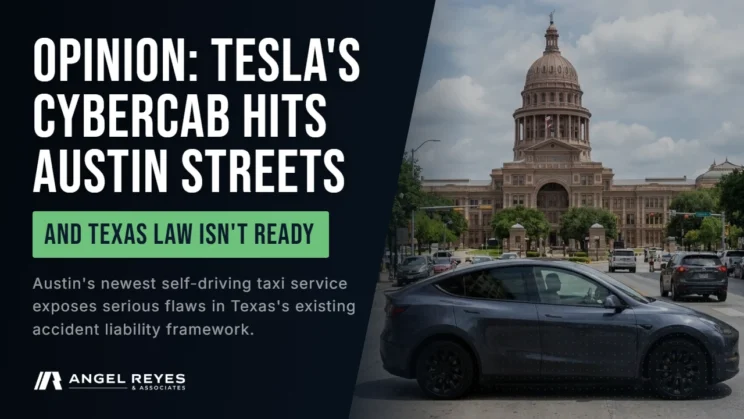
Tesla launched its Cybercab taxi service in Austin yesterday, and public rides start this weekend, just in time for the holiday. Tesla has run its self-driving Robotaxi vehicles here for a while. These are different: no steering wheel, no pedals.
Cybercabs are the first for-hire taxis in Texas without either of them to start taking fares. They will not be alone long, as Zoox is scheduled to launch in Austin this year.
We hear the same worries come back every time: What if it does not stop? What if it misses the red light? With no wheel or pedals, what do you do as a passenger when the vehicle fails?
Pew Research found in February that 71 percent of Americans would be uncomfortable riding in a driverless car. Only 5 percent ever have.
In theory, a road full of driverless cars should be safer than a road full of human drivers. Machines don’t drink, get tired, or get distracted. The early numbers back that up: across 56.7 million driverless miles, Waymo reported 92 percent fewer pedestrian injury crashes than a human benchmark for the same streets. Waymo’s own researchers wrote it, but the evidence is hard to argue with.
Take that far enough and Texas can end a grim streak. TxDOT counts November 7, 2000 as the last day nobody died on Texas roads. More than 91,000 have died over the more than a quarter-century that has passed since that day.
However, we are not at that future yet. The technology is far from finished, and its failures have consequences.
I have spent 35 years suing over crashes. When this news broke, my first thought went to Texas law and how driverless vehicle cases seem to sit in a blind spot that legislators appear to be in no hurry to fix.
We Are Not There Yet
The fleet on the road today is still being debugged in traffic. The same traffic you and your family are also driving in.
Texas DMV records showed 45 Cybercabs cleared for driverless operation. Tesla’s older Model Y robotaxis still have wheels and pedals, and Waymo has carried Austin riders without a safety driver since early 2025.
None of these manufacturers have a clean operating record. Austin ISD reported roughly 20 incidents of Waymo vehicles rolling past school buses with the stop arm out, leading to the developer recalling 3,067 vehicles in December for a software bug.
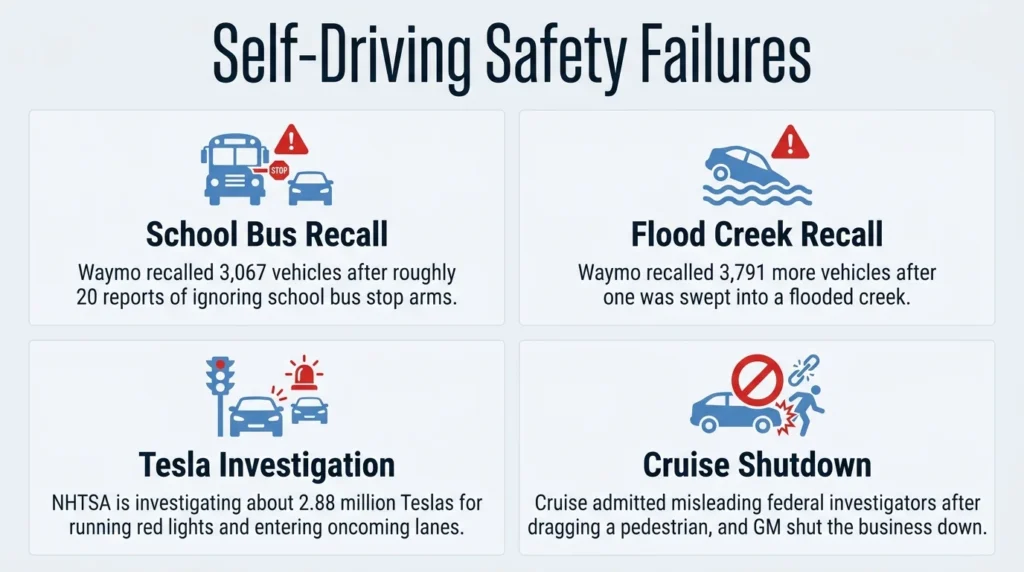
Five months later came a second recall covering 3,791 vehicles after a Waymo vehicle was swept into a flooded creek in San Antonio. NHTSA says the full remedy is still in development.
NHTSA has an open investigation covering about 2.88 million Teslas for running red lights and driving into oncoming lanes.
Then there is Cruise, a self-driving company that made headlines when one of its driverless cars dragged a pedestrian about 20 feet in San Francisco. The company deliberately misled federal investigators, and General Motors eventually shut the robotaxi business down.
None of that makes the technology a failure. It means the safety case is not finished, and right now the rest of is being written on public roads.
Texas Rideshare Law Is Built Around a Driver
Every ordinary auto case pivots on a driver. Who was at the wheel? What did they do? Who employed them? But that structure almost completely collapses when you remove the driver from the equation.
Texas Transportation Code Chapter 545 says that when there is no driver, the automated driving system is the operator when engaged and operational.
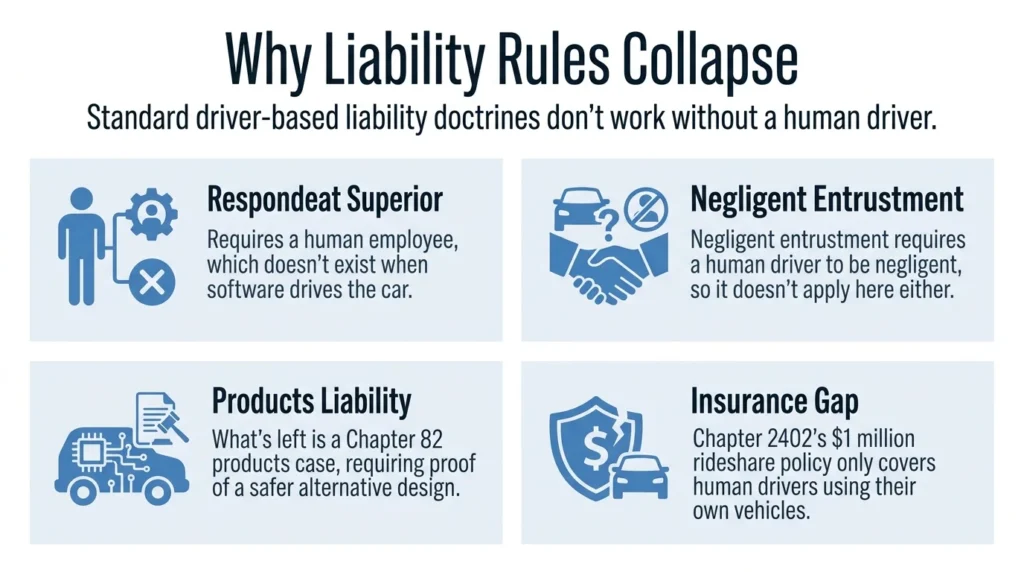
That sounds logical, right? It might be tidy for regulators, but in reality it’s hard on you. Respondeat superior is the legal doctrine that makes an employer answer for an employee’s negligence on the job. But, it needs a human employee. That doesn’t apply here.
Negligent entrustment covers handing the keys to someone you knew or should have known was unsafe. But, again, it requires a human driver who can be negligent. This also can’t apply.
What is left is a products case under Texas Civil Practice and Remedies Code Chapter 82. You have to prove a safer alternative design and beat a compliance presumption. That work costs six figures before trial, and it might not even be possible.
And the $1 million in rideshare coverage that a standard Uber or Lyft ride carries? Texas Occupations Code Chapter 2402 only covers drivers using their own vehicles. Self-driving taxis are not a driver using their own car, so that requirement also doesn’t apply.
The Evidence Problem Is the Real Fight
Establishing liability for a self-driving vehicle accident is difficult too. Texas requires an automated vehicle to carry a recording device, but the law does not set a retention period for that data.
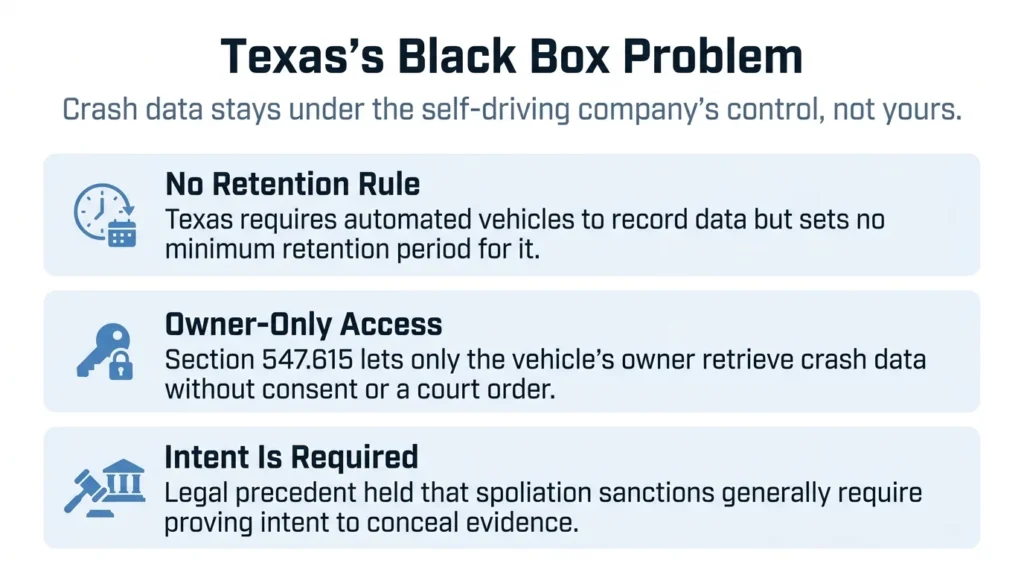
Section 547.615 then limits data retrieval to the owner of the vehicle without consent or a court order. Read that again: the company whose vehicle hurt you holds the only account of how it happened, and allows them to decide how long they want to keep it.
Senate Bill 2807 created permits, first responder plans, and revocation authority, but did nothing regarding vehicle operating data.
Spoliation law will not rescue you either. The Texas Supreme Court held in 2014, in Brookshire Brothers, Ltd. v. Aldridge, that a spoliation instruction generally requires intent to conceal. Try proving intent to a judge about a file you have never seen.
California makes autonomous operators report collisions within 10 days. Texas requires nothing of the sort.
What Should Change & What to Do
The Legislature should have written preservation rules before turning Texas into a self-driving test track for big tech. It did not. As the old saying goes: the best time to plant a tree was 20 years ago, the second-best time is now. The next legislative session begins January 12, 2027.
Lawmakers need to set a retention period on this data and impose a preservation duty the moment notice arrives. They also need to legally grant injured people a right of access to this data that can help them argue their case before a jury.
The people most exposed by these vehicles are not the passengers. It’s pedestrians and other drivers who meet these cars from a crosswalk or the next lane. Nobody asked them if they’d be willing to share the roads with these vehicles. The least that lawmakers can do is level the playing field.
Until that happens, acting quickly might be the only protection you have. If a driverless vehicle hurts you, talk to an attorney who can send a formal preservation demand to the operator, the insurer, and the manufacturer within days. That action may be the only thing keeping your evidence alive.
For more information or to have your case reviewed, contact Angel Reyes & Associates by phone or online for a free, no-obligation consultation.
About the Authors

Angel Reyes
Writer
Angel L. Reyes, III is the Founder and Managing Partner of Angel Reyes & Associates. A nationally recognized trial attorney and business leader, Angel has helped over 70,000 injury victims recover more than $1 billion since founding the firm in 1993. Named to the Texas Super Lawyers list annually since 2008, Angel brings Wall Street experience, Ivy League education, and a deep commitment to client advocacy. He is a frequent legal commentator and published author with extensive contributions to legal scholarship, trial strategy, and consumer protection.

Kyle Nicolas
Editor
Kyle Nicolas is the Web Content & SEO Manager at Angel Reyes & Associates. He has more than 10 years of experience as a marketing co...

Angel Reyes
Reviewer
Angel L. Reyes, III is the Founder and Managing Partner of Angel Reyes & Associates. A nationally recognized trial attorney and business...