Tesla Robotaxi vs Waymo Safety Records in Texas


Every article on this site is researched by our internal team, reviewed for legal accuracy against current Texas law, and held to State Bar of Texas advertising standards before publication. We do not publish content that overstates outcomes or makes promises about results.
Learn more about our
editorial standards .
Key Takeaways
- A robotaxi "safety record" includes Texas compliance, NHTSA crash reporting, recalls, and transparency, not just crash counts.
- NHTSA crash data is not normalized by miles driven, which makes direct Tesla vs Waymo comparisons unreliable without additional context.
- TxDMV's commercial AV authorization becomes enforceable on May 28, 2026, which will strengthen oversight and compliance requirements for robotaxi operators in Texas.
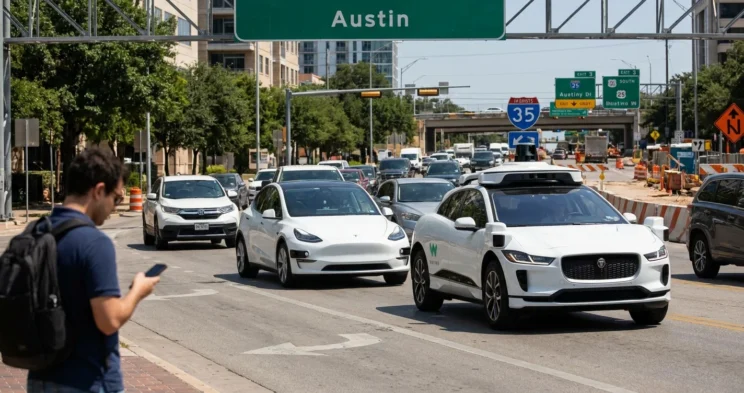
You saw the headline: another self-driving vehicle incident in Austin, this time involving a duck. Maybe you’re considering booking a ride with Waymo or Tesla’s new service. Maybe you share the road with these vehicles every day on your commute to work. Maybe you just want to know which one is actually safer.
The answer is more complicated than any robotaxi company wants you to believe.
What “Safety Record” Means for Robotaxis in Texas
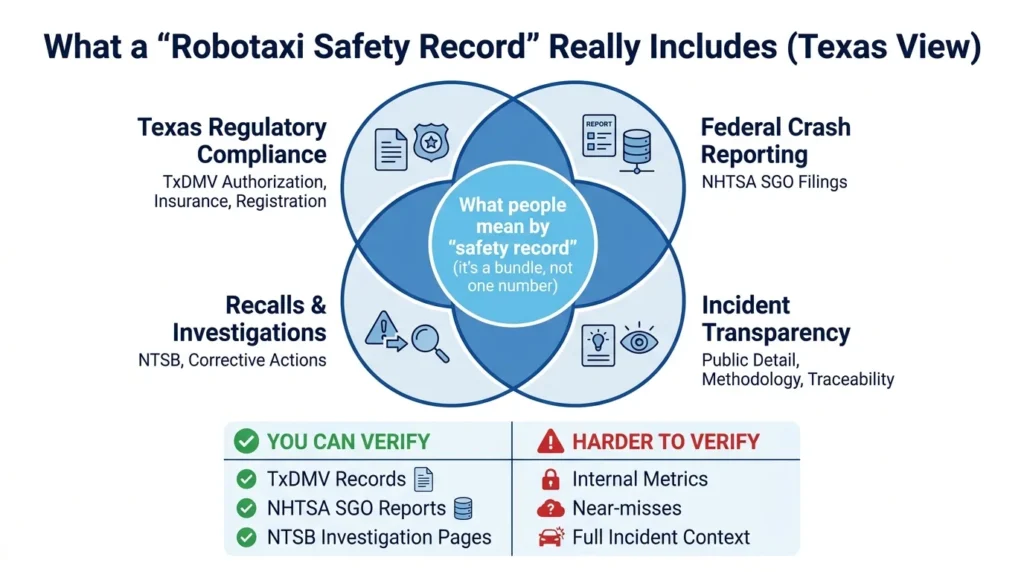
A robotaxi’s “safety record” is not a single number. It’s a bundle of signals across multiple categories, including:
- Texas regulatory compliance (authorization status, insurance requirements)
- Federal crash reporting (NHTSA Standing General Order filings)
- Recalls and investigations (NTSB inquiries, corrective actions)
- Incident transparency (how much detail companies share publicly)
When a company claims its vehicles are “safe,” that statement can be technically true, but that might not tell the whole story. For example, a robotaxi operating only in perfect weather on well-mapped streets in Mueller will have different outcomes than one navigating construction zones near the Domain during SXSW.
Here’s what you can verify independently:
- Official regulatory filings
- NHTSA crash reports
- NTSB investigation pages
Here’s what’s harder to verify:
- Internal safety metrics
- Unreported near-misses
- The full context behind any single incident
Texas’s Autonomous Vehicle Framework & the May 28, 2026 Deadline
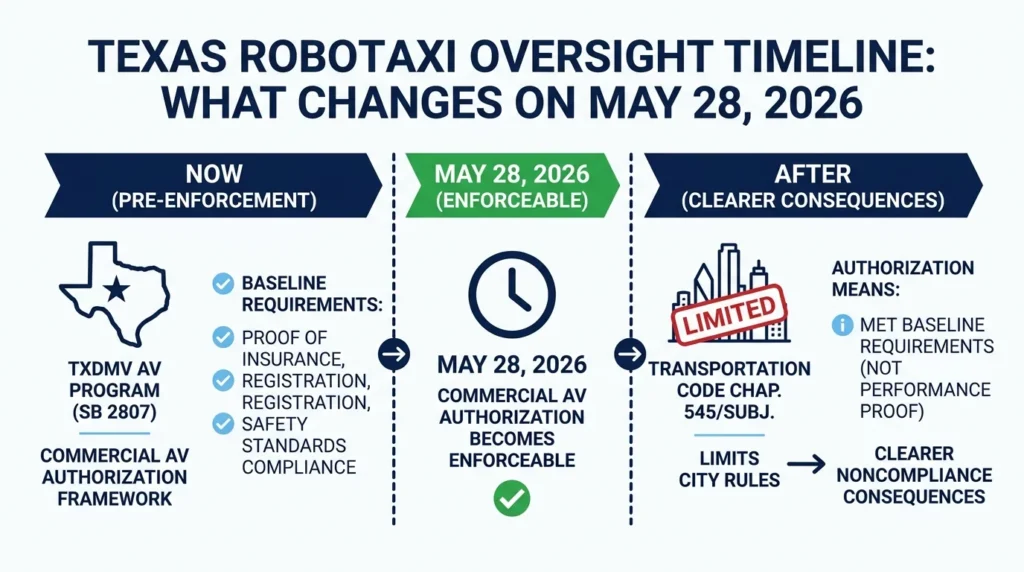
Texas law shapes what companies must do to operate commercially. The TxDMV Autonomous Vehicles Program administers the state’s commercial AV authorization framework under SB 2807. Baseline requirements include proof of insurance, registration, and compliance with safety standards.
The critical date: May 28, 2026. That’s when TxDMV’s commercial AV authorization becomes enforceable. Before that date, oversight operates differently. After that date, companies will face clearer consequences for noncompliance.
Texas Transportation Code Chapter 545 includes Subchapter J provisions that are relevant to AV operations. These provisions also limit how cities like Austin or Houston can regulate autonomous vehicles locally.
Texas Compliance Signals You Can Actually Check
To check Texas compliance signals, start with the TxDMV program page, rather than company marketing materials. Make sure to look for:
- Whether the company appears in official authorization records
- What insurance minimums apply to commercial AV operations
- Whether the service area matches what’s actually authorized
Authorization only tells you that a company met the baseline requirements. It does not tell you how the vehicle performs in real-world conditions, such as on Lamar Boulevard during rush hour or near Zilker Park on a crowded Saturday.
NHTSA Crash Reporting: The Key Federal Dataset & Its Limitations
The NHTSA Standing General Order requires that certain crashes involving automated driving systems must be reported. This creates the closest thing to a standardized federal dataset for robotaxi incidents.
What gets reported depends on the system type. ADS (Automated Driving System) vehicles like Waymo’s fully autonomous fleet have different reporting triggers than Level 2 ADAS vehicles, for which a human driver remains responsible.
Critical limitation: NHTSA explicitly states that this data is not normalized by miles driven or operational design domain. A company with 100 vehicles operating 24/7 in Austin will report more incidents than one with 10 vehicles operating for limited hours. Therefore, raw counts alone will not tell you which option is safer.
Incident narratives in SGO reports can also be incomplete. Details may be redacted, and the “what happened” section might lack the context needed to judge who was at fault or how serious the incident was.
Beyond Crashes: Recalls & Investigations Are Just As Important
Safety records also include corrective actions triggered by near-misses or rule violations, not just injury crashes.
The NTSB investigation HWY26FH007 documents a Texas-specific incident: a Waymo vehicle passing a stopped school bus in the process of picking up students in Austin. This wasn’t a collision, and no one was physically injured, but it triggered a federal investigation and a recall notification (25E-084).
This kind of event shows how “safety record” extends beyond crash statistics. A company’s response to edge cases, school zone behavior, and willingness to issue recalls can be more informative than pure incident counts.
Waymo’s Texas Safety Record: What’s Available Publicly
Waymo publishes a Safety Impact hub that links crash outcomes to NHTSA SGO IDs and compares results to human driver benchmarks. The Austin market is included in this data.
The hub provides:
- Crash outcome data tied to official reporting identifiers
- Benchmark comparisons against human driver collision rates
- Methodology explanations and noted limitations
Waymo itself admits there are limitations. How you compare results depends on the methods you choose. Some incidents go unreported or underreported, which affects the data for both AV and human drivers. The operational design domain (where and when the vehicles operate) also has a significant impact on the results.
The Austin school bus incident demonstrates how even a company with extensive public safety documentation can have serious edge-case failures. The question isn’t whether incidents happen; it’s whether they’re documented, investigated, and addressed.
Tesla Robotaxi’s Safety Record in Texas: What’s Visible & What’s Missing
Tesla’s robotaxi operations in Austin have generated NHTSA attention. Reports of wrong-way driving and braking issues prompted the agency to contact Tesla for more information.
SGO crash-report entries exist for Austin incidents, but there is a challenge in their transparency, as some incident details may be withheld or redacted in public filings. This makes it harder for consumers to understand what actually happened, and whether any patterns exist.
When evaluating Tesla’s safety signals, it’s important to look for:
- NHTSA communications or inquiries (publicly documented concerns)
- SGO crash-report entries (what’s filed and what details are included)
- Recall or corrective action history (evidence of response to problems)
Avoid relying solely on viral clips or headlines. A video of a robotaxi behaving strangely doesn’t tell you whether that behavior was reported, investigated, or fixed.
How to Sanity-Check Any “X Crashes in Austin” Headline
Remember, raw crash counts are nearly meaningless without context. While doing your research, make sure to ask:
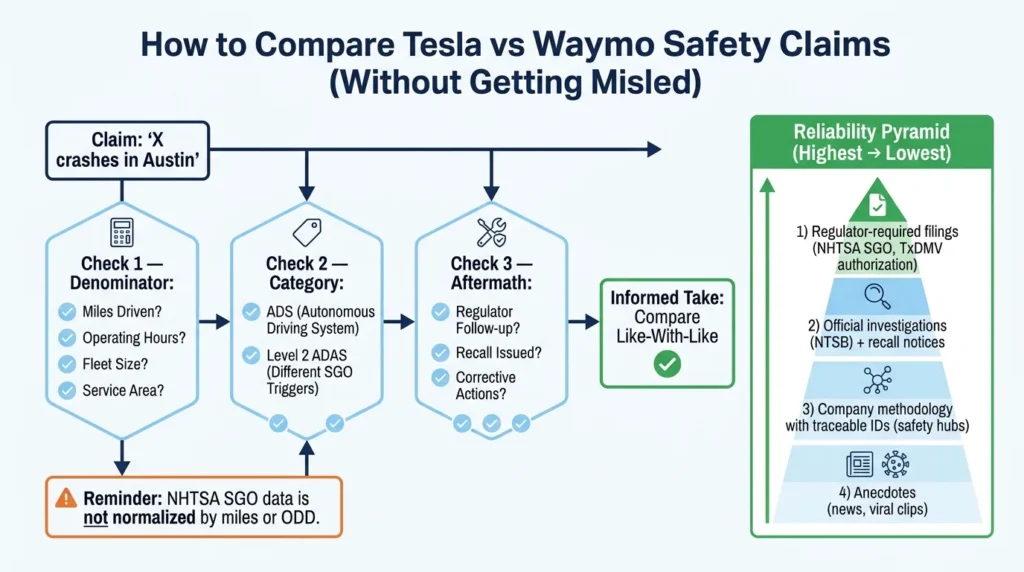
- What’s the denominator? How many miles were driven? How many operating hours were logged? How large was the service area?
- What reporting category applies? ADS and Level 2 ADAS have different SGO thresholds.
- What happened afterward? Did regulators follow up? Were corrective actions taken?
Three crashes in one day sounds alarming. Three crashes across 50,000 miles of urban driving might tell a different story. The SGO data doesn’t give you the denominator, which is exactly why NHTSA discourages using it as a direct safety scoreboard.
Why It’s Hard to Compare Tesla vs Waymo Safety Data
Even with federal reporting and company dashboards, direct comparisons face major obstacles, such as:
Operational Design Domain differences: Waymo operates in geofenced areas with mapped routes. Tesla’s approach may differ in service area boundaries, weather limitations, and road types covered. A vehicle that only operates in ideal conditions will have different outcomes than one that handles more edge cases.
Exposure differences: Miles driven, rider volume, and operating hours vary. Without normalized data, you’re comparing apples to oranges.
Transparency differences: Waymo publishes detailed methodology and links to SGO IDs. Tesla’s public disclosure practices are different. Inconsistent narrative details make it harder to identify patterns in the data.
A Practical Comparison Framework for Texans
Despite everything, you can still make informed judgments if you remember to prioritize evidence by reliability:
- Regulator-required filings (NHTSA SGO reports, TxDMV authorization records)
- Official investigations (NTSB inquiries, recall notifications)
- Consistent public methodology (company safety hubs with traceable data)
- Anecdotal reports (news coverage, social media clips)
Be sure to compare similar categories, such as compliance status, reporting consistency, recall responsiveness, and clarity about operating limits. Prioritize Texas-specific incidents and Texas legal requirements over national averages.
What to Do After a Crash Involving a Robotaxi in Texas
If you’re involved in a crash with an autonomous vehicle as a driver, passenger, or pedestrian, then your immediate priorities are the same as in any other collision:
- Call 911 and get medical attention.
- Document the scene with photos and video footage.
- Collect information from all parties involved.
- Get witness contact details.
For AV-specific crashes, you must also preserve:
- App ride details and timestamps
- Vehicle identifiers (such as license plates and company branding)
- Any communications from the robotaxi operator
- Your own dashcam or phone footage
Evidence in AV cases can be time-sensitive. Vehicle logs and video may be overwritten, so prompt preservation requests are critical. When determining what information to collect after a crash, remember that documentation is even more important when autonomous systems are involved.
Texas minimum insurance requirements may not cover serious injuries. Understanding Texas insurance minimums will help you recognize when coverage gaps might affect your claim.
Liability in Texas AV-Involved Crashes
Potential responsible parties in a robotaxi crash may include:
- The human driver (if one was present and responsible)
- The vehicle owner or operator company
- The service provider or technology developer
- Other involved motorists
The specific facts and the vehicle’s operating mode at the time of the crash will help determine who may be liable. This is why car accident cases involving autonomous vehicles can be more complex than standard collisions. When crashes involve commercial vehicles, truck accident or motorcycle accident considerations may also apply, depending on the types of vehicles involved.
How Angel Reyes & Associates Can Help
Evaluating robotaxi safety claims requires an understanding of both the data and its limitations. If you’ve been injured in a crash involving an autonomous vehicle in Texas, evidence preservation and liability questions can be more complex than in a typical collision.
At Angel Reyes & Associates, Our firm has over 30 years of experience handling serious injury cases across Texas. We offer free initial consultations and work on contingency, meaning there’s no fee unless we win. With 16 locations statewide and the ability to handle the majority of your case remotely, we’re accessible wherever you are.
You can read what our clients say about working with us or learn more about our team. If you have questions about a crash involving a robotaxi or any other vehicle, contact us to discuss your situation.
Tesla & Waymo Safety Record FAQs
Can local Texas cities ban or set their own robotaxi safety rules?
Not usually. Texas law limits local governments from imposing their own rules on autonomous vehicles in many areas, so statewide requirements are favored over city-by-city policies.
Do minor robotaxi fender-benders always show up in NHTSA data?
Not always. NHTSA’s reporting order covers certain crashes and incidents, but not every low-level event will appear in public data, and some details may be delayed or redacted.
Does a robotaxi’s service area affect how “safe” it looks on paper?
Yes. A company operating only in a smaller, geofenced area or one which avoids certain weather conditions, speeds, or road types may not be comparable to one operating in broader or harsher conditions.
Can a company’s own safety report be useful if it is self-published?
Yes, but it should be treated as only one piece of the picture. It is more helpful when it points to regulator IDs, explains its methods, and makes it easier to trace claims back to official records.
What should riders ask before taking a robotaxi in Texas?
Ask where the vehicle is allowed to operate, when service may pause, and what happens if the car stops unexpectedly or gets into a crash. These answers can tell you a lot about the company’s real-world transparency and planning.
About the Authors

Angel Reyes
Writer
Angel L. Reyes, III is the Founder and Managing Partner of Angel Reyes & Associates. A nationally recognized trial attorney and business leader, Angel has helped over 70,000 injury victims recover more than $1 billion since founding the firm in 1993. Named to the Texas Super Lawyers list annually since 2008, Angel brings Wall Street experience, Ivy League education, and a deep commitment to client advocacy. He is a frequent legal commentator and published author with extensive contributions to legal scholarship, trial strategy, and consumer protection.

Kyle Nicolas
Editor
Kyle Nicolas is the Web Content & SEO Manager at Angel Reyes & Associates. He has more than 10 years of experience as a marketing co...

Angel Reyes
Reviewer
Angel L. Reyes, III is the Founder and Managing Partner of Angel Reyes & Associates. A nationally recognized trial attorney and business...