What Happens if Your Uber Driver Refuses to Stop?


Every article on this site is researched by our internal team, reviewed for legal accuracy against current Texas law, and held to State Bar of Texas advertising standards before publication. We do not publish content that overstates outcomes or makes promises about results.
Learn more about our
editorial standards .
Key Takeaways
- Texas false imprisonment requires willful detention without consent or legal authority.
- In immediate danger, call 911 or use Uber's Emergency Button and follow dispatch instructions.
- Once safe, save the GPS route, trip chat, 911 details, and available emergency alerts.
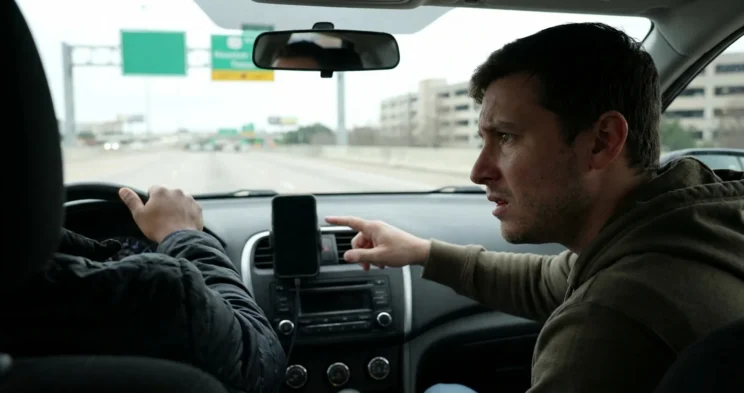
If your Uber driver deliberately keeps you in the car after you ask to leave, without legal authority, the driver can be liable for false imprisonment in Texas. No crash is necessary. If you are in immediate danger, call 911 or use Uber’s in-app Emergency Button.
Being unable to leave a ride can be frightening. Concerns about Uber kidnapping deserve a clear answer, as some incidents may be crimes, but criminal kidnapping requires more than a wrong turn or missed stop. Uber’s own screening and response require a separate investigation.
When Refusing to Stop Becomes False Imprisonment in Texas
A driver commits false imprisonment by willfully detaining you without your consent and without legal authority. A clear request to get out, followed by deliberate steps to keep you inside, can meet that standard.
The Texas Supreme Court identified three elements in Wal-Mart Stores, Inc. v. Rodriguez, 92 S.W.3d 502, 506 (Tex. 2002):
- Willful detention
- Lack of consent
- Lack of legal authority

Rodriguez involved an arrest, not a rideshare trip. It supplies the general Texas rule, rather than a ruling about Uber’s liability.
You can withdraw your consent to continue a ride. What the driver does after you ask to leave helps establish whether the driver intentionally confined you.
|
Facts That May Show Detention |
Facts That Do Not Establish Detention Alone |
|
Refusing a clear request to stop despite safe opportunities |
A navigation error or wrong turn |
|
Deliberately using locks to prevent your exit |
Doors locked during ordinary travel |
|
Threatening you after you ask to leave |
A brief drive to a safe stopping place |
|
Forcing you to travel to an unrequested location |
A detour around traffic on I-35 |

The exact words, timing, safe stopping opportunities, and driver’s response matter. The civil wrong is the confinement itself; it does not require a collision.
Does an Unwanted Uber Trip Count as Kidnapping?
Not automatically. An Uber driver kidnapping allegation requires evidence of intentional or knowing abduction under Texas Penal Code §20.03. A locked door or missed stop alone does not establish that crime.
For a competent adult, statutory restraint means substantially interfering with liberty without consent through force, intimidation, or deception. Section 20.02 separately makes intentional or knowing unlawful restraint an offense.
Under §20.01, abduction adds an intent to prevent release in one of two ways:
- By hiding or holding the person somewhere they are unlikely to be found
- By using or threatening deadly force
Civil false imprisonment, unlawful restraint, and kidnapping have different elements. Police and prosecutors assess criminal charges. The civil detention claim requires its own analysis.
What to Do If the Driver Will Not Let You Out
If you are in immediate danger, call 911 or use Uber’s Emergency Button and follow the dispatcher’s instructions. Documentation comes after safety:
- Call for help. Dial 911 or use the Emergency Button in the Uber Safety Toolkit. Uber says the app displays your location, vehicle information, and plate number. Automatic sharing with 911 is available only in certain US locations.
- Describe the danger plainly. Say the driver will not let you leave. Give your location, direction of travel, vehicle details, and requested destination if available.
- Share your trip if you can. Uber offers trip sharing with a trusted contact. Do not jump from a moving vehicle or physically confront the driver; follow dispatch instructions.
- Report the incident once safe. Use Uber’s serious-incident report, attach supporting material, and save the report and response.
- Use the appropriate state complaint channel. The Texas Department of Licensing and Regulation directs driver complaints to the company and complaints about the company to TDLR. This does not replace emergency help or police reporting.

Evidence That Shows the Route, the Refusal & the Response
Compare the requested destination with the actual route, then document what happened after you asked to leave. Once safe, take these preservation steps:
- Save the route and destination. Keep screenshots of the trip screen, original destination, changes, timestamps, and final drop-off. Texas rideshare receipts must include the origin, destination, time, distance, and fare.
- Keep available Emergency Button records. Save screenshots, alerts, and personal call history. Note when you used the button and what followed.
- Record 911 call details. Write down the call time, responding agency, and incident number. Ask counsel or investigators about preserving recordings and dispatch records because retention and release procedures vary.
- Preserve trip chat and support messages. Keep requests to stop, driver replies, destination changes, and exchanges with Uber support.
- Write your account promptly. Record exact words and events while they are fresh, and collect available witness contact information.
Uber’s US law-enforcement guidelines identify potentially available GPS, trip, communication, customer-service, and prior-complaint records. Availability varies, and preserving a record is different from obtaining it. Counsel should assess civil preservation and discovery; Uber’s law-enforcement portal is not a passenger download service.
Can Uber Be Responsible for the Driver’s Conduct?
Potentially, but the driver’s intentional confinement and Uber’s responsibility require separate proof. Screening failures, earlier complaints, and the company’s response may matter if they establish a legal basis for liability and a connection to the harm.
What Texas Requires Uber to Check
Texas Occupations Code §2402.107 requires specified criminal background checks, review of driving records, exclusion for listed disqualifications, and annual criminal checks. The checks include national and Texas sex-offender databases.
A background check does not guarantee safety. An investigation should examine what screening showed, whether the driver had a disqualifying history, what prior complaints said, when Uber learned of concerns, and how it responded. A bad outcome alone does not prove company negligence.
Section 2402.106 separately requires suspension and investigation after intoxication complaints. That requirement should not be treated as a rule covering every detention report.
How Chapter 150E Can Limit Company Claims
Texas Civil Practice and Remedies Code Chapter 150E can limit company liability only for claims meeting all §150E.002 conditions. These include:
- A claim against the company seeking damages for property loss, bodily injury, or death
- A claim arising from ownership, use, operation, or possession of a network vehicle while its driver or passenger was logged on
- A theory based on specified digital-network activities or the company’s relationship, affiliation, or interaction with a logged-on driver
For covered claims, §150E.003 limits liability for the driver’s acts when the claimant lacks clear and convincing proof of company gross negligence and the company fulfilled relevant Chapter 2402 obligations.
It preserves liability for the company’s own negligence or gross negligence relating to its digital network. One statutory example concerns actual knowledge, at the time of the event, that the driver had become disqualified for a listed reason after the latest required record review or background check.
Chapter 150E is not complete immunity. Whether it reaches a particular detention claim, including one involving only emotional distress, requires analysis of the claimed injuries and every statutory condition.
Talk to Angel Reyes & Associates About a Detention During an Uber Ride
Contact Angel Reyes & Associates for a free consultation about what happened and your options under Texas law. Bring your trip receipt, screenshots, chat history, and any 911 or incident numbers to help explain the timeline.
Angel Reyes & Associates has served injured Texans for over 30 years, and you can reach the firm 24/7.
Past results do not guarantee future outcomes.
Uber Driver Refuses to Stop FAQs
Can an Uber passenger sue for emotional distress after being held in a vehicle against their will?
Potentially, yes, depending on the circumstances and the legal claims supported by the evidence. A passenger may pursue damages for emotional harm resulting from unlawful confinement, even when no physical injury or collision occurred.
Can Uber deactivate a driver accused of refusing to let a passenger exit?
Uber may investigate reports of serious safety incidents and take action against a driver, including account deactivation. However, reporting an incident does not guarantee a particular outcome, and Uber’s internal safety process is separate from a criminal investigation or civil lawsuit.
How long do you have to file a false imprisonment lawsuit in Texas?
Texas generally applies a two-year statute of limitations to false imprisonment claims under Texas Civil Practice and Remedies Code §16.003(a). Exceptions may affect when the deadline begins or whether it applies, so the specific circumstances should be reviewed promptly.
About the Authors

Angel Reyes
Writer
Angel L. Reyes, III is the Founder and Managing Partner of Angel Reyes & Associates. A nationally recognized trial attorney and business leader, Angel founded the firm in 1993, which has gone on to help over 70,000 injury victims recover more than $1 billion. Named to the Texas Super Lawyers list annually since 2008, Angel brings Wall Street experience, Ivy League education, and a deep commitment to client advocacy. He is a frequent legal commentator and published author with extensive contributions to legal scholarship, trial strategy, and consumer protection.

Kyle Nicolas
Editor
Kyle Nicolas is the Web Content & SEO Manager at Angel Reyes & Associates. He has more than 10 years of experience as a marketing co...

Angel Reyes
Reviewer
Angel L. Reyes, III is the Founder and Managing Partner of Angel Reyes & Associates. A nationally recognized trial attorney and business...