When Uber Crash Damages Top $1 Million


Every article on this site is researched by our internal team, reviewed for legal accuracy against current Texas law, and held to State Bar of Texas advertising standards before publication. We do not publish content that overstates outcomes or makes promises about results.
Learn more about our
editorial standards .
Key Takeaways
- Texas requires at least $1 million in trip coverage. That rule does not itself cap damages.
- Insurance disclosures identify policies whose terms determine whether excess coverage applies.
- Evidence of Uber's own negligence may support liability, but does not prove extra coverage.
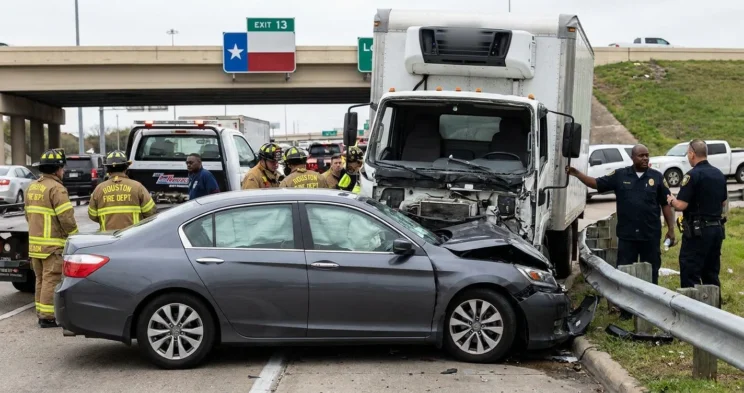
If your medical bills, lost earnings, and future care needs after a Texas Uber crash exceed $1 million, you may be able to seek more than that. Texas requires at least $1 million in liability coverage during a prearranged ride. That requirement is not itself a cap on damages. Recovering more than a policy’s limit depends on additional insurance or resources available from a responsible party.
Texas Insurance Code Chapter 1954 sets the coverage minimums. The driver’s app status, the policies in effect at the time of the crash, and evidence of Uber’s conduct can help identify possible sources of compensation.
Texas Rideshare Insurance Depends on App Status
Texas ties minimum rideshare insurance to the driver’s app status when the crash happened. Required coverage increases once the driver accepts a ride.

- Logged on and available, no ride accepted (§ 1954.052). At least $50,000 for one person’s injury or death, $100,000 per incident for injury or death, and $25,000 for property damage.
- During a prearranged ride (§ 1954.053). At least $1 million in total liability coverage per incident for death, bodily injury, and property damage.
Under § 1954.001, the prearranged ride begins when the driver accepts the request and ends when the last requesting rider leaves the vehicle. The higher minimum can apply while the driver is on the way to a pickup.
The $1 million minimum covers the whole incident. It is not a separate $1 million for each passenger or each person in another car. Several injured people may share the same policy limit.
Trip and driver-app records help establish which coverage period applied. The TDLR operations guide confirms that the driver, the company, or both can supply the required primary insurance. Review the policies in effect on the crash date to identify the available coverage.
Can an Uber Crash Claim Be Worth More Than $1 Million?
§ 1954.053 sets a minimum insurance requirement. Damages from a serious crash can exceed the trip policy’s limit, though recovering that amount depends on the available insurance and the responsible parties’ resources.

Evidence used to calculate your damages may include medical records and bills, documented lost earnings, expected future care costs, and records showing lasting impairment. A diagnosis alone does not establish the claim’s value.
Uber’s public insurance page describes at least $1 million in liability insurance during pickups and trips. It also explains that coverage depends on fault, trip status, and policy circumstances. Review the policies in effect on the crash date to determine the full coverage available.
The Texas Department of Insurance cautions that most personal auto policies exclude ridesharing. Any additional coverage through the driver’s personal policy depends on its terms.
How Can Insurance Disclosures Identify Additional Coverage?
In Texas civil lawsuits subject to these disclosure rules, insurance disclosures can identify policies that may pay part or all of a judgment. Texas Rule of Civil Procedure 194.2(b)(7), together with Rule 192.3(f), requires disclosure of relevant insurance and indemnity agreements, including agreements to reimburse payments.
Initial disclosures are generally due within 30 days after the first answer or general appearance. Different timing applies to parties who join later, and an agreement or court order can change the schedule. This deadline applies during litigation and does not automatically require an insurer to provide policies before a lawsuit.
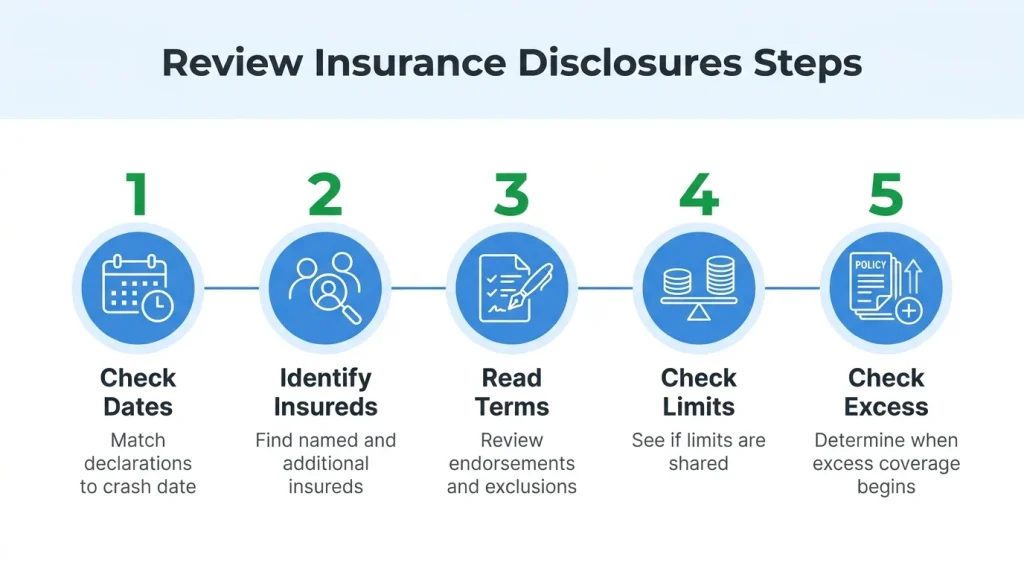
Once the agreements are available, review them to:
1. Check the declarations and policy dates against the crash date.
2. Identify the named insureds and additional insureds.
3. Read the endorsements and exclusions that could affect coverage.
4. Determine whether limits are shared across claimants or types of coverage.
5. Check when any excess policy begins paying and what underlying coverage must be used up first.
These documents may reveal additional coverage. Each policy’s terms determine whether it applies, and disclosure does not automatically make insurance evidence admissible at trial.
When Can Uber Be Liable for Its Own Conduct?
Evidence of Uber’s own negligence or gross negligence may support a separate claim against the company. Naming Uber in a lawsuit or showing that your injuries are severe does not establish company fault.
Texas Civil Practice and Remedies Code Chapter 150E governs qualifying vehicle-related claims against rideshare companies. Under § 150E.003(a), protection against liability for the driver’s conduct requires both the absence of clear and convincing proof of the company’s gross negligence and compliance with the relevant Chapter 2402 obligations.
§ 150E.003(b) preserves liability for the company’s own negligence or gross negligence involving its digital network. One example is failing to block a driver despite knowing about a qualifying disqualification that arose after the driver’s latest required screening.
Texas Occupations Code Chapter 2402 sets driver screening and disqualification requirements, including annual criminal background checks. An investigation may examine screening records, when the company learned of a disqualification, and whether it continued allowing the driver to use the platform. The evidence must connect the alleged failure to the crash. A regulatory violation alone does not prove liability.
Prompt preservation requests can help protect trip-status and driver-approval records needed for that investigation. TDLR’s operations guide confirms ride and driver recordkeeping requirements.
A supported claim against Uber may offer another source of compensation beyond the driver’s trip coverage. It does not guarantee additional insurance or payment. Whether Chapter 150E applies depends on when the claim arose and the circumstances of the crash.
Discuss a Catastrophic Uber Crash Claim With Angel Reyes & Associates
If your losses exceed $1 million, reviewing the crash evidence and insurance policies can help identify possible sources of compensation for your rideshare accident claim.
Angel Reyes & Associates has guided injured Texans for over 30 years. Contact Angel Reyes & Associates for a free consultation to discuss your injuries, available insurance, and who may be responsible. Our team is available 24/7.
Past results do not guarantee future outcomes.
Uber Crash Claims Over $1 Million FAQs
How long do I have to file a lawsuit after a serious Uber accident in Texas?
Under Texas Civil Practice and Remedies Code § 16.003, you must file most personal injury lawsuits within two years of the accident. Certain exceptions may change the deadline, including rules involving minors.
Can multiple people injured in the same Uber accident file separate lawsuits?
Yes. Each injured person may pursue a separate claim, although shared insurance limits can affect how much compensation is available to satisfy all claims.
What happens if an Uber accident victim needs lifelong medical care?
A Texas personal injury claim may include reasonably necessary future medical expenses, such as ongoing rehabilitation, assistive equipment, and long-term nursing care. Medical expert testimony can help establish the expected treatment needs and costs.
Can an Uber passenger recover compensation if another driver caused the crash?
Yes. An injured Uber passenger may pursue a claim against an at-fault third-party driver, and other applicable insurance may provide additional protection depending on the circumstances.
Does Texas allow punitive damages in a catastrophic Uber accident lawsuit?
Texas permits exemplary damages in certain cases involving fraud, malice, or gross negligence under Civil Practice and Remedies Code Chapter 41. These damages require heightened proof and are generally subject to statutory limits.
About the Authors

Angel Reyes
Writer
Angel L. Reyes, III is the Founder and Managing Partner of Angel Reyes & Associates. A nationally recognized trial attorney and business leader, Angel founded the firm in 1993, which has gone on to help over 70,000 injury victims recover more than $1 billion. Named to the Texas Super Lawyers list annually since 2008, Angel brings Wall Street experience, Ivy League education, and a deep commitment to client advocacy. He is a frequent legal commentator and published author with extensive contributions to legal scholarship, trial strategy, and consumer protection.

Kyle Nicolas
Editor
Kyle Nicolas is the Web Content & SEO Manager at Angel Reyes & Associates. He has more than 10 years of experience as a marketing co...

Angel Reyes
Reviewer
Angel L. Reyes, III is the Founder and Managing Partner of Angel Reyes & Associates. A nationally recognized trial attorney and business...