Why Are Your Ears Ringing After a Car Accident?


Every article on this site is researched by our internal team, reviewed for legal accuracy against current Texas law, and held to State Bar of Texas advertising standards before publication. We do not publish content that overstates outcomes or makes promises about results.
Learn more about our
editorial standards .
Key Takeaways
- Airbag deployment creates a 150 to 170 dB impulse that can permanently damage hearing.
- Tinnitus has no direct test, so audiometry and an early documented onset carry the claim.
- Texas law gives you two years from the crash date to file a personal injury claim.
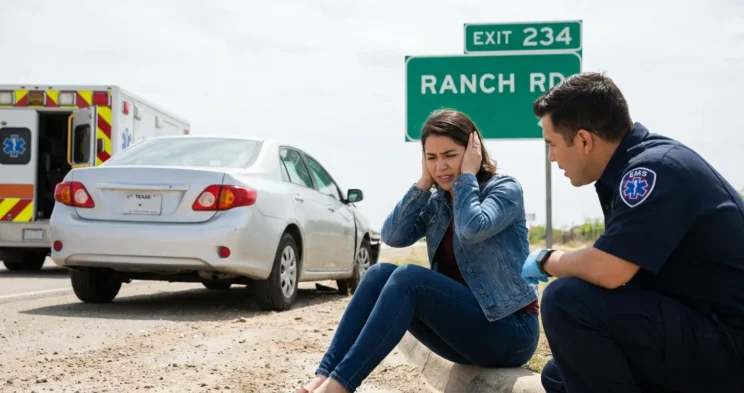
The crash is over, the airbag has deflated, and there is a high-pitched ring in your ears that will not settle down.
That ringing has a name, and it has a documented cause. Tinnitus after a car accident is a recognized injury, and when an airbag fires, the sound it makes is loud enough to damage the inner ear permanently.
Proving it is the harder part. Tinnitus is a subjective symptom with no direct test, so your claim will rest on what your hearing tests show and how quickly you told a doctor about the ringing.
Why Your Ears Started Ringing Right After the Crash
An airbag protects you with a small controlled explosion, and that explosion is intense enough to injure the cochlea.
The impulse lasts well under 100 milliseconds. Intensity, not duration, is what does the damage.
For comparison, the pain threshold for sound sits around 140 dB, and CDC and NIOSH treat sustained exposure at 85 dBA averaged over eight hours as hazardous to hearing. An airbag is one brief impulse rather than a full work shift of noise, but its peak sits far above the levels associated with permanent noise-induced hearing loss.

The same review describes three presumed mechanisms behind airbag ear injuries: acoustic trauma from the noise itself, mechanical deflection or rupture of the inner-ear window from the pressure slap against the ear, and inner-ear concussion syndrome.
The medical literature is careful with that language. Airbags are described as associated with the risk of hearing damage, not as a certain cause in every deployment.
The reason the injury can last is simple biology. Cochlear hair cells damaged by intense impulse noise do not regenerate, so the hearing loss and the tinnitus that comes with it can be permanent.
If your airbag never deployed, the ringing can still be crash-related. Whiplash and traumatic brain injury are both recognized causes of tinnitus, and they injure hearing through different pathways than an acoustic blast.
Either way, the mechanism means something. Every car accident claim has to connect a specific injury to a specific event, and the way your ears were injured shapes the evidence you need.
How Doctors Document Tinnitus & Hearing Loss After a Crash
No test measures your tinnitus directly, so doctors build an objective record around it instead. That record usually comes together in a standard sequence:
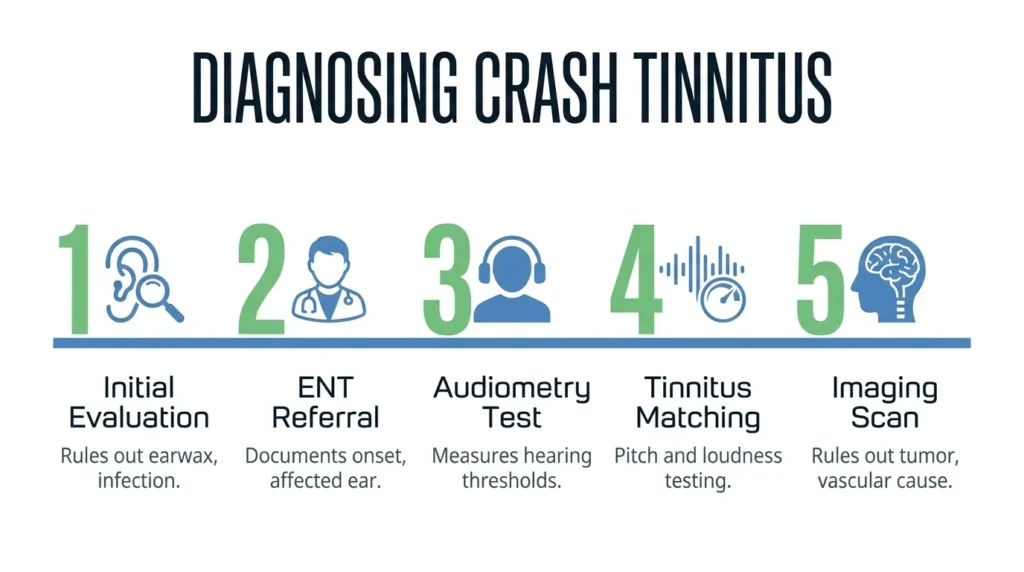
- An initial evaluation, often with primary care, rules out simple causes such as an earwax blockage or an ear infection.
- A referral to an otolaryngologist, or ENT, who examines the ear canal and eardrum and documents when the ringing started, which ear it affects, and what other symptoms came with it.
- Pure-tone audiometry, the standard hearing test after a crash, administered by an audiologist or the ENT to measure your hearing thresholds.
- Follow-up testing by an audiologist to characterize the tinnitus itself, such as pitch and loudness matching.
- Imaging such as an MRI or CT scan in some cases, used to rule out a vascular cause or a tumor rather than to confirm typical post-traumatic tinnitus.
Tinnitus can occur with or without a measurable loss on a standard audiogram. That surprises people who assume a normal audiogram ends the conversation.
When a loss does show up, the pattern is what carries weight. Documented airbag cases concentrate elevated hearing thresholds in the 3 to 8 kHz range, a dip or decline that fits acoustic trauma rather than an unrelated or pre-existing condition.
Why Insurers Dispute Ear-Ringing Claims
Because tinnitus is diagnosed from what you report, an adjuster can question whether it exists at all. The answer is never a better description of the sound. It is a record where several independent pieces of evidence point the same direction.
The adjuster’s job is to close your claim for as little as possible. That is how the business works, and a symptom nobody else can hear is an obvious place to push.
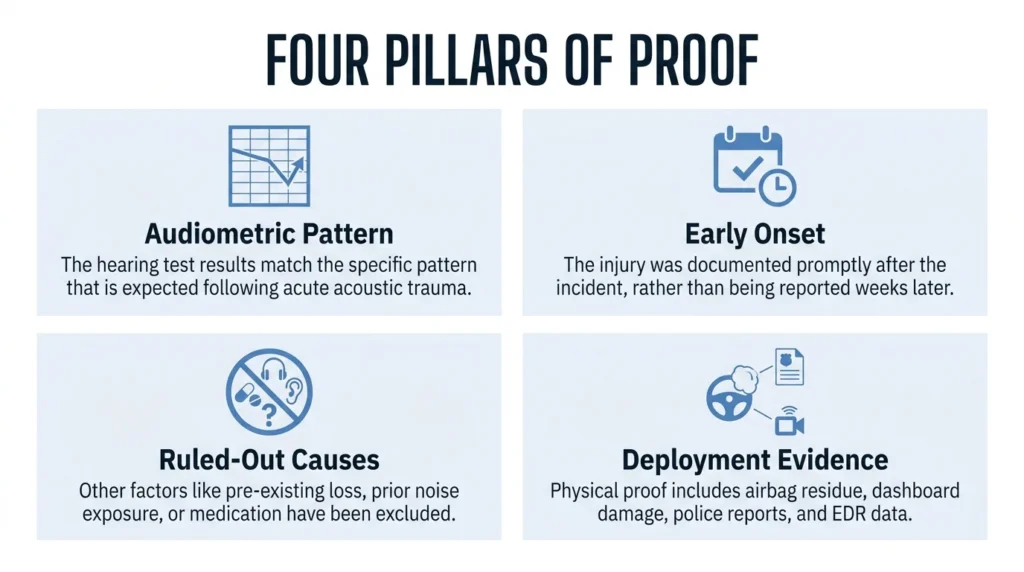
A credible ear-ringing claim generally rests on four things working together:
- An audiometric pattern that matches what acoustic trauma is expected to produce.
- An early, clearly documented onset tied to the crash rather than a gradual or later report.
- Exclusion of alternative causes such as pre-existing hearing loss, unrelated noise exposure, or ototoxic medication.
- Objective proof the airbag deployed, including the deployed airbag itself, powder residue, dashboard or steering wheel damage, the police crash report, photographs, and the vehicle’s event data recorder where one is available.
Timing is the piece most people lose without realizing it. Waiting weeks to mention the ringing hands an insurer room to argue something else caused it, so prompt evaluation and a contemporaneous note of when the symptoms began do real work later.
Deployment evidence does something the medical record cannot. It anchors a symptom only you can perceive to a mechanism anyone can verify.
A peer-reviewed case series of 20 patients with airbag-related ear injuries reported hearing loss in 17 of them and tinnitus in 17 of them, with objective hearing loss confirmed in 88% of the ears patients described as affected.
The study also found that the ear oriented toward the airbag was significantly more likely to be the injured ear, which makes coincidence a difficult argument for the other side.
What Texas Law Requires to Prove a Tinnitus Injury Claim
Texas puts two requirements in your path. You generally need expert medical proof of causation, and you have two years to file:
- Expert testimony on causation. Texas courts generally require expert medical testimony to link an accident to a claimed medical condition, unless the connection is one a layperson could evaluate from ordinary experience. That is the holding the Texas Supreme Court reached in Guevara v. Ferrer, 247 S.W.3d 662 (Tex. 2007).
A juror cannot assess ringing in your ears from common experience the way a visible injury allows, which makes your audiology and ENT evidence the load-bearing proof in the case.
- A two-year filing deadline. Texas Civil Practice and Remedies Code § 16.003 requires a personal injury suit to be filed not later than two years after the cause of action accrues, generally the date of the crash. Texas recognizes a narrow exception for injuries that could not reasonably have been discovered at the time, but courts apply it narrowly, and ringing that starts at or soon after a crash would not typically depend on it.
Read those two requirements together and the strategy becomes clear. The medical documentation that satisfies a court is the same documentation that answers an adjuster, and both have to be built well before the deadline arrives.
Talk to Angel Reyes & Associates About Your Ear-Ringing Injury
Ringing in your ears after a crash is a real, documentable injury. What usually decides the claim is whether the right evidence was gathered early and read correctly.
Angel Reyes & Associates has guided injured Texans through the legal process for more than 30 years, with board-certified personal injury attorneys and investigators on the team. You can reach the firm 24/7.
Contact Angel Reyes & Associates for a free consultation to review your options while your medical record is still taking shape.
Past results do not guarantee future outcomes.
Ear Ringing After a Car Accident FAQs
Can tinnitus after a car accident cause dizziness or balance problems?
Yes. Tinnitus can occur alongside dizziness, vertigo, or balance problems after head trauma or an inner-ear injury, and these symptoms may warrant evaluation for conditions such as vestibular damage or a concussion. Persistent dizziness after a crash should be reported to a medical professional.
Can you have tinnitus after a car accident without hearing loss?
Yes. A person can experience tinnitus even when a standard hearing test shows hearing within normal ranges. Additional evaluation may help identify subtle auditory or neurological problems that a routine audiogram does not capture.
What should you do if your ears start ringing days after a car accident?
Schedule a medical evaluation promptly and explain when the ringing began, whether it is constant, and whether you have hearing changes, dizziness, or ear pain. A delayed onset does not automatically rule out a crash-related injury, but the timing and medical record can affect how causation is evaluated.
Can a car accident cause permanent hearing loss in one ear?
Yes. Trauma from an airbag deployment, head impact, or other crash-related forces can cause hearing loss in one ear, sometimes permanently. An ENT and audiologist can evaluate whether the pattern of hearing loss is consistent with trauma and whether further testing is needed.
How long does tinnitus last after a car accident, and can it go away?
Tinnitus may improve over time, but it can also persist for months or become permanent depending on the underlying injury. The course varies, so follow-up with an ENT or audiologist is important when symptoms continue or interfere with sleep, concentration, or daily activities.
About the Authors

Angel Reyes
Writer
Angel L. Reyes, III is the Founder and Managing Partner of Angel Reyes & Associates. A nationally recognized trial attorney and business leader, Angel founded the firm in 1993, which has gone on to help over 70,000 injury victims recover more than $1 billion. Named to the Texas Super Lawyers list annually since 2008, Angel brings Wall Street experience, Ivy League education, and a deep commitment to client advocacy. He is a frequent legal commentator and published author with extensive contributions to legal scholarship, trial strategy, and consumer protection.

Graham Griffin
Editor
Graham Griffin is the Web & Content Manager at Angel Reyes & Associates, where he oversees content strategy, AI-powered workflows, a...

Angel Reyes
Reviewer
Angel L. Reyes, III is the Founder and Managing Partner of Angel Reyes & Associates. A nationally recognized trial attorney and business...