How Many Hours Can a Texas Truck Driver Drive?


Every article on this site is researched by our internal team, reviewed for legal accuracy against current Texas law, and held to State Bar of Texas advertising standards before publication. We do not publish content that overstates outcomes or makes promises about results.
Learn more about our
editorial standards .
Key Takeaways
- Federal law caps truck driving at 11 hours daily and 60 to 70 hours weekly.
- Texas drivers may split rest using a 7-hour and 2-hour sleeper berth combination.
- Carriers must keep electronic logging device records for at least 6 months.

Truck drivers often spend long days on Texas highways, and fatigue can affect reaction time, judgment, and control behind the wheel. When the vehicle is a fully loaded commercial truck, those effects can increase the risk of a serious crash.
Federal and Texas Hours of Service (HOS) regulations limit how long commercial drivers can drive and remain on duty before they must rest.
Federal & State Driver Fatigue Rules
Two sets of rules govern how long a truck driver may remain behind the wheel. Federal Hours of Service regulations generally apply to drivers involved in interstate commerce. Texas has separate intrastate rules for drivers operating only within the state.
Both systems respond to the same underlying pressure. A persistent driver shortage pushes some carriers to schedule drivers right up against these limits, and sometimes past them.
Overview of Federal HOS Regulations
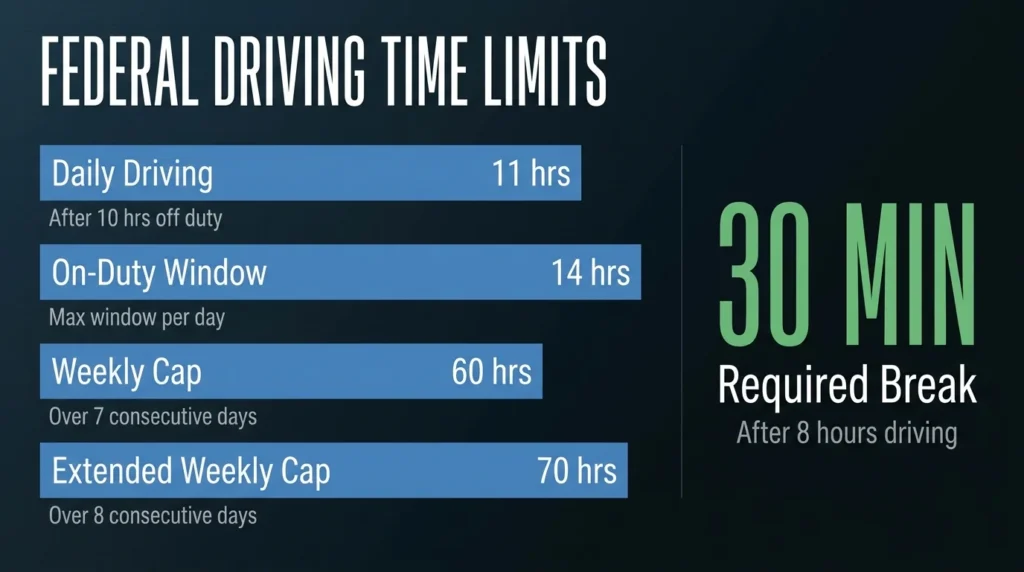
Federal rules limit a truck driver’s driving time to 11 hours, following 10 consecutive hours off duty. Drivers must also stay within a 14-hour on-duty window and take a 30-minute break after 8 hours of driving. These limits come from 49 CFR § 395.3.
The same rule caps total on-duty time across multiple days, since fatigue builds up over a workweek, not just a single shift. A driver may not stay on duty more than 60 hours in 7 consecutive days or 70 hours in 8 consecutive days. The FMCSA’s hours-of-service summary breaks down each of these limits.
These numbers apply to drivers who cross state lines. Texas sets its own similar rules for drivers who stay within the state.
Texas-Specific HOS Regulations & Exemptions
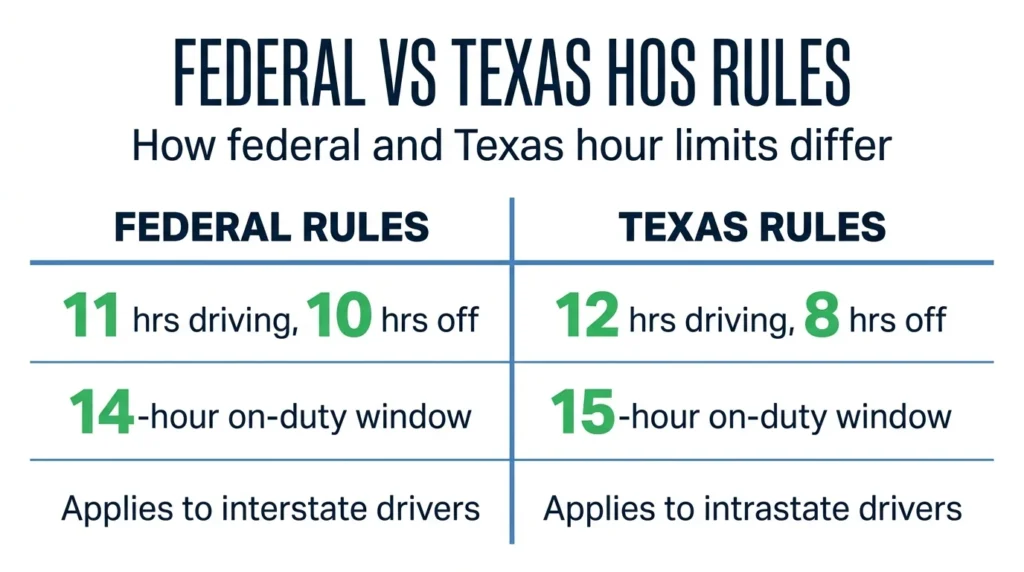
Texas intrastate rules differ slightly from the federal standard. A driver who stays within the state may drive 12 hours after 8 consecutive hours off duty, within a 15-hour on-duty window. These limits appear in the Texas Administrative Code and the Texas Department of Public Safety’s motor carrier safety rules.
The Texas Department of Public Safety adopts these standards under authority granted by Texas Transportation Code Chapter 644.
Drivers can also split their required rest using a truck’s sleeper berth. Under 49 CFR § 395.1, a driver may divide off-duty time into one period of at least 7 consecutive hours in the sleeper berth, plus a second period of at least 2 consecutive hours off duty or in the sleeper berth. Together, the two periods must total at least 10 hours.
Some drivers also qualify for narrow exemptions under the same federal rule:
- Short-haul exemption: drivers who work within a 150-air-mile radius and return within 14 hours do not need to keep a duty-status log under Section 395.1.
- Adverse driving conditions: drivers may extend the driving and on-duty limits by up to 2 hours when conditions like sudden weather changes arise, but only if those conditions were unknown before the duty day began.
These exemptions are narrow by design. Carriers sometimes misapply them to justify pushing drivers past otherwise safe limits.
Consequences of Violating HOS Regulations in Texas
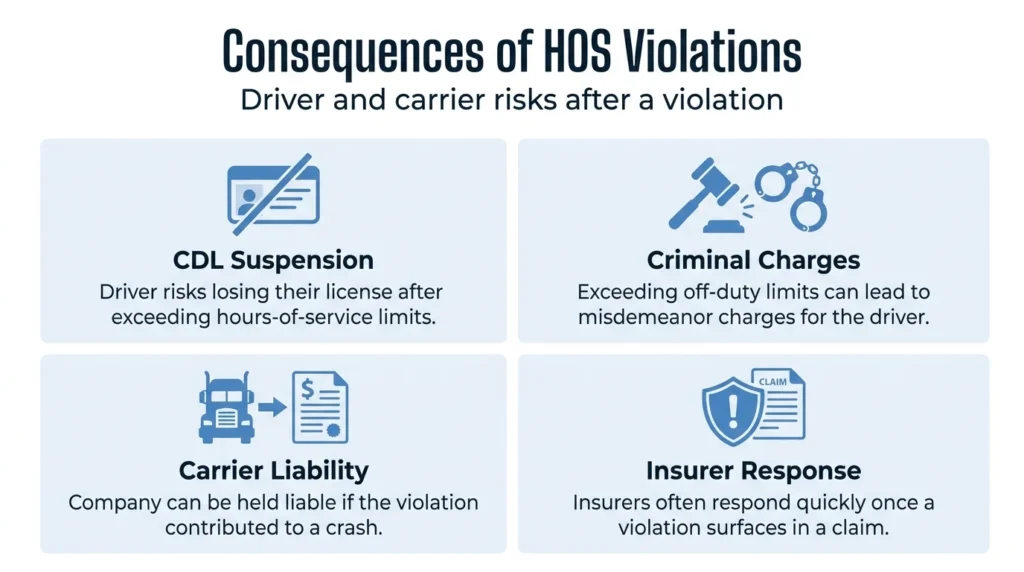
Violating Hours of Service rules can have consequences for the driver and the trucking company. A driver who exceeds these limits risks CDL suspension. Driving while off-duty limits are exceeded can also lead to criminal misdemeanor charges.
Trucking companies may face consequences of their own. When an HOS violation contributes to a crash, the carrier can be held liable for the resulting injuries. Insurers and carriers often respond quickly once a violation surfaces in a claim, and understanding how trucking companies and insurers delay or deny claims can help protect your case.
Why Are Penalties so Strict for HOS Regulations?
Crash risk increases when a driver spends too many hours behind the wheel, especially after exceeding federal driving limits. Fatigue slows reaction time and impairs judgment much like alcohol does. Regulators use firm numerical limits because drivers may not recognize how tired they have become.
Strict enforcement gives carriers and drivers a clear, measurable standard. It also helps investigators determine whether fatigue contributed to a crash by reviewing driving records and other evidence.
Legal Options for HOS Violation Victims
If a trucking company violated Hours of Service rules before your crash, you may have legal options. Depending on what happened, you could pursue a truck accident claim, file an insurance claim, or bring a wrongful death claim if the violation contributed to a fatal crash.
Electronic logging devices make these violations easier to prove than paper logs ever were. Unlike paper logs, which drivers could alter by hand, electronic logging device data automatically records actual driving and on-duty time. Under 49 CFR § 395.8, carriers must retain these records for at least 6 months, so these records should be preserved as soon as possible.
An HOS violation often points to broader questions about truck accident liability and the severity of common truck accident injuries a victim may face. Past case results and the experience of attorneys like Angel L. Reyes III can help you evaluate a firm before choosing representation.
Consult an Experienced Truck Accident Attorney
If you believe a trucking company’s Hours of Service violation caused or contributed to your crash, you do not have to sort out the legal and evidentiary details alone. Angel Reyes & Associates has represented truck accident victims across Texas, and we work on a contingency fee basis, so you pay no fee unless we win your case.
Contact us today for a free consultation to discuss your accident and find out what compensation you may be owed.
Past results don’t guarantee future outcomes.
Texas Truck Driver Hours FAQs
What is the 34-hour restart rule for truck drivers?
A driver can reset the 60-hour, 7-day or 70-hour, 8-day weekly limit by taking at least 34 consecutive hours off duty. The restart is optional, and any interruption to that rest period means the clock starts over from the beginning.
Do bus drivers and other passenger-carrying drivers follow the same hour limits as truck drivers?
No. Passenger-carrying drivers may drive up to 10 hours within a 15-hour on-duty window after 8 hours off duty, and unlike truck drivers, they cannot use a 34-hour restart to reset their weekly limit.
What size vehicles have to follow hours-of-service rules?
Federal hours-of-service rules generally apply to any vehicle weighing 10,001 pounds or more, whether alone or combined with a trailer, or to any vehicle that must display hazardous materials placards. Lighter personal or work trucks below that threshold are usually not covered unless they are built to carry passengers for compensation.
What happens right away if an inspector catches a driver over the hours-of-service limit?
The inspector can place the driver out of service on the spot, which means the truck cannot move again until the driver completes the required off-duty rest. That out-of-service order also becomes part of the driver’s and carrier’s federal safety record.
About the Authors

Angel Reyes
Writer
Angel L. Reyes, III is the Founder and Managing Partner of Angel Reyes & Associates. A nationally recognized trial attorney and business leader, Angel has helped over 70,000 injury victims recover more than $1 billion since founding the firm in 1993. Named to the Texas Super Lawyers list annually since 2008, Angel brings Wall Street experience, Ivy League education, and a deep commitment to client advocacy. He is a frequent legal commentator and published author with extensive contributions to legal scholarship, trial strategy, and consumer protection.

Graham Griffin
Editor
Graham Griffin is the Web & Content Manager at Angel Reyes & Associates, where he oversees content strategy, AI-powered workflows, a...

Spencer Browne
Reviewer
Spencer Browne is a partner at Angel Reyes & Associates and a Board Certified personal injury trial lawyer with nearly 100 jury trials a...