What to Do When Your Insurance Claim Is Denied in Texas


Every article on this site is researched by our internal team, reviewed for legal accuracy against current Texas law, and held to State Bar of Texas advertising standards before publication. We do not publish content that overstates outcomes or makes promises about results.
Learn more about our
editorial standards .
Key Takeaways
- A denied or underpaid Texas insurance claim can often be challenged with targeted documentation and a clear written record.
- Texas prompt-payment rules in Chapter 542 can create leverage when an insurer misses acknowledgment, decision, or payment deadlines.
- Your next best step depends on whether the dispute is about coverage, valuation, or delay without a decision.
What to Do When Your Insurance Claim Is Denied in Texas
You were in an accident on the 610 loop in Houston. You reported the loss, sent photos, answered questions, and waited. Then, after weeks of waiting, the insurer denied your claim or offered an amount that does not come close to covering the damage you sustained.
Situations like this happen to Texans every day, including Houston homeowners after a storm, or Dallas drivers dealing with collision repairs.
A denial is not always final, and an underpayment is not the end of the process. What you do next can affect your documentation, your deadlines, and your leverage.
Common Reasons Texas Insurers Deny Claims
A denial usually falls into one of these buckets:
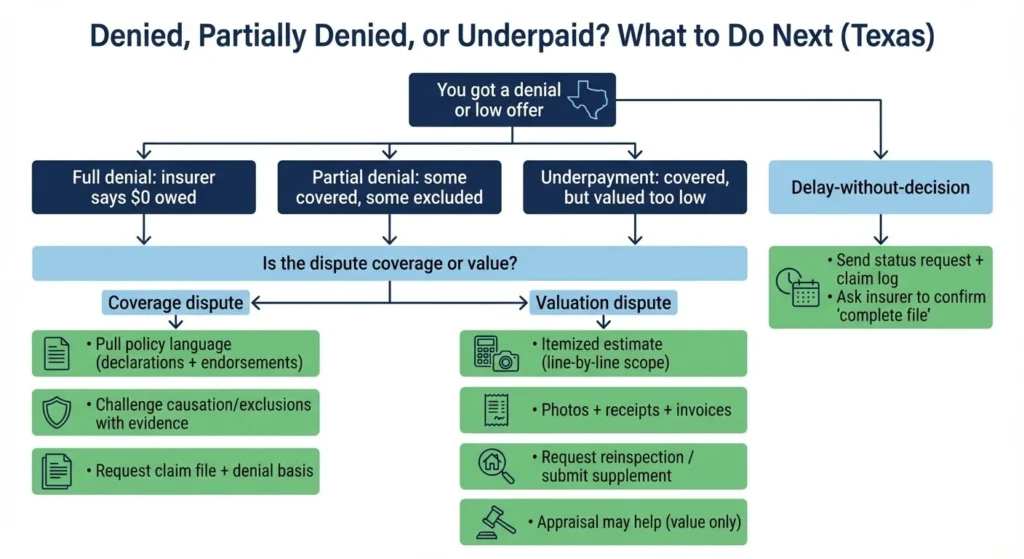
- Full denial: The insurer claims they owe you nothing.
- Partial denial: The insurer agrees to cover some damage but excludes other parts.
- Underpayment: The insurer accepts responsibility to cover losses, but values those losses too low.
The level of denial is important to how your case proceeds and what options are available to you.
Denial letters often point to one of these categories:
- Policy-based reasons: Exclusions, a lapse in coverage, late notice, or alleged misrepresentation
- Fact-based reasons: Disputes about the cause of loss, timing, wear and tear, or pre-existing damage
- Process-based reasons: Alleged failure to cooperate, missed proof-of-loss deadlines, or missing documents
Coverage Disputes vs. Valuation Disputes
There are two main categories for reasons why you might dispute a claim denial: coverage disputes and valuation disputes.
- Coverage disputes argue whether the policy applies at all. This often hinges on exclusions, endorsements, and causation facts.
- Valuation disputes are more common and concern how much the covered loss is worth. This is typically documentation-heavy and can be suited for supplements or appraisal.
These two categories call for different strategies. If the insurer says something is “not covered,” appraisal alone may not resolve the core issue. If the insurer says something is covered, but a far lower value than you believe is fair, valuation-focused documentation can move the claim.
Texas-Specific Scenarios
Storm & Weather Property Claims
Hail and wind claims often involve disputes about wear and tear, pre-existing damage, and matching. Ask for an itemized estimate that shows what was included, what was excluded, and why.
If the claim was partially approved, submit a focused supplement tied to specific line items with supporting photos and contractor scope.
Auto First-Party Claims
Collision, comprehensive, PIP, and MedPay claims can turn on repair supplements, medical billing records, and documentation of out-of-pocket costs. If your shop’s estimate differs from the insurer’s, request a reinspection and submit the detailed shop scope.
Delay Without a Formal Denial
Some insurers avoid a clear decision. They keep requesting more information or say they are still reviewing evidence. Document these delays using status requests, your claim log, and a clear “complete file” confirmation.
Red Flags That Suggest an Unreasonable Denial
Not all denials are illegitimate! When an insurance company has a valid reason not to accept a claim, they often will refuse to do so. After all, they do want to protect themselves from fraud or falsified claims that might lead to big financial losses.
That being said, insurers will sometimes try to use these procedures to absolve themselves of responsibility for legitimate claims as well. Their denial will often show signs that the claim was not handled carefully. Watch for:
- A form letter with no meaningful policy citation
- Reasons that change from one communication to the next
- Ignoring photos, estimates, or receipts you already provided
- Repeated “still reviewing” responses after you supplied everything requested
If you see these patterns, strengthen your paper trail and consider escalation.
Texas Deadlines Under Chapter 542
Texas has prompt-payment rules that can create leverage when an insurer misses deadlines. The deadlines often hinge on when the insurer received “all items, statements, and forms” it reasonably requested.
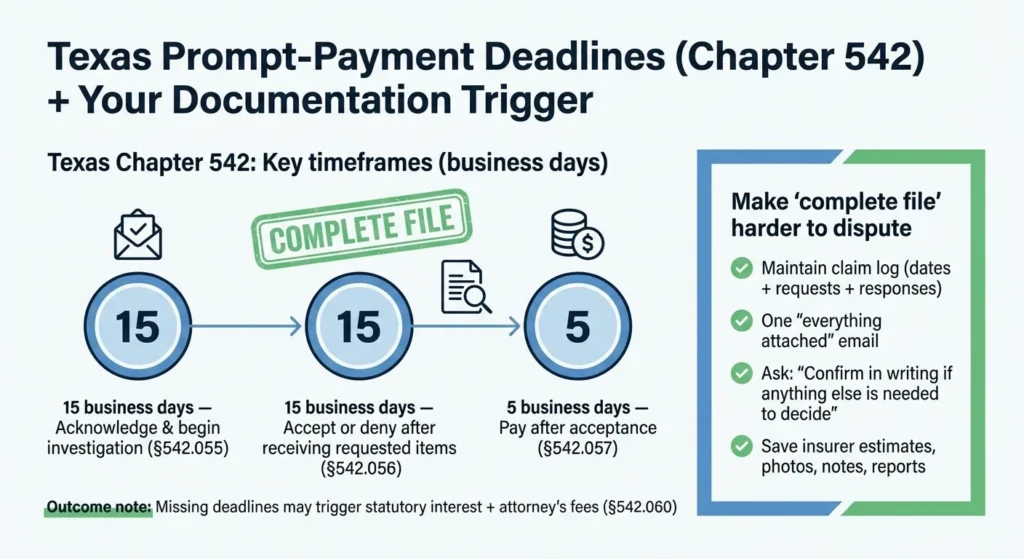
Key provisions include:
- Acknowledgment & investigation: Texas insurers are usually required to acknowledge your claim within 15 business days. (Texas Insurance Code § 542.055)
- Accept or deny after receiving requested items: Once insurers receive their requested evidence regarding your claim, they have another 15 business days to make a decision on it. ( 542.056)
- Pay after acceptance: Should they accept your claim, insurers have five business days to remit payment. ( 542.057)
Should an insurer violate any of these deadlines, their potential liability for violations can include statutory interest plus attorney’s fees in certain cases. (§ 542.060)
These deadlines are fact-specific. Insurers who violate these deadlines may argue the claim file was not “complete” yet. The best way to remove this possibility is through comprehensive documentation.
How to Build a Claim Record That Supports Your Position
Create a simple claim log and keep it updated. Note the following:
- The date you reported the claim
- The date the insurer acknowledged it
- Every request for information and the date you responded
- Inspection dates and who attended
- The dates estimates were received and sent
- Every offer, partial approval, or denial with dates
After you submit documents, send one email that lists everything attached and ask the insurer to confirm in writing whether it needs anything else to decide. This helps pin down the “complete file” dispute.
What to Do Immediately After a Denial Letter
A denied claim is not the end of the road. Taking decisive and effective action quickly can help you overcome this roadblock and keep your case on track.
Do these steps as soon as possible:
- Read the denial carefully and isolate the stated reasons.
- Calendar any deadlines in the denial letter or policy.
- Request the claim file and any written estimates used to value the loss.
- Organize your evidence (photos, receipts, invoices, prior repairs, communications).
- Keep communications in writing or confirm every call with a follow-up email.
How to Challenge a Denial or Underpayment in Texas
Internal Appeal & Reconsideration Packet
Start by asking for a supervisor to review and provide a clear explanation of what would change the decision. If you have new evidence, ask for a reinspection.
A strong reconsideration packet usually includes:
- The denial letter
- The relevant policy pages (declarations plus applicable endorsements)
- Photos and videos
- Contractor or shop estimate that explains the scope of work needed, line-by-line
- Receipts and proof of mitigation or temporary repairs
- A one-page cover letter that lists disagreements point by point
Texas Department of Insurance Complaint
You can also file a complaint with the Texas Department of Insurance (TDI). These complaints can compel the insurer to respond in a structured way, and they can create a regulatory record.
Use TDI’s complaint resources here:
- Online complaint portal: TDI Complaint Portal
- The TDI’s resource for help with insurance complaints: Get help with an insurance complaint
- The TDI’s phone help line: 800-252-3439
The TDI does not act as your lawyer, but a complaint can still be useful when the insurer is delaying, changing reasons, or refusing to explain its position. Sometimes, having a government entity get involved is enough pressure to get an insurer to cooperate.
Talk to Angel Reyes & Associates About a Denied Insurance Claim
If your claim was denied or underpaid, you deserve a clear explanation of your options and the deadlines that may apply. Angel Reyes & Associates can review the denial letter, assess your timeline, and help you decide whether an internal appeal, a TDI complaint, a demand letter, appraisal, or litigation fits your situation.
If you want to discuss next steps, you can contact our firm for a free initial consultation. We also handle cases on a no fee unless we win basis.
FAQs
What is an examination under oath (EUO), and do I have to attend?
An EUO is a formal interview under oath that some policies allow the insurer to request during an investigation. Missing it can be used as a cooperation issue, so get the request in writing and prepare carefully. We recommend consulting with an attorney if the insurer requests this.
What is the appraisal process, and when does it help in Texas claims?
Appraisal is usually a valuation tool to resolve disputes about the amount of loss, not whether something is covered. It can be useful when both sides agree the claim is covered but disagree on scope or pricing.
Should I cash an insurance check if I think the payment is too low?
Ask whether the check is a partial payment and whether cashing it affects your ability to pursue more. Be cautious about signing any release, because releases can end your right to seek additional payment.
Can I hire a public adjuster, and how is that different from a lawyer?
A public adjuster helps document and negotiate the claim value, usually for a percentage fee. A lawyer can advise on legal rights, deadlines, and litigation options if the dispute goes beyond valuation.
What should I request when I ask for the “claim file”?
Ask for the insurer’s estimates, photos, communications, logs or notes reflecting decision-making, and any reports used to support denial or pricing. Also request a complete copy of the policy, including endorsements, so you can match the denial to the actual language.
About the Authors

Angel Reyes
Writer
Angel L. Reyes, III is the Founder and Managing Partner of Angel Reyes & Associates. A nationally recognized trial attorney and business leader, Angel has helped over 70,000 injury victims recover more than $1 billion since founding the firm in 1993. Named to the Texas Super Lawyers list annually since 2008, Angel brings Wall Street experience, Ivy League education, and a deep commitment to client advocacy. He is a frequent legal commentator and published author with extensive contributions to legal scholarship, trial strategy, and consumer protection.

Graham Griffin
Editor
Graham Griffin is the Web & Content Manager at Angel Reyes & Associates, where he oversees content strategy, AI-powered workflows, a...

Spencer Browne
Reviewer
Spencer Browne is a partner at Angel Reyes & Associates and a Board Certified personal injury trial lawyer with nearly 100 jury trials a...