What Insurance Covers Robotaxi Accidents in Texas?


Every article on this site is researched by our internal team, reviewed for legal accuracy against current Texas law, and held to State Bar of Texas advertising standards before publication. We do not publish content that overstates outcomes or makes promises about results.
Learn more about our
editorial standards .
Key Takeaways
- Texas TNC rules require robotaxis to carry $1 million in coverage during a prearranged ride, but lower limits apply when the vehicle is merely logged in and available.
- Your own UM/UIM and PIP coverage can provide critical protection when the at-fault party is uninsured, underinsured, or when liability is still being determined.
- Preserving ride receipts, timestamps, and trip confirmations is essential because the coverage phase at the moment of impact determines which policy applies.
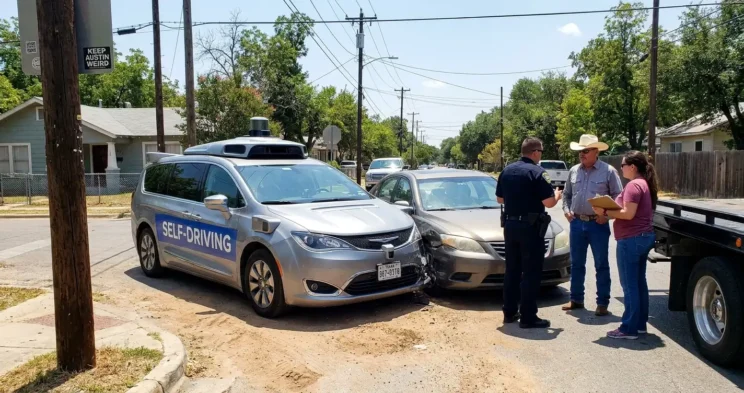
You were a passenger in a robotaxi heading down I-35 through Austin when another vehicle ran a red light and struck the side of your ride. Now you’re dealing with medical bills, missed work, and a confusing web of insurance companies. There’s no human driver to exchange information with. Multiple adjusters are calling. And you’re not sure which policy should actually cover your injuries.
Texas robotaxi crashes create unique insurance questions. Understanding how coverage works for these types of accidents can help you protect your personal injury claim and avoid costly mistakes when talking to insurers.
Texas Is an At-Fault State: What That Means for Robotaxis
Texas follows a “proportionate responsibility” (at-fault) system. This means the party that caused the car accident is financially responsible for the damages, and their insurance typically pays first. However, robotaxi accidents are rarely simple. Determining who pays depends on two distinct factors: Coverage (which policy responds and at what limits) and liability (who is at fault).
The Stack of Policies You May Obtain Coverage From
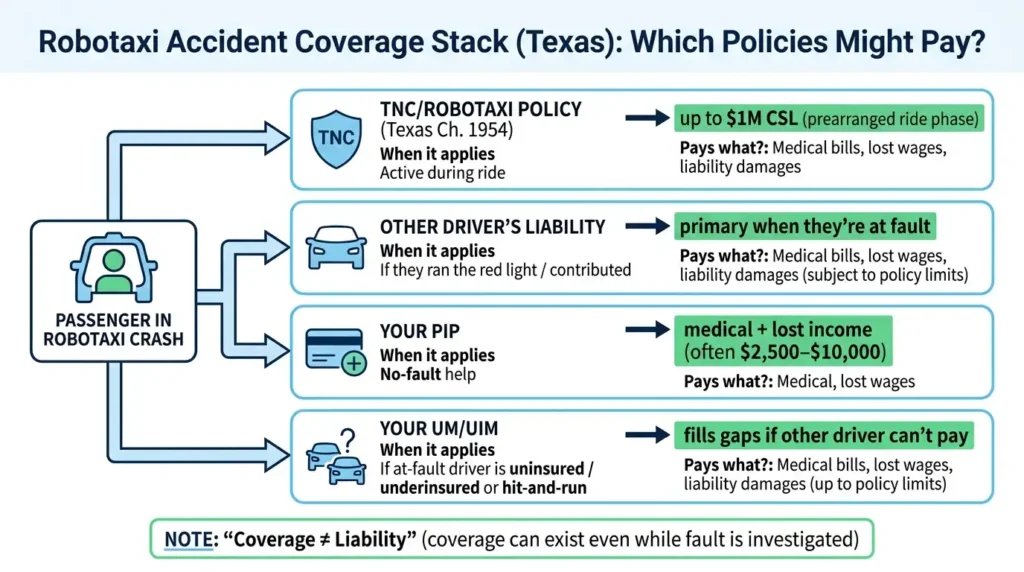
In a robotaxi crash, multiple insurance layers may be triggered simultaneously.
TNC Insurance
The robotaxi operator’s policy is governed by Texas Insurance Code Chapter 1954. Under the Autonomous Vehicles Regulatory Program, as of January 1, 2026, Texas law officially treats the Automated Driving System (ADS) as the “driver,” requiring these companies to carry the same TNC coverage as traditional rideshare vehicles. This ensures that a $1 million combined single limit is available to passengers from the moment a ride is accepted through drop-off.
Third-Party Liability
The insurance of another driver if they caused or contributed to the crash. If you were a robotaxi passenger and another driver caused the crash, that driver’s liability insurance is primary. Texas minimum liability limits ($50,000 per person / $100,000 per accident / $40,000 property damage) often fall short for serious injuries. According to the Texas Office of Public Insurance Counsel, these minimums may not cover extensive medical treatment, surgery, or long-term rehabilitation.
Personal Injury Protection (PIP)
PIP is your own first-party coverage that can pay certain medical expenses and lost income up to your policy limits, regardless of fault. This makes PIP valuable immediately after a robotaxi accident. Common PIP limits range from $2,500 to $10,000, though higher amounts are available. PIP can work alongside other coverage. It may pay your immediate bills while you pursue a larger liability claim against the at-fault party.
UM/UIM Coverage
Your own policy if the at-fault party is uninsured or their limits are too low. Uninsured motorist (UM) coverage applies when the at-fault driver has no insurance. This includes hit-and-run situations where the driver cannot be identified. Underinsured motorist (UIM) coverage applies when the at-fault driver’s limits are too low to cover your damages. Texas law requires insurers to offer UM/UIM coverage. Under Texas Insurance Code Chapter 1952, this coverage must be provided unless you rejected it in writing.
Navigating Shared & Complex Fault
While single-fault scenarios are straightforward, many collisions in Texas involve shared responsibility.
The following types and rules of liability may apply:
- The 51% Bar Rule: Under Texas law, you can recover damages as long as you are 50% or less at fault. If you are found 51% responsible, you are barred from recovery entirely.
- Shared Liability: If a robotaxi and another driver both contribute to an accident at a busy intersection like Lamar and 38th, you may be able to pursue claims against both liability policies.
- Non-Driver Liability: Because there is no human “driver” in a robotaxi, fault may extend to the vehicle owner, the software developer, or the maintenance provider.
Confirm the Crash Phase
The single most important factor in determining which robotaxi insurance applies is the ride’s status at the moment of impact.
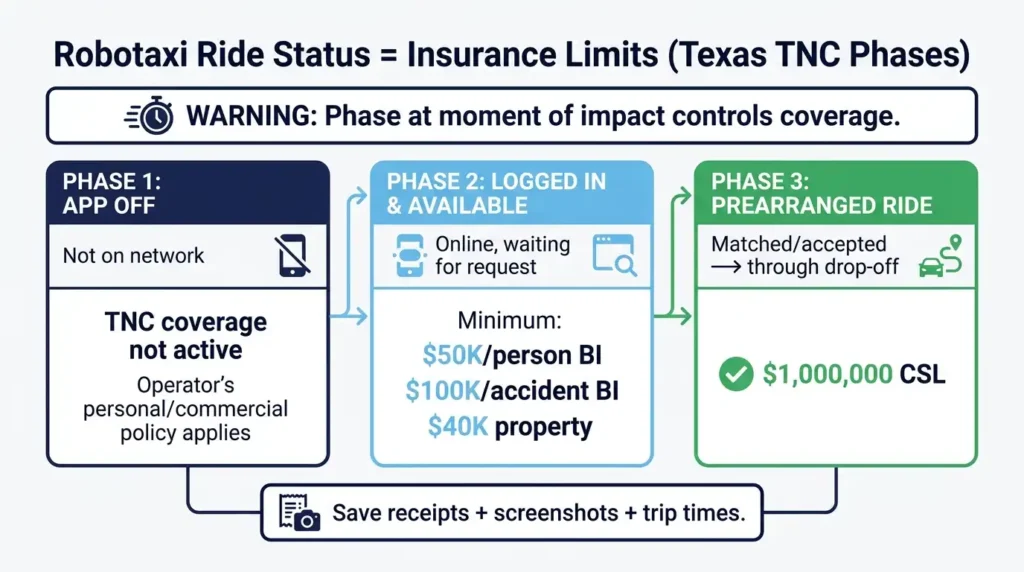
Texas TNC rules establish different coverage requirements based on these three phases:
- Phase 1: App Off. The robotaxi is not logged into the network. The operator’s commercial or personal policy applies. TNC coverage is not active.
- Phase 2: Logged In & Available. The vehicle is online and waiting for a ride request. Texas requires minimum coverage of $50,000 per person / $100,000 per accident for bodily injury and $40,000 for property damage during this phase.
- Phase 3: Prearranged Ride. From the moment a ride is matched or accepted through passenger drop-off. This phase triggers the higher coverage requirement of $1,000,000 combined single limit.
Timestamps matter. If you were injured during a prearranged ride on Loop 1 in Austin, the $1 million policy should apply. If the robotaxi was merely cruising and available near the Domain, lower limits may be in effect.
Post-Crash Checklist
When there’s no human driver, the post-crash process changes.
Here’s what you should do to protect yourself and your claim:
- Record the robotaxi’s license plate and vehicle identification numbers.
- Gather photos and video of all vehicles, damage, and the surrounding area.
- Collect contact information for any witnesses.
- Take screenshots of your ride status and trip confirmation.
- Report the incident to all relevant insurers.
- Seek medical evaluation even if injuries seem minor.
- Request the official crash report.
- Request trip status confirmation from the robotaxi company.
- Obtain any incident reference number from their support channel.
- Request an incident reference number.
Time-sensitive evidence disappears quickly. Nearby business cameras may overwrite footage within days. Request preservation immediately.
How to Communicate with Insurance Companies After a Robotaxi Crash
How you handle communication with insurance companies can significantly impact your claim. Adjusters are trained to minimize payouts, so it is important that you know how to communicate with them during this process.
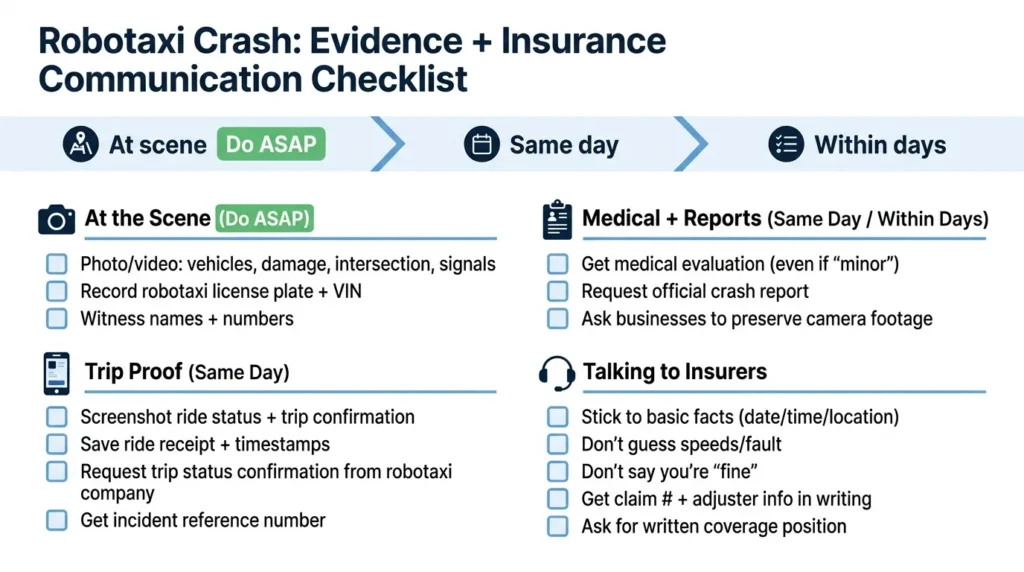
When speaking with adjusters, we recommend that you:
- Stick to basic facts regarding the date, time, location, and parties involved.
- Do not guess about fault or speeds.
- Do not minimize your injuries or say you’re “fine.”
- Request the claim numbers and the adjuster’s contact information in writing.
- Ask for written confirmation of coverage positions.
Consider consulting an attorney before providing recorded statements, especially when serious injuries are involved, multiple insurers are disputing coverage, or the ride phase is contested.
How We Can Help After a Texas Robotaxi Crash
Robotaxi accidents create insurance questions that didn’t exist a few years ago. Multiple policies, disputed coverage phases, and missing “driver” information complicate claims that would otherwise be straightforward.
At Angel Reyes & Associates, we’ve spent over 30 years helping injured Texans navigate complex insurance situations, including rideshare accidents. We offer free consultations and work on a contingency basis. Our team has helped clients recover more than $1 billion in compensation.
We serve the entire state of Texas with 16 locations and can handle most of your case remotely. If you’ve been injured in a robotaxi crash in Dallas, Fort Worth, Austin, or anywhere in Texas, contact us today to discuss your options.
Witness Statement FAQs
Can a robotaxi passenger use their own health insurance after a crash?
Yes. Health insurance may help cover treatment, but it does not replace an injury claim, and your plan may later seek reimbursement from any settlement, depending on the policy and the facts.
What if the robotaxi company says the vehicle was not in an active ride when the crash happened?
That dispute often turns on electronic records like app screenshots, ride receipts, dispatch logs, and trip timestamps, so keeping your own copies of evidence is very important.
Does Texas law require me to have PIP or UM/UIM on my own auto policy?
Texas insurers generally must offer both PIP and UM/UIM, but you can reject either in writing, so the best way to know if you have them is to check your declarations page.
Can a hit-and-run crash involving a robotaxi trigger UM coverage in Texas?
It can, if the facts meet your policy’s requirements and the at-fault vehicle cannot be identified or has no insurance. Prompt reporting and good documentation usually matter in these claims.
About the Authors

Angel Reyes
Writer
Angel L. Reyes, III is the Founder and Managing Partner of Angel Reyes & Associates. A nationally recognized trial attorney and business leader, Angel has helped over 55,000 injury victims recover more than $1 billion since founding the firm in 1993. Named to the Texas Super Lawyers list annually since 2008, Angel brings Wall Street experience, Ivy League education, and a deep commitment to client advocacy. He is a frequent legal commentator and published author with extensive contributions to legal scholarship, trial strategy, and consumer protection.

Kyle Nicolas
Editor
Kyle Nicolas is the Web Content & SEO Manager at Angel Reyes & Associates. He has more than 10 years of experience as a marketing co...

Angel Reyes
Reviewer
Angel L. Reyes, III is the Founder and Managing Partner of Angel Reyes & Associates. A nationally recognized trial attorney and business...