How Insurance Companies Use Witness Statements in Texas


Every article on this site is researched by our internal team, reviewed for legal accuracy against current Texas law, and held to State Bar of Texas advertising standards before publication. We do not publish content that overstates outcomes or makes promises about results.
Learn more about our
editorial standards .
Key Takeaways
- Keep conversations with the other driver’s insurer short and push for written questions instead of recorded statements.
- Capture independent witness contact details and a brief written account within 24 to 72 hours.
- Preserve texts, photos, and video leads in one claim folder so your evidence stays usable later.

How Insurance Companies Use Witness Statements in Texas
If you’re involved in a crash on I-35, you can be certain that any insurance companies involved will try to develop and lock in a story early. One way they do that is by pushing for recorded statements and comparing them to evidence like photos, vehicle damage, and witness accounts.
Witnesses are a crucial part of any claim, just the same way they’re crucial for any matter of justice. While a witness could add further legitimacy to your statement, a witness who says the wrong thing or says something that could be twisted and used against you could give an insurer a way to escape liability.
Recorded Statements & Your Options
As someone involved in the accident, you are a witness to the event! Both your own insurer and any other insurance companies involved will likely ask for a recorded statement.
If the other driver’s insurance company asks first, treat it like a negotiation, not a requirement. In many Texas third-party claims, you can decline a recorded interview and still pursue the claim.
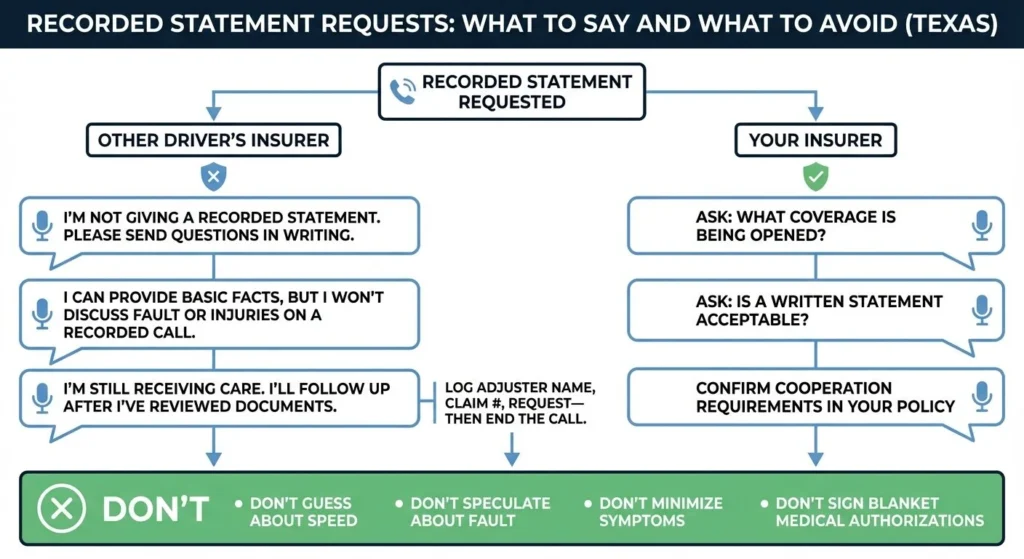
Use one of these responses to control the conversation:
- “I’m not giving a recorded statement. Please send questions in writing.”
- “I will report basic facts, but I won’t discuss fault or injuries on a recorded call.”
- “I’m still receiving medical care. I’ll follow up after I’ve reviewed the documents.”
Write down the adjuster’s name, company, claim number, and what they asked for. Then stop the call. A short log helps later if the story shifts or deadlines get disputed.
Your own insurance company is different. Your policy may require cooperation, and that can include a statement. If you are unsure, ask your insurer what coverage is being opened and whether a written statement is acceptable.
Witness Statements That Actually Help
Insurance companies tend to weigh independent witnesses more heavily than drivers or passengers. A clean witness statement can also reduce blame shifting if fault is contested.
A useful witness statement usually includes:
- Where the witness was located and what direction they were facing
- What the witness saw first, including the lane, signal, or right of way
- What the witness saw at impact, including which vehicle struck which part
- What happened immediately after, including any unsafe driving or admissions
If a witness did not see a key detail, leave it out. “I didn’t see the light” is better than guessing.
At-Scene Witness Capture
When you can do it safely, find witnesses before traffic clears and people leave. Look for drivers who stopped, pedestrians, nearby employees, or residents who came outside.
Ask in a neutral way so the statement does not look coached. Say, “Can you tell me what you saw?” Then let them speak.
Collect these basics from each witness so you can follow up:
- Full name
- Phone number and email
- Best time to reach them
- Where they were standing or sitting when they observed the crash
After you collect contact details, get a short statement while the memory is fresh. A text message or note is often enough if it is in the witness’s own words.
Written Statements, Texts & Recordings
A short, written statement is often safer than a long recorded interview. It keeps the witness focused on what they actually observed and reduces filler that can be misinterpreted.
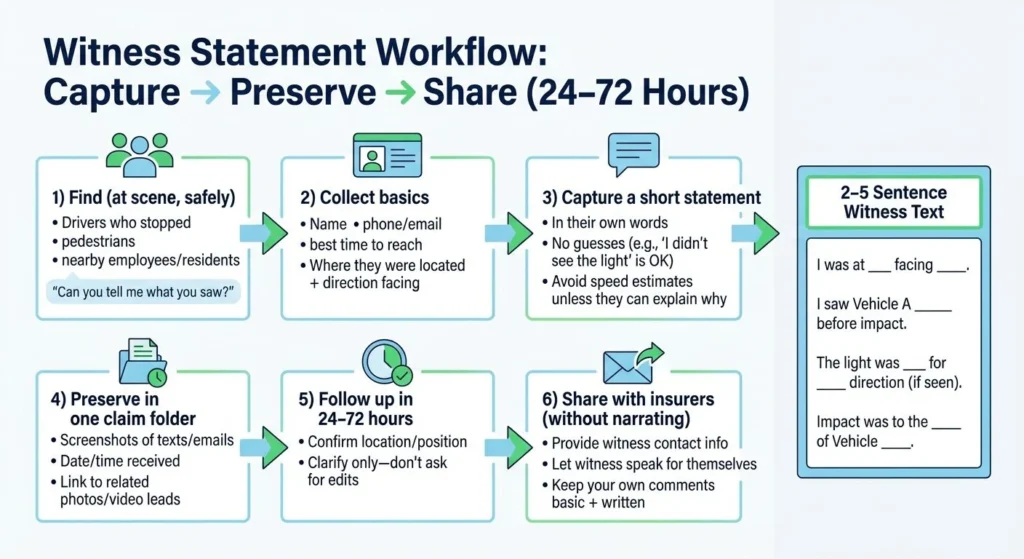
If the witness agrees, ask them to include these items in two to five sentences:
- “I was at (location) and saw (vehicle A) do (action) before impact.”
- “The light was (color) for (direction) when (vehicle) entered.”
- “I saw the point of impact on (front/rear/side) of (vehicle).”
If the witness prefers audio, get clear permission before recording. Do not ask them to estimate speed unless they can explain why their estimate is reliable.
Preserving Statements, Video & Other Proof
Gathering a witness’s name is not enough. You need to preserve the information in a way you can use weeks later.
Use one folder for the claim and save:
- Screenshots of texts and emails from witnesses
- Photos of the scene, damage, skid marks, and signs
- The date and time you received each witness statement
- A call log of insurer contacts and what was requested
Follow up within 24 to 72 hours with a simple confirmation message. Ask only for clarification, not edits. If something is unclear, ask, “Can you confirm where you were standing when you saw the impact?”
Also track video sources right away. Many systems overwrite footage quickly. Write down the address and the business name for any location that might have a camera, then request preservation as soon as possible.
Sharing Witness Info with Insurers
You can provide witness contact information without narrating the witness’s story for them. Give names and numbers, then let the witness speak for themselves.
When the other driver’s insurer asks what the witness will say, use this approach:
- Provide the witness’s identity and contact details
- Provide your photos and repair estimate if requested
- Decline to speculate about fault, speed, or injuries
- Ask for all settlement terms in writing before you agree to anything
Be careful with quick releases. A release can limit future medical claims even if symptoms worsen later. Read every line and ask questions before signing.
If You Already Gave a Recorded Statement
A recorded statement is not automatically fatal. The risk is making it worse with follow-up calls.
Do these steps immediately:
- Write down what you remember saying, including any uncertain answers
- Request a copy of the recording or a transcript if available
- Stop additional recorded conversations until you review what exists
- Preserve witness statements and video that confirm the actual sequence of events
If you need to correct a clear mistake, keep it factual and narrow. Do not invent explanations to fill gaps.
Crash Reports & Complaint Options
If you need the official crash report, start with the report number and the responding agency. Texas reports are commonly requested through the state system. Use the TxDOT crash reports & records page to find the current request process.
If an insurer tells you something is “required” and you believe it is misleading, document it and consider escalating. You can review complaint steps through the Texas Department of Insurance auto insurance complaint page.
Getting Your File Claim-Ready
Build your claim file so it stands up even if fault is disputed.
Use this order:
- Witness list with contact details and where each witness stood
- Witness texts, emails, or written notes saved as screenshots or PDFs
- Scene photos, vehicle photos, and repair estimates
- Medical visit dates, diagnoses, and mileage logs for appointments
- A communications log with every insurer call, email, and letter
A clean file reduces delays and limits openings for blame shifting.
If an insurer is pressuring you for a recorded statement, focus on control and documentation. Gather independent witness statements quickly, preserve video leads, and keep your communications short and written when possible.
For help organizing a Texas injury claim and handling insurer communications, contact Angel Reyes & Associates to schedule a free consultation. We have over 30 years of experience handling injury cases across Texas, and have successfully recovered more than $1 billion for our clients. Past results do not guarantee future outcomes.
Witness Statement FAQs
Can I decline a recorded statement and still send witness information?
Often yes. You can provide witness names and contact details while keeping your own comments limited to basic facts and written responses.
What is the fastest way to get a usable witness statement after a crash?
Get a short text or note within 24 hours that states where the witness was and what they directly observed, without guesses about speed or fault.
Should I ask a witness to talk to the other driver’s insurance company?
You can ask, but keep it low-pressure. Many witnesses will only confirm facts once, so preserve a written statement first.
What should I do if the insurer offers a quick settlement before witnesses respond?
Ask for the offer and release terms in writing and review them carefully. Do not sign a release until you understand how it affects future medical treatment.
Where can I escalate if I think an insurer is misrepresenting what I must do?
Save the call details and written communications, then review the complaint process through the Texas Department of Insurance for auto claims.
About the Authors

Angel Reyes
Writer
Angel L. Reyes, III is the Founder and Managing Partner of Angel Reyes & Associates. A nationally recognized trial attorney and business leader, Angel has helped over 70,000 injury victims recover more than $1 billion since founding the firm in 1993. Named to the Texas Super Lawyers list annually since 2008, Angel brings Wall Street experience, Ivy League education, and a deep commitment to client advocacy. He is a frequent legal commentator and published author with extensive contributions to legal scholarship, trial strategy, and consumer protection.

Graham Griffin
Editor
Graham Griffin is the Web & Content Manager at Angel Reyes & Associates, where he oversees content strategy, AI-powered workflows, a...

Spencer Browne
Reviewer
Spencer Browne is a partner at Angel Reyes & Associates and a Board Certified personal injury trial lawyer with nearly 100 jury trials a...