How Accident Photos Influence Insurance Decisions in Texas


Every article on this site is researched by our internal team, reviewed for legal accuracy against current Texas law, and held to State Bar of Texas advertising standards before publication. We do not publish content that overstates outcomes or makes promises about results.
Learn more about our
editorial standards .
Key Takeaways
- Take wide scene photos first to support liability decisions, then layer in vehicle angles, close-ups, and identifiers.
- Document injuries with a day-one baseline and consistent progression photos that align with medical paperwork.
- Preserve originals, back up twice, and share a clean, indexed set so you can prove exactly what was sent.
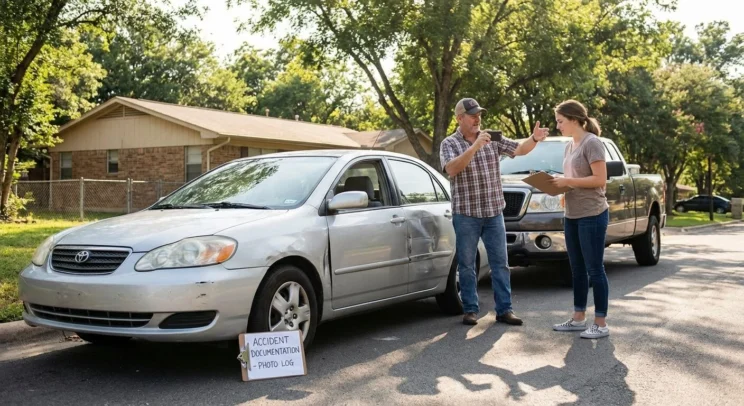
How Accident Photos Influence Insurance Decisions in Texas
Insurance adjusters make a series of decisions fast, and photos can influence those decisions when they clearly answer liability, damage causation, severity, and timeline. The old saying “a picture is worth a thousand words” holds very true when it comes to presenting evidence that establishes a narrative and potentially helps you achieve a better outcome for your case.
Fault & Liability Decisions
Photos help an insurer decide how much fault to assign and how confident they feel defending that position. Adjusters look for whether the damage matches the impact story and whether the claimed cost to fix that damage is supported.
Texas uses comparative fault principles, so partial responsibility allegations can reduce a payment or shift negotiations. Scene photos reduce “your word versus theirs” disputes. If fault is disputed, injuries are more than minor, or the insurer is minimizing damage, a structured photo set can support a clearer liability and damages position.
Photos to Take to Build Your Case
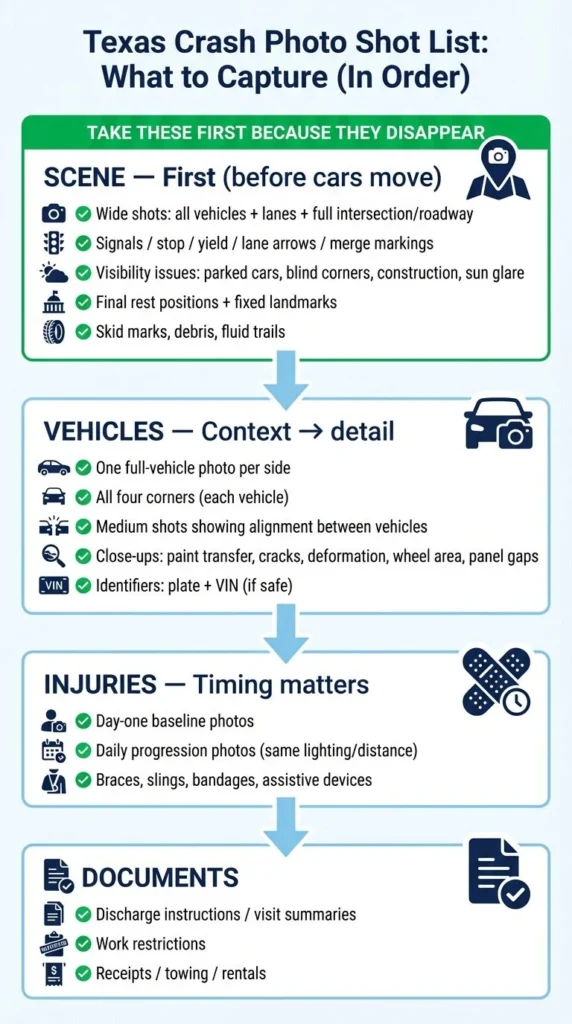
Photos on the Scene
If you are okay, uninjured, and able to do so, taking pictures of as much of the accident scene as possible is an invaluable start to your case. Get photographs of damage to both vehicles, road design, and any other factors that may have played a role in the accident.
Take these shots first because they disappear as traffic moves and vehicles get towed:
- Wide shots showing every vehicle, lane line, and the full intersection or roadway.
- Traffic controls and right-of-way clues like signals, stop signs, yield signs, lane arrows, and merge markings.
- Visibility issues like parked vehicles, blind corners, construction barrels, and sun glare from the driver’s approach.
- Final rest positions with fixed landmarks so distance and direction can be evaluated later.
Close-Up Shots
Use this sequence so your close-ups are tied to context:
- One full-vehicle photo per side, then all four corners for each vehicle.
- Medium shots that show impact alignment between vehicles.
- Close-ups of paint transfer, cracked lenses, bumper deformation, wheel area damage, and panel gaps.
If you can, ask the body shop inspecting your vehicle to take photos of any hidden damage, like frame warping or other compromised structural integrity, after teardown. Hidden damage photos and a written supplement request often drive whether the insurer expands the estimate.
Injury Documentation
Injury photos influence how an insurer evaluates timing and consistency, especially when visible symptoms develop after day one.
Use a repeatable method:
- Take day-one baseline photos, even if marks look minor.
- Take daily photos for several days. Using similar lighting and distance to show if bruising or other injuries darken or worsen.
- Document braces, slings, bandages, or assistive devices as you need them during treatment.
- Take legible photos of discharge instructions, work restrictions, and visit summaries that match the timeline. (Use a scanner to make digital copies if you have one.)
Avoid using filters and “enhance” tools when photographing your injuries. Changes to color and contrast can create avoidable credibility arguments.
Preserve Originals, Metadata & a Clean Sharing Record
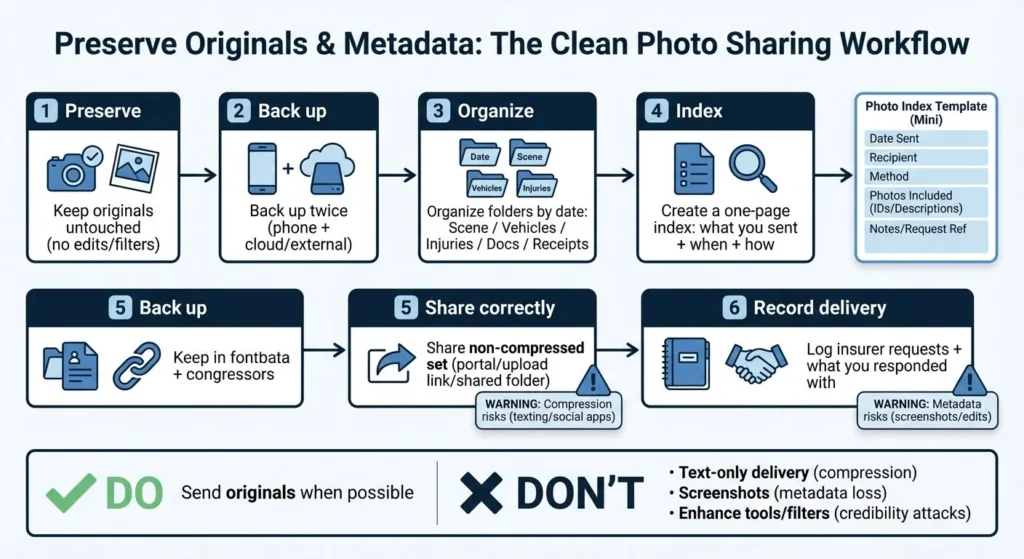
Good photos lose value when the file trail gets messy. Use these handling rules:
- Keep original files untouched. Work from copies when you share.
- Back up your photos in two places, such as phone storage plus cloud storage.
- Organize by date with folders like Scene, Vehicles, Injuries, Documents, Receipts.
- Keep a one-page index of what you sent, when you sent it, and how you sent it.
- Do not remove metadata from any photos; this compromises a photo’s credibility, especially the age of AI-generated images.
Texting often compresses images. If you already texted photos, follow up with a non-compressed set through the insurer’s portal or a shared folder.
When the Claim Stalls: Two Practical Escalation Tools
Even with photo evidence supporting your claim, insurance companies can still stall or refuse to take responsibility. In these cases, you can take a few steps to push them forward.
If you need the Texas Peace Officer’s Crash Report (CR-3), TxDOT provides an online crash report purchase portal you can use to locate and buy a copy.
If communication breaks down or you believe the insurer is mishandling the claim, the Texas Department of Insurance has instructions on how to file an insurance complaint and what information to include.
It is also a good idea to retain an attorney if your insurer is stalling. At Angel Reyes & Associates, we have over 30 years of experience helping injured Texans, and have helped more than 70,000 clients recover more than $1 billion in compensation. Use our contact form to request a free, no obligation consultation to learn more about your options.
Texas Crash Photo FAQs
Should I send every photo I took to the insurance adjuster?
Not necessarily. Send an organized set that tells the story without clutter and keep the full originals privately. If the insurer asks for more, you can provide targeted additions with a clear index.
What if I already sent compressed photos by text message?
Follow up with the highest-quality originals through the insurer’s upload link or portal if available. Keep a note showing which photos were sent by text and which were later re-sent in full quality.
Do screenshots reduce the value of my photos?
Often yes, because screenshots can strip metadata and reduce resolution. Share the original files when possible, or export them in a way that preserves full size.
What if my photos are on a friend’s phone, not mine?
Ask for the original files to be transferred directly, not re-saved through social apps that compress them. Save them into your own dated folder and record who took them and when.
Can I take photos after the vehicles were towed and still help the claim?
Yes, especially for conditions at the tow yard, additional damage, and any personal property losses. You still need scene context, so request the report number and preserve any remaining location photos.
About the Authors

Angel Reyes
Writer
Angel L. Reyes, III is the Founder and Managing Partner of Angel Reyes & Associates. A nationally recognized trial attorney and business leader, Angel has helped over 70,000 injury victims recover more than $1 billion since founding the firm in 1993. Named to the Texas Super Lawyers list annually since 2008, Angel brings Wall Street experience, Ivy League education, and a deep commitment to client advocacy. He is a frequent legal commentator and published author with extensive contributions to legal scholarship, trial strategy, and consumer protection.

Kyle Nicolas
Editor
Kyle Nicolas is the Web Content & SEO Manager at Angel Reyes & Associates. He has more than 10 years of experience as a marketing co...

Spencer Browne
Reviewer
Spencer Browne is a partner at Angel Reyes & Associates and a Board Certified personal injury trial lawyer with nearly 100 jury trials a...