



What Happens If You’re in an Accident with an Unoccupied Driverless Car?


Every article on this site is researched by our internal team, reviewed for legal accuracy against current Texas law, and held to State Bar of Texas advertising standards before publication. We do not publish content that overstates outcomes or makes promises about results.
Learn more about our
editorial standards .
Key Takeaways
- Texas law treats the automated driving system as the "operator," shifting liability focus to the business entity that deployed the vehicle.
- Multiple parties may be responsible in a driverless crash, including fleet operators, manufacturers, maintenance providers, and other drivers.
- Preserving digital evidence quickly is critical because AV data retention periods can be short, and access may require a formal legal process.
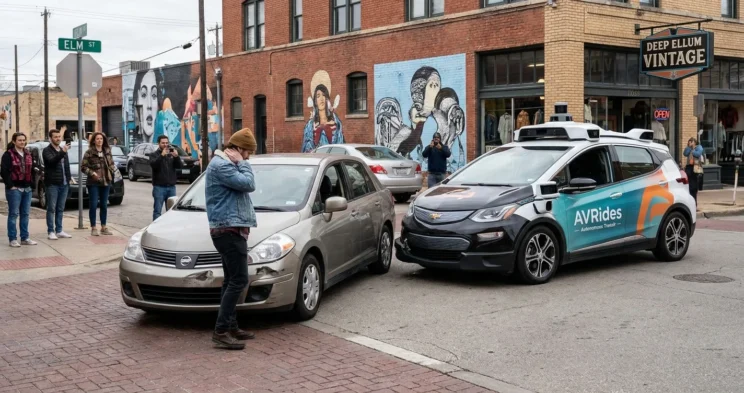
You were driving through Deep Ellum when a car with no one behind the wheel rolled through a stop sign and struck your vehicle. The robotaxi’s sensors and cameras kept recording, but no driver stepped out to exchange information. Now you’re dealing with injuries, vehicle damage, and a question that feels impossible to answer: who do you hold accountable when there’s no human driver?
Driverless vehicles are no longer a future concept in Dallas. Robotaxi services are expanding across the city, and Texas law has adapted to allow these vehicles to operate without anyone inside. That legal shift changes how crash claims work.
Understanding who may be responsible and how to protect your claim starts with knowing what makes these cases different.
Why Driverless Crashes Are Different in Texas
Texas law now explicitly allows “automated motor vehicles” to operate with the Automated Driving System (ADS) engaged, even when no human occupant is present. This means liability investigations often focus on the responsible business entity and system performance rather than driver error.
These claims typically involve multiple corporate defendants, several insurance policies, and technical evidence that doesn’t exist in traditional car accidents. The company that deployed the vehicle, the manufacturer of the automated system, and maintenance providers may all play a role. Identifying the right parties early shapes the entire personal injury claim.
Texas Law: Who Counts as the “Operator” When the Car Is Driving Itself?
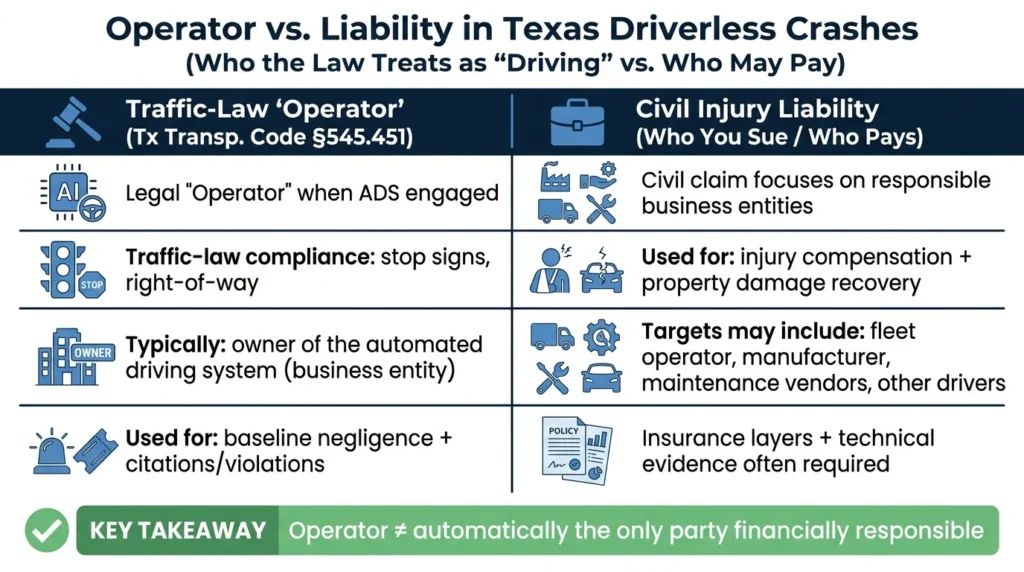
Texas Transportation Code § 545.451 (Subchapter J) addresses automated driving by designating the owner of the automated driving system as the legal “operator” for traffic law compliance. While the software is “licensed” to drive, a legal entity – typically a corporation – is responsible for ensuring the vehicle follows the rules of the road.
In plain terms, the law recognizes that when a vehicle’s automated system is engaged and controlling the car, that system bears responsibility for following traffic rules. This matters for citations, right-of-way determinations, and baseline negligence analysis.
However, the “operator” and “who pays in a civil injury claim” are related but not identical concepts. Your civil claim focuses on the business entity behind the vehicle, such as the authorization holder, fleet operator, owner, or manufacturer. This shift means investigators look first at the company that deployed the vehicle and any product or maintenance failures that contributed to the crash.
Who May Be Liable in a Texas Driverless Crash
Most no-occupant AV cases require looking beyond a “driver” and evaluating multiple parties who may share responsibility.
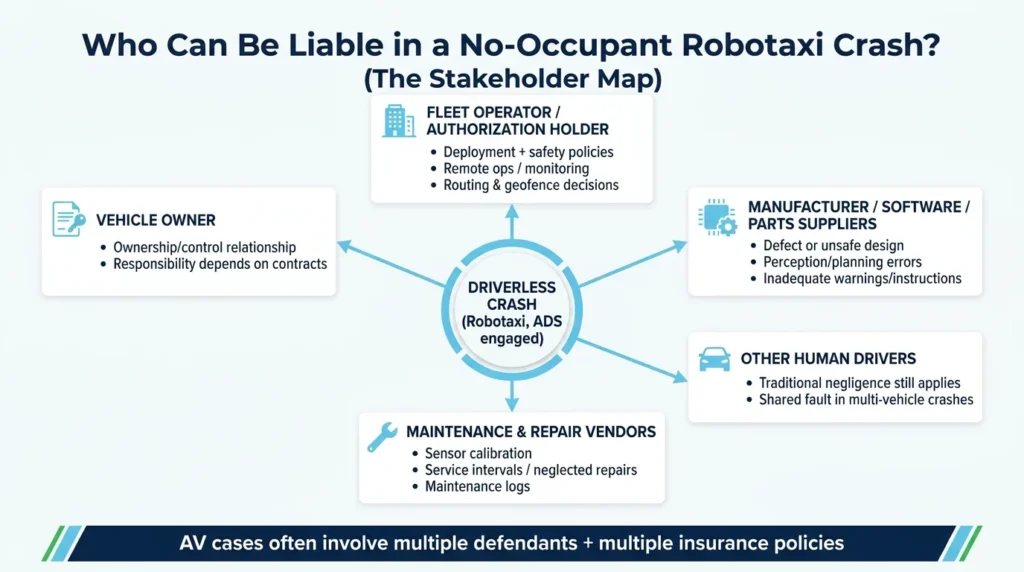
The following parties may be liable in a self-driving vehicle accident:
- Fleet operator or authorization holder: The entity responsible for deployment decisions, remote operations, and safety management practices. This is often the robotaxi company whose branding appears on the vehicle.
- Vehicle owner: If different from the operator, ownership theories may apply depending on the relationship between parties.
- Maintenance and repair vendors: Improper sensor calibration, neglected service, or faulty repairs can be pivotal. These failures may not be obvious without examining service records.
- Manufacturer, software developer, or parts suppliers: Product liability may be implicated if a defect or unsafe design contributed to the crash. This could involve the vehicle manufacturer, the company that developed the automated driving software, or suppliers of sensors and cameras.
- Other human drivers: AV involvement doesn’t rule out a conventional negligent driver causing the collision. Multi-vehicle crashes may involve shared fault among several parties.
How Fault Is Typically Argued
Liability theories often run in parallel, meaning your lawyer isn’t just picking one reason why you should win – they are pursuing multiple legal arguments at the same time. A strong claim plan evaluates all plausible paths early.
Potential liability arguments include:
- Negligence and operational failures include unsafe routing decisions, inadequate remote monitoring, poor weather or zone decision-making, and dispatch policies that put vehicles in situations they couldn’t handle safely.
- Product liability covers defective sensors, perception or planning errors in the software, and inadequate warnings or instructions to other road users.
- Maintenance failures involve service records, calibration logs, and prior incident history that may reveal patterns of neglect.
Similar principles apply in truck accident cases, where maintenance records and corporate policies often determine liability.
Insurance in Texas Self-Driving Vehicle Crashes
Insurance can be layered when a vehicle is commercially deployed. Multiple policies may apply, and determining which one is primary takes time.
Common coverage layers include:
- Commercial auto policies held by the fleet operator.
- General liability coverage for the operating company.
- Product liability policies from manufacturers.
- Personal auto coverage from any other involved drivers.
What victims often experience is “finger-pointing” between the software developer’s product liability insurance and the fleet operator’s commercial auto policy. Insurance companies are businesses with a goal of resolving claims for the lowest possible payout. Understanding their position helps you protect yours.
Evidence That Matters for Your Claim
Beyond standard crash evidence, AV cases may involve recordings and telemetry subject to specific access rules.
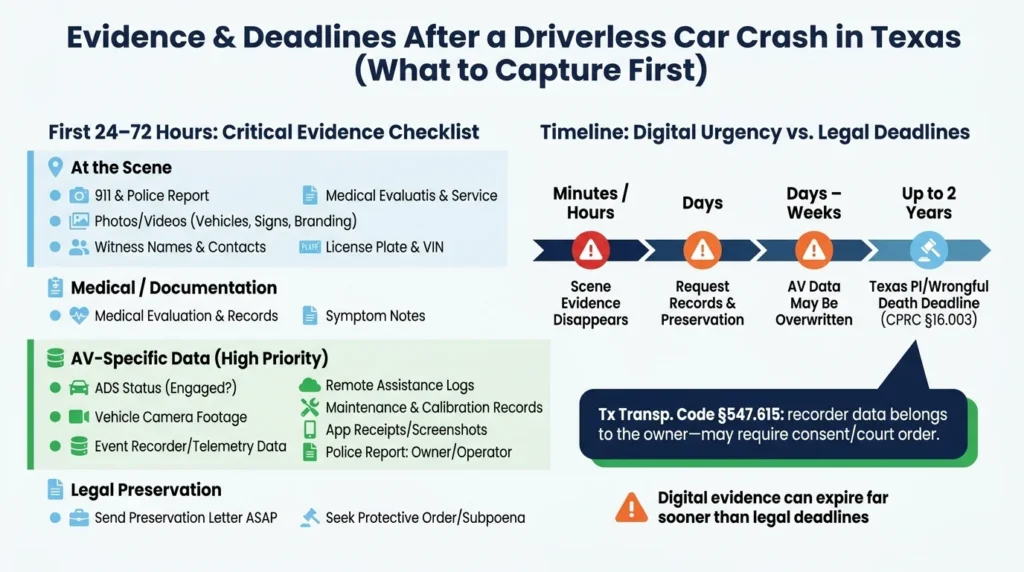
Texas Transportation Code § 547.615 is very specific: recording device data is the property of the vehicle owner. It generally cannot be retrieved by a third party without owner consent or a court order. This is why acting quickly is vital; your attorney may need to file for an emergency protective order or a subpoena to prevent this data from being overwritten or withheld.
Preservation letters and targeted requests should go out before data is overwritten. Digital evidence from automated vehicles may only be retained for limited periods.
It is important to collect the following evidence:
- 911 records and police reports
- Scene photos and videos
- Witness contact information
- Medical records documenting your injuries
- System status showing whether the automated driving system was engaged
- Event data from the vehicle’s recorders
- Camera footage from the vehicle’s sensors
- Remote assistance logs if a human monitor was involved
- Maintenance and certification records
- Vehicle branding and any visible company names
- License plate and VIN
- In-app disclosures if you were a passenger or used an app to summon the vehicle
- Police report fields listing the registered owner and operator
Deadlines for Texas AV Injury Claims
Even when liability is complex, Texas legal deadlines still apply. Delays can jeopardize both evidence and recovery.
Texas Civil Practice & Remedies Code § 16.003 provides a two-year deadline for personal injury and wrongful death claims. However, the “digital deadline” is much shorter. If you wait, the telemetry data that proves the system failed could be deleted by the company’s internal servers.
If a government entity is involved in your crash, different notice and deadline rules may apply. These situations require quick evaluation. Learn more about claims involving government entities.
When to Contact an Accident Attorney
Because no-occupant AV claims can involve layered insurance and technical proof, early legal guidance helps secure evidence and identify responsible parties.
Consider talking to an attorney if:
- You suffered serious injuries
- Fault is disputed or unclear
- A commercial robotaxi was involved
- You cannot identify which company operated the vehicle
- Data appears to be missing or withheld
What to bring to a consultation:
- Crash report number
- Photos and videos from the scene
- Witness list
- Medical records
- Letters from insurance companies
- App receipts or screenshots showing the trip
Angel Reyes & Associates has over 30 years of experience handling complex injury claims across Texas. We offer free initial consultations and work on a contingency basis, meaning we charge no fees unless we win.
Our team has recovered more than $1 billion for clients and can handle most of your case remotely. We have 16 locations across Texas and are available 24/7 to discuss your case. Contact us today to review your driverless car accident claim and learn how we can help protect your rights.
Unoccupied Self-Driving Car FAQs
Does it matter whether the self-driving car was carrying a passenger at the time of the crash?
It can. A passenger trip may create extra records like app receipts, trip logs, and platform data that can help show which company was involved and what the vehicle was doing.
Can a driverless car crash lead to both an insurance claim and a product liability claim?
Yes. Some cases involve both traditional insurance issues and separate claims that a vehicle part, sensor, or software system was defective.
Will there usually be a police report if a robotaxi crashes in Texas?
Often yes, if law enforcement responds, especially when there are injuries or significant damage. That report may help identify the vehicle, the registered owner, and basic crash details, but it may not fully explain why the automated system failed.
Can weather or road construction affect liability in a driverless car crash?
Potentially. Poor weather, faded lane markings, temporary construction patterns, or blocked signs can matter if the vehicle was operated in conditions it could not safely handle.
Are self-driving car crashes investigated by federal agencies?
Sometimes. Certain automated-driving crashes may also be reported to federal regulators, which can mean additional records or safety-related information exists beyond the usual local crash documents.
About the Authors

Spencer Browne
Writer
Spencer Browne is a partner at Angel Reyes & Associates and a Board Certified personal injury trial lawyer with nearly 100 jury trials across Texas. He focuses on car, truck, and wrongful death cases, with notable verdicts including a landmark win in the Choctaw Casino bus crash case. A recognized speaker and legal educator, Spencer is a member of the American Board of Trial Advocates and has been honored as a Texas Super Lawyer and one of D Magazine’s Best Lawyers in Dallas. He brings deep trial experience and relentless advocacy to every client he represents.

Kyle Nicolas
Editor
Kyle Nicolas is the Web Content & SEO Manager at Angel Reyes & Associates. He has more than 10 years of experience as a marketing co...

Angel Reyes
Reviewer
Angel L. Reyes, III is the Founder and Managing Partner of Angel Reyes & Associates. A nationally recognized trial attorney and business...