What to Do If a Waymo Vehicle Hits You as a Pedestrian


Every article on this site is researched by our internal team, reviewed for legal accuracy against current Texas law, and held to State Bar of Texas advertising standards before publication. We do not publish content that overstates outcomes or makes promises about results.
Learn more about our
editorial standards .
Key Takeaways
- Collecting evidence from a driverless vehicle requires documenting the vehicle itself, preserving digital trip records, and using Waymo's official reporting channels.
- Liability in a Waymo crash may involve multiple parties, and Texas proportionate responsibility rules mean your recovery depends on fault percentages assigned to each party involved.
- The statute of limitations for personal injury claims makes early action critical, as key evidence like surveillance footage and witness memories deteriorates quickly.
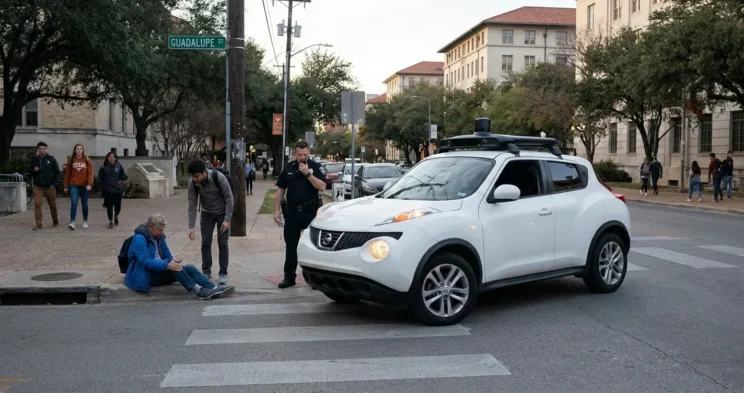
You were crossing Guadalupe Street near campus in Austin when a white sedan with spinning sensors on the roof rolled through the crosswalk and struck you. Now you’re standing on the sidewalk with a throbbing knee, watching the Waymo idle at the curb without a driver while bystanders gather.
You have questions. Who do you even talk to? Who pays for your medical bills?
Waymo crashes throughout Texas raise issues that traditional collisions don’t. The steps you take in the next few hours can make a significant difference in your ability to recover compensation.
Texas Legal Duties After a Collision
Texas law requires involved parties to take specific actions after any car accident.
Under Texas Transportation Code Chapter 550, you must:
- Stop at the scene (or as close as safely possible).
- Render reasonable assistance to anyone injured.
- Exchange information with other parties involved.
The severity of the crash affects reporting requirements. Crashes involving injury, death, or significant property damage typically require a police report. After you are done filing your report with an officer, ask for the incident or case number. You’ll need this for insurance claims and any legal action.
If you’re transported to the hospital before you can exchange information, document everything as soon as you’re physically able. Write down what you remember while the details are fresh.
What Information to Collect From a Waymo Vehicle
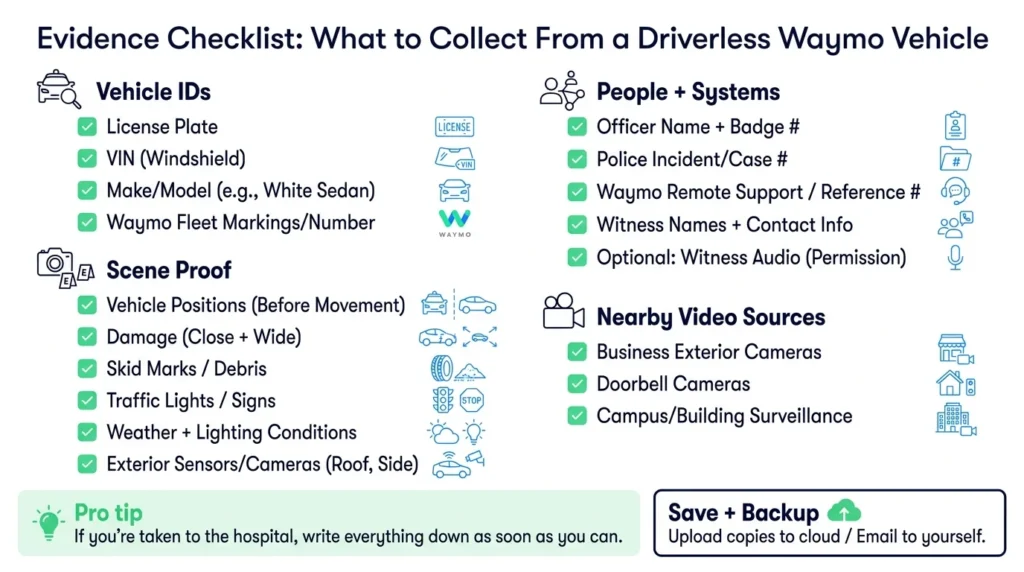
A Waymo vehicle won’t hand you an insurance card. You’ll need to gather information differently.
Take photos and videos to document vehicle identifiers, such as the license plate number, VIN (visible through the windshield), make and model, and any Waymo fleet markings or vehicle numbers.
Strong documentation protects your claim. Be sure to take photographs and videos of:
- Vehicle positions before anything moves.
- Damage to all vehicles (close-ups and wide shots).
- Skid marks, debris, and road conditions.
- Traffic signals, signs, and lane markings.
- Weather and lighting conditions.
- The Waymo vehicle’s exterior sensors and cameras.
If Waymo’s remote support team or a safety response representative arrives, get their contact information and any reference numbers they provide. Also record the responding officer’s name and badge number.
Witness information is critical. Get names and phone numbers immediately. People leave quickly, and memories fade. If a witness is willing, ask them to describe what they saw while you record audio on your phone.
Check for nearby surveillance. Businesses everywhere often have exterior cameras for their security. Doorbell cameras on residential streets may also capture accidents.
What If the Accident Happened While You Were a Passenger in a Waymo Car?
If you were a passenger in the Waymo ride, preserve your trip details immediately. Take screenshots of your Uber app showing the ride ID, pickup and dropoff locations, and timestamps. Waymo rides are currently booked through Uber, so your app history contains important documentation.
Do not attempt to disable, move, or tamper with the Waymo vehicle unless emergency responders direct you to do so for safety reasons. These vehicles have specific shutdown procedures that first responders are trained to handle.
Waymo-Specific Evidence You Should Gather
The sensors and cameras covering a Waymo vehicle record extensive data. Photograph the vehicle’s exterior sensor array. This helps identify the specific vehicle configuration and confirms what recording equipment was present.
If you have significant injuries, an attorney can send a preservation letter requiring relevant parties to retain evidence.
Medical Care & Documentation
Get evaluated the same day, even if you feel okay. Adrenaline masks pain. Symptoms from soft tissue injuries, concussions, and internal injuries often appear hours or days later.
Emergency rooms, urgent care clinics, and your primary care doctor can all create the initial medical record linking your injuries to the crash. Follow up with any referrals. Gaps in treatment raise questions during claims.
Keep copies of:
- Discharge papers and diagnosis codes
- Imaging results (X-rays, MRIs, CT scans)
- Referrals to specialists
- Work restriction notes
Avoid posting about the crash or your injuries on social media. Insurance adjusters review public profiles, and even innocent posts can be taken out of context.
Reporting the Crash to Waymo
Even if police responded, report the incident directly to Waymo through their official contact portal. This creates a record with the correct corporate entity.
Include the following details in your report:
- Date, time, and location of the crash
- Police incident or case number
- Whether you were a pedestrian, cyclist, driver, or passenger
- Photos, if you can attach them
Keep your report factual. Describe what happened without speculation about what the vehicle’s systems did or didn’t do.
Who Can Be Liable in a Waymo Crash
Self-driving vehicle crashes often involve multiple potentially responsible parties.
Depending on the facts, liability could fall on:
- Another human driver who caused or contributed to the crash.
- Waymo (as the vehicle operator).
- A safety driver (if one was present and operating the vehicle).
- A component manufacturer or software supplier.
- Other entities, depending on circumstances.
Claims may involve negligence theories (someone failed to act reasonably) or product-related theories (something was defective). The analysis depends heavily on what actually caused the crash.
Early evidence preservation matters because vehicle data, surveillance footage, and witness memories are all time-sensitive.
Confirm Whether the Vehicle Was in Autonomous Mode
This detail matters for liability. A Waymo vehicle can operate in full autonomous mode or be driven manually by a safety operator. The distinction affects who may be held responsible for the accident. Under the Texas Transportation Code, the legal “operator” shifts from the software to the human the moment the manual override is engaged.
In your personal injury claim, pinpointing the exact millisecond of this transition is vital, as it determines whether you are pursuing a traditional negligence case against a driver or a complex product liability claim against the manufacturer.
Insurance & Compensation
A Waymo crash may involve multiple insurance policies, including your own coverage, another driver’s insurance, and Waymo’s commercial fleet coverage. Sorting out which policies apply and in what order requires careful analysis.
Damages in Texas injury claims typically include:
- Medical expenses (past and future)
- Lost wages and reduced earning capacity
- Pain and suffering
- Property damage
- Out-of-pocket costs
Do not give a recorded statement to any insurance adjuster before understanding the implications. Don’t sign broad medical authorization forms that give insurers access to your entire health history. These requests benefit the insurance company, not you.
Key Deadlines to Be Aware Of
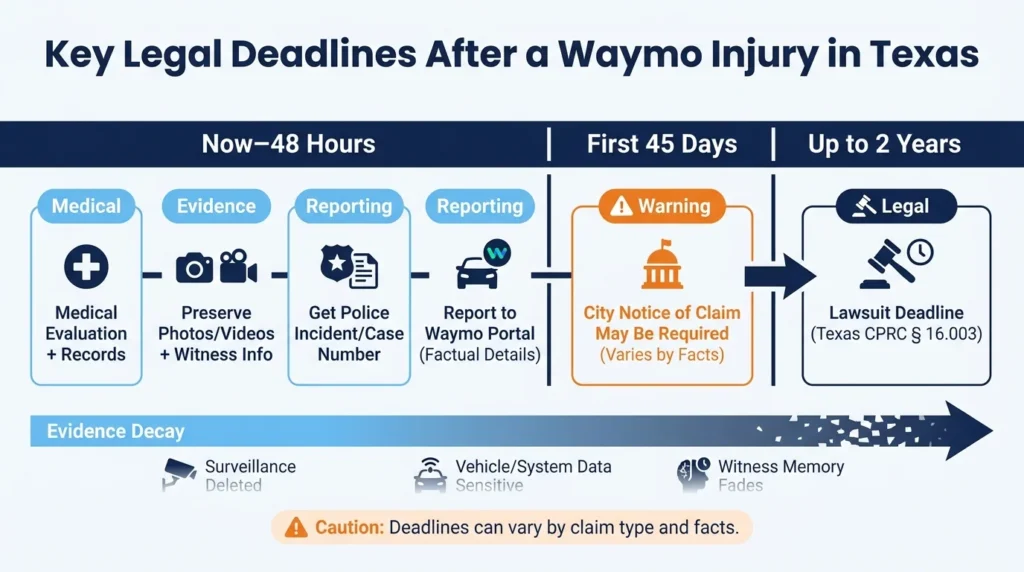
Under Texas Civil Practice and Remedies Code § 16.003, the state of Texas generally allows two years from the date of injury to file a personal injury lawsuit.
However, if a government entity (like an Austin Transportation Department vehicle or roadway defect) was even partially responsible for your Waymo accident, a formal Notice of Claim must be filed with the city within 45 days.
Missing these deadlines or waiting too long to file a claim can either prevent you from filing a claim or make proving your claim more difficult. Surveillance footage gets deleted. Witnesses move or forget details. Medical records become harder to connect to the crash.
Deadlines can vary based on claim type and specific facts.
When to Talk to a Lawyer
Getting legal advice early on helps you build a stronger claim and adhere to necessary deadlines.
Consider calling an attorney if:
- You have injuries requiring medical treatment.
- You went to the emergency room or urgent care.
- Fault is disputed or unclear.
- Multiple vehicles or parties were involved.
- You were a pedestrian or cyclist.
- Property damage is significant.
At Angel Reyes & Associates, we’ve spent over 30 years helping Texans injured in complex crashes. We offer free consultations and work on a contingency basis, meaning you pay no fees unless we win.
If a Waymo injured you anywhere in Texas, contact us today to discuss your options. We’re available 24/7 and serve clients across our more than 20 Texas locations. Se habla español.
Waymo Accident FAQs
What if the Waymo vehicle drove away after the crash?
Leave the scene only if you need emergency medical care or to get to safety, and try to record the vehicle’s plate, direction of travel, and any video or witness information right away. A police report becomes especially important if the other vehicle is gone before you can get identifying details.
Can a pedestrian or cyclist make a claim after being hit by a Waymo vehicle?
Yes, pedestrians and cyclists can pursue an injury claim if a Waymo vehicle or another party caused the crash. The same basic Texas fault rules apply, but evidence – like crosswalk signals, bike-lane markings, helmet or body-cam footage, and nearby surveillance – can be especially important.
Should I use my own car insurance if I was hit by a Waymo?
Sometimes yes, especially for quick access to benefits like MedPay, personal injury protection, collision coverage, or uninsured/underinsured motorist coverage if your policy includes them. Using your own coverage does not necessarily mean you were at fault, and your insurer may later seek repayment from the responsible party.
What if I was injured as a passenger inside a Waymo ride?
Save your ride receipt, trip ID, app screenshots, and any in-app messages, because those details can help identify the vehicle and the companies involved. Passenger claims may still involve questions about whether another driver, the Waymo operator, or multiple parties share responsibility.
Do Waymo vehicle crash cases usually take longer than regular car accident claims?
They can, because there may be more parties, more insurance carriers, and more technical evidence to sort through. Cases involving disputed vehicle data, system operation, or product-related issues often take more investigation than a typical two-car crash.
About the Authors

Angel Reyes
Writer
Angel L. Reyes, III is the Founder and Managing Partner of Angel Reyes & Associates. A nationally recognized trial attorney and business leader, Angel has helped over 70,000 injury victims recover more than $1 billion since founding the firm in 1993. Named to the Texas Super Lawyers list annually since 2008, Angel brings Wall Street experience, Ivy League education, and a deep commitment to client advocacy. He is a frequent legal commentator and published author with extensive contributions to legal scholarship, trial strategy, and consumer protection.

Kyle Nicolas
Editor
Kyle Nicolas is the Web Content & SEO Manager at Angel Reyes & Associates. He has more than 10 years of experience as a marketing co...

Angel Reyes
Reviewer
Angel L. Reyes, III is the Founder and Managing Partner of Angel Reyes & Associates. A nationally recognized trial attorney and business...