Cruise Robotaxis: The San Francisco Crash, The Shutdown Fallout, & What Texas Drivers Should Know


Every article on this site is researched by our internal team, reviewed for legal accuracy against current Texas law, and held to State Bar of Texas advertising standards before publication. We do not publish content that overstates outcomes or makes promises about results.
Learn more about our
editorial standards .
Key Takeaways
- California suspended Cruise's robotaxi permit after a pedestrian was struck and dragged, followed by federal scrutiny over incomplete crash reporting and GM's decision to stop funding the program entirely.
- Texas law treats the automated driving system as the "operator" when engaged, which creates unique liability questions that may involve fleet operators, car manufacturers, and software developers.
- Acting quickly to preserve AV data logs, video footage, and ride records is critical because retention windows are limited, and companies may not voluntarily disclose all relevant information.
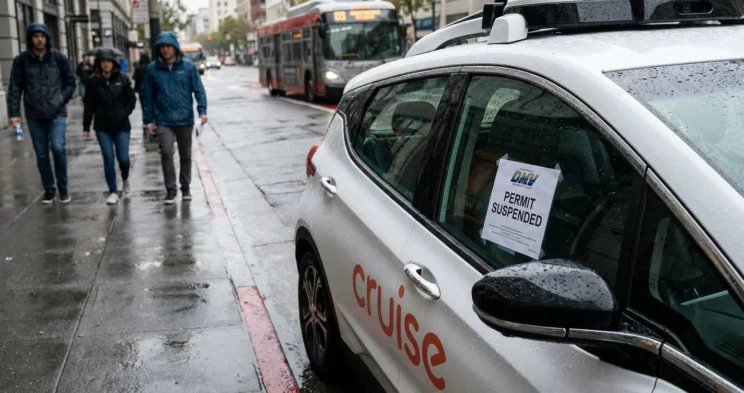
You’re scrolling through the news and see another headline about self-driving cars. Cruise, a self-driving taxi company owned by General Motors, had its permits suspended in California after a pedestrian was struck and dragged. Federal regulators got involved, and GM pulled the plug on funding entirely.
Now, you’re wondering: what does this mean for Texas? Could you end up in a crash with a robotaxi on I-10? And if you did, who would you hold responsible?
These are fair questions. Texas has its own rules for automated vehicles, and crashes involving them raise liability issues that don’t exist in typical collisions. The Cruise incident illustrates the safety concerns and claim complications you might face in a similar situation.
What Happened With Cruise’s Robotaxi Program
Cruise, a subsidiary of General Motors, operated driverless taxis in San Francisco. The program came to an abrupt halt in October 2023 after a serious pedestrian incident.
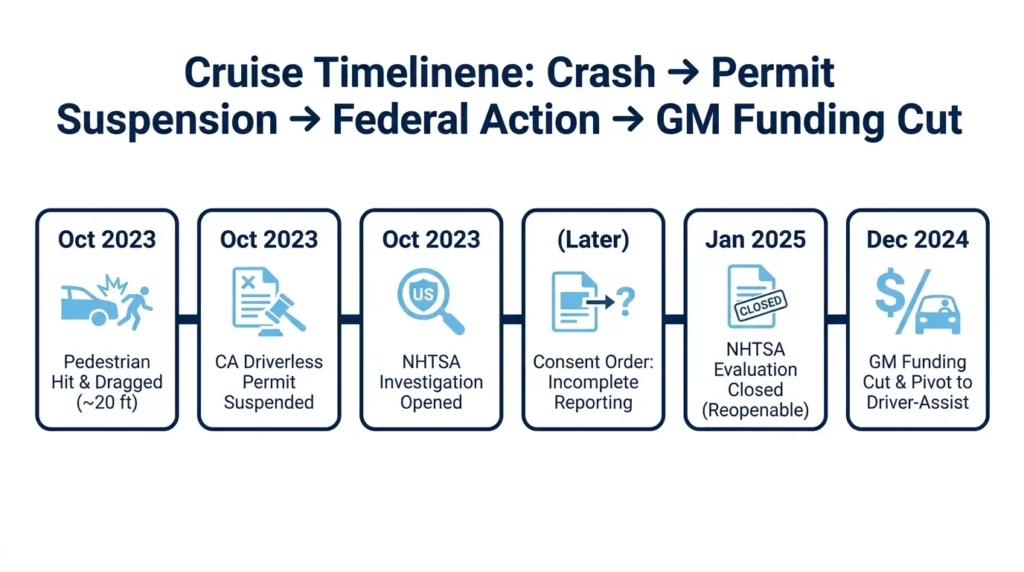
According to AP News reporting, California regulators suspended Cruise’s driverless vehicle deployment permit, citing an “unreasonable risk to public safety.” The suspension came after a pedestrian was struck by a hit-and-run driver, then hit again by a Cruise vehicle. The robotaxi’s automated system then dragged the pedestrian approximately 20 feet before stopping.
The National Highway Traffic Safety Administration later issued a consent order addressing Cruise’s failure to fully report crash details. The company had not initially disclosed the post-impact dragging to federal regulators. This incomplete report raised serious questions about transparency and oversight.
NHTSA opened a preliminary investigation in October 2023. According to AP coverage of the investigation’s closure, the agency ended its preliminary evaluation in January 2025 without further action, though it reserved the right to reopen the matter.
By December 2024, GM announced it would stop funding Cruise’s robotaxi efforts entirely. The company instead pivoted toward driver-assist technology for personal vehicles.
Why This Matters for Texas Drivers
You might think California’s regulatory actions won’t affect you here in Texas, but the Cruise incident reveals challenges that apply anywhere automated vehicles operate.
Texas permits automated driving systems under state law. Texas Transportation Code § 545.454 states that when an automated driving system (ADS) is engaged, the system itself is considered to be the “operator” of the vehicle. This creates a unique legal framework that differs from traditional crashes in which a human driver is clearly at fault.
If you’re driving down Bandera Road in San Antonio, and an automated vehicle causes a collision, the question of “who was driving?” becomes complicated. The answer affects everything from the police report to insurance claims and potential lawsuits.
The Cruise shutdown also demonstrates how quickly evidence can become unavailable. When companies restructure, pause operations, or change ownership, some records may not be available due to data retention policies. That’s why it’s critical to act quickly after any AV-involved crash.
Who Is Liable in a Self-Driving Car Accident?
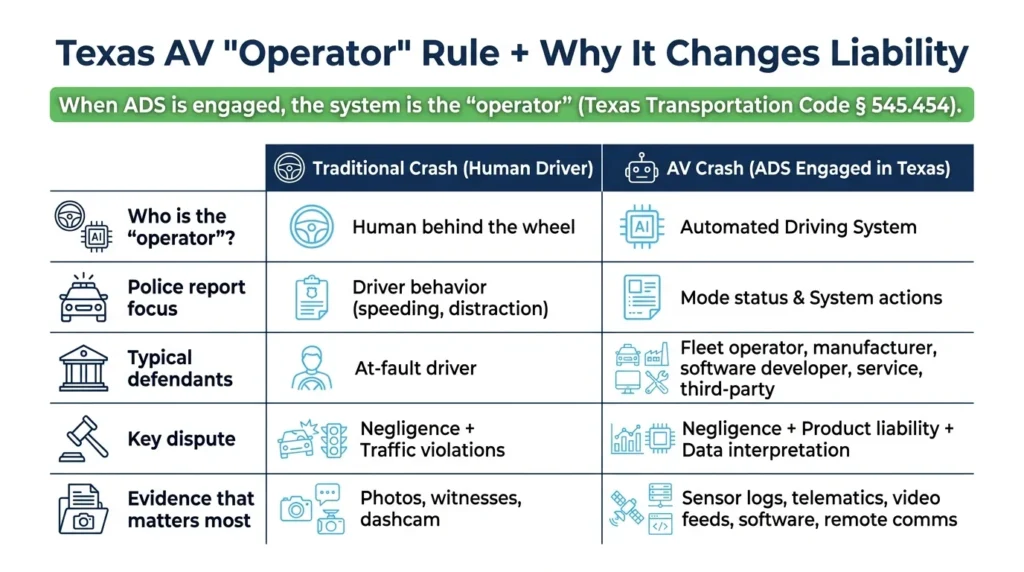
Determining fault after an automated vehicle crash often involves multiple potential defendants. Unlike a typical car accident where you’re dealing with one at-fault driver and their insurance company, AV crashes can implicate any or all of the following:
- The fleet operator or company that deployed the vehicle and maintained it for commercial use
- The vehicle manufacturer if a mechanical defect contributed to the crash
- The software developer if the ADS failed to perceive hazards, react appropriately, or make safe decisions
- A third-party driver if another human driver’s actions contributed to the collision
- Maintenance or service providers if improper repairs or upkeep played a role
Your claim might involve negligence theories, product liability arguments, or both. The specific facts of your claim will determine which parties are responsible.
If You Were a Robotaxi Passenger
Passengers in automated vehicles have a right to safe transportation. If you’re injured while riding in a robotaxi or AV, potential defendants include the fleet operator, any safety driver present, and possibly the car manufacturer or software company.
Key evidence includes your ride receipt, in-app communications, trip route data, and any interior or exterior video that the vehicle recorded. Don’t give recorded statements to insurance representatives before understanding your rights. Quick settlement offers rarely reflect the full value of serious injuries.
Document everything about your trip, including the pickup location, as well as any unusual vehicle behavior, error messages, or prompts you noticed. This “automation context” is key to establishing what the system was doing when things went wrong.
If You Were a Pedestrian or Cyclist
Pedestrians who are struck by automated vehicles face particularly serious injuries. The Cruise incident in San Francisco shows that what the AV detects and how fast it responds are critical.
If you’re hit while crossing Broadway Street in downtown San Antonio or walking through Montrose in Houston, make sure you document all of the following:
- Crosswalk signals and whether you had the right of way
- Lighting conditions and visibility
- The vehicle’s apparent speed before impact
- The point of impact on both your body and the vehicle
- Any witnesses and/or nearby security cameras
AV cases often hinge on what the vehicle’s sensors detected and how quickly the system responded. Braking data, perception logs, and post-crash behavior records can be critical. These records may be overwritten within days or weeks, so hiring a lawyer to quickly preserve evidence is paramount.
Texas follows a modified comparative fault system. If you’re found partially at fault, it can affect your recovery, but you shouldn’t assume you were at fault just because an insurance company suggests it.
If You Were Driving Another Vehicle
When the “other driver” is actually a company operating an automated system, the claims process looks different. In this case, you’re not exchanging information with another individual; you’re dealing with a corporate entity whose rapid-response teams and legal counsel are already involved.
At the scene, make sure you write down the police report number, photograph the vehicle’s VIN and any company markings, and identify the fleet operator’s contact information. Note whether the vehicle appeared to have a safety driver or if it was operating fully autonomously.
Common defenses in these cases include claims that you made an unexpected lane change, sensor limitations prevented detection, or your own distracted driving contributed to the crash. Dashcam footage, witness statements, and video footage from an intersection camera can counter these arguments.
These claims often resemble commercial truck accident cases more than typical car crashes. The opposing side will have more resources, more data, and more lawyers. Hiring experienced legal representation will help you level the playing field.
What to Do After an AV or Robotaxi Crash in Texas
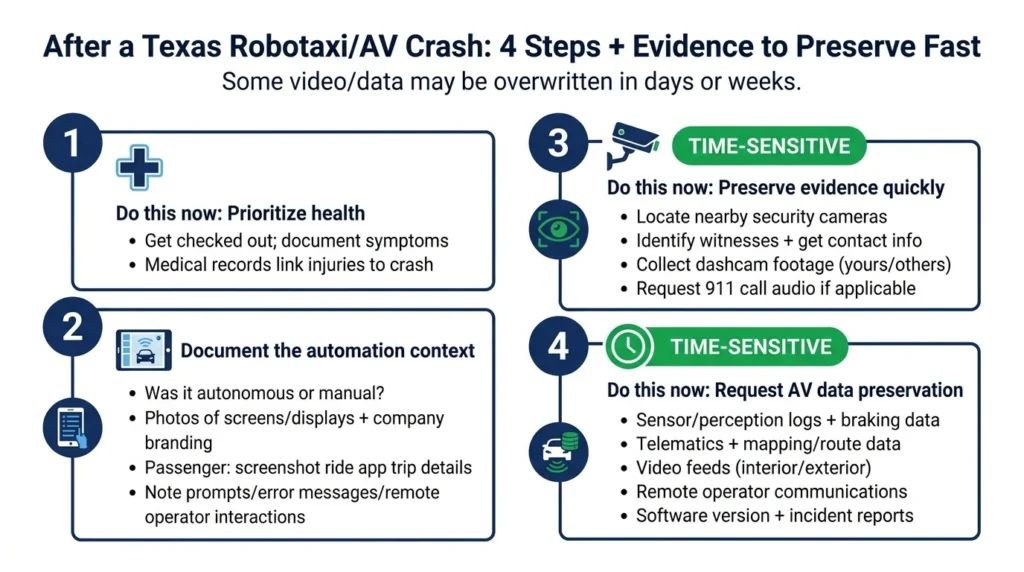
Like any other collision, you should take the following steps after an automated vehicle crash:
1. Prioritize your health. Get medical attention even if your injuries seem minor. Some symptoms may take hours or even days to appear. Prompt medical records will document the connection between the crash and your injuries. Review our guide on what to do after a car accident in Texas for more detailed instructions on this step.
2. Document the automation context. Note whether the vehicle appeared to be in autonomous mode. Take pictures of any screens, displays, or company branding. If you were a passenger, screenshot your ride app showing the trip details. Record any interactions with remote operators or in-vehicle prompts.
3. Preserve evidence quickly. Nearby businesses may have security cameras that captured the crash. Other drivers may have dashcam footage. If you called 911, request the audio recording of your call. Bear in mind that all this evidence can disappear within 48 to 72 hours if it is not immediately preserved.
4. Request data preservation. Automated vehicles generate extensive records, such as sensor logs, telematics data, video feeds, mapping information, remote operator communications, software version details, and incident reports. These records may be stored in proprietary formats with limited retention windows. An attorney can send preservation letters requiring the company to keep this evidence.
The consent order in the Cruise case highlighted how companies may not voluntarily disclose all relevant crash information. Don’t assume you’ll receive complete records without making formal requests.
Insurance & Compensation in AV Injury Claims
Money for your injuries and losses typically comes from several potential sources:
- The fleet operator’s liability policy covers vehicles used commercially. These policies often have higher limits than personal auto insurance.
- Another driver’s insurance applies if a human driver contributed to the crash.
- Your own UM/UIM coverage may apply if the at-fault party is uninsured or underinsured.
- Medical payments coverage on your own policy can help with immediate medical bills regardless of fault.
Recoverable damages generally include medical expenses, lost wages, pain and suffering, long-term impairment, and property damage. Serious injuries involving automated vehicles can result in substantial claims involving corporate defendants and higher insurance policy limits.
Common sticking points include disputed fault, causation arguments about whether the AV or another factor caused your injuries, and low initial offers that undervalue your claim. Multi-party negotiations add another layer of complexity.
Remember, insurance companies are businesses with a goal of resolving claims for the lowest possible payout. Hiring legal representation will help ensure that your interests are protected.
When to Contact a Texas Car Accident Lawyer
Automated vehicle crashes present unique challenges that require professional legal help. Consider reaching out if:
- You suffered serious injuries that require ongoing treatment
- The “operator” of the vehicle is unclear or involves a corporate fleet
- Video or data logs are missing or being withheld
- You’re receiving pressure for recorded statements or quick settlements
- Multiple parties may share fault
An attorney can send preservation letters immediately, coordinate requests for AV data and records, investigate fault across multiple potential defendants, and handle communications with insurance companies, so you can focus on recovery.
At Angel Reyes & Associates, we’ve spent over 30 years helping injured Texans recover more than $1 billion through a wide range of both straightforward and complex claims. We offer free consultations, and we work on contingency, meaning you pay no fee unless we win. Our team is available 24/7, and we can handle the majority of your case remotely.
If you’ve been injured in a crash involving an automated vehicle or robotaxi, or any other collision in Texas, contact us today to discuss your options.
Cruise Robotaxi FAQs
Do self-driving cars have to follow the same traffic laws as traditional vehicles in Texas?
Yes. Texas law generally allows automated vehicles to operate only if they comply with applicable traffic laws and are equipped with required systems (such as recording devices and minimum-risk maneuvers if the system fails).
Can a robotaxi crash involve a product liability claim, instead of just a car insurance claim?
Sometimes. If the facts suggest that the vehicle, sensors, software, or another component malfunctioned, the case may involve both a standard negligence claim and a product liability claim.
What if the company says the vehicle was in manual mode, not autonomous mode, when the crash happened?
This can become a key factual dispute, which is why it is crucial to preserve timing data, onboard logs, app records, and video footage. The answer may affect who is treated as the “operator,” and which parties could be responsible.
Will a government investigation decide who wins a Texas injury claim?
Not by itself. Regulatory actions and reports can be important evidence, but a civil injury claim still hinges on specific facts, available proof, and Texas law.
Can you still file a claim if another driver started the chain of events?
Possibly. Texas cases can involve shared fault, so more than one party may be responsible if multiple acts contributed to your injuries.
About the Authors

Angel Reyes
Writer
Angel L. Reyes, III is the Founder and Managing Partner of Angel Reyes & Associates. A nationally recognized trial attorney and business leader, Angel has helped over 70,000 injury victims recover more than $1 billion since founding the firm in 1993. Named to the Texas Super Lawyers list annually since 2008, Angel brings Wall Street experience, Ivy League education, and a deep commitment to client advocacy. He is a frequent legal commentator and published author with extensive contributions to legal scholarship, trial strategy, and consumer protection.

Kyle Nicolas
Editor
Kyle Nicolas is the Web Content & SEO Manager at Angel Reyes & Associates. He has more than 10 years of experience as a marketing co...

Angel Reyes
Reviewer
Angel L. Reyes, III is the Founder and Managing Partner of Angel Reyes & Associates. A nationally recognized trial attorney and business...