What Qualifies as a Personal Injury Case?


Every article on this site is researched by our internal team, reviewed for legal accuracy against current Texas law, and held to State Bar of Texas advertising standards before publication. We do not publish content that overstates outcomes or makes promises about results.
Learn more about our
editorial standards .
Key Takeaways
- A valid personal injury case usually requires duty, breach, causation, and damages.
- Texas personal injury claims can arise from accidents, defective products, or intentional harm.
- Early legal guidance can help preserve evidence and protect your right to compensation.

What Qualifies as a Personal Injury Case?
You’re trying to get your shopping done at your local grocery store, but you don’t see that someone has recently spilled their water bottle on the slick, polished floor you’re walking on. With no warning sign in sight, you step ahead, lose your footing, and fall straight backward, landing on your head.
Now you are hurt. Medical bills are coming in. You are missing work. You may be asking one simple question: Does this count as a personal injury case?
In Texas, a personal injury case usually begins when someone else’s negligence or intentional act causes you harm. If their actions led to your injury and you suffered measurable losses, you may have the right to seek compensation.
The Core Elements of a Personal Injury Case
A personal injury case must prove four legal elements under Texas law.
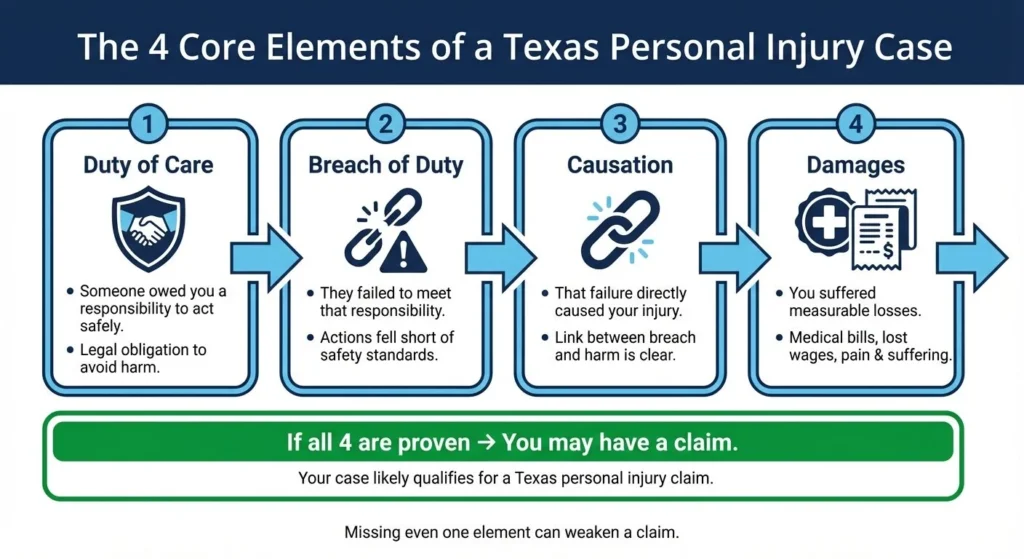
1. Duty of Care
A “duty of care” simply means that someone has an obligation to make sure others around them are safe. Drivers must follow traffic laws. Property owners must keep their homes or businesses reasonably safe. You must demonstrate that the property owner had this duty at the time of the accident.
2. Breach of Duty
You must be able to demonstrate that the person or business responsible for that duty of care failed to meet that duty. Running a red light, ignoring a spill in a store aisle, or failing to fix a faulty parking lot light fixture may qualify as a breach of this duty.
3. Causation
You must be able to show the breach of duty directly caused your injury. If a distracted driver crashes into your vehicle and you suffer a back injury, the connection between their negligence and your harm must be clear.
4. Damages
You must have suffered actual damages, or verifiable losses. Without damages, there is no personal injury claim, even if someone acted carelessly.
This can include:
- Medical expenses
- Lost wages
- Reduced earning capacity
- Physical pain
- Emotional distress
- Property damage
Common Types of Personal Injury Cases in Texas
Personal injury law covers a wide range of incidents across Texas, from Houston highways to construction sites in Fort Worth.
Here are some of the most common types of cases:
Vehicle Accidents
Car accidents, truck accidents, motorcycle accidents, and rideshare accidents frequently lead to injury claims. Claims can also arise from vehicles striking pedestrians.
Commercial truck accidents often involve additional parties, such as trucking companies or maintenance providers.
Texas drivers have a duty to operate their vehicles safely. When they speed, drive distracted, or fail to yield, serious injuries can result.
Slip & Fall Accidents
Property owners must maintain reasonably safe premises, free from hazards that might lead to someone slipping or tripping and falling.
If a store, apartment complex, or office building fails to address dangerous conditions and you are injured as a result of them, you may have the right to compensation.
Workplace & Construction Accidents
Workplace injuries can qualify as personal injury cases in certain situations. Construction accidents often involve heavy machinery, unsafe scaffolding, or falling objects.
If a third party, such as a subcontractor or equipment manufacturer, contributed to your injury, you may have a claim beyond normal workers’ compensation.
Defective Products
Manufacturers and sellers have a duty to provide safe products. If a defective vehicle part, unsafe appliance, or faulty medical device causes injury, the company may be held responsible under product liability law.
Dog Bites & Animal Attacks
Pet owners can be held liable if they fail to control a dangerous animal. Dog bites often lead to medical treatment, scarring, and emotional trauma, especially in children.
Assault & Battery
Not all personal injury cases involve negligence. If someone intentionally harms you, such as in an assault, you may have a separate civil personal injury claim for compensation in addition to any criminal charges filed against the perpetrator.
What Is a Personal Injury Claim?
A personal injury claim is the legal process used to pursue compensation. The injured person, called the plaintiff, seeks damages from the at-fault party, known as the defendant. The defendant can be:
- An individual
- A business
- A property owner
- A medical provider
- A manufacturer
Many claims are resolved through insurance negotiations. Others require filing a lawsuit in a Texas civil court.
Insurance companies are businesses. Adjusters are trained to close claims for as little as possible. Their goal is to protect company profits, not your long-term recovery. Understanding this dynamic is important before accepting any settlement offer.
What Types of Compensation Can You Recover?
Personal injury compensation generally falls into two categories: economic damages and non-economic damages.

Economic damages are financial losses with clear dollar amounts. They include:
- Medical bills
- Future medical treatment
- Lost wages
- Loss of future earning ability
- Property damage
Non-economic damages are designed to compensate for losses that do not have a readily assigned value or a purchase receipt. They may include:
- Physical pain
- Emotional distress
- Mental anguish
- Loss of enjoyment of life
While these damages do not have fixed price tags, they are still legally recognized under Texas law.
When Should You Speak with a Lawyer?
You should consider speaking with an attorney as soon as possible after an injury. Evidence can disappear quickly, witness memories fade, and insurance companies may request recorded statements that can later be used against you.
An experienced personal injury lawyer works to:
- Investigate the accident
- Gather medical records and evidence
- Calculate the full value of your damages
- Negotiate with insurers
- File a lawsuit if necessary
The goal is to protect your rights while you focus on healing.
Do All Injuries Qualify?
Not every accident leads to a valid personal injury case. If no one else was at fault, or if you did not suffer measurable damages, you may not have a claim.
However, many people underestimate the strength of their case. Even injuries that seem minor at first can lead to long-term complications and financial strain. A proper legal evaluation can help clarify your options.
Taking the Next Step
If you were injured because someone else failed to act responsibly, you deserve clear answers and practical guidance. Understanding what qualifies as a personal injury case is the first step toward protecting your financial future.
For over 30 years, Angel Reyes & Associates has served injured Texans by guiding them through the legal process with clarity and focus. If you are ready to understand your rights and explore your options, contact our team today to schedule a free case review.
Personal Injury Case FAQs
How long do you have to file a personal injury lawsuit in Texas?
Under Texas law, most personal injury lawsuits must be filed within two years of the date the claim accrues. Missing that deadline can bar recovery, although limited exceptions may apply in cases involving minors or legal disability.
Can you still recover compensation in Texas if you were partly at fault for the accident?
Yes, Texas follows a modified comparative fault rule, so you can usually still recover damages if you were not more than 50% responsible. Any recovery is reduced by your percentage of fault.
What evidence is most helpful in proving a Texas personal injury case?
Strong cases often rely on medical records, accident reports, photographs, witness statements, video footage, and proof of lost income. In a slip-and-fall case, evidence showing the owner knew or should have known about the hazard can be especially important.
Does a pre-existing condition prevent you from bringing a personal injury claim?
Not necessarily. If an accident made an existing condition worse, you may still have a valid claim for the additional harm caused by the incident.
What happens if your injuries seem minor at first but get worse later?
That can still support a personal injury case because some injuries, including head, neck, and soft-tissue injuries, become more noticeable over time. Prompt medical evaluation and consistent follow-up care can make the link between the accident and your symptoms easier to prove.
About the Authors

Angel Reyes
Writer
Angel L. Reyes, III is the Founder and Managing Partner of Angel Reyes & Associates. A nationally recognized trial attorney and business leader, Angel has helped over 70,000 injury victims recover more than $1 billion since founding the firm in 1993. Named to the Texas Super Lawyers list annually since 2008, Angel brings Wall Street experience, Ivy League education, and a deep commitment to client advocacy. He is a frequent legal commentator and published author with extensive contributions to legal scholarship, trial strategy, and consumer protection.

Kyle Nicolas
Editor
Kyle Nicolas is the Web Content & SEO Manager at Angel Reyes & Associates. He has more than 10 years of experience as a marketing co...

Angel Reyes
Reviewer
Angel L. Reyes, III is the Founder and Managing Partner of Angel Reyes & Associates. A nationally recognized trial attorney and business...